Comments are always welcomed, as I’ve learned quite a bit from reader feedback. As always, thanks for stopping by, and while you’re at it, feel free to visit my camera shop at http://www.ccstudio2380.com (CC Design Studios hosted by Etsy). – Chris Whelan
The Yashica ‘J’ series of 35mm SLR film cameras. The top body is the J-7, followed by the J-4, the J-5, and finally, the first one in the series, the J-3. These were heavyweight cameras in their day—the best (for the most part) that Yashica produced from its factory in Nagano Prefecture (Shimosuwa).
This image is missing the Reflex 35 or Penta J and the J-P.
Comments are always welcomed, as I’ve learned quite a bit from reader feedback. As always, thanks for stopping by, and while you’re at it, feel free to visit my camera shop at http://www.ccstudio2380.com (CC Design Studios hosted by Etsy). – Chris Whelan
It was released in 1961 as the next step in Yashica’s 35mm SLR line development. Actually, it’s still very much a Pentamatic S, but without the self-timer. This was the first Yashica with the popular M42 screw mount. The Penta J was also known as the Reflex 35 J in markets outside the U.S. and Japan.
Comments are always welcomed, as I’ve learned quite a bit from reader feedback. As always, thanks for stopping by, and while you’re at it, feel free to visit my camera shop at http://www.ccstudio2380.com (CC Design Studios hosted by Etsy). – Chris Whelan
The MF drive handles better for me. Its grip is so big that I feel confident toting it by my side.
Canon’s film eaters: The F-1 is on the left with the Motor Drive MF, and the Canon New F-1 is on the right with an AE Motor Drive FN. The grip on the New F-1 is slick, so it feels less secure in my hand. The most significant difference between these two is that the New F-1 is a shutter-priority AE camera, and with this motor drive, all one needs to do is focus. The original F-1 would need the rather large Servo EE Finder to achieve the same performance results.
Comments are always welcomed, as I’ve learned quite a bit from reader feedback. As always, thanks for stopping by, and while you’re at it, feel free to visit my camera shop at http://www.ccstudio2380.com (CC Design Studios hosted by Etsy). – Chris Whelan
Classic Canon AE-1 35mm SLR film camera.Shown with a sharp Canon New FD 50mm f/1.8 lens.My set will include everything pictured (minus the display stand).This is the last AE-1 in my extensive Canon camera collection.
This beautiful set is now available in my Etsy camera shop at http://www.ccstudio2380.com. It’s been professionally serviced and returned to factory specifications, including a new battery. Just add the film!
Comments are always welcomed, as I’ve learned quite a bit from reader feedback. As always, thanks for stopping by, and while you’re at it, feel free to visit my camera shop at http://www.ccstudio2380.com (CC Design Studios hosted by Etsy). – Chris Whelan
Here are some random images of cameras that I’ve featured on my Instagram and Facebook pages.
An early Nikon F. The camera that started it all.Nikon FTn Photomic Apollo Nikon FTn Photomic, late 1972 to early 1973, ‘Apollo’ body. I purchased this lovely set from the original owner’s daughter. It still works like new, but I haven’t had the time to shoot a roll of film with it yet, as there are many more in line before it. What a machine!Nikon F Photomic T 35mm camera set with a sharp and fast Nikkor 50mm f/1.4 lens. c1967.Asahi Pentax H2 set from 1959. It’s one of the more classic-designed early SLRs in my collection. The Auto-Takumar f/2 55mm lens is as good as they come.
Comments are always welcomed, as I’ve learned quite a bit from reader feedback. As always, thanks for stopping by, and while you’re at it, feel free to visit my camera shop at http://www.ccstudio2380.com (CC Design Studios hosted by Etsy). – Chris Whelan
Nikon F Photomic T and a Nikon F2 Photomic A. The F is from around 1967, and the F2 is from 1978.Nicca 3-S and a Pentax ME Super. The Pentax is only slightly larger than what was considered to be a miniature camera in the 1950s, the Nicca 3-S 35mm rangefinder.
Comments are always welcomed, as I’ve learned quite a bit from reader feedback. As always, thanks for stopping by, and while you’re at it, feel free to visit my camera shop at http://www.ccstudio2380.com (CC Design Studios hosted by Etsy). – Chris Whelan
Yashica’s first 35mm camera was made from April 1958 to December 1960. New evidence indicates that the Yashica 35 had a longer run than previously reported. The first units rolled off the line in April 1958, and the last in December 1960. This camera may be one of the last made – its serial number shows it to be a December 1960 model, which was the 1,150th of that month. The lens is a Tomioka-made f/1.9, 4.5cm, with a Copal MKV-SV shutter. The build quality and sharpness of the lens are exceptional.
Comments are always welcomed, as I’ve learned quite a bit from reader feedback. As always, thanks for stopping by, and while you’re at it, feel free to visit my camera shop at http://www.ccstudio2380.com (CC Design Studios hosted by Etsy). – Chris Whelan
I know Petri has made several different camera models over the years, some of which I absolutely love and others, like this one, that I dislike. Is it a classic, or has it not aged well? It was released in 1969, so at that time, early SLRs weren’t especially stunners compared to the more refined models of the later 1960s. That said, I think the Asahi Pentax H2 from 1959 is one of the best-designed cameras from that era. The Nikon F is a stunning camera, but I dislike removing the base plate to load and unload film.
I admit, it would look better with a lens. Without a lens, it looks like a plumbing fixture.A previous owner added the leatherette on the pentaprism, hiding the serial number. Does this add to or subtract from the camera’s appearance?Pretty clean design from behind.The tripod mount screw is moved forward under the lens mount; otherwise, it’s a simple base plate.
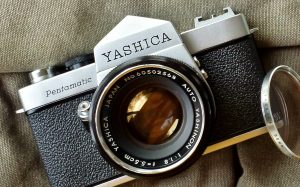
Here are my Asahi Pentax H2 from 1959 and my Yashica Pentamatic ’35’ from 1960 as a comparison.
Comments are always welcomed, as I’ve learned quite a bit from reader feedback. As always, thanks for stopping by, and while you’re at it, feel free to visit my camera shop at http://www.ccstudio2380.com (CC Design Studios hosted by Etsy). – Chris Whelan
Yashicaflex Rookie by Yashima Optical Industry Company, Limited (Yashica by 1958).
It’s rarely seen outside Japan, where it was an inexpensive medium-format 6x6cm 120 film camera. The only item I’m missing is the inner ‘presentation box.’ The outer shipping box is pictured. It was marketed to the first-time camera user as an uncomplicated camera that even a rookie could use.
It’s pictured with its cousin, the Yashica model A.
Comments are always welcomed, as I’ve learned quite a bit from reader feedback. As always, thanks for stopping by, and while you’re at it, feel free to visit my camera shop at http://www.ccstudio2380.com (CC Design Studios hosted by Etsy). – Chris Whelan