Comments are always welcomed, as I’ve learned quite a bit from reader feedback. As always, thanks for stopping by, and while you’re at it, feel free to visit my camera shop at http://www.ccstudio2380.com (CC Design Studios hosted by Etsy). – Chris Whelan
Here is another super nice digital camera from Panasonic – the Lumix DMC-FZ28.
Panasonic Lumix DMC-FZ28. A 10-megapixel bridge camera with an 18x optical zoom lens from Leica.It is fun to use a digicam with a sharp CCD sensor for film-like images.It has excellent macro capabilities.The Leica lens has a zoom range of 27 to 486mm (35mm equivalent).Super telephoto image at 486mm.Wide-angle at 27mm.Complete image stabilization in addition to the 18x zoom.
Comments are always welcomed, as I’ve learned quite a bit from reader feedback. As always, thanks for stopping by, and while you’re at it, feel free to visit my camera shop at http://www.ccstudio2380.com (CC Design Studios hosted by Etsy). – Chris Whelan
Regular readers know I love using (on occasion) simple ‘low’ resolution digicams. It’s fun to remember how special these early digital cameras were and to revisit the images they produced.
My Canon PowerShot A530 is a perfect example of the type of camera we used in the early 2000s. With 5 megapixels and a CCD sensor, it’s quite capable of producing film-like pictures that stand up against today’s high-resolution cousins.
Canon PowerShot A530 has a sharp (and fast) Canon 4x optical zoom lens with excellent macro abilities (as close as 1.97 inches from the lens). The CCD sensor creates film-like images.Azalea blossom captured in simple point-and-shoot macro mode.A classic from Canon.It’s been my camera of choice for grabbing quick garden pics over the years.It fits easily in a pocket, and although the LCD screen is not large by today’s standards, it’s plenty bright enough for composing your shots.Florida redbud blossoms.It’s available in my Etsy camera shop at http://www.ccstudio2380.com.
Thanks for stopping by, Chris
Follow me on Instagram at @ccphotographyai
Comments are always welcomed, as I’ve learned quite a bit from reader feedback. As always, thanks for stopping by, and while you’re at it, feel free to visit my camera shop at http://www.ccstudio2380.com (CC Design Studios hosted by Etsy). – Chris Whelan
Comments are always welcomed, as I’ve learned quite a bit from reader feedback. As always, thanks for stopping by, and while you’re at it, feel free to visit my camera shop at http://www.ccstudio2380.com (CC Design Studios hosted by Etsy). – Chris Whelan
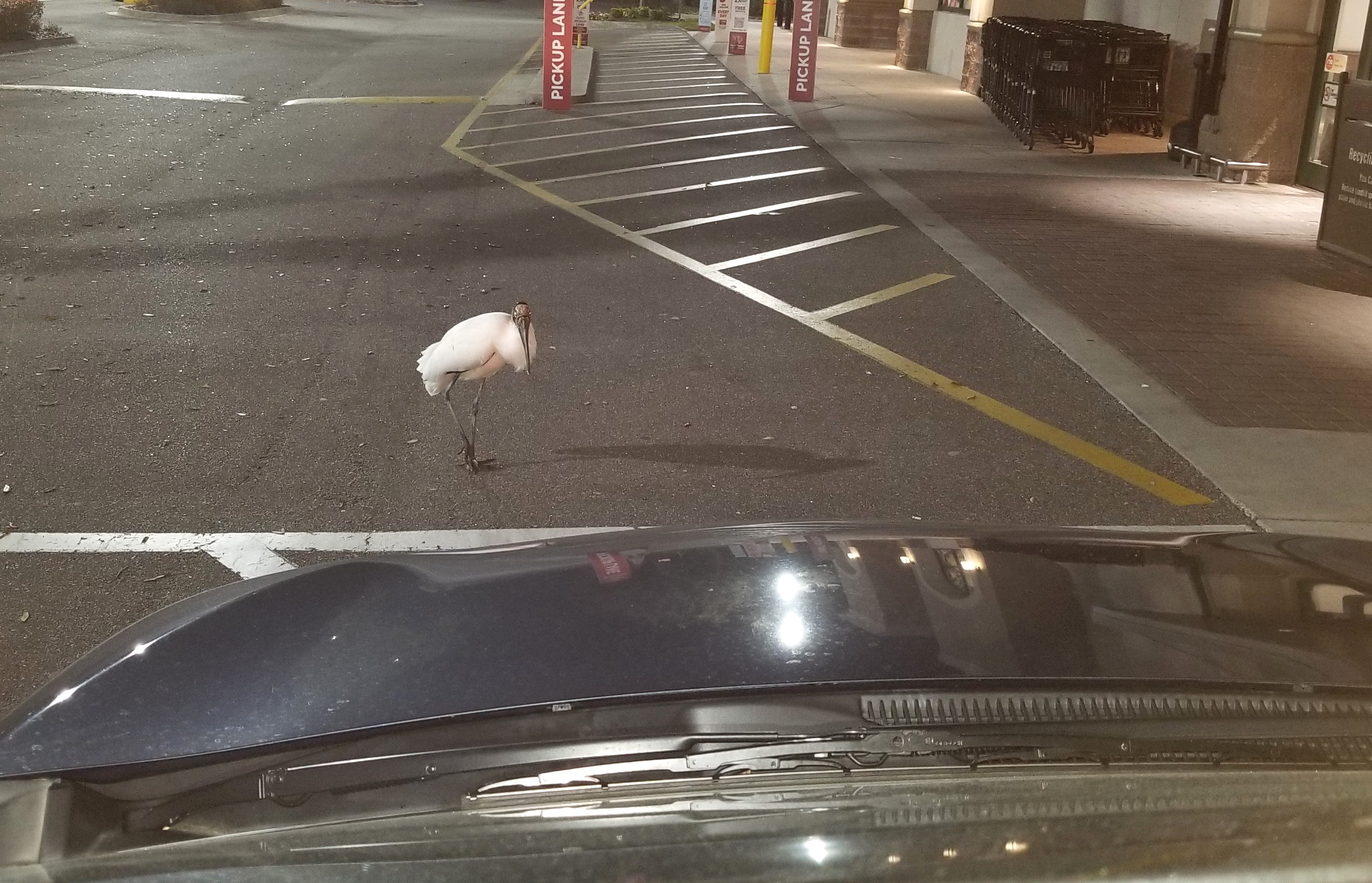
A wood stork is getting some late-night shopping at my local Harris Teeter grocery store in Northeast Florida.
He kept tripping the doors as he debated whether or not to go inside.Stare down.Stay in the crosswalk!
Thanks for stopping by, and have a great day, Chris.
Follow me on Instagram at @ccphotographyai
Comments are always welcomed, as I’ve learned quite a bit from reader feedback. As always, thanks for stopping by, and while you’re at it, feel free to visit my camera shop at http://www.ccstudio2380.com (CC Design Studios hosted by Etsy). – Chris Whelan
One of the fun things I enjoy about using adapters on my digital mirrorless cameras is the ability to use classic (vintage) film camera lenses that were initially designed for use on an SLR. In this case, I’m shooting with a Canon NFD Reflex Lens 500mm f8 ‘Mirror Lens.’
Canon and Fuji – a winning combination.
Here is a description of the lens by Canon –
This high performance super telephoto lens with a focal length of 500mm utilizes catadioptric system while enabling handheld shooting due to being lightweight and compact.
Reflex lenses have two significant features: one is the ability to almost completely compensate for secondary chromatic aberration which is more likely to occur at longer focal lengths in general dioptric system; the other is a dramatic reduction in the overall lens length due to the light path being looped back.
While making the most of these advantages of catadioptric system, optimal positioning of the optical system based on Canon’s own new optical design technology is used to properly compensate for various aberrations including aberration changes resulting from focusing that tend to occur in reflex lenses, providing quality image reproduction in all shooting ranges from close distances to infinity.
Moreover, in order to prevent reductions in contrast resulting from inner reflection, which is a problem in reflex lenses, the entire lens is given multilayered coating in addition to meticulous consideration being taken, such as electrostatic flocking being performed inside the lens barrel.
Furthermore, it has the feature of filters being able to be replaced with the lens attached to the camera by adopting a filter inserted into the light path.
Canon 500mm Reflex Lens mounted on my Fujifilm X-T2.
Here are a few images I shot this morning from my studio windows. The 35mm equivalent focal length of this 500mm lens on a 1.5 crop sensor APS-C camera (my T2) is 750mm!
My neighbor’s satellite dish is seen through numerous tree branches. The mirror lens tends to make closer objects not in focus appear to disappear.Japanese black pine needles on a distant tree. Notice the circular out-of-focus areas in the background. Mirror lenses produce circular highlights because there aren’t aperture blades (fixed f/8), so the lens is always ‘circular.’The lens can produce wonderful, soft, dreamy colors and patterns (which I like).Underexposed by a stop, I was more interested in getting the focus correct.
This set is compact and not very heavy. I’ve even shot hand-held, but most images will benefit from using a tripod and the self-timer function to trip the shutter. I’m using a K&F Concept FD-FX adapter to use my Canon lens from 1981 on my X-T2 from 2016. I enjoy the unique look of digital images when shooting with a classic lens. I purchased the lens recently (I’ve owned a few in the past) for only $100, which included the digital adapter, Canon lens caps, the filter, and a beat-up case.
Follow me on Instagram at @ccphotographyai
Comments are always welcomed, as I’ve learned quite a bit from reader feedback. As always, thanks for stopping by, and while you’re at it, feel free to visit my camera shop at http://www.ccstudio2380.com (CC Design Studios hosted by Etsy). – Chris Whelan
Comments are always welcomed, as I’ve learned quite a bit from reader feedback. As always, thanks for stopping by, and while you’re at it, feel free to visit my camera shop at http://www.ccstudio2380.com (CC Design Studios hosted by Etsy). – Chris Whelan
Scientific/Medical ‘Sci-Med’ camera with a Real Time Winder both are from around 1977 or early 1978. No official documentation exists on this variant of the Contax-Yashica RTS (first model) released in 1975. It’s been referred to as the RTS ‘Fundus,’ but again, there needs to be a mention of why it was produced and for what purpose beyond the Sci-Med community to be able to accept that designation, in my opinion. Slight enhancements include a small raised collar around the sensitive magnetic shutter release button and a shutter speed lock button on the right side of the camera’s top plate (as viewed from the front). The shutter speed dial locks in the 1/60 position (electronic flash sync speed), and the button needs to be depressed to select another speed. The Real Time Winder was mated with this camera as they shared the curious ‘Registered Number U.S.A.’ sticker. Many unknowns exist about this limited production camera, and much misinformation is floating around. I hope to uncover some truths or, at the very least, present only factual info. If you have documentation concerning this Scientific/Medical version, please share it with me – advertisements, brochures, or mentions in the photographic press back in the day.
Most RTS cameras have degraded or peeled leatherette coverings as the adhesives and the slightly softer leather haven’t held up over the decades. This one has, for the most part. The RTS line (RTS, RTS II Quartz, and RTS III) all use lenses with the Contax/Yashica (C/Y) mount.The Real Time Winder can shoot up to 2 frames per second (2 fps). Higher-speed motor drives and winders with speeds up to 5 fps were also available.The JCII ‘Passed’ sticker is in a different position from where these stickers were usually placed on the RTS, which would be on the left side of the prism. I guess it was put here on the Sci-Med version because the ‘Registered’ sticker was placed on the prism (by the factory or the distributor?).The baseplate is marked ‘Scientific / Medical’; otherwise, it’s not different from a standard RTS.The registration numbers are different, but the winder and the camera body were together as a set when I purchased them.Early magazine advertisement. Here, it incorrectly indicates that the Real Time Winder is capable of 2 1/2 fps. The manual has it at 2 fps.1976 magazine ad.Beautifully designed and highly functional.
The Contax-Yashica RTS, Real Time System, was jointly developed by Yashica and Carl Zeiss, with the design originating from Porsche. The camera features fully automatic through-the-lens electronic exposure control; select the proper film speed (ASA, ISO) and the desired aperture (f-stop), and the camera selects the appropriate shutter speed. It’s also a fully manual camera, with the user setting the shutter and aperture values. It was a camera I was initially interested in when I was looking to replace my first SLR, the Yashica TL Electro-X, in 1978 when I was stationed in the Navy in Japan. If I remember correctly, the Navy Exchange stores didn’t have a large selection of Contax cameras, so my choice quickly became the Canon F-1 over the Nikon F-2.
Here is my first Contax RTS, which isn’t the Sci-Med version.
I chose the Yashica ML 50mm f1.7 lens over the more expensive Zeiss T-Star (T*) lens.
Thanks for stopping by, Chris
Follow me on Instagram at @ccphotographyai
Comments are always welcomed, as I’ve learned quite a bit from reader feedback. As always, thanks for stopping by, and while you’re at it, feel free to visit my camera shop at http://www.ccstudio2380.com (CC Design Studios hosted by Etsy). – Chris Whelan
Please respect that all content, including photos and text, is this blog’s property and its owner, Yashica Pentamatic Fanatic, Yashica Sailor Boy, Yashica Chris, Chasing Classic Cameras with Chris.
The “easy” way to get a nearly 500mm lens. With a modern mirrorless digital camera, an inexpensive adapter, and a classic lens initially made in the film era, you have a super telephoto lens you may already own.
A Nikkor-H Auto 300mm f4.5 telephoto lens from around 1970 mated to my 2016 Fujifilm X-T2 mirrorless digital camera via a Fotodiox NIK-FX lens adapter.
The Fotodiox adapter I’m using here was purchased directly from them for under $30 (no affiliation). I use Fotodiox because they have an easy-to-navigate site that makes buying easy. Any third-party lens adapter maker will do so shop around. Some adapters can be expensive, so know what you want and need before overbuying.
Autofocus. In my situation here, my camera lens combination can no longer use autofocus, and any type of image stabilization is also lost (unless your mirrorless camera has built-in IBIS). So it’s back to old-school photography – manually focusing the camera and adjusting the aperture, ISO, and shutter speed to get the correct exposure – the fun stuff!
It wasn’t the best day for shooting with a long telephoto lens as the sun was obscured by a thick layer of cirrus clouds – not much color going on. The long focal length of this lens compresses distant objects creating an exciting look. This row of townhomes at the beach was quite distant from my vantage point, and close objects were not in focus (shallow depth of field).Check your camera collection – maybe there’s new life for your old lenses and a new perspective for your next photo outing.
Thanks for stopping by, Chris
Follow me on Instagram at @ccphotographyai
Comments are always welcomed, as I’ve learned quite a bit from reader feedback. As always, thanks for stopping by, and while you’re at it, feel free to visit my camera shop at http://www.ccstudio2380.com (CC Design Studios hosted by Etsy). – Chris Whelan
Please respect that all content, including photos and text, is this blog’s property and its owner, Yashica Pentamatic Fanatic, Yashica Sailor Boy, Yashica Chris, Chasing Classic Cameras with Chris.
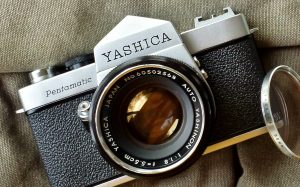
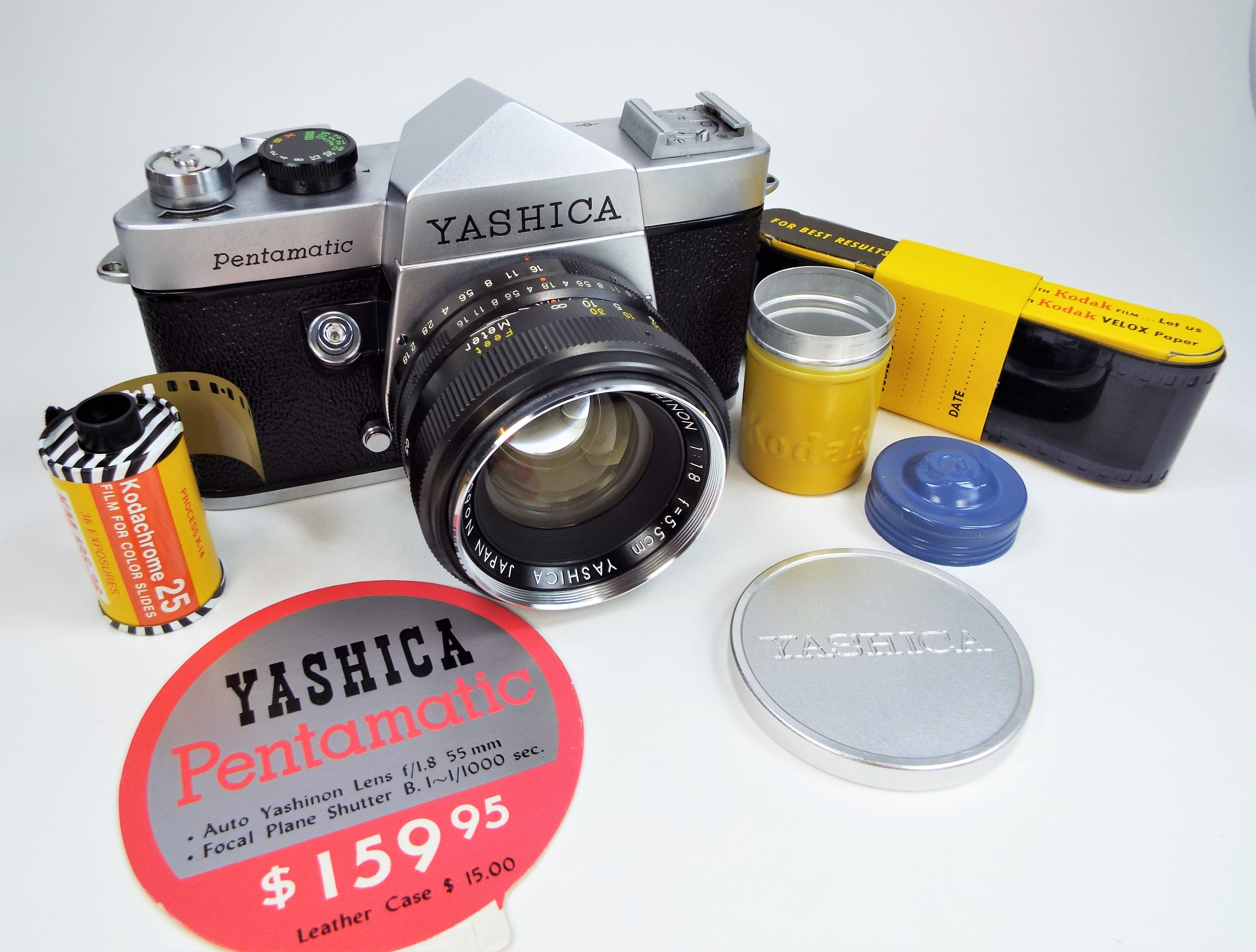
Over the years, I have collected an incredible variety of cameras made by Yashica, from their earliest days (1953) to the last true Yashica models in the late 1980s to early 1990s. I’d have to say that this Yashica Pentamatic set (made in August 1960) is my most impressive find. It’s a one-owner set, and it is in like-new condition. It came with some unexpected goodies (pictured), too.
A gem of a camera set from 1960.
Thanks for stopping by, Chris
Follow me on Instagram at @ccphotographyai
Comments are always welcomed as I’ve learned quite a bit from reader feedback. As always, thanks for stopping by, and while you’re at it, feel free to visit my camera shop at http://www.ccstudio2380.com (CC Design Studios hosted by Etsy). – Chris Whelan
Please respect that all content, including photos and text, is this blog’s property and its owner, Yashica Pentamatic Fanatic, Yashica Sailor Boy, Yashica Chris, Chasing Classic Cameras with Chris.


















 Chasing Classic Cameras with Chris