Nicca Flash Unit from around 1953

As you may have guessed by now if you casually follow this blog that I also have a passion for collecting bits of camera gear made by and for the Nicca Camera Company. Nicca was acquired by Yashica in 1958 and that acquisition led directly to Yashica developing (with lots of help from Nicca designers) its first 35mm single-lens reflex camera the Pentamatic 35 by early 1960. Yashica was a bit slow to the marketplace with an SLR as Canon, Asahi Pentax and Canon (among others) had already introduced SLRs by then.

Because of this relationship, Nicca has always held a prominent spot in my collection and the Nicca 3-S remains one of my favorite 35mm rangefinders to shoot with. Recently I’ve added this wonderful flash set to my collection.

From the instruction booklet, it describes this as “an automatic rechargeable flash gun specifically designed for Nicca cameras”.

DSCF6402

Considering its age (1953) it’s in outstanding condition. Hey, it’s as old as me!
DSCF6378

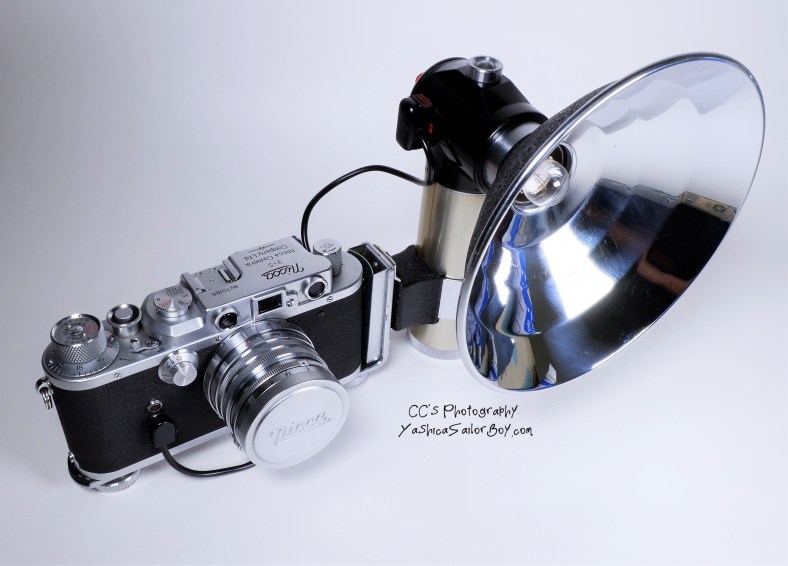
All set to go. The Nicca B.C.B. flash unit attached to my Nicca 3-S.

DSCF6377

Viewed from above the pilot lamp is visible on the top center of the flash head. It lights up when the flash is ready to fire.

DSCF6380

The red-tipped bulb ejector button. You don’t want to handle a hot bulb.

DSCF6383

As part of the set, I received the original instruction booklet and a pamphlet for the flashbulbs which were made by West Electric Company of Tokyo and Osaka – later to become or at least partner with National-Matsushita.

DSCF6413

A closer look at the “Exposure Guide Numbers” card pictured in the previous image above.

DSCF6405

The reflector is about 5.5 inches across. The bulb looks tiny compared to the reflector but believe me, it puts out some light!
Nicca AD Cool

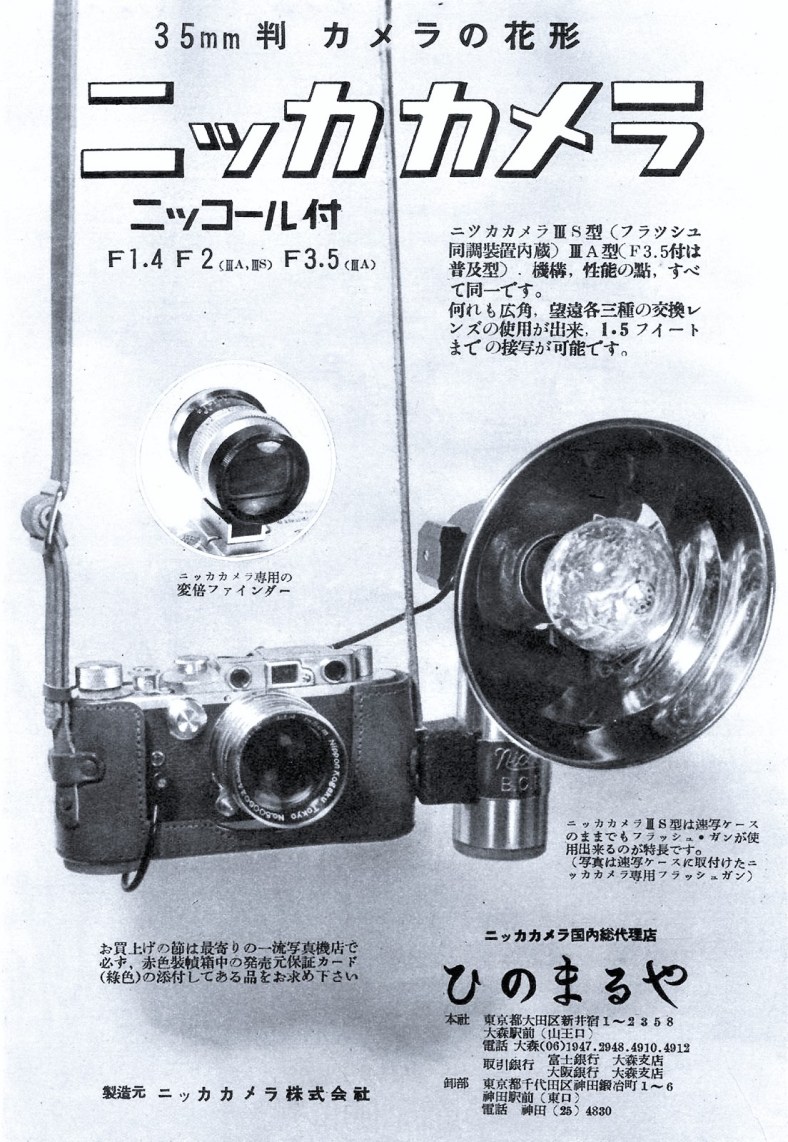
Advertisement from late 1951 0r 1952.  The flash looks like it used a slightly different connector cord than the one in my set. Hinomaruya ( ひのまるや ) was the Domestic General Agent for Nicca in Japan.

DSCF6418

Details from the instruction booklet. Shown in this image is a capacitor and 22.5-volt battery to power the flash but it could also be powered by two “D” cell batteries or three “AA” penlight batteries with an adapter.

DSCF6458

Size comparison between the flash handle and two D-cell batteries. As can be seen, the optional add on handle extension would need to be used. 

DSCF6420

Front view without the reflector. My guess is that the “BC” means battery-capacitor and the “B” is for battery (I don’t know for sure about the last “B” at this point).

DSCF6422

Camera side view with the shutter cord connector and “L” bracket connector visible. The red-tipped bulb ejector button is also visible.

DSCF6426

Parts detail minus the reflector and the capacitor/battery.

Nicca only made 35mm rangefinder cameras (maybe a lens or two but unproven) during its existence so the flash unit was made by another company. It’s likely that the West Electric Company, Limited, of Osaka and Tokyo was the manufacturer although no part of the flash is marked with the name “West”. Only the included pamphlet mentioned West. As stated earlier in this post, it’s likely that West merged or partnered with National-Matsushita Electric to build additional models of flash units during the second half of the 1950s.

Thanks for stopping by! If you know what “B.C.B.” means please share it with me. – Chris

Please respect that all content, including photos and text, are the property of this blog and its owner, Yashica Pentamatic Fanatic, Yashica Sailor Boy, Yashica Chris.

Copyright © 2015-2019 Yashica Pentamatic Fanatic, Chris Whelan
All rights reserved.


Nicca 3-F Camera Case – first of its kind?

I know, this is not an overly exciting post – rather obscure actually.

nicca 3-f leather case

Nicca 3-F ‘Snap Shot Case’.

The Nicca 3-F was one of many well-built 35mm rangefinder cameras produced by Nicca Camera Company in the late 1950s. Nicca would be acquired by Yashica in early 1958 and some of the technology that Nicca possessed went to Yashica in the deal. The acquisition directly led to the development of Yashica’s first 35mm SLR, the Pentamatic in late 1959. I digress.

My good friend Paul Sokk (www.yashicatlr.com) recently shared this scan of an instruction booklet he acquired for his Nicca. What struck me as I translated (actually an app on my phone translated it) is how this camera case was constructed.

Here’s the translation: “The snap shot case uses a brown box skin and comes with a shoulder strap as an accessory. It is glued, and the case of the stringer does not use any adhesive. Moreover, it has sufficient strength against external force (especially the projection of the lens part). Recently, there are those who use the camera out of the case and naked, but since it is likely that the camera is often hurt, it is recommended to put it in the case and use it as much as possible”.

I hadn’t noticed Nicca cases before this one that did not use stitching. Why is that important? On most vintage (40-year-old or more) cases the stitching has long since failed and the case falls apart. It will be interesting to see if these glued cases stood the test of time and in better condition than their stitched cousins.

case detail

A close-up view of a glued case.

20170606_115821

Typical stitched case.

Thanks for stopping by! – Chris

Please respect that all content, including photos and text, are the property of this blog and its owner, Yashica Pentamatic Fanatic, Yashica Sailor Boy, Yashica Chris.

Copyright © 2015-2019 Yashica Pentamatic Fanatic, Chris Whelan
All rights reserved.

Nicca Bits

I love finding “new” bits of vintage photo gear especially when you’ve been hunting for them for years.

These bits may seem like no big deal but if you collect hard to find items in their original boxes and cases it’s rewarding when it all comes together.

DSCF2011

Nicca-Hinomaruya Y2 filter and lens hood. Both are from at least 1955 but likely earlier.

DSCF2005

Hinomaruya was the exclusive distributor of Nicca cameras and accessories.

DSCF9989

DSCF9995

DSCF2004

Using a Y2 yellow filter is a must when shooting with black and white film. It will generally darken a blue sky and provide more contrast between the sky and clouds. It can also help add better definition when shooting landscapes where haze and light atmospheric fog is present. When using a Y2 filter on a camera such as this one you must compensate by a factor of two when taking your meter readings. If you’re using an SLR with TTL metering then the camera’s built-in meter will compensate for you.

nicca 33 bro v3

Nicca Type 33 sales brochure showing a slightly different box for the hood and for a color filter along with the older style filter box. The Type 33 was one of the last Nicca cameras produced by the company and was released in 1958 so this would represent the last style of filter and hood boxes. As with everything else, these items were distributed by Hinomaruya.

Studio Camera: Fujifilm X-A10

Thanks for stopping by! – Chris

Please respect that all content, including photos and text, are the property of this blog and its owner, Yashica Pentamatic Fanatic, Yashica Sailor Boy, Yashica Chris.

Copyright © 2015-2019 Yashica Pentamatic Fanatic, Chris Whelan
All rights reserved.


Nicca 3-S on location

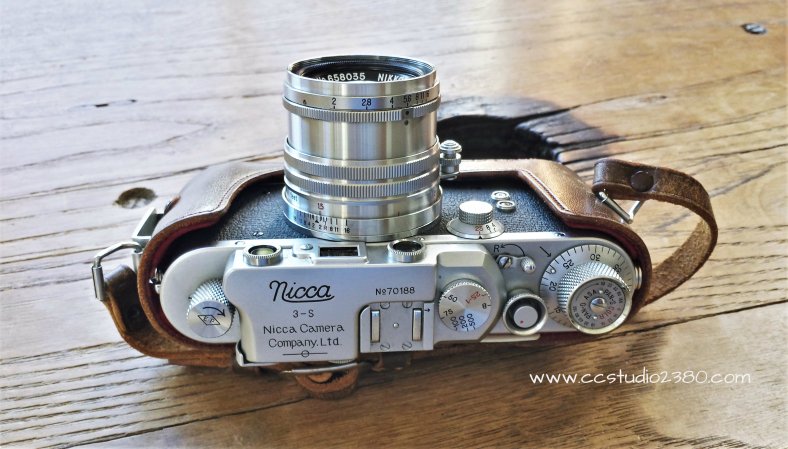
1950s vintage Nicca rangefinder 35mm camera shot on location – c1911 post office.

Nicca at PO

After a day spent on a photo walk in our local historic district, our Nicca takes a break for a beauty shot. The mid-afternoon lighting is always just right in this 100-year-old post office – the table once held ink wells (the hole behind the camera) and the wood table top has such a wonderful patina and texture.

Our Nicca 3-S is fully operational – it’s considered to be one of the best Leica copy cameras produced in Japan in the early part of the 1950s. The 5cm f/ 2 lens is a Nikkor and is clear and sharp.

Of interest, the <E.P> mark on the rewind knob (extreme left) indicates that this camera was available for sale in Japan as an exempt purchase, meaning that it was for sale only to military personnel and their families, diplomatic personnel and their families and possibly available at duty-free shops. Photogear marked with the <E.P> symbol was not for sale to Japanese citizens as it was tax-exempt.

Thanks for your visit!

Chris

Shameless plug – stop by our e-commerce shop at https://www.ccstudio2380.com for more great and interesting stuff! ^.^

Please respect that all content, including photos and text are property of this blog and its owner, Yashica Pentamatic Fanatic, Yashica Sailor Boy, Yashica Chris.

Copyright © 2015-2017 Yashica Pentamatic Fanatic, Chris Whelan
All rights reserved.