Timeless Tuesday – exploring early digital cameras – Sony Mavica

As the title implies, I’ve decided to take another look at some early digital cameras and to see if they can find a place in today’s photographic landscape. Here’s a look at what was essentially the first digital camera to use a 3.5-inch floppy disk as “film”. Sony used the advertising tagline “The Fun is in the Floppy” in its late 1990s ads.

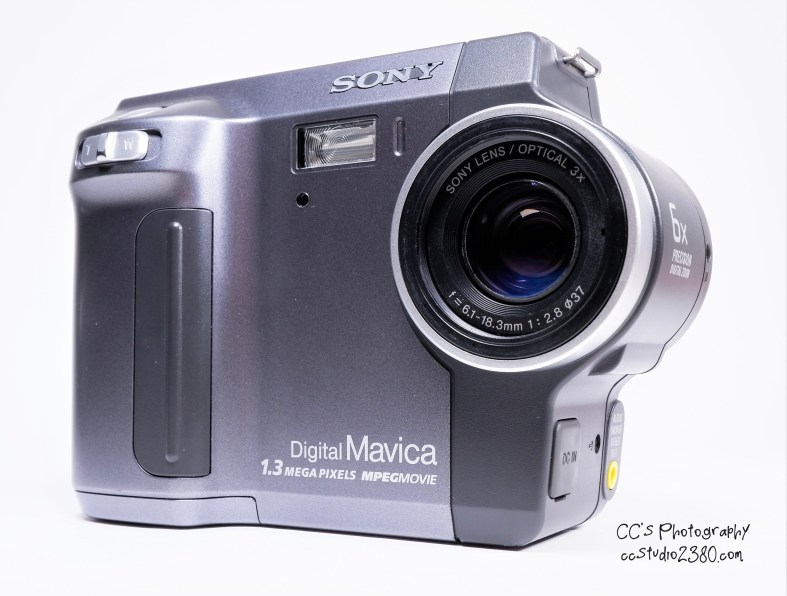
The Sony Digital Mavica 1.3 model MVC-FD85 made its way to market in the late days of 1999 with an official release of February 2000. Here’s that camera.
DSCF2105

The strength of Sony has always been the sheer size of the company and the ability to do incredible R&D.
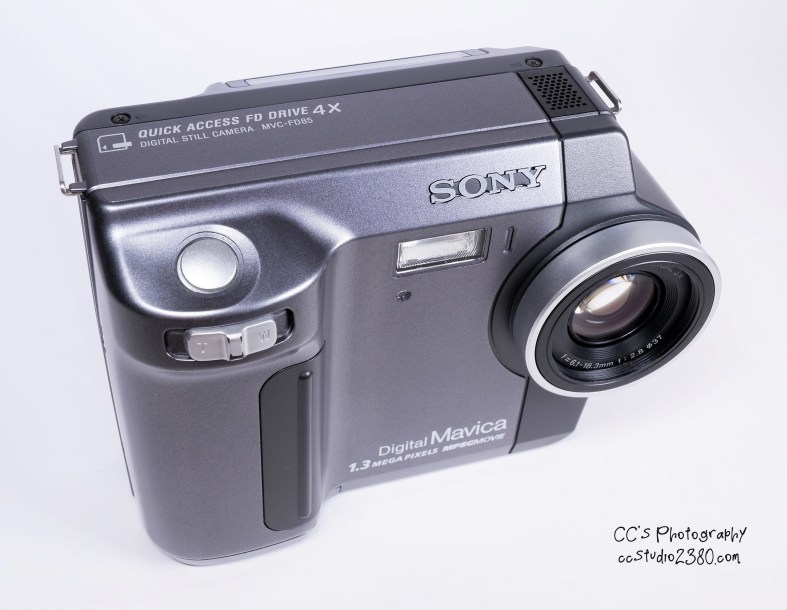
DSCF2107

Sony lenses in video cameras were almost beyond equal (maybe Canon would disagree) but the Mavica made good use with what it was given.
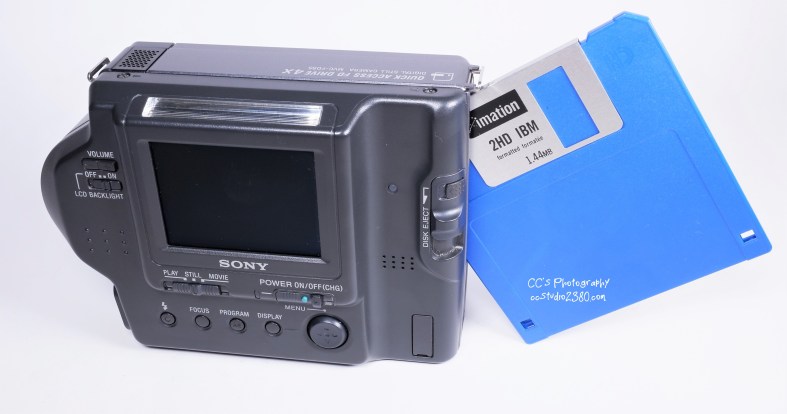
DSCF2109

The film. A standard 3.5-inch floppy. The “MVC” in the camera’s name refers to “Magnetic Video Camera” hence the use of a floppy disk for file storage.

At its highest resolution (1280 x 960) the Mavica FD85 will record only six images on one disk. This led to photographers carrying around a box full of disks if they were expecting to record a number of images. Six disks equaled one roll of 36 exposure 35 mm film.

I acquired this Mavica from the original owner – a local guy that was downsizing his collection of “stuff”. It’s in mint condition with only a few marks indicating gentle past use. From some of the other cameras that I purchased from him, I could tell that he took excellent care of his gear. It fired up perfectly after an overnight charge of the battery and with a fresh disk inserted here’s the first batch of pics. Except for the last photo, none of these images were enhanced in any way.
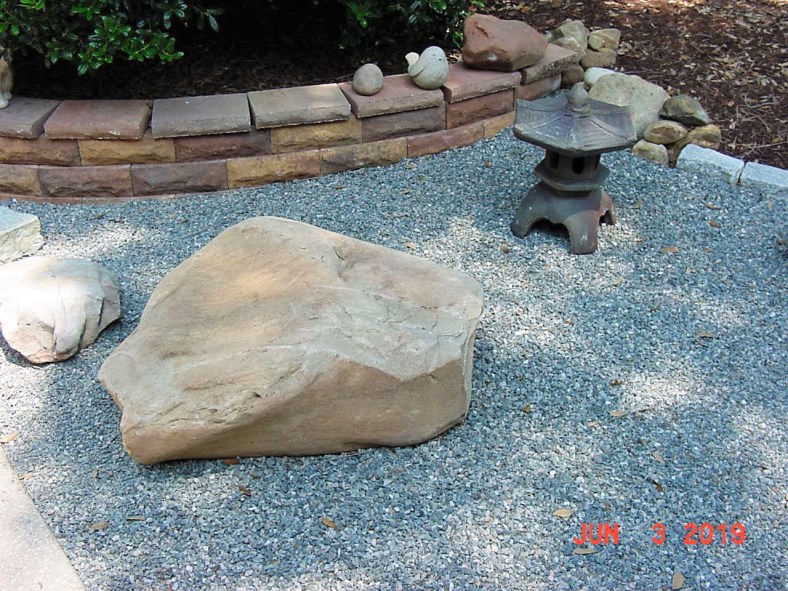
MVC-001F

After nearly 15 years of slumber here’s the first image taken with the Mavica and recorded to floppy. All things considered, the auto exposure and auto focus handled the scene perfectly. Yes, we’ve become accustomed to high def pics from our smartphones and this picture falls way off in that regard but I like it because it appears “film-like” with its softness and lack of mind-shattering contrast. This is a wide angle shot.
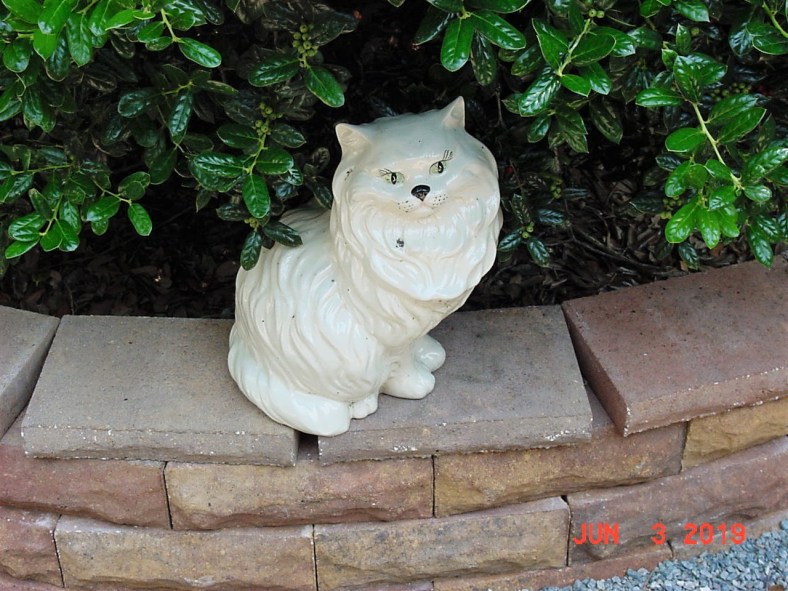
MVC-002F

Using the telephoto zoom lens this image is not technically bad. Auto focus and auto exposure appear spot on and the scene is pleasing. Remember, back in 2000 the main purpose of this camera was to upload the images to your PC and for emailing them as attachments. Most people had less than cutting edge PC’s at home – remember “Y2K”?
MVC-008F

I took the Mavica into my studio and under the harsh studio lighting (5600K) the camera did just great. This was shot using the macro setting but I believe the camera has a pretty broad focusing range. This pic was cropped a bit and I made a slight adjustment in the contrast. It looks like there’s good depth of field and overall it’s reasonably sharp. I would use this image for listings in my various online shops as it’s technically just fine for that venue.

Ads from back in the day suggest that this camera sold for around $700 to $800. That’s crazy big money then and still is today. It will be fun to give the camera a bit of a workout over the coming months – 1.3 megapixels might just be a new way of seeing things.

Thanks for stopping by! – Chris

Please respect that all content, including photos and text, are the property of this blog and its owner, Yashica Pentamatic Fanatic, Yashica Sailor Boy, Yashica Chris.

Copyright © 2015-2019 Yashica Pentamatic Fanatic, Chris Whelan
All rights reserved.
 

Fuji Panorama Cardia – a plastic fantastic from 1991

One of the first dedicated 35 mm panorama compact cameras from Fuji Photo Film Company. It was available only in Japan and was released in December 1991. Actually a sophisticated camera a notch or two above being just a point and shoot – debateable.

There’s so little information about this wonderful camera on the web, I hope this post helps a bit for those interested in this format and camera.

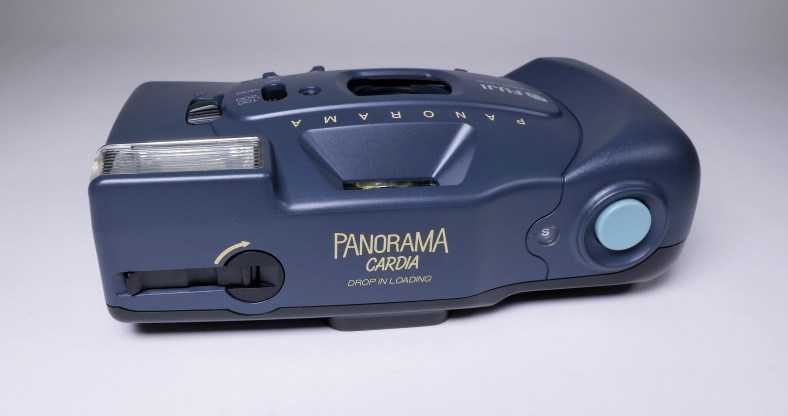
DSCF2074 (2) (1) (1) (1) (1) (1) (1) (1) (1)

It’s not as basic as it seems. This camera was released for the Japanese domestic market in December 1991 and listed for 15,800 JPY (about $123 USD).

It’s a dedicated panorama format 35 mm film camera (13 x 36 mm actual image size). The panorama setting is not adjustable.

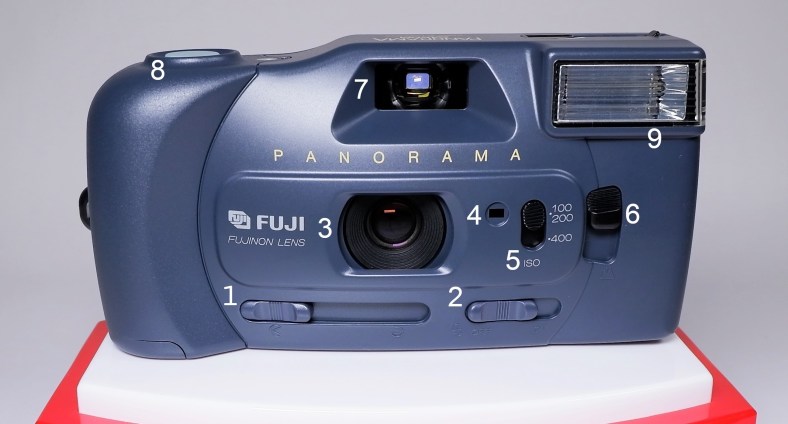
1. Opens and closes the lens cover and when closed locks the shutter button.

2. Flash on/off switch.

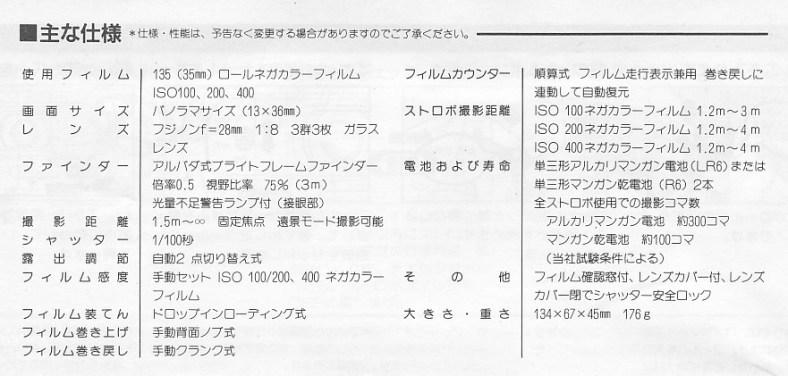
3. Fujinon 28 mm f8 glass lens – 3 elements in 3 groups. The fixed focus lens focuses from 1.5 m to infinity switchable to landscape mode.

4. CdS light receiver.

5. Two position ISO selector switch.

6. Landscape Mode Switch “Far-view Mode Lever”.

7. Albada bright frame finder.

8. Shutter release button.

9. Manual strobe/flash.

The aperture is “automatically” adjusted for lower light levels and the camera will give a low-light warning in the viewfinder. It’s been reported by a Japanese blogger that the aperture was capable of f4 to f16 but that is not backed up by data from Fujifilm that I can find.

The shutter is fixed to fire at 1/100th of a second.

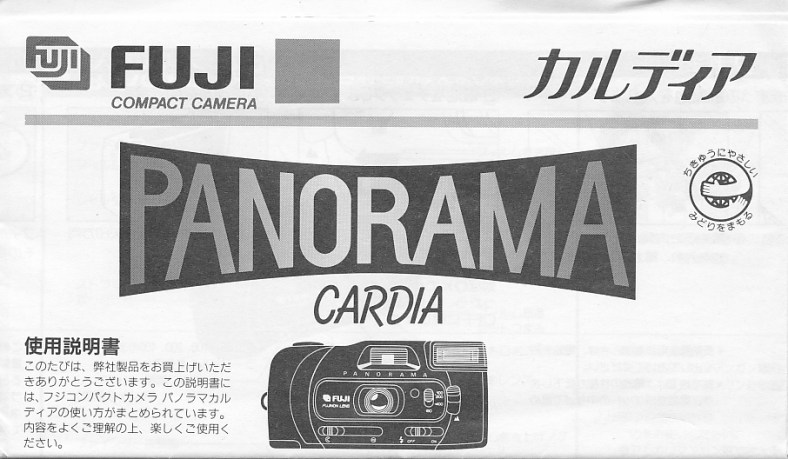
I’ve scanned a few pages from the instruction pamphlet (below).

IMG_20190527_0001

IMG_20190527_0002 1

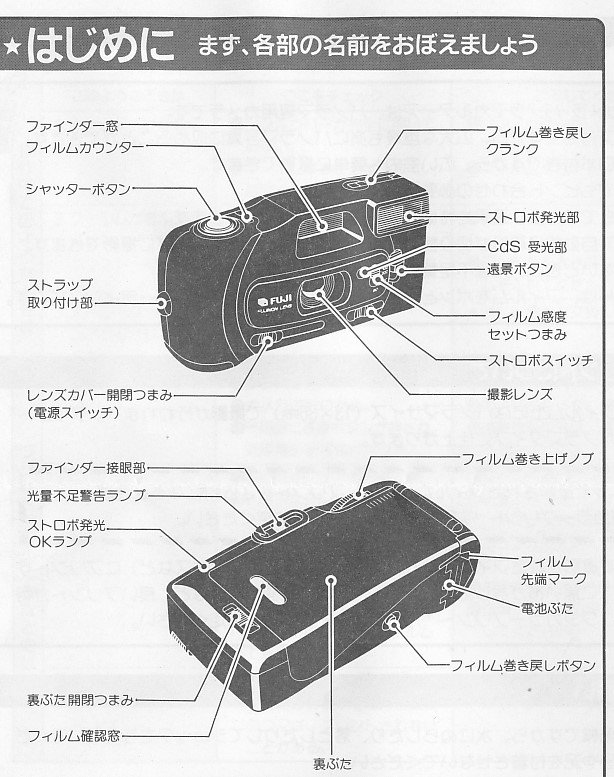
Take notice of the clearly marked “CdS light receiver” vice exposure meter. It could be just a difference in the machine translation from what was meant in the original Japanese text.

IMG_20190527_0005 3

Specifications from Fuji confirms that the lens is a Fujinon f8 28 mm wide angle with glass optics – 3 elements in 3 groups (you’ll find that info in line 4).

DSCF2066

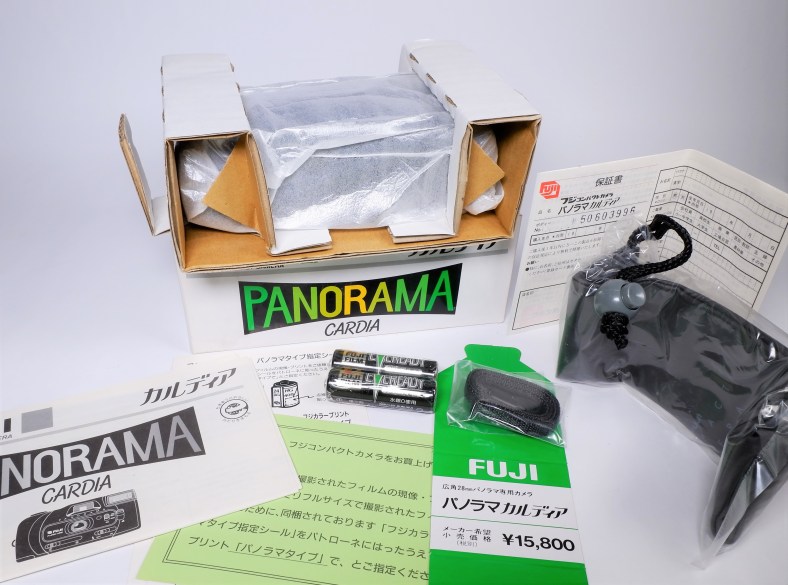
Unboxing a classic.

DSCF2072

This camera set is available in my Etsy studio shop at http://www.ccstudio2380.com

Thanks for stopping by! – Chris

Please respect that all content, including photos and text, are the property of this blog and its owner, Yashica Pentamatic Fanatic, Yashica Sailor Boy, Yashica Chris.

Copyright © 2015-2019 Yashica Pentamatic Fanatic, Chris Whelan
All rights reserved.
 

In the Shop – Fun with Fuji

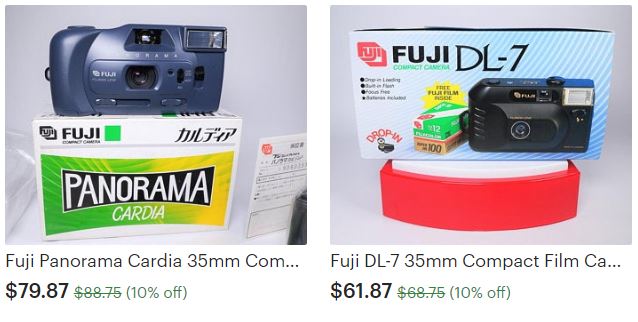
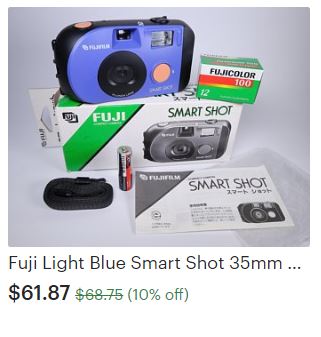
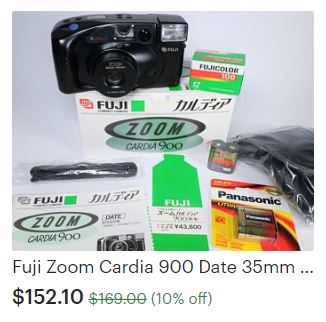
I’ve added these hard to find classic Fuji cameras in my camera shop recently. These are all considered to be still “new in the box” and in factory mint condition. Here’s your chance to add these totally unused (but tested) 35mm film cameras from the late 1980s and early 1990s.

These are available at http://www.ccstudio2380.com

new fuji ads

fuji new ad

Full descriptions and additional pictures can be found at http://www.ccstudio2380.com

new 2 ads

Happy SUNday! – Lionel Trains

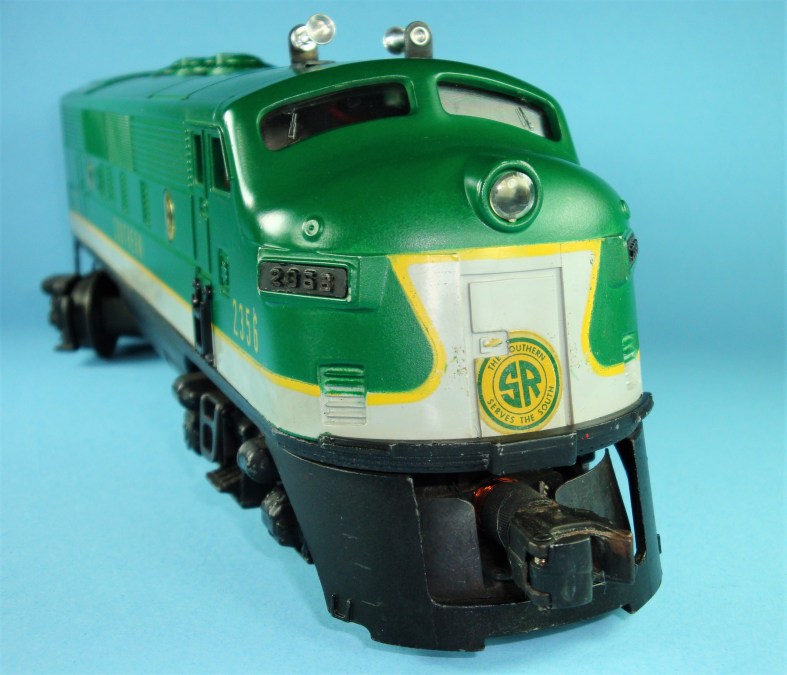
A few peeks at some of my Lionel trains from the 1950s and 1960s. These trains saw some action!

DSC01626

“O” gauge locomotive.

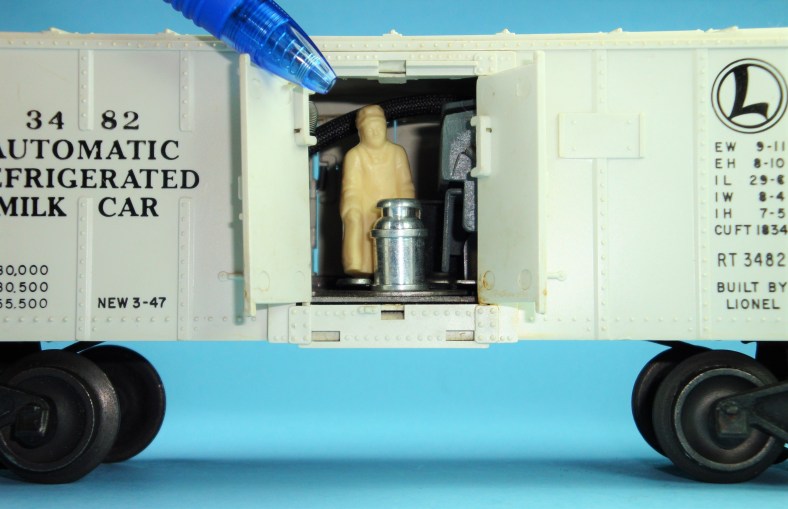
DSC01742

He actually moved the milk cans onto a platform. Super cool!

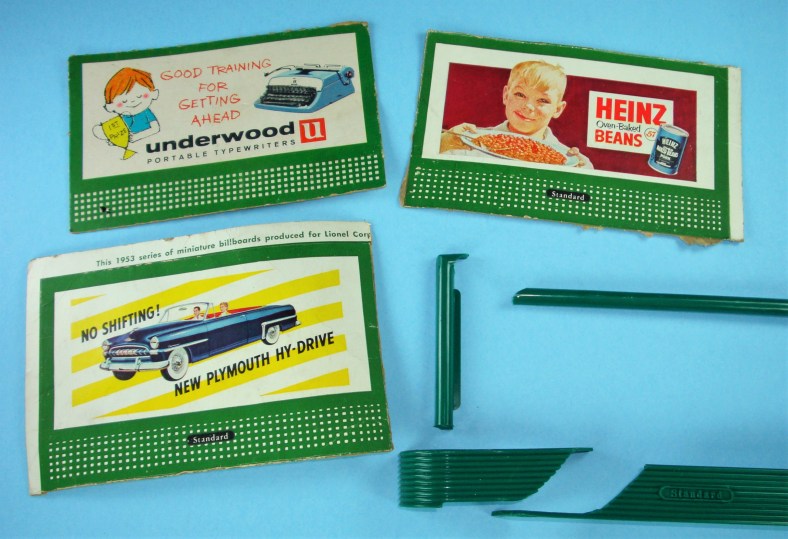
DSC01815

Some random billboard ads of the day.

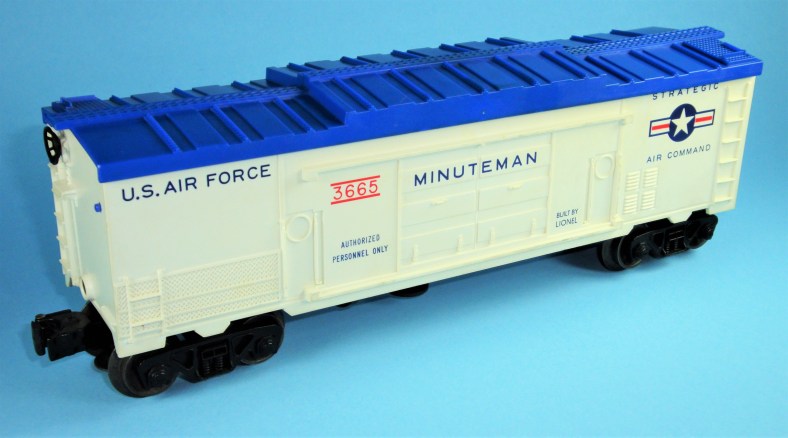
DSC01551

The 1960s missile train car – yep, the roof opened and a missile would fire – toy armageddon!

All of my trains have been sold off to various collectors. I just have the pics and great memories of playing with them with my dad.

Camera: Sony Cyber-shot DSC-W170

Have a beautiful day! – Chris

Please respect that all content, including photos and text, are the property of this blog and its owner, Yashica Pentamatic Fanatic, Yashica Sailor Boy, Yashica Chris.

Copyright © 2015-2019 Yashica Pentamatic Fanatic, Chris Whelan
All rights reserved.
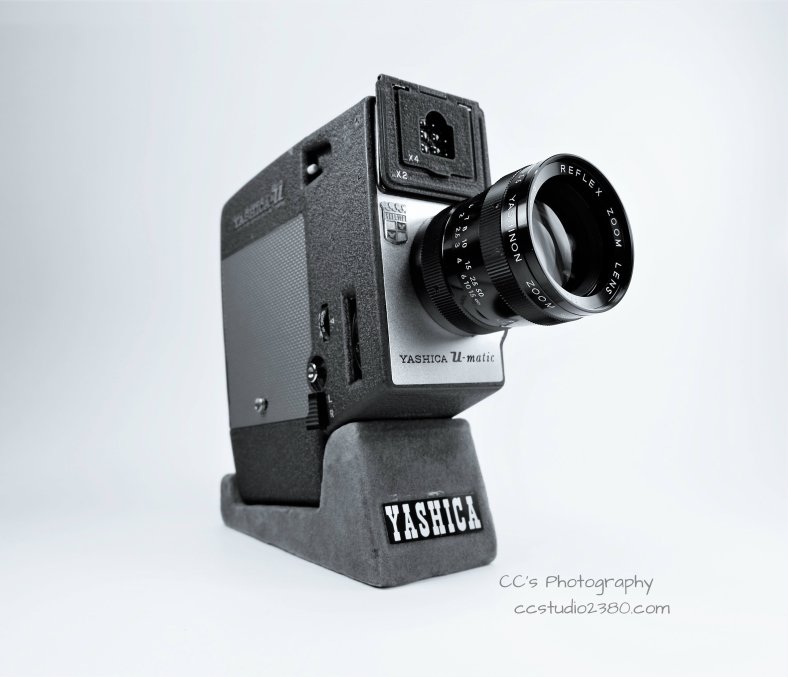
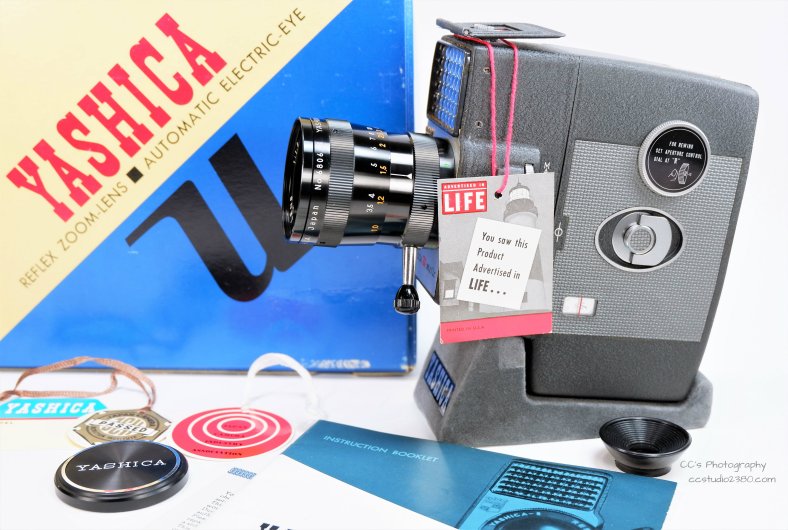
Timeless Tuesday – Yashica 8 U-matic

42343866145_361107190e_o

Yashica 8mm film movie camera from 1961. Fast f1.8 Yashinon zoom lens. The camera sold for around $140. in the early 1960s.

29388131048_a5d3c072cb_o

Complete kit. BTW, the little hang tag from LIFE depicts a cover from 1947.

Thanks for stopping by! – Chris

Please respect that all content, including photos and text, are the property of this blog and its owner, Yashica Pentamatic Fanatic, Yashica Sailor Boy, Yashica Chris.

Copyright © 2015-2019 Yashica Pentamatic Fanatic, Chris Whelan
All rights reserved.
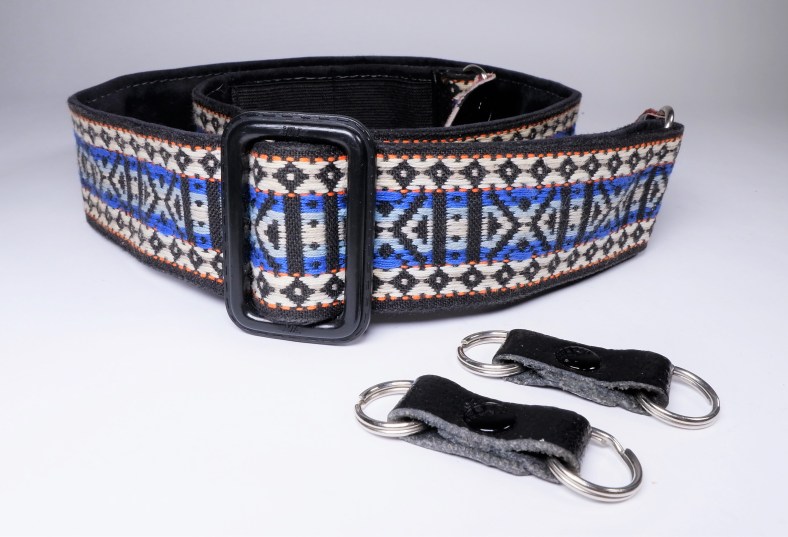
Timeless Tuesday – Hippie Strap

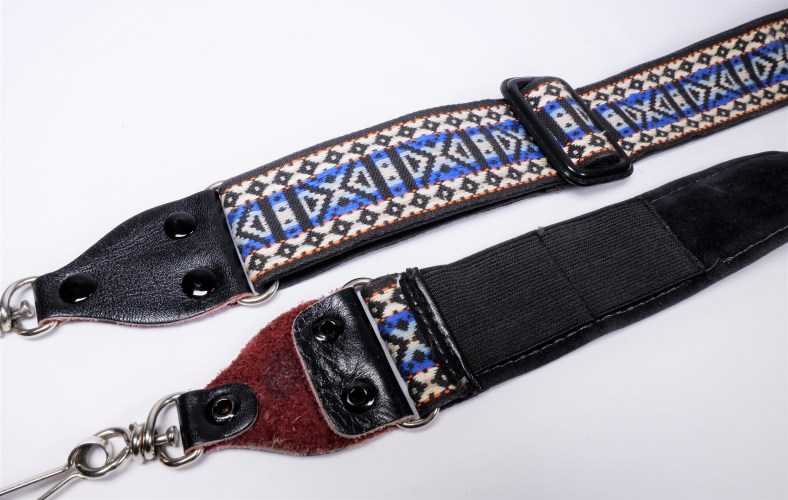
Here’s a bit of throwback photo gear from my collection – it’s time to pass it along. This one is very lightly used and was actually on display with one of my 1970s Yashicas. It’s about 1.5 inches wide and about 36 to 40 inches long as it is adjusted now so it’s a nice long camera strap that’s perfect as a neck or shoulder strap.

DSCF2035

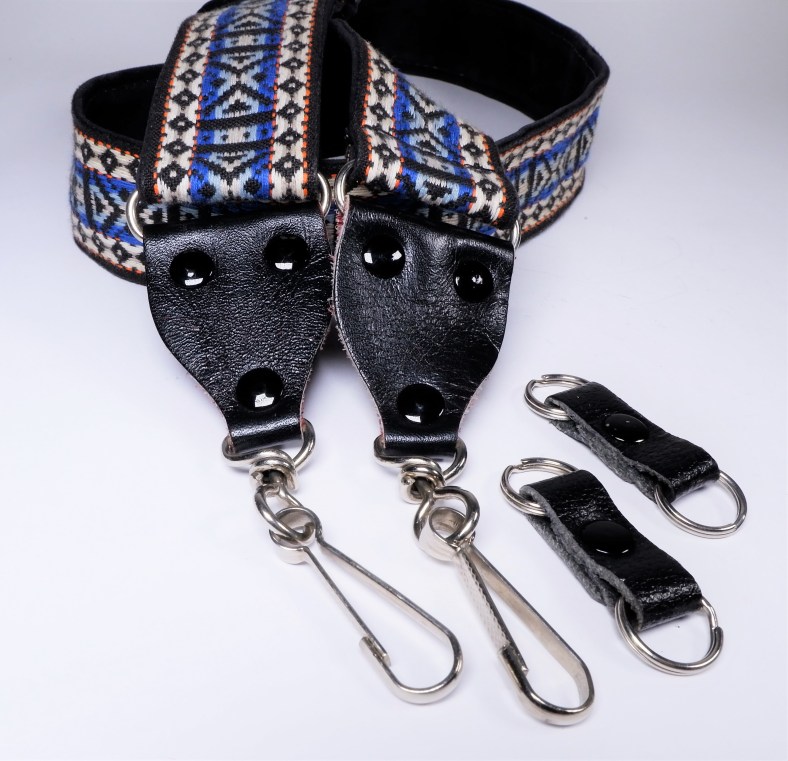
It has nice leather accents and the metal clips are shiny and bright.

DSCF2037

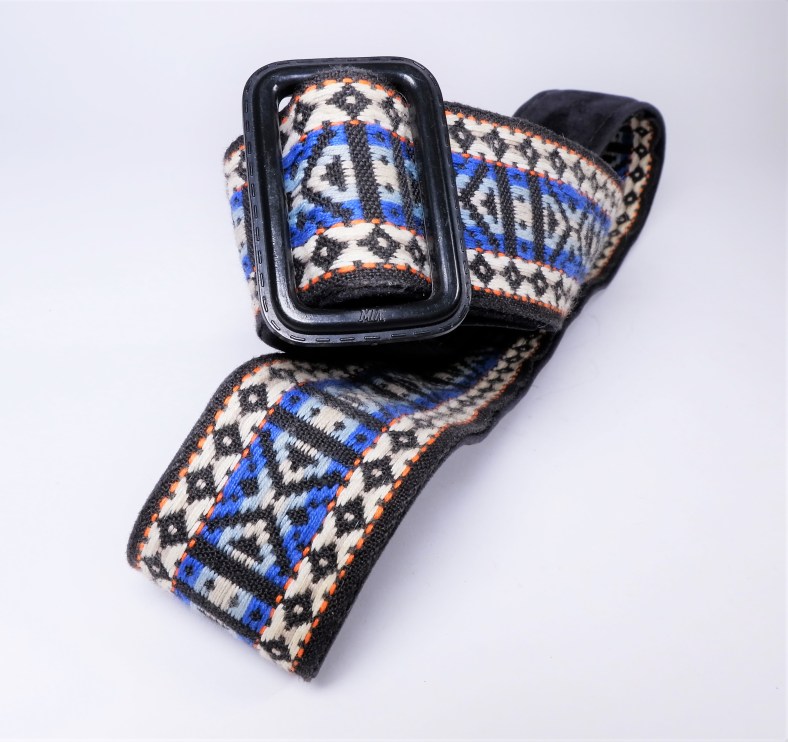
Great colors and an awesome vintage pattern.

DSCF2042

It holds two film canisters (film cans if you’re going old school) and the underside is a soft suede-like material.

DSCF2041

It’s available in my studio shop at http://www.ccstudio2380.com – lots of other neat items in the shop at 10% off too! – Chris

Please respect that all content, including photos and text, are the property of this blog and its owner, Yashica Pentamatic Fanatic, Yashica Sailor Boy, Yashica Chris.

Copyright © 2015-2019 Yashica Pentamatic Fanatic, Chris Whelan
All rights reserved.
Nicca Bits

I love finding “new” bits of vintage photo gear especially when you’ve been hunting for them for years.

These bits may seem like no big deal but if you collect hard to find items in their original boxes and cases it’s rewarding when it all comes together.

DSCF2011

Nicca-Hinomaruya Y2 filter and lens hood. Both are from at least 1955 but likely earlier.

DSCF2005

Hinomaruya was the exclusive distributor of Nicca cameras and accessories.

DSCF9989

DSCF9995

DSCF2004

Using a Y2 yellow filter is a must when shooting with black and white film. It will generally darken a blue sky and provide more contrast between the sky and clouds. It can also help add better definition when shooting landscapes where haze and light atmospheric fog is present. When using a Y2 filter on a camera such as this one you must compensate by a factor of two when taking your meter readings. If you’re using an SLR with TTL metering then the camera’s built-in meter will compensate for you.

nicca 33 bro v3

Nicca Type 33 sales brochure showing a slightly different box for the hood and for a color filter along with the older style filter box. The Type 33 was one of the last Nicca cameras produced by the company and was released in 1958 so this would represent the last style of filter and hood boxes. As with everything else, these items were distributed by Hinomaruya.

Studio Camera: Fujifilm X-A10

Thanks for stopping by! – Chris

Please respect that all content, including photos and text, are the property of this blog and its owner, Yashica Pentamatic Fanatic, Yashica Sailor Boy, Yashica Chris.

Copyright © 2015-2019 Yashica Pentamatic Fanatic, Chris Whelan
All rights reserved.
 

Yashica L AF vs. Kyocera T Scope

In case you missed this post the first time around here’s another look at these two exceptional cameras by Yashica-Kyocera.

Chris and Carol's avatarChasing Classic Cameras with Chris

Round 1 – The Introduction

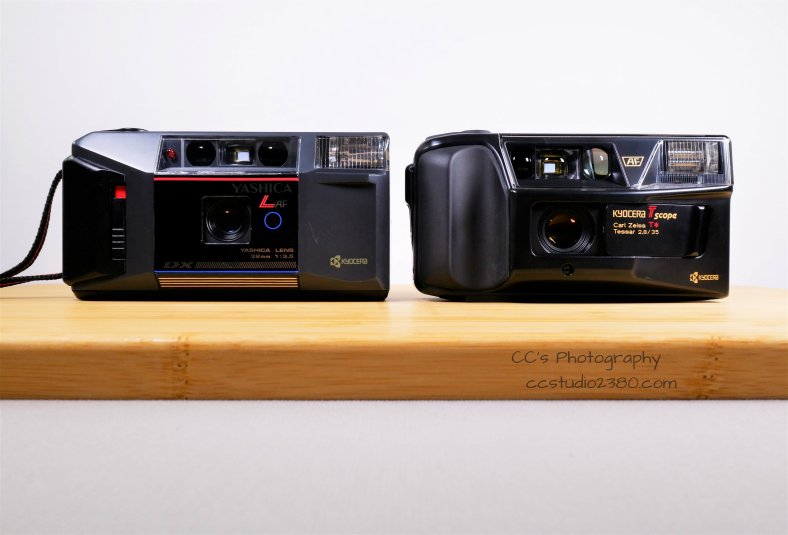
The Yashica-Kyocera L AF from 1986 and the Kyocera T Scope (Japanese name, T3 elsewhere). The L AF was assembled in Hong Kong with parts made in Japan and the T Scope was made in Japan.

Key feature – waterproof (more like weatherproof) – not a dive camera.

kyocera t scope

DSCF7805 logo N.A. Scope = “New Angle Scope”

The scope is just like a waist-level finder – pretty cool actually.

DSCF7813 logo

ky and laf logo Cousins

I’ll be doing a side by side field test of these two cameras shortly. Is the T3 really worth the extra money over the Yashica? The T Scope features a Carl Zeiss T* Series Tessar f/2.8 35mm lens against the Yashica (Tomioka?) f/3.5 32mm lens. I have a hunch that the Yashica’s lens was also made by Zeiss at the Tomioka factory in Tokyo. We’ll see if the vaunted T* coating makes a noticeable difference.

DSCF7808 logo Not often seen…

View original post 19 more words

Vintage View

Happy Saturday!

Digging through some archived pics I came across this one.

14940004703_3a4161c383_o (1)

Thanks for stopping by! – Chris

Please respect that all content, including photos and text, are the property of this blog and its owner, Yashica Pentamatic Fanatic, Yashica Sailor Boy, Yashica Chris.

Copyright © 2015-2019 Yashica Pentamatic Fanatic, Chris Whelan
All rights reserved.