Happy SUNday! Vintage Camera Edition

Happy SUNday y’all! Two new offerings in our online store – from our collection to yours!

DSCF7431 logo

Nikon Nikkormat FT3 – as clean as new – it’s been fully tested and is ready to roll! Check it out in our online store for a super deal on the wonderful classic from Nikon.

DSCF7514 logo

Asahi Pentax Spotmatic SP model – early first version of this super popular camera. I’ve replaced the light seals and mirror pad and it’s been detailed inside and out. 100% fully working and a joy to use. Available in our online store at a great price.

Visit our store at https://www.ccstudio2380.com for more pictures and a complete detailing of the specifications of each camera set. These are from our personal collection of classic film cameras and have never been offered for sale before. Our home is smoke and pet free and we always store and maintain our cameras and lenses properly.

Thanks for stopping by!

Chris and Carol


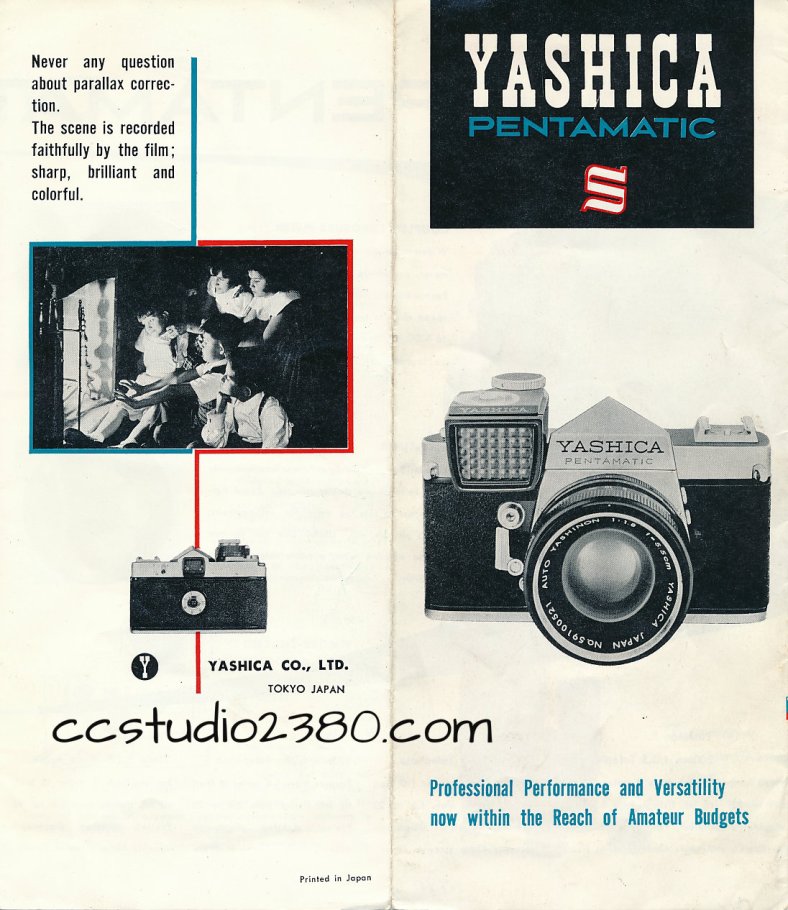
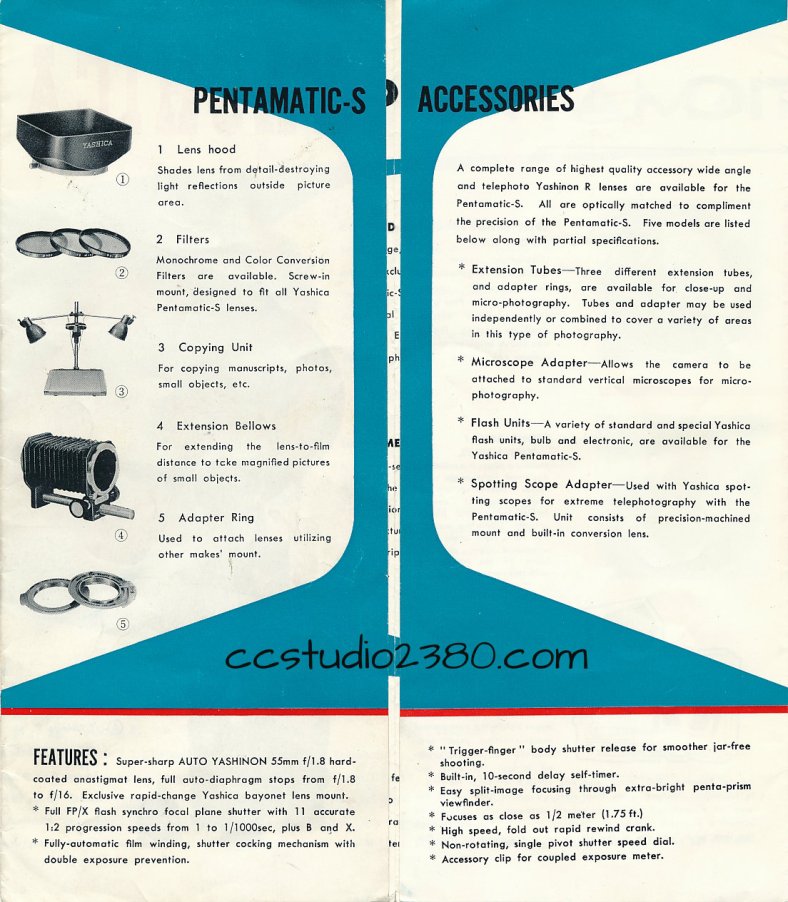
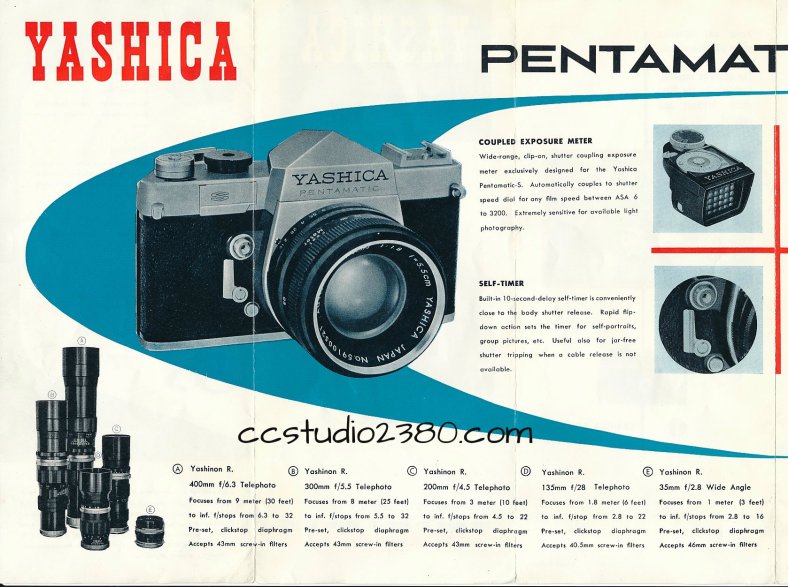
Yashica Pentamatic S Sales Brochure

As was typical with Yashica sales material, this brochure is undated. Our best guess would put it around late 1961. It’s fairly complete with all of the major accessories and lenses that were available for the Pentamatic line of cameras – the original Pentamatic ’35’, the Pentamatic II, and the final camera the Pentamatic S.

IMG_20180325_0004 logo

The Pentamatic S was available in the US but received only limited press – few advertisements and only 3 different brochures in English are known to exist.

IMG_20180325_0003 logo

The Pentamatic S was made starting in August 1961. By that time, the Pentamatic family of cameras were starting to show their age and lack of sophistication and were already having trouble in the world marketplace.

IMG_20180325_0005 logo

The Pentamatic is a well-made camera but was lacking in some important basics that were addressed with the S. Adding a coupled exposure meter and a self-timer were but a few steps Yashica took to make the camera more competitive. The original lens for the Pentamatic ’35’ was made by Tomioka Optical and the S went back to using it. The middle camera (Pentamatic II) was only released in Japan and was equipped with a Zunow made 5.8cm f1.7 lens.

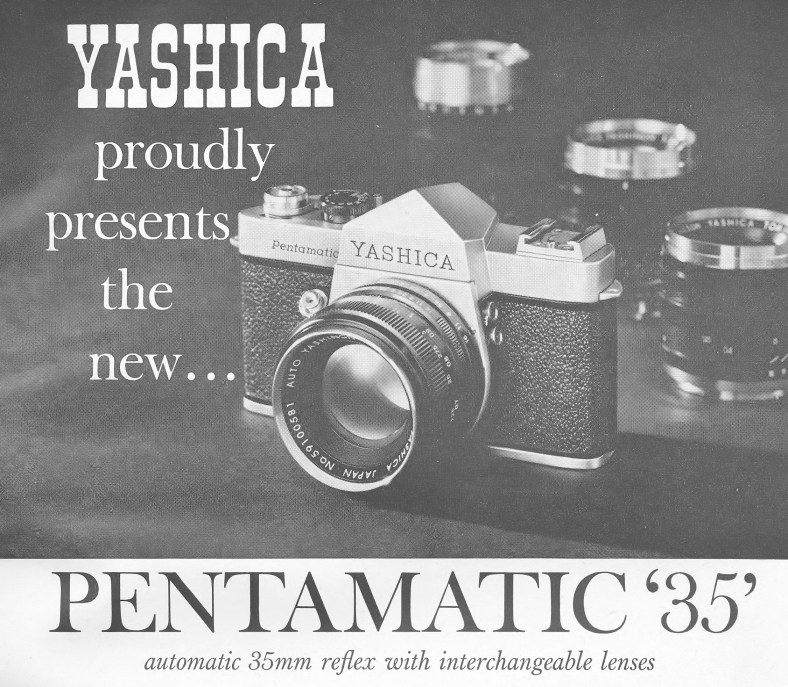
yashica 7-31 ad

The first known advertisement for the new Pentamatic – Spring 1960. Take notice that the lens serial number 59100581 is very close to the serial number on the lens in this late 1961 brochure (59100521). The Yashica marketing team must have held onto some of the first lenses made for them by Tomioka.

Thanks for stopping by! If you want to add a truly unique camera to your collection take a look at the Yashica Pentamatic S – if you can find a nice, clean working model go for it!

Please check out our online shop at https://www.ccstudio2380.com for some neat vintage cameras and some brand new modern classics!

Chris

Please respect that all content, including photos and text, are the property of this blog and its owner, Yashica Pentamatic Fanatic, Yashica Sailor Boy, Yashica Chris.

Copyright © 2015-2018 Yashica Pentamatic Fanatic, Chris Whelan
All rights reserved.

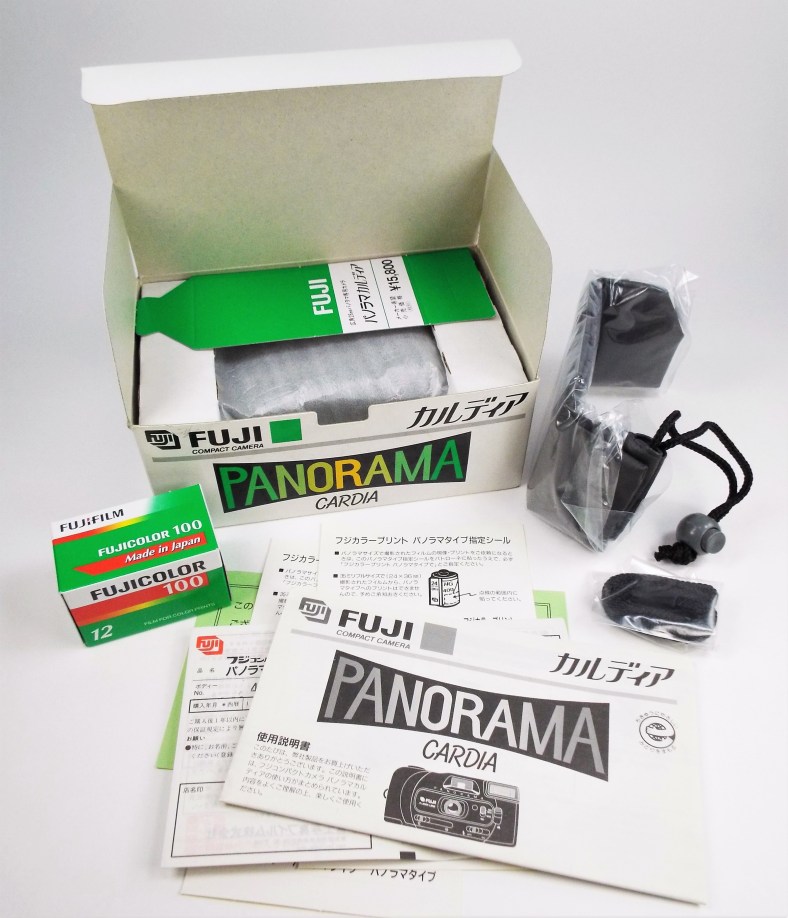
Fuji Panorama Cardia – 1991

From the ‘Plastic Fantastic’ period of Fuji Photo Film comes this awesome little 35mm compact camera.

Fuji Panorama Cardia

Lots of good looking plastic.

DSCF6781

Released in Japan in December 1991 for ¥15,800. It features a fixed 28mm Fujinon f/8 lens and a shutter speed of 1/100. Manual winding but with auto exposure and automatic flash.

DSCF6770

The set came with plenty of documentation and a nice padded camera case. We added the roll of Fujicolor for a bit of, you know, color!

We love collecting these “new old stock” cameras from the 1980s, 1990s and the 2000s. They were, for the most part, excellent cameras that provided a bridge from complicated SLR cameras to easier to use compact cameras capable of producing high-quality images. Of course, modern smartphones can do panorama photography so why use a film camera? A look that just looks “different” – so analog with all of its imperfections.

Thanks for your visit! Be sure to stop by our online store at https://www.ccstudio2380.com

Chris

Please respect that all content, including photos and text, are the property of this blog and its owner, Yashica Pentamatic Fanatic, Yashica Sailor Boy, Yashica Chris.

Copyright © 2015-2017 Yashica Pentamatic Fanatic, Chris Whelan
All rights reserved.

The Yashica Pentamatic – Our 8 Year Search – Some Conclusions & Wild Speculations

We’ve been hot on the elusive trail of the Pentamatic family of cameras from Yashica now for well over 8 years. We’ve looked under every rock (auction sites), nook (web searches) and crannies (well, just crannies) for anything related to the Pentamatic. Our search has led us to some interesting conclusions – and wild speculations!

20171125_133916 (2)

Some Conclusions

The first Pentamatic was “born” in December 1959 but wasn’t available for sale in the U.S. until April 1960. The Pentamatic was Yashica’s first 35mm single-lens reflex camera and was designed with the help of technology obtained from Yashica’s acquisition of Nicca Camera in 1958 and with some involvement with designers from Zunow Optical in 1959. Of course, Yashica designers were involved too as well as collaboration with Tomioka Optical for the first lenses.

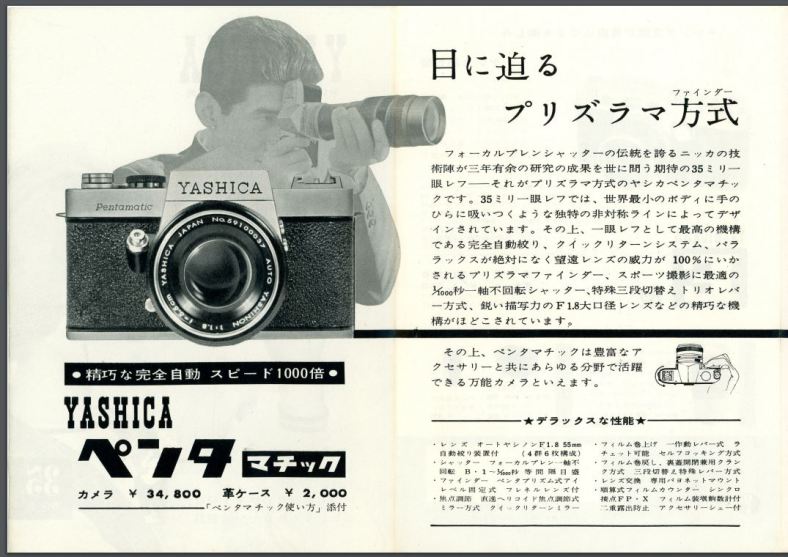
Below is a scan of what appears to be the first sales brochure for the Pentamatic found in Japanese. A machine translation of it proves that Yashica and Nicca designers worked together to jointly develop the camera over a 3-year period. The exact date of this brochure has not been established but it appears to be at least issued in the Spring of 1960. Many thanks to my good friend Paul Sokk for his efforts in researching the Pentamatic with me over the years. His fabulous site can be found at www.yashicatlr.com

Yas inside P1 bro

Scan courtesy of Paul Sokk at http://www.yashicatlr.com

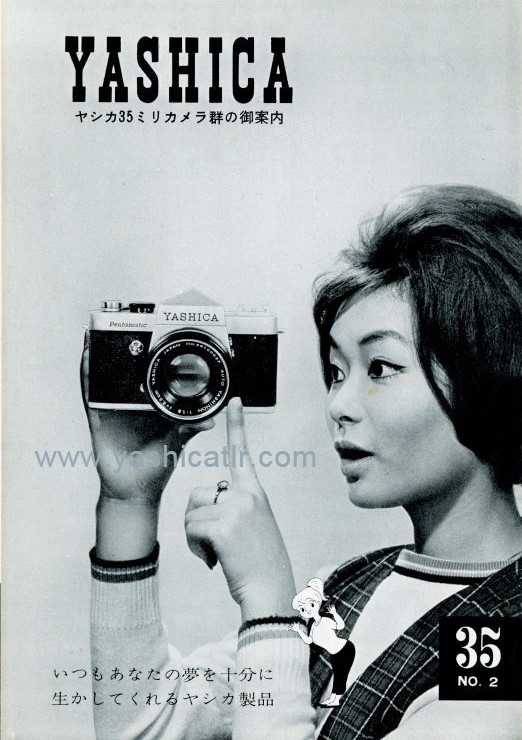
Below is a scan of the cover of that first sales brochure that features the new Pentamatic.

Yas Cover P1 bro (1)

Scan courtesy of Paul Sokk at http://www.yashicatlr.com

The original Pentamatic was a failure. A beautiful, sleek and modern camera at a great price, but still a failure. A replacement for it (Pentamatic II) was released by September 1960 – just a few short months after the original Pentamatic debuted.

The Pentamatic and the Pentamatic II were both out of production by January 1961. The Pentamatic S didn’t appear until around April 1961. Little was significantly changed over the course of these 3 models during this short timeframe. The Pentamatic II and its one-off lens improved on its semi-automatic capabilities. The body stayed the same with the exception of adding the engraved “II” after the name. No logic to this as Yashica could have simply made the new lens available as an option to the original Pentamatic. There had to be another reason to call it the model II and it appears that there were some internal changes made to accommodate the new lens.

The standard lens that was available for the Pentamatic II was designed and built (quickly?) by Zunow vice Tomioka. Our best guess at this point.

The Pentamatic II was only available for sale in Japan.

The Pentamatic S essentially was the replacement for the original Pentamatic – not the Pentamatic II. The model S added a lug for attaching an accessory exposure meter that coupled to the shutter speed dial. The S also added a self-timer and the body got a redesign (the strap lugs were moved to the front and the shutter release button was no longer at a 45-degree angle).

The Instruction Booklets

The booklets have been an additional source of fun separate from the camera searches. The booklet for the original Pentamatic was relatively easy to find. The first Pentamatic saw about 16,000 units made so the booklet is much more available. The Pentamatic II booklet was the hardest to locate since only around 5,000 cameras were made. The Pentamatic S booklet is even rarer – only around 3,000 cameras produced.

DSCF6534

The 3 Pentamatic instruction booklets. Notice that the Pentamatic and Pentamatic II booklets have the same design while the model S differs dramatically. More “clues”.
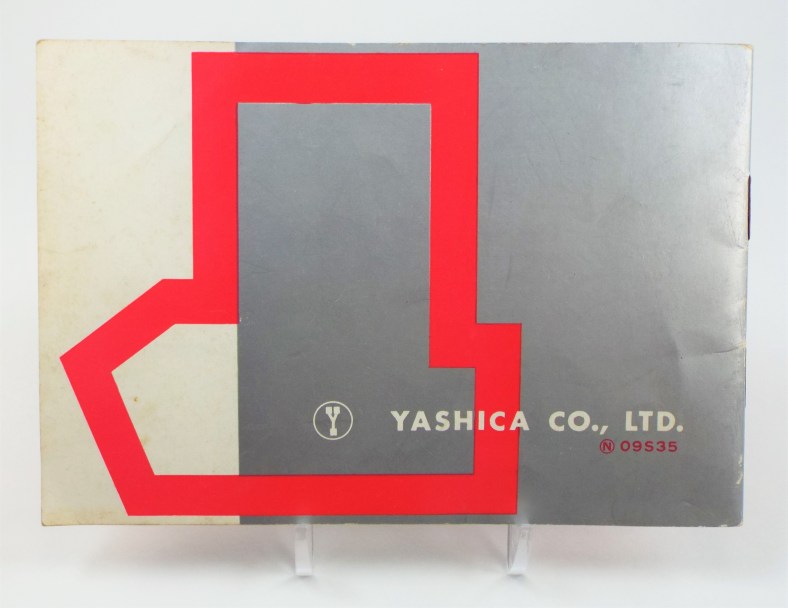
DSCF6540

The back cover of the Pentamatic II booklet – the only one to carry a date (lower right corner). This one is dated September 1960. Showa date is 35.

Inside the booklets…

DSCF6543

The original Pentamatic.

DSCF6545

The Pentamatic II.

DSCF6544

The Pentamatic S.

Wild Speculations

Wild Spec 1 – The first Pentamatic was not initially released in Japan. Yashica had a slow go with its early production so only a limited number were available for the April to June debut in the U.S. There were only about 4,000 cameras made by then and that just didn’t support a wide release of it in their home market. However, with the discovery of the as yet undated sales brochure found by my friend Paul Sokk it does appear that some of the first Pentamatics were in fact distributed in Japan. We do feel that Yashica had a suspicion that the original model would not go over well at home. Why do we feel this way? During our quest of all things Pentamatic, we’ve yet to find an instruction booklet for the original Pentamatic in Japanese (or any other language besides English). We’ve seen no early 1960s advertisements either. Although we’ve yet to find these items that does not mean they don’t exist.

Wild Spec 2 – The Pentamatic II was only available in Japan and was never intended for widespread availability in the world marketplace. We further feel that the Pentamatic II was the camera Yashica intended to release in Japan vice the original Pentamatic. Why? Same thing… in over 8 years of searching we’ve never seen a Pentamatic II instruction booklet in English and the only sales brochures we have are in Japanese. No English ads or brochures anywhere (yet). Update: As of April 2019 still no English ads or books.

Wild Spec 3The Pentamatic S wasn’t available in Japan. Crazy right? The same thing applies here – no Japanese advertising or brochures and no instruction booklets in anything but English. Again, not finding them does not translate to not being produced but the likelihood looks slim.

Wild Spec 4 – As we stated in the conclusions section above, the standard lens for the Pentamatic II (5.8cm f/1.7) was made for Yashica by Zunow Optical vice Tomioka. This flies in the face of what’s known and we don’t have solid written proof (yet, if ever). Both the original Pentamatic and the Pentamatic II ended production in January 1961. By coincidence, that’s the reported date of Yashica’s acquisition of Zunow (or their bankruptcy). Once Zunow went bust they no longer make lenses for the Pentamatic II.

Wild Spec 5 – Once the Pentamatic II stopped production, Yashica started selling the original Pentamatic in Japan (or at least increased its availability in Japan). We would still like to find a Pentamatic instruction booklet in Japanese to validate this thought.

Wild Spec 6 – Since the Pentamatic S wasn’t sold in Japan, there was a rather large gap in Yashica’s SLR availability. The next camera to be sold widely in Japan (and the U.S.) was the Penta J but that didn’t come out until the Summer of 1961.

These marketing and production missteps led to a less than stellar debut for Yashica in the world of 35mm SLRs. The competition during this same period was “inventing” much more sophisticated (and mostly more expensive) cameras which had a wider range of interchangeable lenses and accessories. It took Yashica a long time to establish a “foot in the door” with their Penta J and their first internally coupled exposure metered SLR, the Yashica J-3 (Jaguar).

Things we would like to find…
600x450-2015111900010

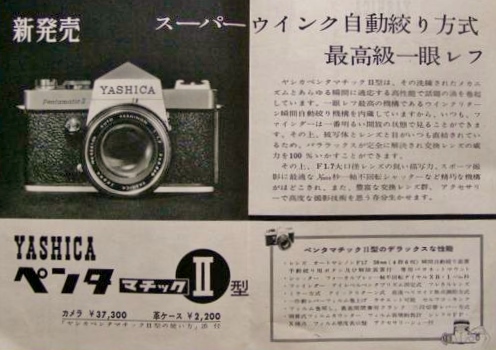
Original sales brochure for the Pentamatic II.

The first thing we would like to discover would be an ad, sales brochure or instruction booklet in English for the Pentamatic II. We don’t think we will as we feel that they don’t exist.

We would like to find a Pentamatic instruction booklet in Japanese. They must exist but we’ve yet to find one.

A Pentamatic S instruction booklet and a sales brochure in Japanese. Don’t think they exist but time will tell.

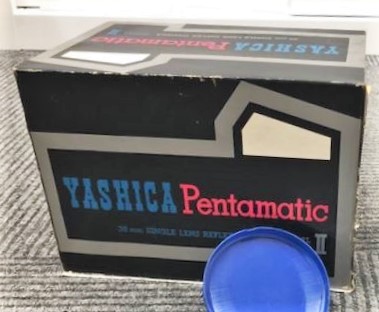
A Pentamatic II box!!! They must exist – someone’s got to have one in their collection! Update: Finally found one but we missed acquiring it for our collection so we “borrowed” this image –
yashica P2 Box

Very similar to the original Pentamatic box but black vice silver.

A Pentamatic (any model) in its original boxes in factory fresh condition. WooHoo!

***Solid proof that the standard lens for the Pentamatic II was made by Zunow Optical.***

Other than these things, I think we’re good! ^.^

Thanks for your visit! If you’ve made it this far in the post give yourself a big pat on the back! You just may be on your way to becoming a ‘Yashica Pentamatic Fanatic’!

Please stop by our online shop at https://www.ccstudio2380.com and check out some of our classic cameras available for sale.

We are active buyers of quality cameras and equipment – especially anything Yashica, Nicca, Fujica or whatever! Contact us at chriscarol@ccstudio2380.com

Please respect that all content, including photos and text, are the property of this blog and its owner, Yashica Pentamatic Fanatic, Yashica Sailor Boy, Yashica Chris.

Copyright © 2015-2019 Yashica Pentamatic Fanatic, Chris Whelan
All rights reserved.
Happy SUNday!

Vintage St. Peter's Basilica

Vintage view of St. Peter’s – 1986

Canon F-1 with Canon FD 24mm f/ 2.8 wide angle lens on Kodak Kodachrome 25 film.

Have a fantastic SUNday! Chris ^.^

Please respect that all content, including photos and text are property of this blog and its owner, Yashica Pentamatic Fanatic, Yashica Sailor Boy, Yashica Chris.

Copyright © 2015-2017 Yashica Pentamatic Fanatic, Chris Whelan
All rights reserved.

Zunow SLR – 1958

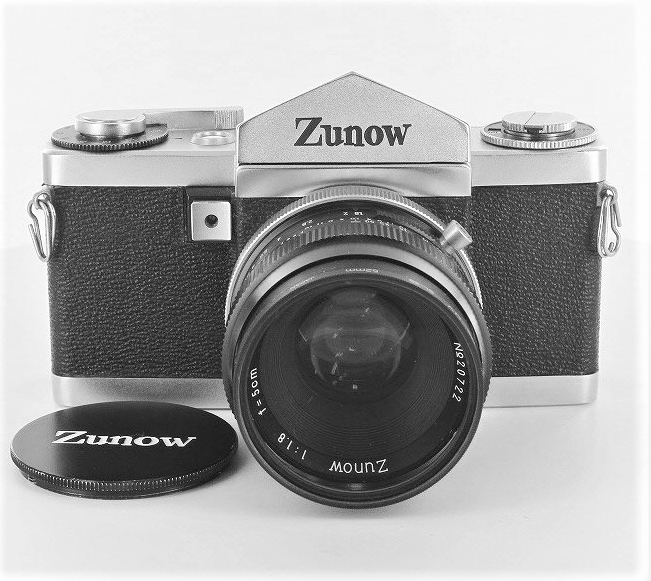
One of the rarest early Japanese 35mm SLR cameras ever made. The Zunow SLR (below).

zunow beauty

Zunow SLR 1958.

This gorgeous Zunow sold for a cool ¥ 1,880,000 (about $16,700 USD)!

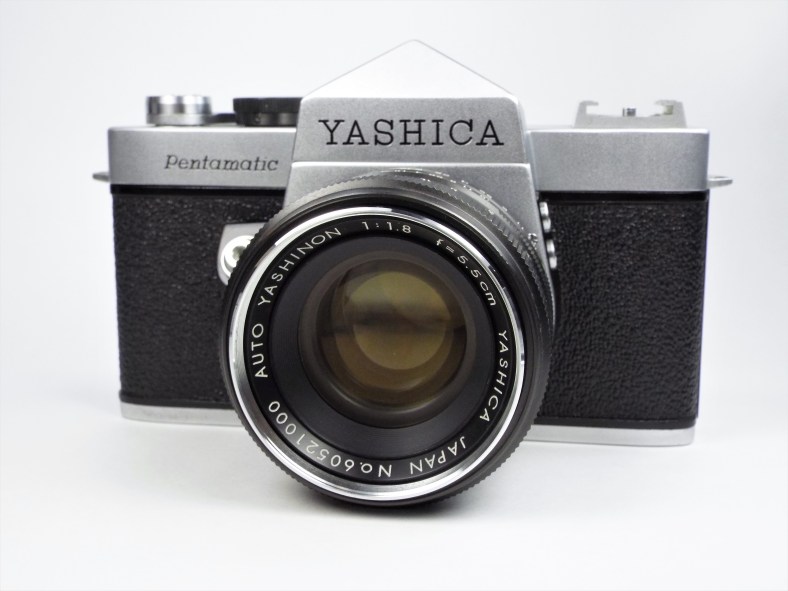
The Yashica Pentamatic (below) just sold for $16,598 less!

DSCF6236

Yashica Pentamatic 35mm SLR. Yashica’s first ever. A cousin to the Zunow? We think so.

We believe designers and engineers from Zunow and Nicca played a big part in bringing the Pentamatic to market by early 1960.

Thanks for your visit! To find out more about Yashica and the Zunow connection stay a bit and check out our blog here on the ‘Yashica Pentamatic Fanatic’!

Chris and Carol ^.^

Please respect that all content, including photos and text are property of this blog and its owner, Yashica Pentamatic Fanatic, Yashica Sailor Boy, Yashica Chris.

Copyright © 2015-2017 Yashica Pentamatic Fanatic, Chris Whelan
All rights reserved.

New Yashica Pentamatic Set – all the goodies too!

We’re always on the lookout for interesting Pentamatic sets. This was purchased from the original owner who purchased it in March of 1961 in Philadelphia. It’s the first Pentamatic set that had the “dealer price card” included.

It’s a beautiful camera in nearly mint condition – hardly any signs of use and of course it works perfectly. This particular camera was made in August 1960 and the lens is from around the same time.

DSCF6354

The interesting negative holder from Kodak (upper right) is from the first roll of film that the original owner shot (high contrast B&W copy film). I’m not sure of the exact period the Kodachrome film is from but I do know that I’ve shot more than my share of Kodachrome in my life.

The dealer price card was designed to slip into the cold shoe of the camera (by folding the little tab on it and inserting it in the shoe).

Carol and I are always looking for nice examples of all models of the Pentamatic (Pentamatic, Pentamatic II and Pentamatic S) so if you have a nice one to sell please feel free to contact us through our blog or at chriscarol@ccstudio2380.com

Be sure to stop by our online store at https://www.ccstudio2380.com

Thanks! Chris and Carol ^.^

Please respect that all content, including photos and text are property of this blog and its owner, Yashica Pentamatic Fanatic, Yashica Sailor Boy, Yashica Chris.

Copyright © 2015-2017 Yashica Pentamatic Fanatic, Chris Whelan
All rights reserved.

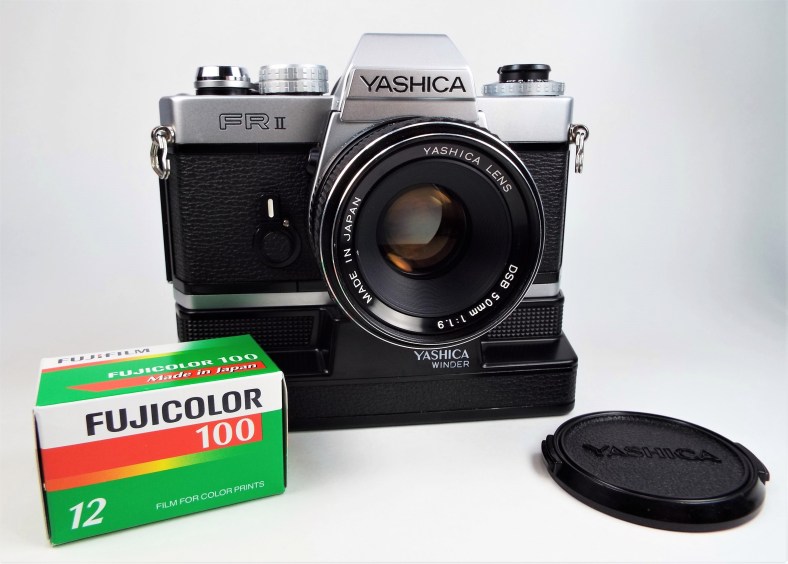
Yashica FR II – the camera that made me buy the Canon F-1

I know – the FR II and the F-1 are miles apart in features (and price). I purchased my first Yashica, a TL Electro-X in 1971 and used it faithfully through much of the 1970s. Being a young (and married) US Navy Sailor and money deprived, the TL suited me just fine – until I was transferred to Japan in 1977. If you were ever stationed in Yokosuka then you know what Building A33 means. It was the Navy Exchange camera and stereo heaven!!! Reps from all of the major camera manufacturers were present and demonstrated their latest gear to the now cash flush Sailors. Upstairs was a branch of Navy Federal Credit Union… if you couldn’t afford it, finance it! Pure bliss.

I’m so easily distracted.

So it was time for me to upgrade my trusty TL Electro-X, so naturally I looked at what Yashica had to offer. The FR was out but it didn’t do it for me and quite frankly, the Contax RTS didn’t either. So I waited and saved some money and started reading the Navy Exchange catalog every day (and night). The Canon F-1 looked promising but was expensive. The TL needed to hold me over as I was diverted to purchasing stereo equipment. Sansui pre and power amps, Teac reel to reel, Dual turntable and some killer Kenwood speakers. A small fortune so a camera upgrade would have to wait.

Now it’s the summer of 1978. My ship was inport (finally) long enough for Carol and I to spend some quality time together and to focus our attention on replacing the Yashica. Another visit to A33 and another visit with the Yashica rep. Now the FR II was the camera of the day (and he was still pushing the RTS too). No way. The friendly Canon rep was all too happy to take my money and hand me a bright new F-1 with 55mm f/ 1.4 lens and Canon 80-200mm zoom. The Yashica was sold off to a friend and that was it for Yashica (for the next couple of decades).

IMG_20170420_0001

Oh happy day! July 1978 – my new Canon F-1 and Canon FD 80-200mm f/ 4 zoom lens.

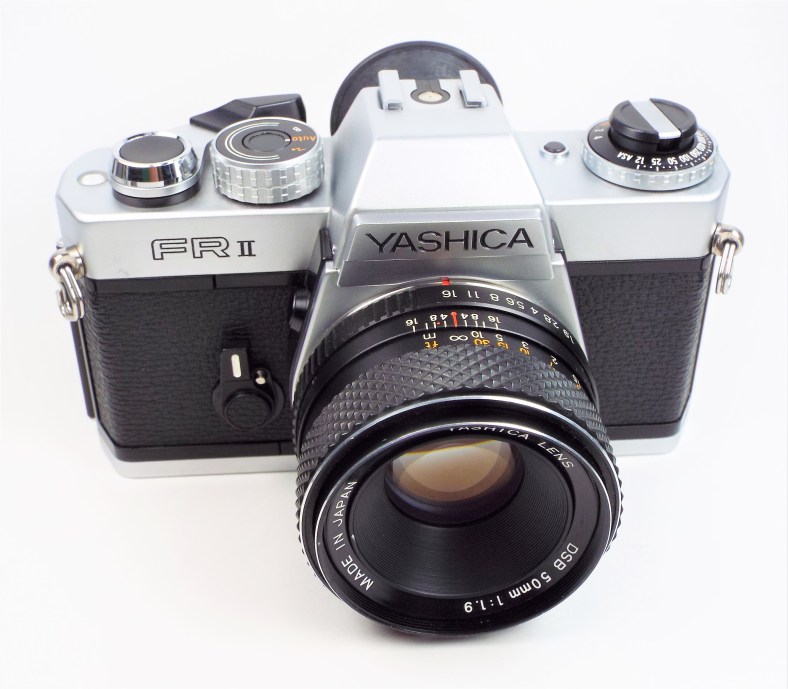
Present day now and I’m finally an owner of a Yashica FR II.

DSCF5487

I picked up this beauty recently because it looked to be in near perfect condition and I figured, why not. Well I gotta say that I’m impressed. Not impressed enough to regret my F-1 purchase back in 1978, but impressed.

DSCF5492

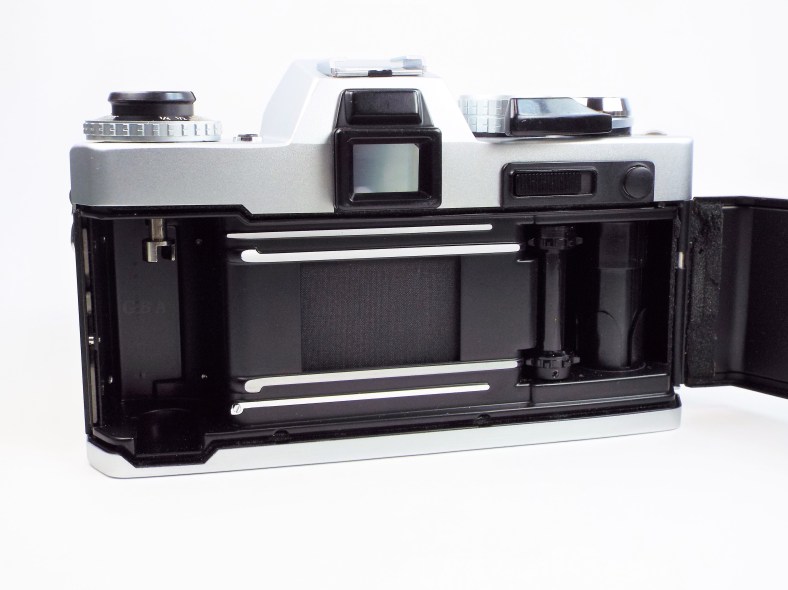
The camera feels good in my hands – well balanced and the viewfinder is super bright. What a big difference over the Yashica TL Electro-X. The Contax/Yashica lens is crisp, clear and focusses easily (split-image). The meter is simple (this is a aperture priority camera) so you’re only messing with the f stops.

DSCF5488

With the power winder attached it’s a tad on the heavy side but would be useful as a weapon (or anchor).

DSCF5493

Simple lines and layout. The meter switch (upper right) is a bit awkward but the meter is accurate and that’s all that matters.

DSCF5495

Uses all of the C/Y bayonet mount lenses which can be had for a song today. Here is a 135mm, f/ 2.8 lens that came with it in basically unused condition.

DSCF5489

We have so many cameras in the queue right now I have no idea when we’ll get a chance to run a roll through it.

Verdict. I’ve waited nearly 40 years to shoot with it so I’m excited to see how it does out in the field. If you find a nice one for sale (mint condition) then give it a try. Stay away from the ones that look rough – these don’t hold up well with abuse. Prices are all over the place – you may be able to strike a nice deal with a seller who’s ready to part ways. Best of luck!

Studio Camera: Fujifilm FinePix S9900W

Chris

E.P Marked Photo Gear. Is it really worth more?

Photo gear made in Japan will sometimes carry a strange marking  <E.P>

20170603_191236

In the above example, the <E.P> mark is engraved on the rewind knob of this Nicca camera. This camera is from the 1955 to 1957 period.

s-l1600 (23)

In the example above, this Nikkor 13.5cm lens has the <E.P> mark engraved on a small lever near the base of the lens. On the lens case below, the <E.P> mark is stamped into the leather just below the JAPAN stamp. The case belongs with the lens pictured above.

s-l1600 (22)

First time we’ve seen the mark on a lens case. To us that implies that the case was mated with that lens from the factory (or wherever the mark was applied).

So what’s up with the <E.P> mark anyway?

As we understand it, the Japanese government needed a way to identify which pieces of photo gear were sold through military facilities and duty free shops in Japan. We feel that the mark means “Exempt Product” – cameras or electronic gear purchased without paying taxes to the government of Japan and purchased by authorized personnel (military members and their families, tourists and by diplomatic members and their families). We’ve seen alternate meanings as “Post Exchange” (military base stores) but U.S. Navy stores are called “Navy Exchange – NEX” and U.S. Army/Air Force stores are “BX/PX or Base Exchange/Post Exchange”. It’s hard to make “NEX or BX” into “EP”.  Other explanations of <E.P> include: Export Permitted (or Export Permit), Exchange Program and Export Production.

The “Black Market”.

The majority of the photo gear we have in our collection that bears the <E.P> mark, was in fact purchased through military facilities and not at duty free shops. Another cause for concern after the War, and we know this first hand from having lived in Japan in the late 1970s, was the so called black market that may have existed (it did) in Japan. The difference between what a service member could buy a camera for at the Navy Exchange (reduced cost and no taxes) and what that same item sold for at a Japanese camera store was just too great not to tempt some selling on the black market. The military stores kept tabs on the amount of tobacco and liquor that a family could purchase and big ticket items (cameras and stereo equipment) included a statement on the receipt that the service member would check and then sign that the item was for their personal use. A direct reminder that you were not to resell the item to unauthorized individuals. Our guess would be that if a Japanese citizen had a camera in their possession with the <E.P> mark it would be easy to question where it was purchased. However, the <E.P> marks were normally on parts of the camera that could be removed and replaced with non marked parts. No system is perfect so if there’s a will they’ll be a way.

DSCF3795

The <EP> mark on a Yashica-Mat from 1960.

So, does the mark make my photo gear more valuable? Yes. Collectible? Yes. Desirable? Yes. But to whom?

Like anything that’s collected, if someone wants it just because of the mark (in this case), then the <E.P> mark makes your item more desirable. In the real world, the gear is no different except for the mark. But – and it’s a big but – there are fewer of them out there. In the case of the nice Yashica-Mat pictured above, let’s say that Yashica sold 1,000 of them in 1960 throughout Japan. Maybe 5% were marked <E.P> (and that may be way high). So if you want to collect a mint condition Yashica-Mat made in 1960, there may be, let’s say only 10 available worldwide at any one time, and if one of those has the mark, well that adds a nice bonus of rarity to the mix. Another way to look at the mark is that the gear was less likely purchased by a professional photographer and therefore may have been better taken care of by its owner. Lots of exceptions to that line of thinking but it does have some merits.

So there you have it. Something of an explanation. If you have photo gear from the 1950s, 1960s and sometimes from as late as the early 1970s and you have the mark, well now you know a bit more about it. If you’d like us to appraise it for you we will be more than happy to. Just contact us here on the blog and we can get something going for you.

Studio Camera: Fujifilm FinePix S9900W

Chris

Recent Pentamatic Auction Action

As you know, here on the Fanatic we are constantly searching for new and exciting Yashica Pentamatic gear that becomes available on various collector auction sites. Here are some interesting pieces that sold recently.

First up this little gem! Unloved but working well, this ugly duck sold for just $12… shipping included! Turns out to be fully working with super nice glass and clean guts. It was made (the body) in June of 1960 and is the 5,843rd Pentamatic to roll off the factory floor.

s-l1600 (16)

From June 1960. It cleaned up rather nicely. (here still dirty)

Tominon lenses were hot on the auction block – here’s what appears to be a new in the box (unverified) Tominon 10cm, f/2.8 lens with a sharp looking box.

s-l1600 (10)

Very low serial number on this beautiful lens… 336!

Very nice looking original box with what looks like a complete set. This brought a solid $250 at auction. Not bad if it’s really unused and has no issues.

s-l1600 (11)

And here’s another Tominon 10cm, f/2.8 lens mated with a good looking body. This lens is a tad newer (serial number wise) than the one above but still a low number… 611

s-l1600 (12)

The body was made in January of 1960 so it’s part of the first wave of Pentamatics to come off the line. It has the honor of being only the 669th made since December 1959 (when the P1 was first built).

s-l1600 (13)

This combo did well at auction with aggressive bidding by many bidders. It brought just over $300! Not bad for such a nice early set.

So there you have it. From $12 to over $300… a busy period for the Pentamatic.

Thanks for your visit!

Chris