Modern Classics – Fujifilm Zoom Date 110EZ

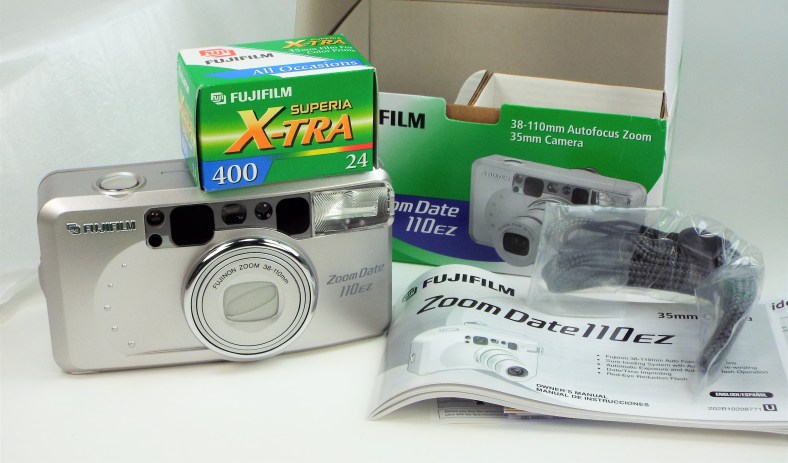
No it’s not a 110 film camera as the name might imply but one of the last in a long series of 35mm super compact cameras from Fuji.

This one debuted about late 2003 – not that long ago when you think about recent film cameras vs. emerging digital cameras.

DSCF5732

As the name implies, it has a zoom lens (38-110mm) and can imprint the date on the film.

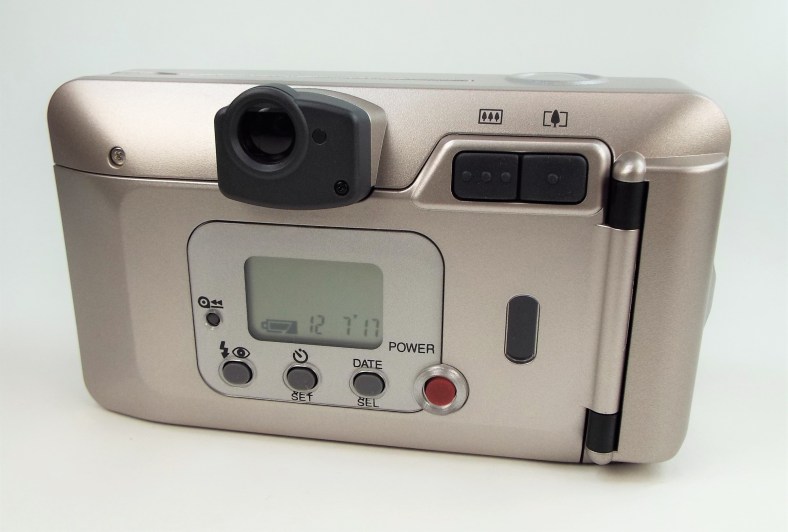
DSCF5731

Autofocus, exposure, flash and red-eye reduction.

DSCF5734

Electronic shutter from 1/2 to 1/500th second.

DSCF5735

Nice bright viewfinder – large LCD with date/time imprint and super fast two position zoom buttons. The red power button is almost impossible to push with a normal fingertip. Too small for me.

DSCF5737

Power zoom Fujinon lens 38-110mm (f 6.3 to 11.7).

DSCF5739

The camera is one of the smallest in our collection of plastic fantastic Fujifilm compact 35s. It weighs in at only 190 grams without the CR123A lithium battery.

Automatic DX film ISO setting from ISO 50-3200. Automatic film loading and film advance and auto pre-wind system.

As we’ve stated before, these cameras are getting harder to find in still brand new condition (with all original factory issued stuff)… so, they are somewhat collectable and if you’re looking for a super compact film camera to take on your next outing, the Fujifilm line is a very good choice.

Studio Camera: Fujifilm FinePix S9900W

Thanks for your visit!

Chris

Shop Dog

20464405042_dc5087757e_o (1)

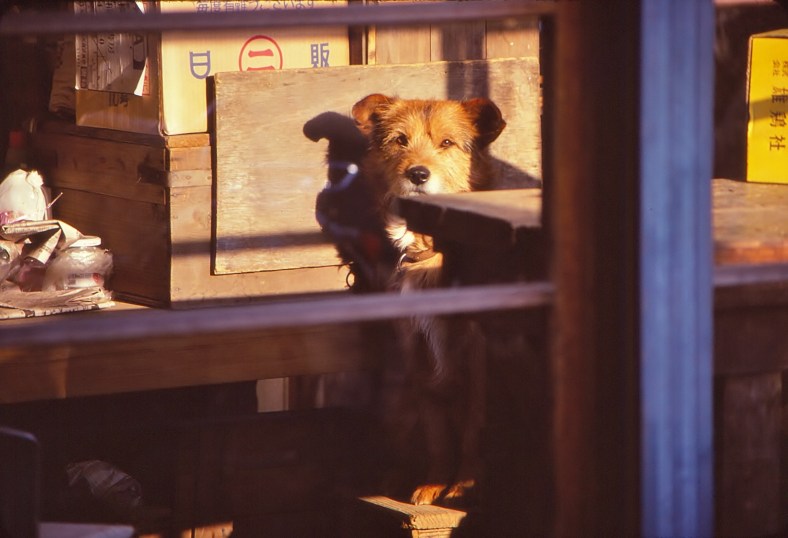
Shop dog keeping a watchful eye on me as I pass through his territory. 

Honmoku, Naka-ku, Yokohama late 1970s. One of my favorite images from that time period as the various shop dogs and cats were not easy to get pictures of. The late day sun helped to add depth to the composition.

Camera: Canon F-1 (1978 Version) with FD 80-200mm zoom lens on Kodachrome.

Chris

Pentamatic – Finally Found ‘in the wild’. Nerds heaven!

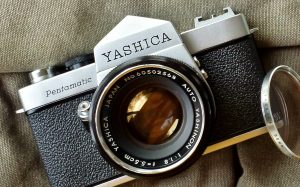
After many years of searching for proof that Yashica had in fact released its first production run (from December 1959) of the 5.5cm f1.8 Auto-Yashinon lenses for the Pentamatic ’35’ – we finally found one in the wild! Now it’s ours.

We stumbled upon this lens the other day on an online auction site. After some negotiations with the seller, we reached an accord. The camera this lens was mounted on was a pure dog… “Junk Treatment” as ‘Google Translates’ the kanji for crap (one would think) items. We took a chance that the lens was going to be OK. We’ve seen enough of these over the years to get a good feel – this one we just had to have even if it matched the condition of the camera body it was on. Man was it dirty – sooty and a tad yellow (the markings yellow over time). But it was a hidden gem. No mold – no fungus – no cleaning marks or haze – and, the best part, it focuses crisply and although the aperture blades are a bit worn, they move nicely (snappy as ‘they’ say).

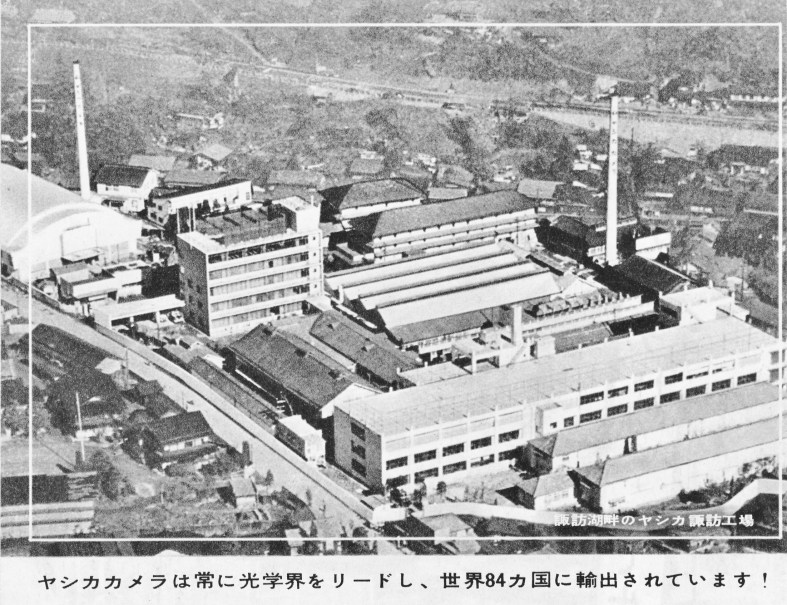
The Pentamatic went into production at Yashica’s modern factory campus in Suwa, Nagano Prefecture in December 1959. At the same time, or just slightly before (maybe in October), Tomioka Optical started making the lenses for the first Pentamatics. We don’t know for certain if Tomioka delivered completed lenses to Yashica or only manufactured the optics for them and Yashica did the rest – we just don’t have that information yet.
dscf3477

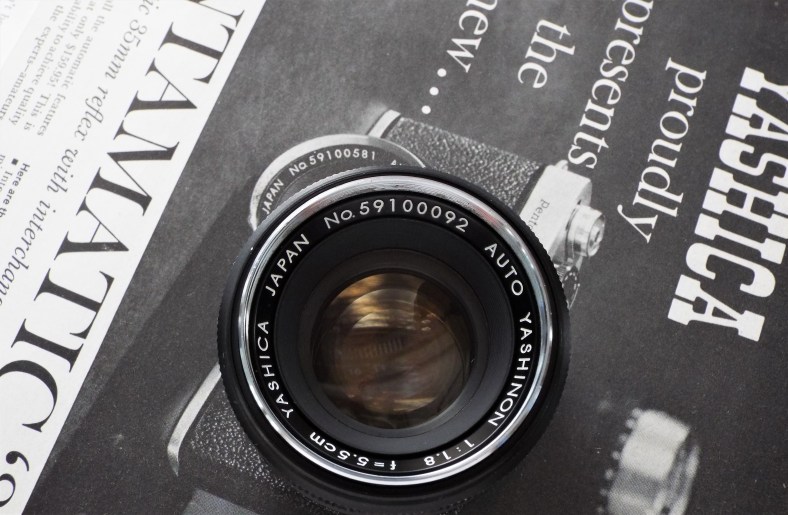
Here’s the lens we just acquired – Auto Yashinon 55mm (5.5cm) f1.8 which was the normal lens supplied with Yashica’s first Pentamatics. The background ad is from a ‘Popular Photography’ magazine – June 1960 issue. The ad lens serial number is – No. 59100581 – our lens serial number is – No. 59100092. Not often do you find a lens in the wild with a lower serial number than an ad. By the way, the advertisement was the first ever for the Pentamatic.
20170203_092654

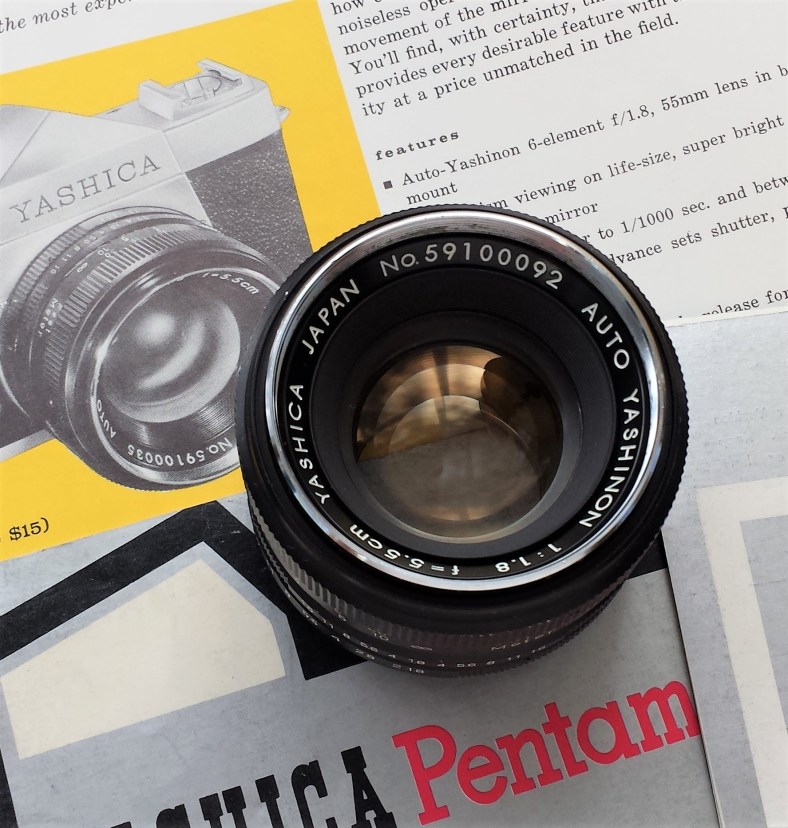
The lens that is featured in one of the first sales brochures for the Pentamatic, is serial numbered – No. 59100036. Our lens was made just slightly after the lens in the brochure (same day?). We don’t know when the sales brochure came out. Our guess is March 1960. The photographs were probably taken by the marketing people in Yashica’s Shibuya headquarters sometime in late 1959 or early 1960.

We know – this is all super boring nerd stuff that only Yashica fanatics would find interesting – wait, that’s a great name for a blog… ‘Yashica Pentamatic Fanatic’. ^.^

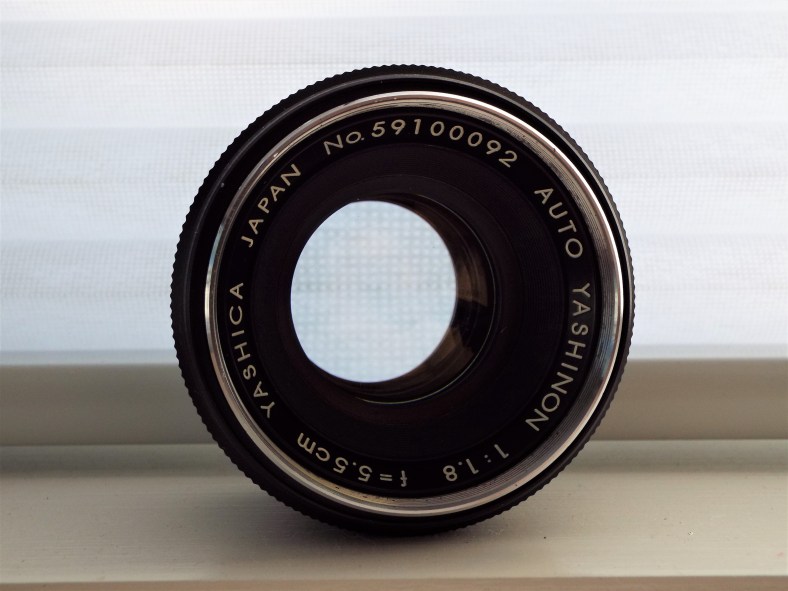
So what does the serial numbers tell us? The SN No. 59100092 (our lens) translates to – made in 1959, the ’10’ is for October, and the 0092 is the sequential production number of the lens assembly. This means that Tomioka Optical started production of the new lenses for the Pentamatic as early as October 1959! Lenses made in 1960 are labeled No. 605xxxxx. The ‘5’ being a placekeeper or model number. The highest serial number we have in our collection is No. 60515157. That lens came with a Pentamatic body that was made in January 1961 and the lens was the 15,157th made up until that point.

The highest serial number seen in the wild is No. 60521460 which was mounted on a Pentamatic-S body.
dscf3483

Thanks for your visit and if you made it to this point in the post, pat yourself on the back! You may be a bit of a camera nerd – just like us!

Chris & Carol ^.^
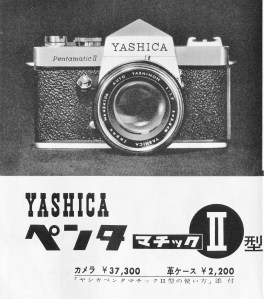
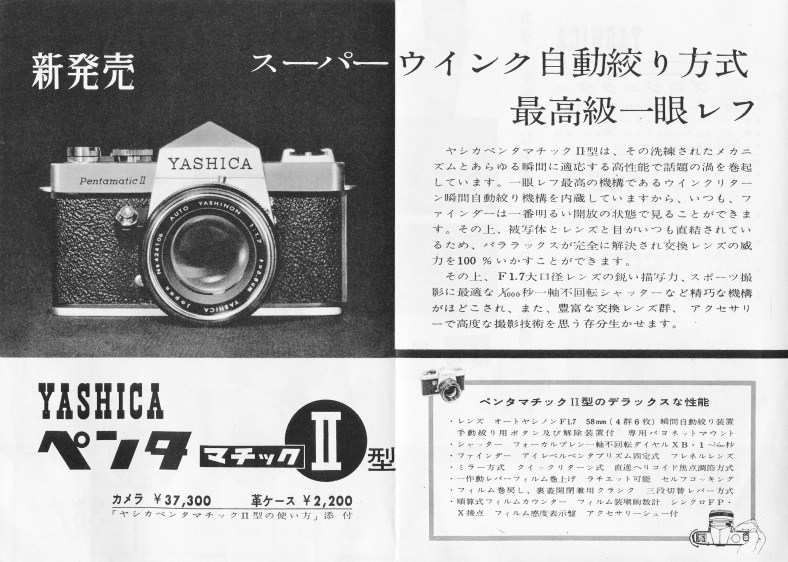
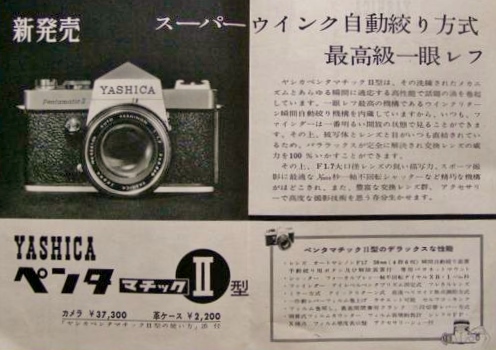
Pentamatic II Brochure

We finally have our proof that the original Pentamatic ’35’ and the Pentamatic II were advertised and sold in the Japanese domestic market. This brochure is dated February 1961 which validates the general release date of the model II. We have proof (via advertisements and brochures) that the Pentamatic S was also available for sale in Japan towards late 1961 (September?). By the way, included is this photo stream is a nice aerial view of Yashica’s factory complex in Suwa, Nagano Prefecture.

IMG_20151218_0001 IMG_20151218_0002 (2)IMG_20151218_0002IMG_20151218_0008 (2)IMG_20151218_0004IMG_20151218_0003

Why the Pentamatic?

The Yashica Pentamatic has always fascinated me from the moment I first caught a glimpse of it while doing research on the Yashima / Yashica Company. It was (and still is) a strange-looking camera… so 1960s and it was Yashica’s very first 35mm single-lens reflex (SLR) camera. I love its sleek lines and simple design… and it was just a little bit “quirky”. My first 35mm SLR was the very popular and stylish Yashica TL Electro-X (in satin chrome finish) which I purchased in early 1972. That camera was big and heavy just like the Pentamatic… lots of brass and glass as they say. The exposure system was a through the lens (TTL) affair that used two red arrows to guide you in adjusting the shutter speed and aperture to obtain a properly exposed image. It was fairly accurate and easy to use but under some low light conditions the meter would be off as much as 1/2 to 1 full “f stops” especially when shooting with color slide film for transparencies. I used that Yashica through my first year of living in Yokohama before purchasing a Canon F-1 in 1978. Why the departure from Yashica? Simple, when comparing the new Contax RTS to the F-1, in my opinion, there was no contest. I also liked the system that Canon offered and the wide array of professional accessories and lenses.

So back to the Pentamatic. When I started to concentrate my research on the Pentamatic, I found nothing but confusing and contradicting information on the internet (as is typical of anything). No clear images of the camera, no images of its boxes or the accessories available. The release date was especially bothersome as it was all over the map and even now many sites still give the wrong introduction date in the U.S. The specifications of the cameras are often wrong or incomplete and when I did find solid proof of something, it made the existing entries even more out of line with reality. The Pentamatic series of SLRs (the original model I, model II and the model S) never sold in vast quantities (the original Pentamatic model I was produced at around 1,500 units per month at its peak of production) as best as I can tell, so finding a complete set was rare and finding sales brochures was even more daunting.

My quest was simple (I thought)… purchase a few Pentamatics and find a few instruction booklets and I would be all set. Wrong! Yashica normally does not date their cameras, lenses and publications (instruction booklets, warranty cards, accessory pamphlets and sales brochures) so I knew that I had my work cut out for me. On the other side of the coin, my Canon collection has dates everywhere! I can honestly say that I’ve never found something from Canon that was not dated in some way. Why didn’t Yashica do the same? I did discover eventually that from about 1956 or so onward Yashica (then Yashima) did date many of their photography booklets and featured pictures of their factories in Nagano Prefecture and of their headquarters in Shibuya-ku, Tokyo. Many of these early booklets even had pictures of the president and founder (Mr. Yoshimasa Ushiyama) of Yashima… not often seen in other camera manufacturer’s publications. The practice of dating publications slowly vanished around late 1958 and by 1960 was basically gone. It wasn’t until the late 1960s and early 1970s that Yashica would occasionally slip in a date on a publication (but never on the camera or lens).

In summary… I don’t have all the answers to my Pentamatic questions and I am constantly updating information as I receive it both here on my blog and on my Flickr page (Yashica Sailor Boy). My goal is to be as accurate as I can, fill in the blanks and share whatever I have with others. I encourage comments and would gladly receive any and all bits of info that you may want to share with me. Thank you for visiting my page!

Chris

600x450-2015111900010

Nice Pentamatic model II page from a Yashica sales brochure from February 1961. Not a bad price in Japan at that time… about $110 (USD) with case. When introduced in mid 1960, the original model I was listed at about $159 (USD) here in the U.S.