‘Colorful London’ – 1987

Beautifully sunny afternoon in London – September 1987

IMG_20171020_0003

‘Color with no U’

Canon F-1 with Canon FD 24mm f/ 2.8 lens on Kodacolor.

Thanks for stopping by!

Chris

Please respect that all content, including photos and text are property of this blog and its owner, Yashica Pentamatic Fanatic, Yashica Sailor Boy, Yashica Chris.

Copyright © 2015-2017 Yashica Pentamatic Fanatic, Chris Whelan
All rights reserved.

Standing Her Post – London 1987

Could this same image be taken today?

IMG_20171020_0002

‘Policewoman, me and Ben’

Canon F-1 with Canon FD 24mm f/ 2.8 on Kodacolor

Thanks for stopping by!

Chris

Please respect that all content, including photos and text are property of this blog and its owner, Yashica Pentamatic Fanatic, Yashica Sailor Boy, Yashica Chris.

Copyright © 2015-2017 Yashica Pentamatic Fanatic, Chris Whelan
All rights reserved.

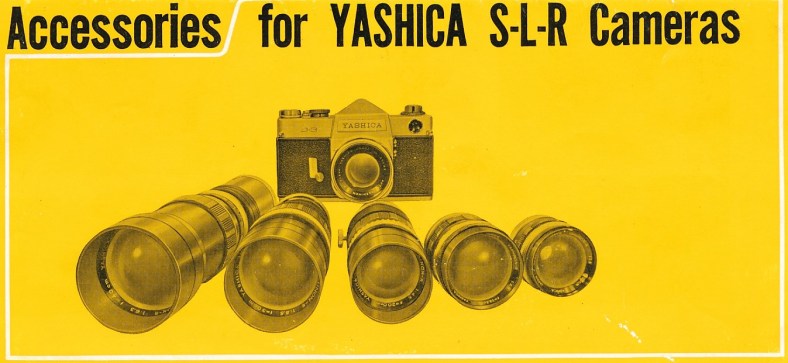
Yashinon Lenses – 1962*

That date* might be a bit misleading as the sales brochure this was scanned from is undated (as is most Yashica marketing stuff). Our only clue as to the date is that it (the brochure) features the newly released J-3 and doesn’t include any other Yashica SLR. No Penta J or Reflex 35 (same camera different markets) and no J-5.

We like it because it features the Yashinon lenses available at that time. If you look closely at the mounts of the lenses, you’ll see the M42 screw-in mount. Yashica does state in the brochure that all of these lenses are available in both the Yashica Pentamatic bayonet mount and the M42 mount. My friend Paul, see An Interview with Paul Sokk – Site Author of the popular YashicaTLR.com , has proposed that Yashica may have distributed these lenses to dealers (market dependent) with both mounts – meaning that they were shipped with the “new to Yashica” M42 mounts but could be converted easily at the dealer level to bayonet mounts for the Pentamatic. Sounds very possible. At this time, Yashica also sold adapter rings for mounting their M42 lenses to Exakta mount bodies and for mounting Praktica mount (M42) lenses to their Pentamatics. Confusing? Yes. Yashica guessed incorrectly when they choose to design their own bayonet mount for the Pentamatic back in 1959. Was it Yashica or was it Tomioka’s designers? How about the ex Nicca and Zunow designers? We may never know but it doomed the Pentamatic right out of the gate.

IMG_20170726_0004

Excellent snapshot of the lenses that were available at the time. The dual mounts (bayonet and M42) reflects Yashica’s indecision as to which mount to embrace.

IMG_20170726_0007

Cover of the sales brochure that was included with our Yashica J-3 when new.

It is generally believed that all of these lenses were made by Tomioka Optical of Tokyo.

While some early Pentamatic bayonet mount lenses bear the Tomioka and sometimes Tominon names, most only carry Yashica and Yashinon. The same applies to the M42 mount lenses. Some can be found with Tominon but most simply have Yashinon. We don’t have positive proof that some lenses (both types) may have been made by another lens manufacturer. But whom? Taiho Optical (which was the former Nicca Camera hidden away in Suwa) but was really Yashica, or or or. We just don’t know. Pure speculation to think that another company did, but then again, no proof that there wasn’t another maker.

Thanks so much for your visit! If you made it this far you just may be a “Yashicaphile” or just Yashica junkies like us. Do you have something to contribute??? We’d love to hear from you and would love to include your info in our blog. Thanks! ^.^

Chris & Carol

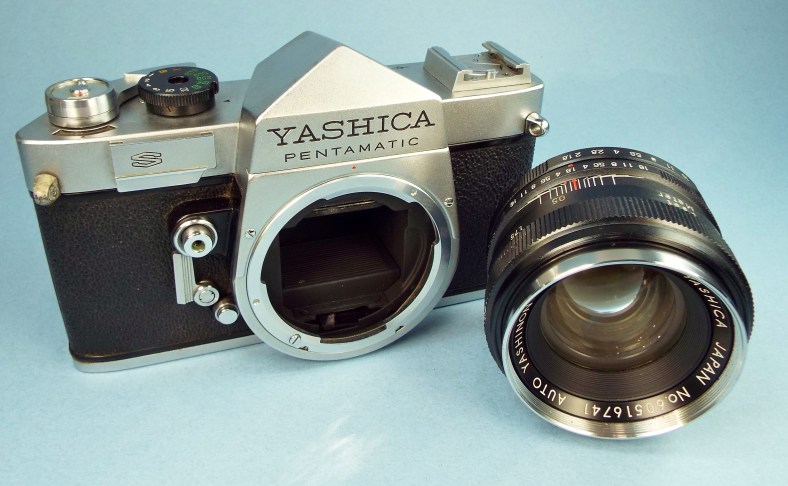
Pentamatic S – 1961 to 1962

The Pentamatic S… the last true Pentamatic in the short lived series of SLRs from Yashica. The Pentamatic II is the hardest to find from a collector’s standpoint as they were only available for sale in Japan with the S close behind.
dscf2832

The Pentamatic S. The last camera in the short lived Pentamatic series.
dscf2837

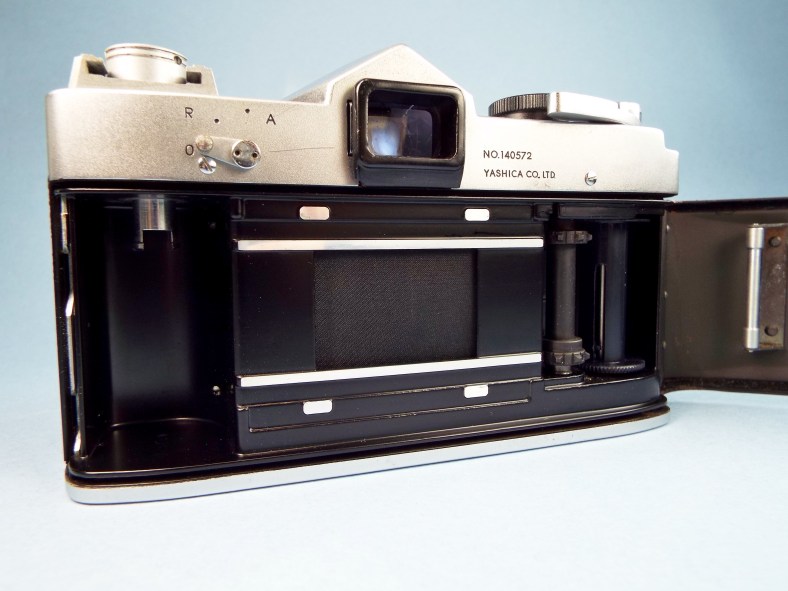
Pentamatic cameras tend to have very well designed film paths and film chambers. We rarely find corrosion and the chambers are large and easy to keep clean. The Nicca inspired cloth focal-plane shutter in this example is super clean and shows no white mold spots.

The Pentamatic S pictured above, the serial number is NO. 140572. Our other S is NO. 140294. These numbers decode to… 1=1961, 4=April, and the last four digits equal the sequential production numbers. The S models were not produced in great numbers so it is possible that both of these cameras were made during the same month as they are within 300 units of one another. Another serial number in our database is… NO. 141796 which suggests that it was the 1,796 th unit made in April of 1961. Interestingly the serial number of the model S in Yashica’s instruction booklet is NO. 140893. It is odd that the camera in the booklet has a higher production number than two cameras we own.

dscf2838

The only difference between the S and the original Pentamatic ’35’ is the notch in the shutter speed dial on the S. It is used to couple the clip-on exposure meter to the dial.

dscf2839

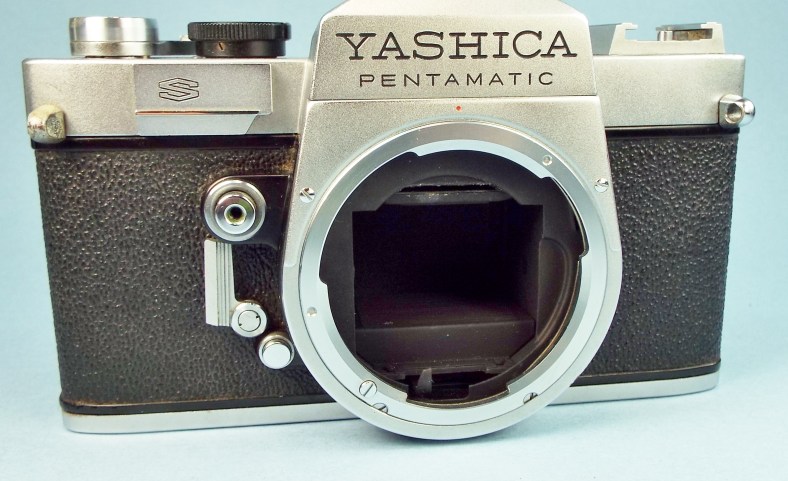
The biggest changes in the S from the original… the shutter release button is no longer at a 45 degree angle but its position on the body is the same. The S adds a self-timer and the light meter (exposure meter) lug on the face just below the shutter speed dial.
dscf2840

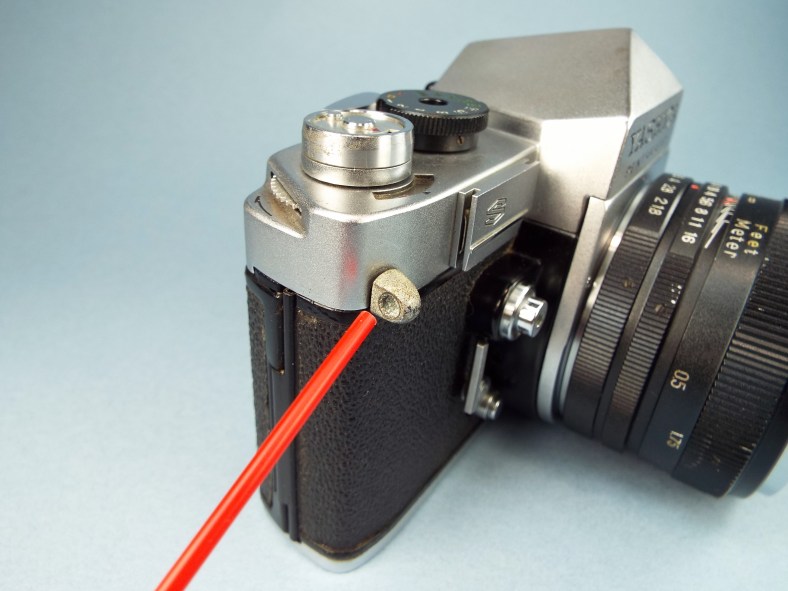
The lug for the neck strap has been relocated to the front from its previous position (on the side). It’s interesting to note that this lug is super corroded while the lug on the other side is not.
dscf2835

As we mentioned in the previous post on our blog, the Pentamatic series of cameras are prone to mirror lock-up. This S is currently in the locked-up position and has resisted my attempts at freeing it. It had been working at the higher shutter speeds (1/125 and higher) but now it sticks at all speeds. Ugh!

In summary… the Pentamatic S is a very worthy camera and is built like a tank. The S went back to using the Auto Yashinon f/1.8 5.5cm lens which was the standard lens on the original Pentamatic ’35’. The Tomioka Optical built lens is sharp and smooth. The S allows for the attachment of a separate exposure meter on the front lug (where the “S” is) and can couple with the shutter speed dial. Still a long way from TTL metering but at least headed that way.

Thanks for your visit!

Chris and Carol

Please visit our online store at https://www.ccstudio2380.com for a nice selection of classic film cameras and vintage photo accessories.