Nicca Camera Box – 1953

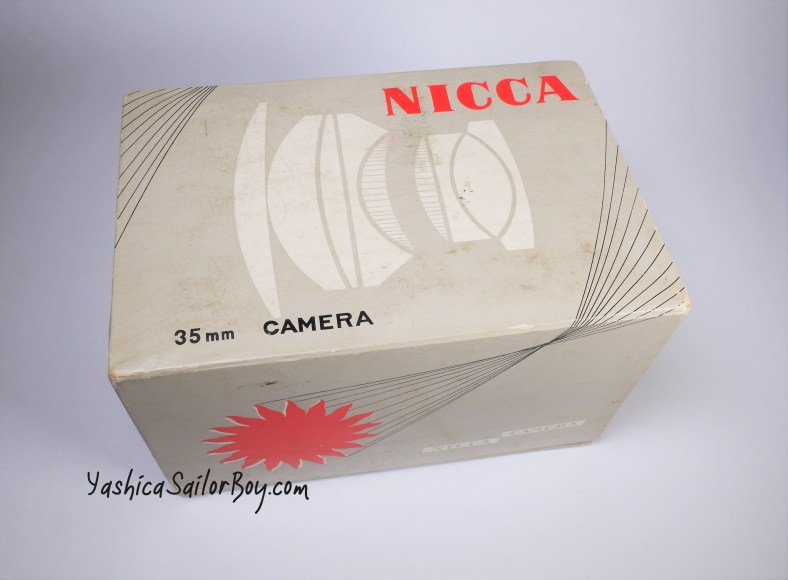
Most of our camera collection revolves around, no surprise, cameras and lenses. However, collecting camera boxes can be just as fun (and infinitely more difficult). Here’s a rather rare box from Nicca for the Type 3-S and Type 4 35mm rangefinder cameras.

Nicca Type 3-S Box

From 1953 – the top design on the box is the Nikkor 50mm f/1.4 lens elements and groups.

Nicca Type 3-S Box 2

The inside of the box is lined with fabric.

Nicca Box with Camera

The camera (Type 3-S) safely tucked inside.

Thanks for stopping by! – Chris

Please respect that all content, including photos and text, are the property of this blog and its owner, Yashica Pentamatic Fanatic, Yashica Sailor Boy, Yashica Chris.

Copyright © 2015-2019 Yashica Pentamatic Fanatic, Chris Whelan
All rights reserved.

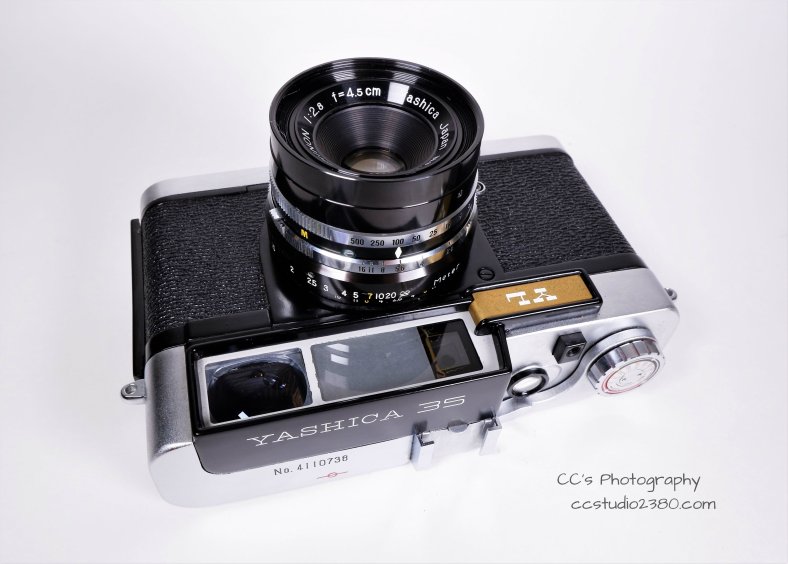
Yashica 35 – Yashima’s first 35mm camera!

Yashima Optical Industries Company, Limited (Yashima) released their first 35mm rangefinder camera in April 1958. The camera was in development for at least a year (no proof of that but it seems reasonable to assume that an established TLR camera maker didn’t just pull this camera out of thin air). It could have been developed totally in-house as there is only speculation that Yashima received outside assistance in its development.

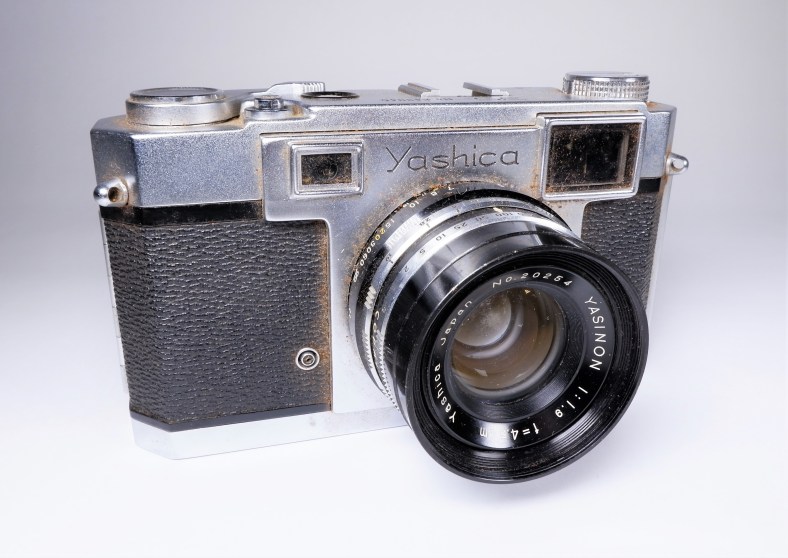
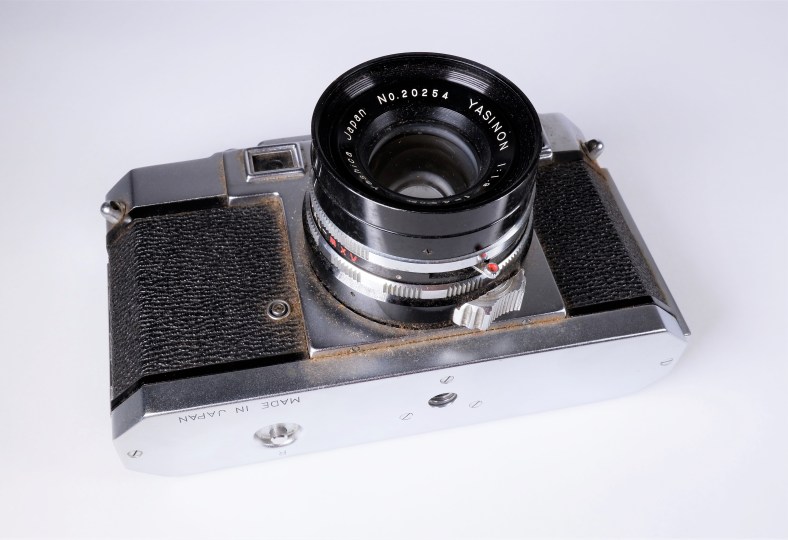
Here’s my earliest example of this historic camera. Note that the lens is marked “Yasinon” vice “Yashinon”. Yashima released at least two months of cameras (April and May 1958) with those markings before changing to what we now know as Yashinon.
DSCF6642

My recently acquired Yashica 35 with 60 or more years of dirt! Straight from an online seller in Japan. Note the unfamiliar “Yasinon” lens. These super early examples are rather hard to find since there were only two months of production.
DSCF6646

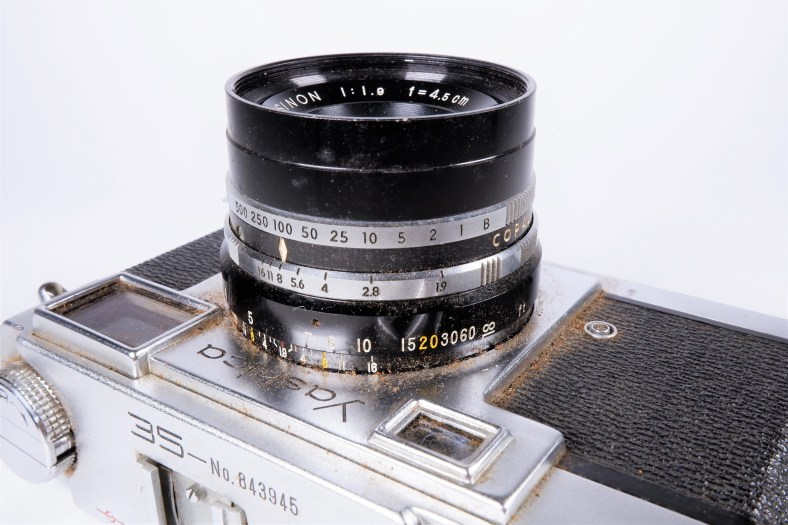
The good news is that it appears the camera lived most of its life in its leather case so there’s no damage to the surfaces of the body and lens. The bad news about living in a leather case is that it tends to support the growth of mold and fungus on the glass elements of the lens and in the rangefinder.
DSCF6651

The dirt is mostly made up of dust and fibers from the felt lining of the leather case and not soot and finger grime – which is a good thing. Sometimes this type of dirt actually keeps the surfaces protected from metal corrosion as long as it’s been stored in a dry environment.
Yashica 35 Japan

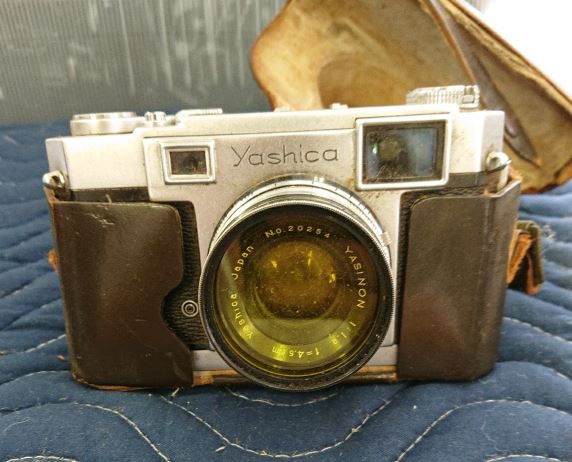
What it looked like on the Japanese auction site.

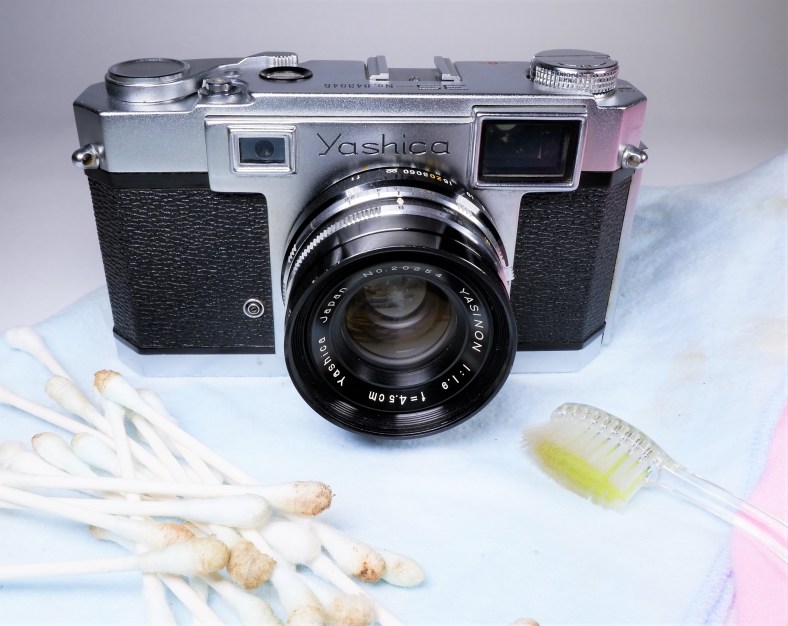
After some initial cleaning of the exterior (see below) with a bunch of Q-tips and some Windex, the camera is looking a whole lot better.
DSCF6654

I use Q-tips and a bit of Windex to gently clean the surfaces of the camera. The Windex leaves no residue and doesn’t harm the leatherette, metal or glass (I’ve safely used that for years). I use the super soft toothbrush to gently clean those hard to reach crevices and to polish the surfaces to a nice sheen.
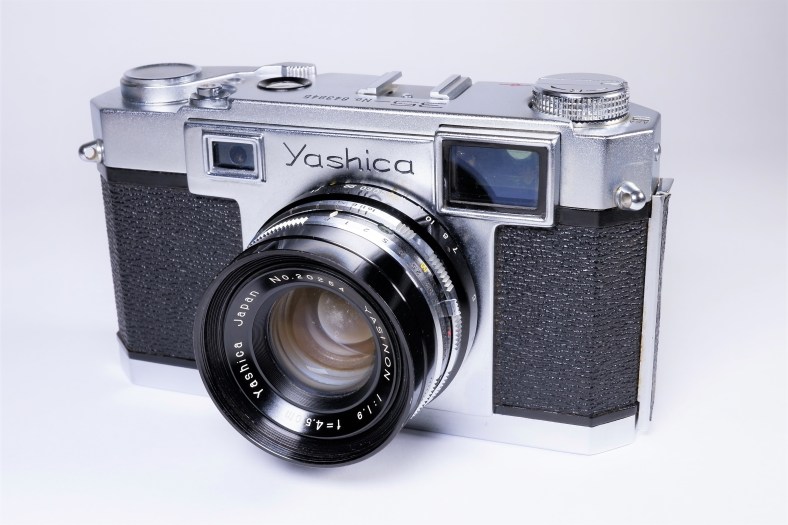
DSCF6659

Looking sharp but not perfect. If I want a totally clean and usable camera I’ll have to remove the top plate and clean the rangefinder and viewfinder elements. The rangefinder is accurate and focus is easy to obtain but it’s just a little dim inside. If you look closely at the center of the lens you will see the patch of fungus. Unfortunately, that is not cleanable.
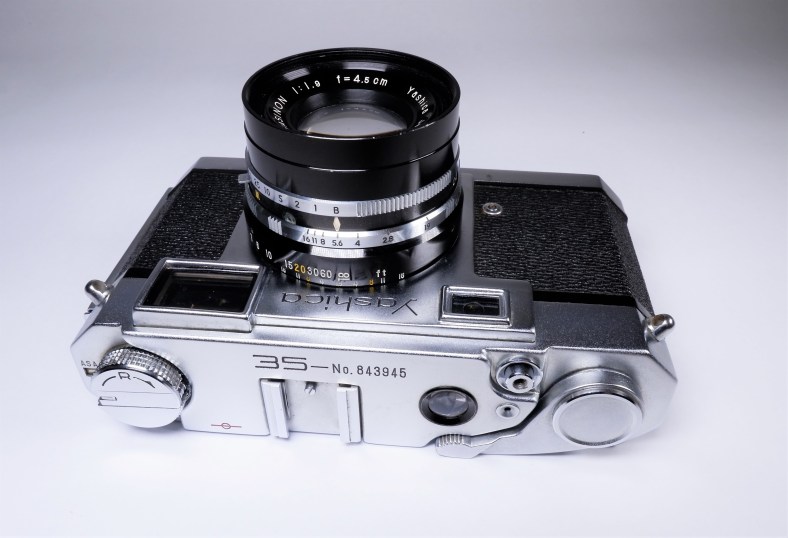
DSCF6655

The serial number, No. 843945, decodes to 8 = 1958, 4 = April, 3945 is the production sequence number 3,945 since production began in April.

This is one of the earliest examples of this fine camera having been built sometime in April 1958. Yashima used quality materials and production techniques as the fit and feel of the camera are of a much more expensive camera.
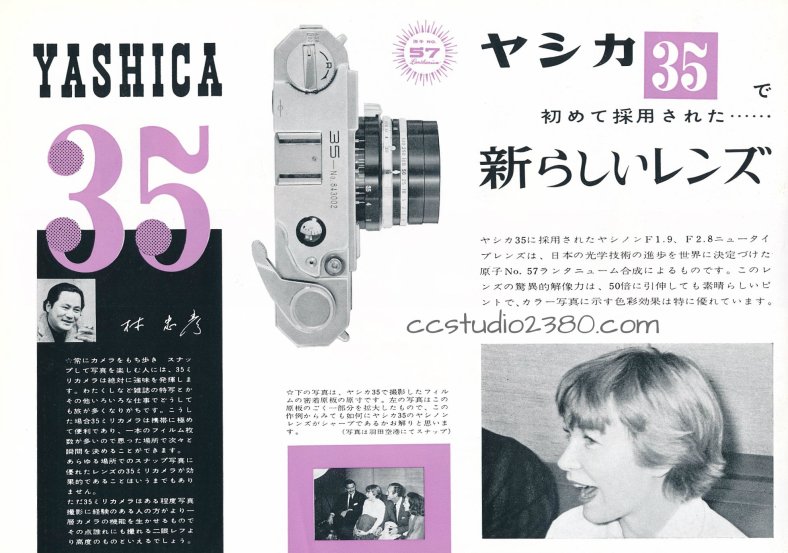
IMG_20180615_0005 logo

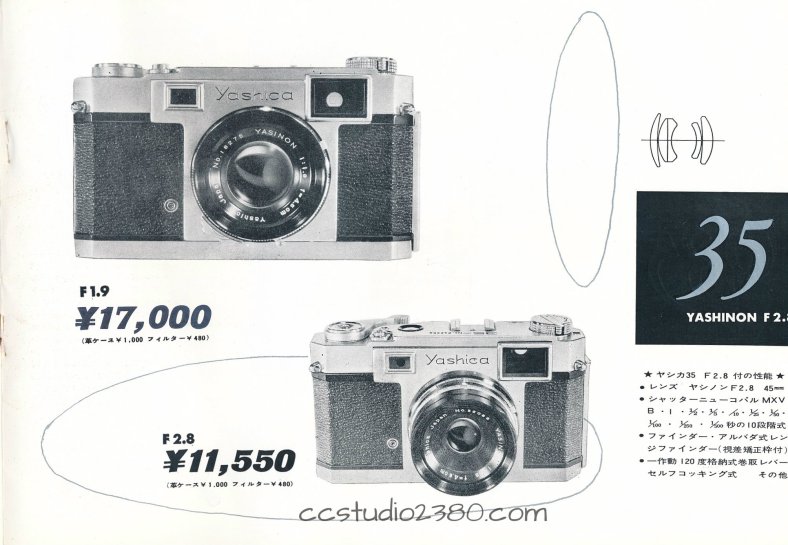
Earliest sales brochure for the Yashica 35. The serial number of the camera pictured is just a bit earlier than my new camera. Here it’s No. 843002 and mine is No. 843945.
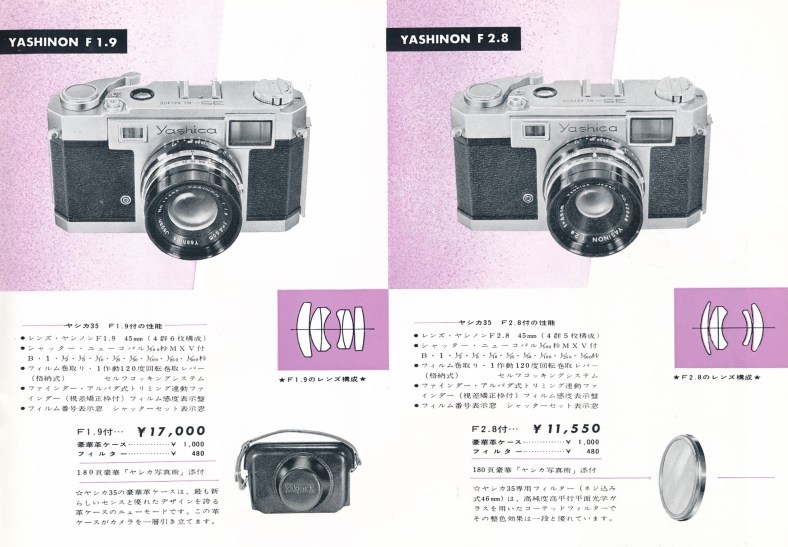
IMG_20180615_0006

Same brochure as pictured above. The f1.9 lens model is on the left. The serial number on the lens is No. 18275. Mine is No. 20254.

If you look closely, the lens is described as a Yashinon F1.9 even though the lens says Yasinon. Yashima was in the process of changing over or was it them catching a mistake?
IMG_20180625_0001 logo

BTW, 17,000 JPY was about $47 USD in April 1958

By the way, it’s generally believed that these two lenses were made for Yashima by Tomioka Optical. Yashima did have a relationship with Zunow Optical by there’s no proof that these lenses are from Zunow.

Thanks for stopping by! – Chris

Please respect that all content, including photos and text, are the property of this blog and its owner, Yashica Pentamatic Fanatic, Yashica Sailor Boy, Yashica Chris.

Copyright © 2015-2019 Yashica Pentamatic Fanatic, Chris Whelan
All rights reserved.
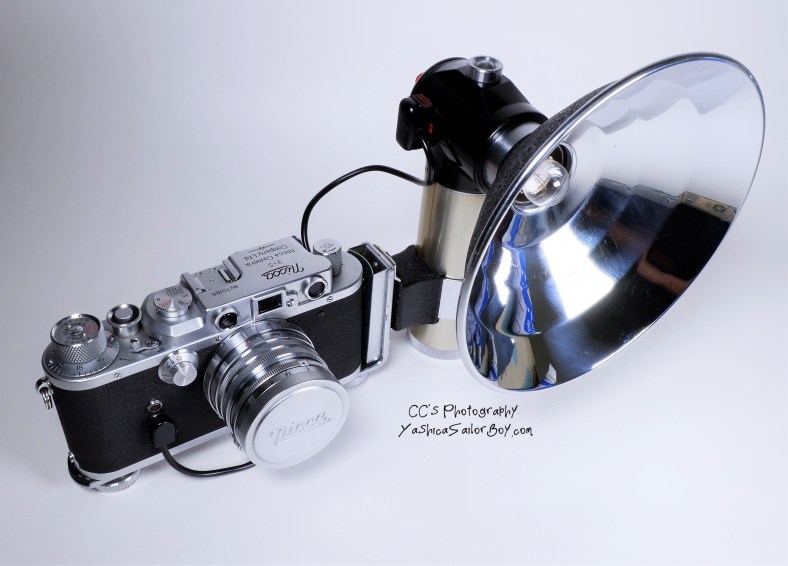
Nicca Flash Unit from around 1953

As you may have guessed by now if you casually follow this blog that I also have a passion for collecting bits of camera gear made by and for the Nicca Camera Company. Nicca was acquired by Yashica in 1958 and that acquisition led directly to Yashica developing (with lots of help from Nicca designers) its first 35mm single-lens reflex camera the Pentamatic 35 by early 1960. Yashica was a bit slow to the marketplace with an SLR as Canon, Asahi Pentax and Canon (among others) had already introduced SLRs by then.

Because of this relationship, Nicca has always held a prominent spot in my collection and the Nicca 3-S remains one of my favorite 35mm rangefinders to shoot with. Recently I’ve added this wonderful flash set to my collection.

From the instruction booklet, it describes this as “an automatic rechargeable flash gun specifically designed for Nicca cameras”.

DSCF6402

Considering its age (1953) it’s in outstanding condition. Hey, it’s as old as me!

DSCF6378

All set to go. The Nicca B.C.B. flash unit attached to my Nicca 3-S.

DSCF6377

Viewed from above the pilot lamp is visible on the top center of the flash head. It lights up when the flash is ready to fire.

DSCF6380

The red-tipped bulb ejector button. You don’t want to handle a hot bulb.

DSCF6383

As part of the set, I received the original instruction booklet and a pamphlet for the flashbulbs which were made by West Electric Company of Tokyo and Osaka – later to become or at least partner with National-Matsushita.

DSCF6413

A closer look at the “Exposure Guide Numbers” card pictured in the previous image above.

DSCF6405

The reflector is about 5.5 inches across. The bulb looks tiny compared to the reflector but believe me, it puts out some light!

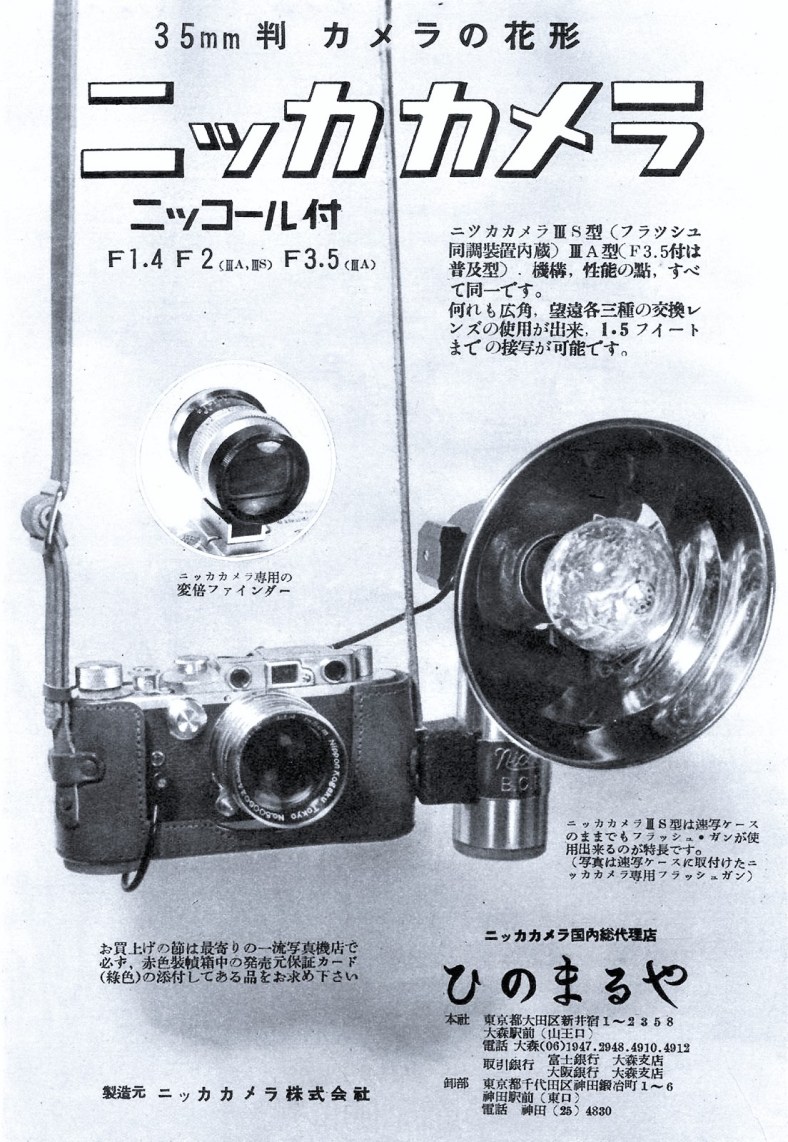
Nicca AD Cool

Advertisement from late 1951 0r 1952.  The flash looks like it used a slightly different connector cord than the one in my set. Hinomaruya ( ひのまるや ) was the Domestic General Agent for Nicca in Japan.

DSCF6418

Details from the instruction booklet. Shown in this image is a capacitor and 22.5-volt battery to power the flash but it could also be powered by two “D” cell batteries or three “AA” penlight batteries with an adapter.

DSCF6458

Size comparison between the flash handle and two D-cell batteries. As can be seen, the optional add on handle extension would need to be used. 

DSCF6420

Front view without the reflector. My guess is that the “BC” means battery-capacitor and the “B” is for battery (I don’t know for sure about the last “B” at this point).

DSCF6422

Camera side view with the shutter cord connector and “L” bracket connector visible. The red-tipped bulb ejector button is also visible.

DSCF6426

Parts detail minus the reflector and the capacitor/battery.

Nicca only made 35mm rangefinder cameras (maybe a lens or two but unproven) during its existence so the flash unit was made by another company. It’s likely that the West Electric Company, Limited, of Osaka and Tokyo was the manufacturer although no part of the flash is marked with the name “West”. Only the included pamphlet mentioned West. As stated earlier in this post, it’s likely that West merged or partnered with National-Matsushita Electric to build additional models of flash units during the second half of the 1950s.

Thanks for stopping by! If you know what “B.C.B.” means please share it with me. – Chris

Please respect that all content, including photos and text, are the property of this blog and its owner, Yashica Pentamatic Fanatic, Yashica Sailor Boy, Yashica Chris.

Copyright © 2015-2019 Yashica Pentamatic Fanatic, Chris Whelan
All rights reserved.
 

Leotax Merite Camera Case – 1959

Here’s a beautiful leather camera case for the Leotax Merite and Elite. The quality of its construction is evident even after 60 years of use (gentle use). The Merite was a 35mm rangefinder camera built by the Leotax Camera Company in the Leica style.

DSCF6225

A beautiful leather camera case from around early 1959.

DSCF6226

Excellent materials and attention to detail.

DSCF6227

Quality stitching throughout.

DSCF6230

The bottom half of the case was attached by a patented hinge assembly that quickly detached from the top half.

Brochure 2 (1) 2

Advertising flyer for the Leotax Merite. The camera and lens sold for 42,500 JPY which was about $118 in 1959. The case went for an additional 1,800 JPY which was $5

Thanks for stopping by! – Chris

Please respect that all content, including photos and text, are the property of this blog and its owner, Yashica Pentamatic Fanatic, Yashica Sailor Boy, Yashica Chris.

Copyright © 2015-2019 Yashica Pentamatic Fanatic, Chris Whelan
All rights reserved.

Leotax Merite TV2 – 1958

While doing some research on late 1950s Japanese 35mm rangefinder cameras, I came across the Leotax brand. Their cameras are highly regarded by collectors and photographers alike. They have a reputation of being one of the better built Leica inspired models, especially during the early 1950s. I personally believe that Nicca built the best versions as I own several different models and I occasionally shoot with a Nicca 3-S.

My good friend Paul Sokk pointed out that a Leotax camera box in my collection has the name of the model spelled differently than the accepted norm – ‘Merite vs. Merit’. Intrigued we both started looking for proof as to the camera’s “real” name. The camera was also known as the model TV2.

merite 2

My recently acquired Leotax Merite camera box (from Japan). Mérite in French.

“Excellent mechanism with the best technology”… Leotax Merite

Brochure 2

Paul spotted this sales flyer from Leotax. The name ‘Merite’ is clearly spelled out. Notice that the camera itself does not have a name on it.

Brochure 2 (1)

boxed (10)

Here’s a Merite camera (not verified) with a box that’s marked ‘TV2’ which was another name that the Merite was known by.

It’s interesting to note that the next camera in the Leotax line was called ‘Elite’. Another French word that would fit nicely with Merite. Is any of this definitive? No, but the fact that the flyer and the box match I would imagine that was and is the intended name.

For more about the Leotax Camera Company please visit here. The Merite is referred to by its improper name at the moment.

Thanks for stopping by! – Chris

Please respect that all content, including photos and text, are the property of this blog and its owner, Yashica Pentamatic Fanatic, Yashica Sailor Boy, Yashica Chris.

Copyright © 2015-2019 Yashica Pentamatic Fanatic, Chris Whelan
All rights reserved.


Nicca 3-F Camera Case – first of its kind?

I know, this is not an overly exciting post – rather obscure actually.

nicca 3-f leather case

Nicca 3-F ‘Snap Shot Case’.

The Nicca 3-F was one of many well-built 35mm rangefinder cameras produced by Nicca Camera Company in the late 1950s. Nicca would be acquired by Yashica in early 1958 and some of the technology that Nicca possessed went to Yashica in the deal. The acquisition directly led to the development of Yashica’s first 35mm SLR, the Pentamatic in late 1959. I digress.

My good friend Paul Sokk (www.yashicatlr.com) recently shared this scan of an instruction booklet he acquired for his Nicca. What struck me as I translated (actually an app on my phone translated it) is how this camera case was constructed.

Here’s the translation: “The snap shot case uses a brown box skin and comes with a shoulder strap as an accessory. It is glued, and the case of the stringer does not use any adhesive. Moreover, it has sufficient strength against external force (especially the projection of the lens part). Recently, there are those who use the camera out of the case and naked, but since it is likely that the camera is often hurt, it is recommended to put it in the case and use it as much as possible”.

I hadn’t noticed Nicca cases before this one that did not use stitching. Why is that important? On most vintage (40-year-old or more) cases the stitching has long since failed and the case falls apart. It will be interesting to see if these glued cases stood the test of time and in better condition than their stitched cousins.

case detail

A close-up view of a glued case.

20170606_115821

Typical stitched case.

Thanks for stopping by! – Chris

Please respect that all content, including photos and text, are the property of this blog and its owner, Yashica Pentamatic Fanatic, Yashica Sailor Boy, Yashica Chris.

Copyright © 2015-2019 Yashica Pentamatic Fanatic, Chris Whelan
All rights reserved.

Sometimes silly is just silly – collecting Yashica stuff 101.1

Carol and I have been Yashica fanatics since the early 1970s and over the years we’ve collected some pretty silly stuff related to Yashica.

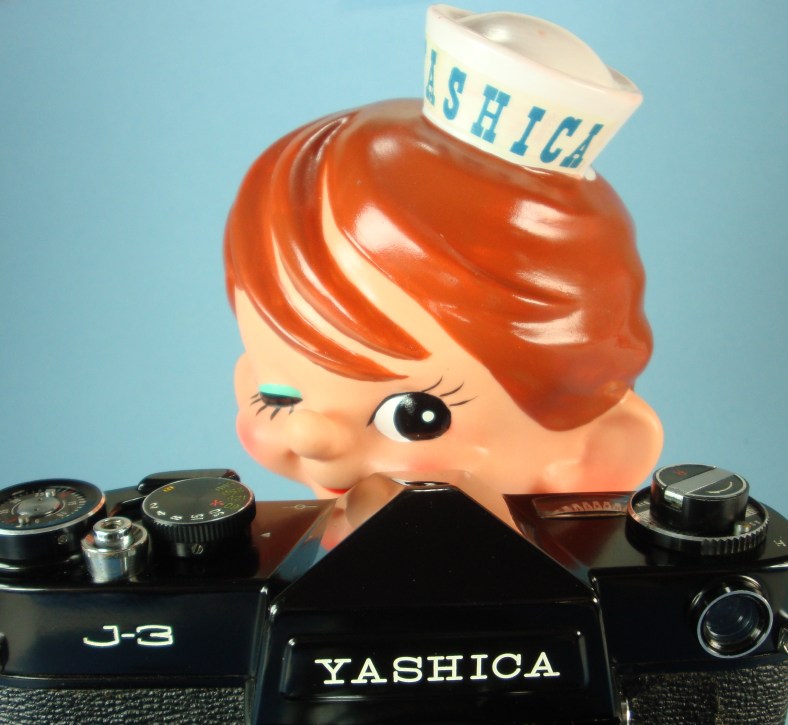
In 1962 the Yashica marketing guys and gals came up with a cute little fellow to act as a marketing mascot of sorts to promote Yashica’s extensive new line of SLRs and the next generation of 35mm rangefinder cameras. Yashica’s ‘Sailor Boy’ (never officially named) was born courtesy of a design executed by Modern Plastics of Japan.

The ‘Sailor Boy’ appeared in Yashica’s sales brochures and occasionally in a few instruction booklets. Here he’s pictured in an early flyer for the Minimatic-S (1963).

26088376221_59093d3733_o

This is the larger dealer display ‘Sailor Boy’ – about 20cm tall.

15133132085_31459ec63f_o

Here’s the dealer display ‘Sailor Boy’ helping to promote the new (1962) J-3.

Anyway, here’s where the real silliness comes in. When you start to discover all of the different ways that Yashica employed their little mascot it’s a fun challenge to find him on some pretty unlikely things. Here he’s promoting the release of the Electro 35 – the world’s first electronic 35mm camera (1966).

DSCF9533

Of course he’d be on a couple of beach bags – he’s Yashica’s ‘Sailor Boy’.

DSCF9534

Whether riding a smiling dolphin or dancing in a grass skirt on a remote island, the ‘Sailor Boy’ was always there to remind you to take your non-waterproof Yashica Electro 35 along for the fun!

Thanks for stopping by! – Chris

BTW, there’s some neat new stuff (cameras and gear) over in our shop at http://www.ccstudio2380.com – there’s always a few classic cameras to pick from as well as a nice collection of lenses.

Please respect that all content, including photos and text, are the property of this blog and its owner, Yashica Pentamatic Fanatic, Yashica Sailor Boy, Yashica Chris.

Copyright © 2015-2019 Yashica Pentamatic Fanatic, Chris Whelan
All rights reserved.
Happy SUNday! – Rangefinders Rule

DSCF8692 logo

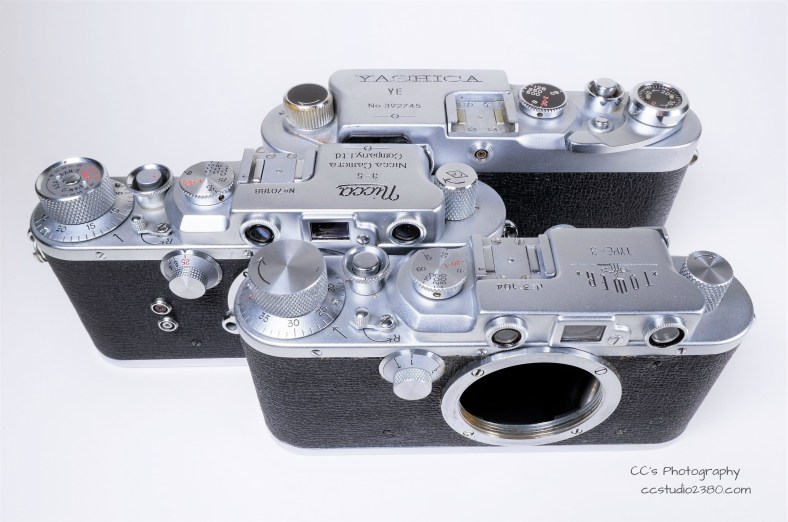
A trio of 1950s Japanese 35mm rangefinder cameras. Starting from the top, the Yashica YE was made shortly after Yashica acquired Nicca in 1958. In the middle, the Nicca 3-S was one of the last cameras made with the Nicca name and last, the Tower Type-3 which was made by Nicca for the Sears, Roebuck and Company around 1951. All of these were considered to be excellent “copies” of the Leica rangefinder.

Thanks for stopping by and have a great day! – Chris

By the way, I’m having a big after Christmas sale in my online camera shop at http://www.ccstudio2380.com – stop by and see if something strikes your fancy! ^.^

Please respect that all content, including photos and text, are the property of this blog and its owner, Yashica Pentamatic Fanatic, Yashica Sailor Boy, Yashica Chris.

Copyright © 2015-2018 Yashica Pentamatic Fanatic, Chris Whelan
All rights reserved.

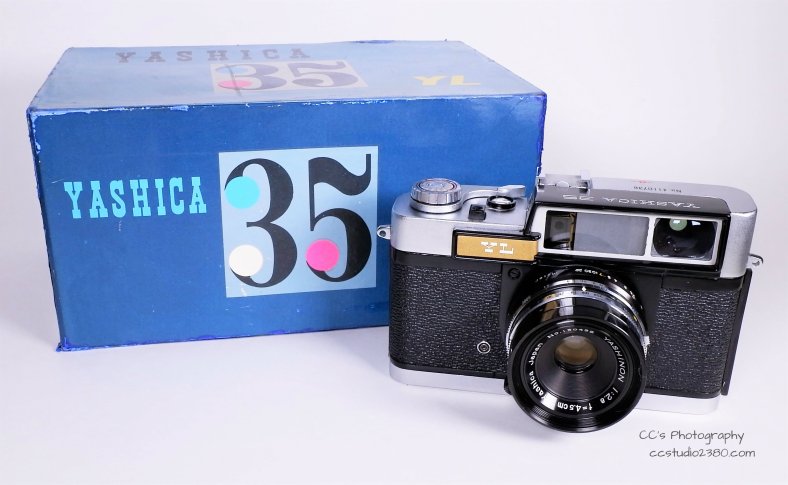
Yashica 35 YL – 1959 Rangefinder

A classic 35mm rangefinder film camera from Yashica. This one was built in November 1959. I like the feel of this camera – it’s a tad heavy at just over 700 grams with no film loaded and it feels “heavy” in your hands. It’s “chunky” design with the prominent black top plate is either a love it or hate it feature. I will say this, the view through the large viewfinder is outstanding. Bright and clear with an easy to focus double image focusing spot.

DSCF8401 logo

I kinda like the feel of the odd and different black plastic rectanglar shutter release button – it has a nice touch. The film advance lever is silky smooth and it’s easy to load a film cartridge – lots of space in there for chunky fingers.

DSCF8410 logo

If you’re looking to get into using a late 1950s Japanese made rangefinder I highly recommend the YL or its similar cousin the Yashica 35 YK.

Thanks for stopping by! – Chris

Please respect that all content, including photos and text, are the property of this blog and its owner, Yashica Pentamatic Fanatic, Yashica Sailor Boy, Yashica Chris.

Copyright © 2015-2018 Yashica Pentamatic Fanatic, Chris Whelan
All rights reserved.

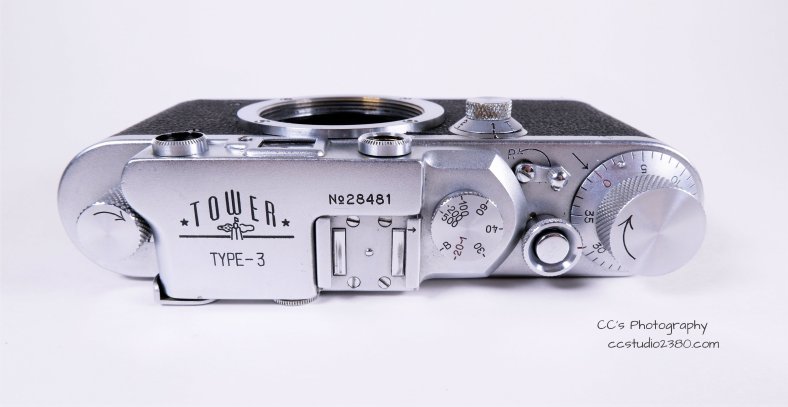
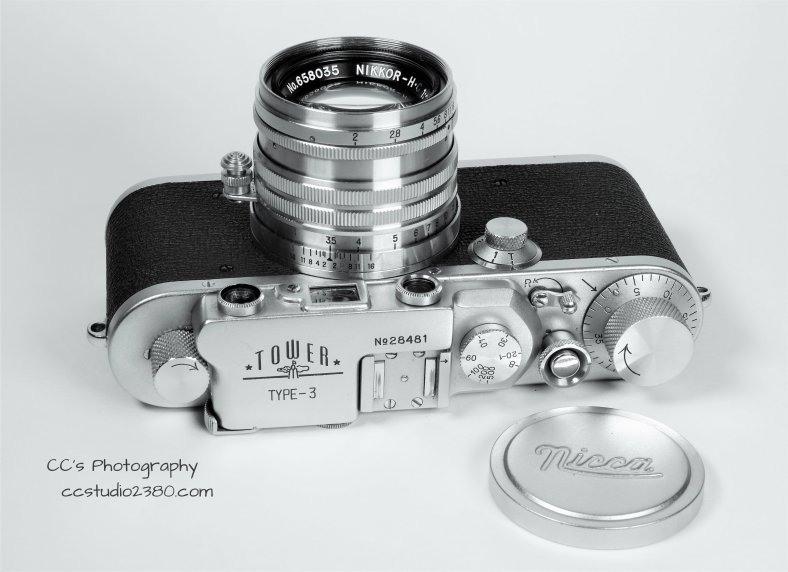
Tower Type-3 35mm Rangefinder – Made by Nicca for Sears

One of the better made Leica type of 35mm rangefinder cameras from the early 1950s. This one dates back to the period during the occupation of Japan following WWII. The occupation formally ended in April 1952.

I believe the Nicca-Towers are extremely attractive in their design and some (like this gem) have aged very well (1951 on this one).

DSCF8226 logo

The Tower brand was made by Nicca Camera Company for Sears, Roebuck and Company for sale in the United States through their stores and in their catalogs.

DSCF8230 logo

DSCF8231 logo

DSCF8244 logo

Nippon Kogaku Nikkor – H.C f2 5cm lens from my Nicca s-3

These cameras accept all L39 screw-in (Leica type) lenses made by a ton of manufacturers – Canon, Nikkor, Leitz and more than I care to think about. Oh yeah, Nicca even made one with their own name and Yashica made a few too. Happy hunting!

Chris

Please respect that all content, including photos and text, are the property of this blog and its owner, Yashica Pentamatic Fanatic, Yashica Sailor Boy, Yashica Chris.

Copyright © 2015-2018 Yashica Pentamatic Fanatic, Chris Whelan
All rights reserved.