Zeiss Ikon Ikoblitz – folding fan flash

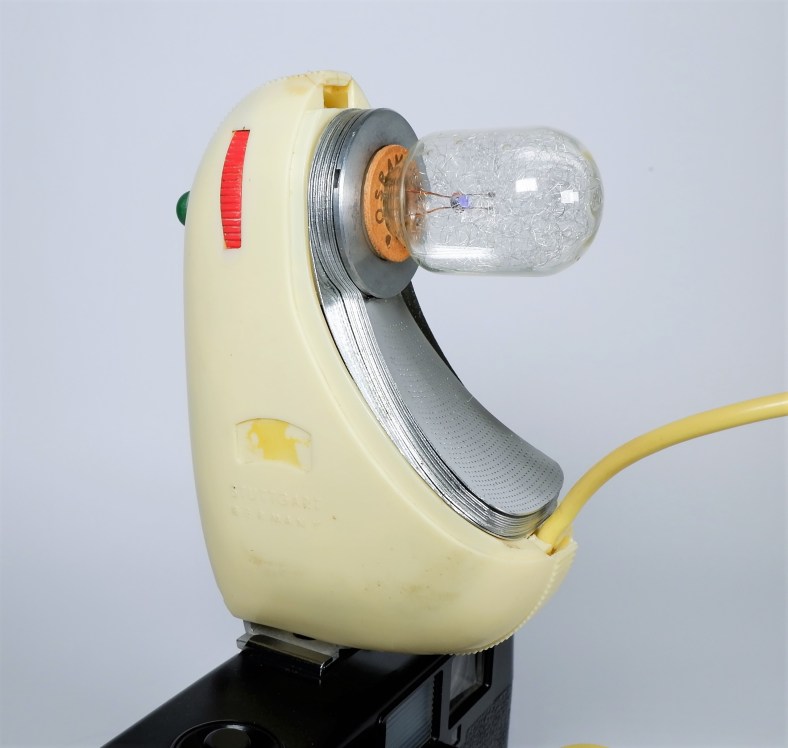
I’m not quite sure of the when of this flash (guessing mid-1950s) or the model number but I do know that it was made by Zeiss Ikon in Germany. It’s falling apart – the plastic is very brittle, the original 22 1/2 volt battery looks like a science experiment and it obviously doesn’t work. On the plus side, the vinyl case is still in good (not great) condition, the metal fan reflector looks good and works and the flash bulb and connecting wire look fantastic.

DSCF9666

DSCF9672

DSCF9673

DSCF9674

DSCF9676

Anyway, another example of mid-century design. I imagine when it was new it was pretty cool and would slip into a pocket or camera bag with ease.

Thanks for stopping by! – Chris

Please respect that all content, including photos and text, are the property of this blog and its owner, Yashica Pentamatic Fanatic, Yashica Sailor Boy, Yashica Chris.

Copyright © 2015-2019 Yashica Pentamatic Fanatic, Chris Whelan
All rights reserved.

Vintage Bewi Automat “A” Exposure Meter

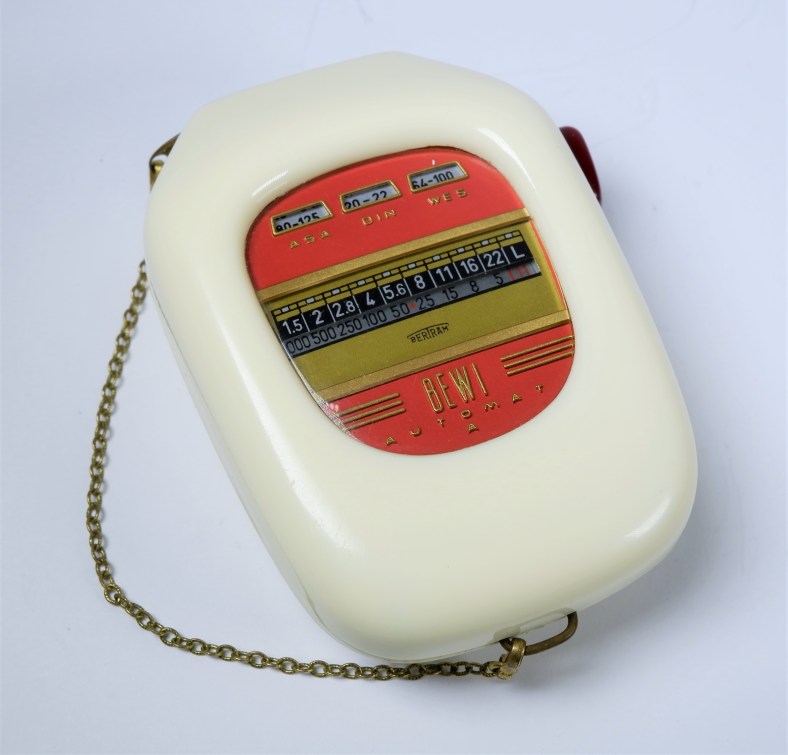
Straight from the desk of a mid-century designer, this super cool (and fully working) selenium cell exposure meter is a joy to use and play with.

DSCF9661

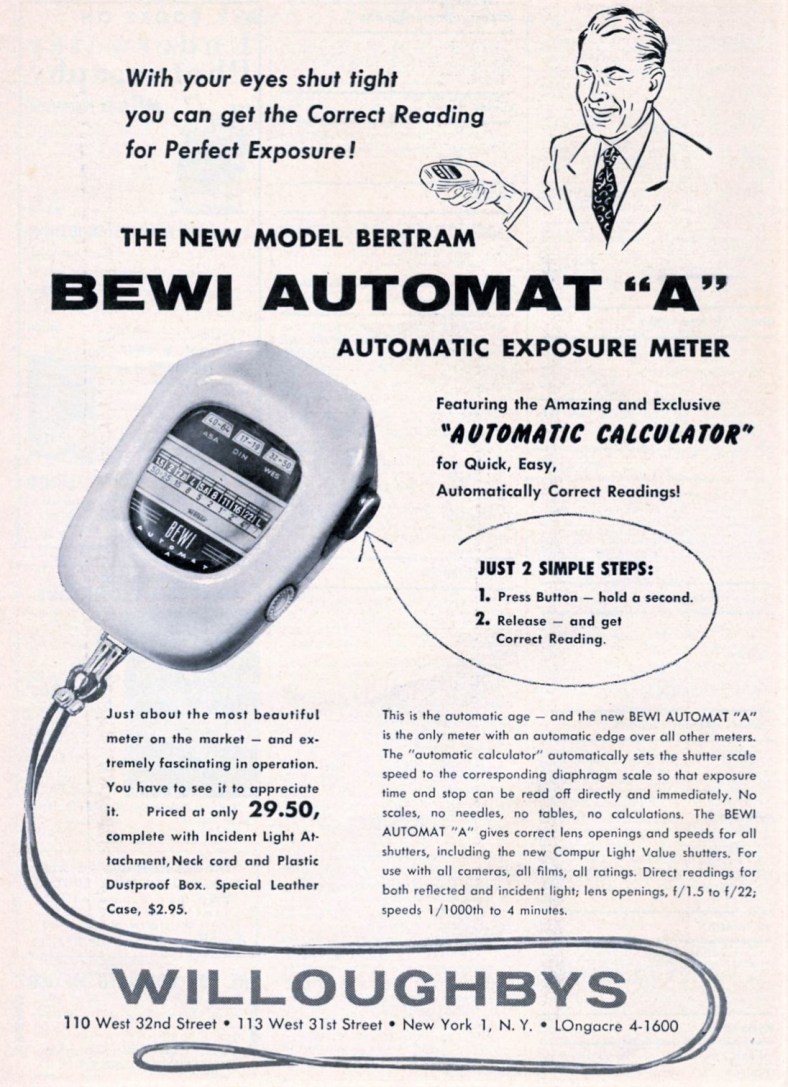
The first thing I noticed about it is that unlike typical meters from this period (the 1950s) there’s no visible meter needle or pointer. Everything that moves does so inside. I know, I took it apart to see what was going on and there was the needle being “busy” reacting to light. Maybe this ad will do a better job at describing just what makes this meter so special.

5035958868_5796574f21_o

DSCF9653

Semi-transparent cover over the selenium cells allows for incident light readings.

DSCF9654

Selenium cells exposed for full reflected light readings.

DSCF9656

In its case, it’s about the size of a deck of cards but it fits nicely in the palm of your hand. I have it available in my shop as it’s time to pass it along to the next collector. You can see additional pictures of it and a complete description at http://www.ccstudio2380.com

Thanks for stopping by! – Chris

Please respect that all content, including photos and text, are the property of this blog and its owner, Yashica Pentamatic Fanatic, Yashica Sailor Boy, Yashica Chris.

Copyright © 2015-2019 Yashica Pentamatic Fanatic, Chris Whelan
All rights reserved.

Sears Camera Catalog – 1952

Cute cover image for the Sears, Roebuck and Company Camera Catalog of 1952. The cover features the Nicca made Tower branded Type-3 (Type III) 35mm rangefinder camera of the early 1950s.

sears tower ad logo

A scan of the original cover of the catalog.

IMG_20181102_0007 logo

From the Tower Type-3 instruction booklet – 1951

More “goodies” to follow from this exceptional camera set we recently acquired. – Chris

Please respect that all content, including photos and text, are the property of this blog and its owner, Yashica Pentamatic Fanatic, Yashica Sailor Boy, Yashica Chris.

Copyright © 2015-2018 Yashica Pentamatic Fanatic, Chris Whelan
All rights reserved.

Heavyweights 1954-1955

DSCF8482 logo

On the left is the Fujicaflex Automat by the Fuji Photo Film Company – Fuji’s first and only twin-lens reflex (TLR) camera. On the right is the Yashica Flex S (aka Yashicaflex S) by Yashima Kogaku Seiki Company.

Yashima (later to be known as Yashica) went on to build TLRs until 1986 producing thousands encompassing over thirty models.

The Fujicaflex was under development by Fuji since around 1948 and the direction they took was to build a high-quality camera geared to the serious amateur and semi-professional photographer. By all accounts, it was a bust in the marketplace (way too expensive) as Fuji never attempted to follow it up with a second model and ending production in just about a year.

The Fujicaflex is noticeably larger than the Yashica Flex S – the Fuji weighs 1,323 grams and the Yashica comes in at 1,117 grams. Both cameras were weighed with a roll of 120 film loaded.

DSCF8485 logo

The Yashica Flex S was the first ever TLR with an attached exposure meter. I imagine you could say built-in as the meter’s cells were located behind the nameplate flap and were connected to the meter on the camera’s left side via wires. The non-coupled selenium cell meter was built by Sekonic and was marked “Sekonic CB-1”.

We’ll continue to feature the Fujicaflex in upcoming posts and hopefully soon we’ll be able to post some images taken with it. I’ve got a roll of Fujichrome Velvia 100 in it now.

Thanks for stopping by and be sure to check out some of our unique photo gear in our shop at http://www.ccstudio2380.com

Chris

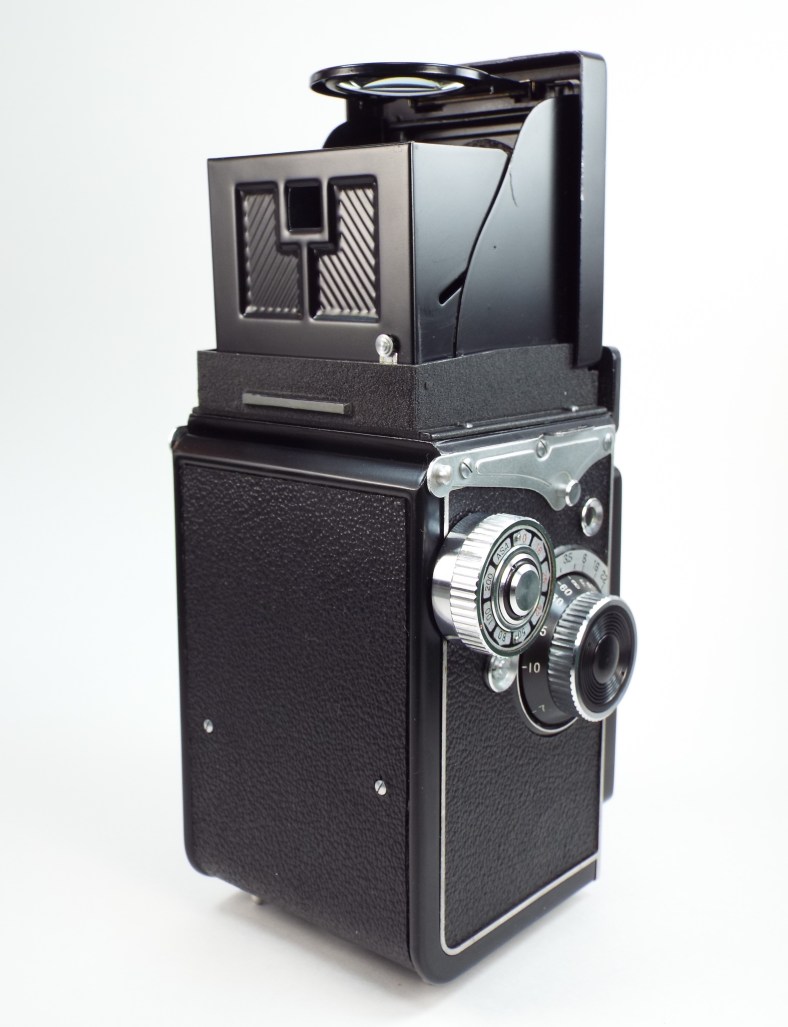
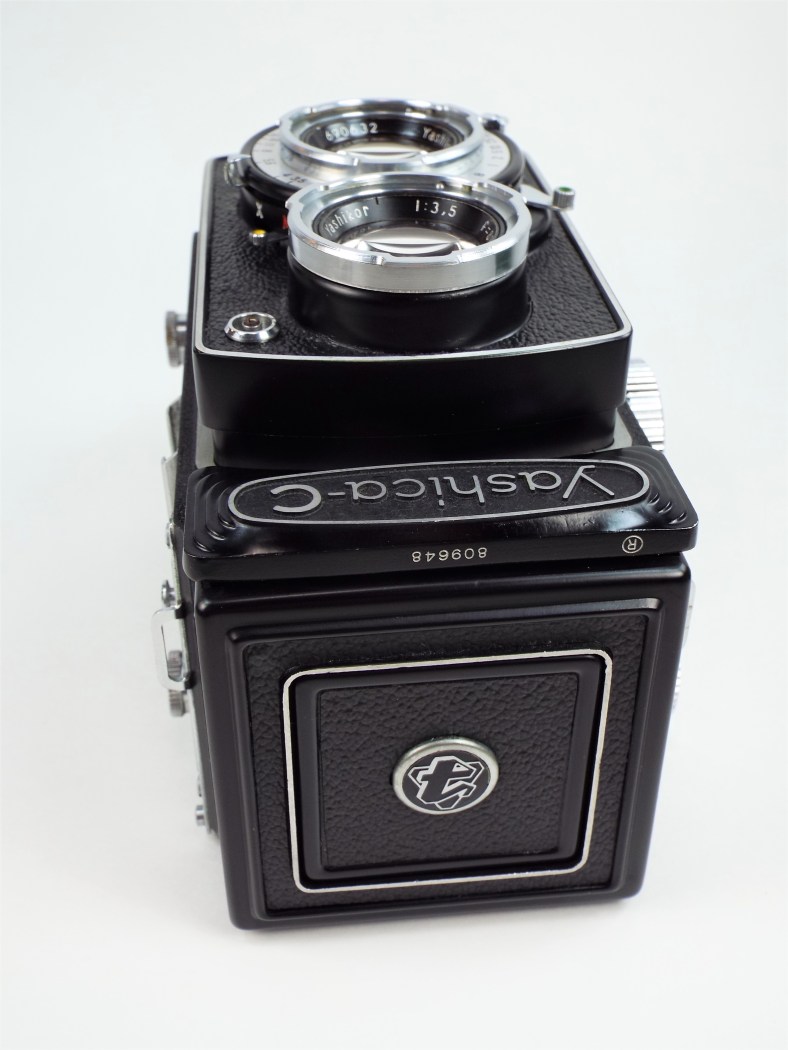
1957 Yashica-C

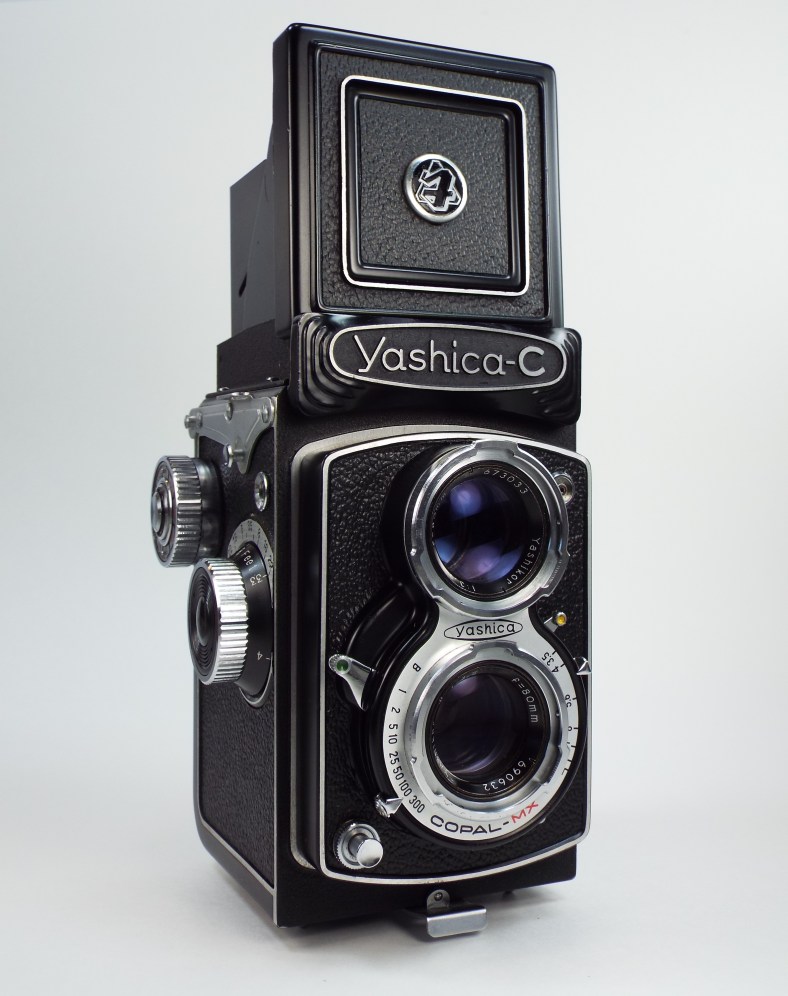
The Yashica-C made by Yashima, was part of the new wave of Yashicas that were released in late 1956 for sale in the world markets (focus scale is only in feet). It was listed at $46.50 plus $8.00 for the “De Luxe Leather Eveready Case”. The other models released at the same time were the Yashica-A ($29.95) and the Yashica LM ($59.95) which featured a built-in exposure meter!
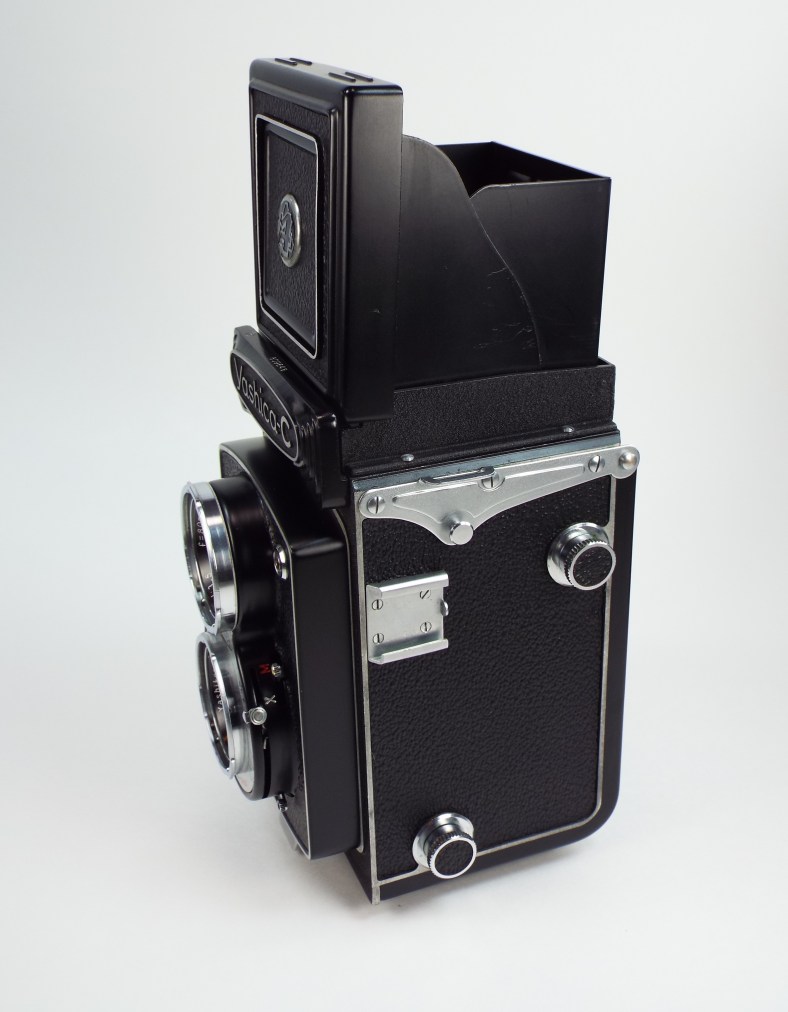
dscf3511

dscf3512

dscf3513

dscf3514

This handsome camera came to us recently with all features fully working – even after six decades of use, no issues. Our guess would be this camera saw maybe 1 or 2 rolls of film in its life. It is in factory new condition.

Features: Semi-automatic film wind, 80mm Yashikor f: 3.5 taking and viewing lenses (hard coated and color corrected), Copal shutter with speeds at 1, 1/2, 1/5, 1/10, 1/25, 1/50, 1/100, 1/300 second and Bulb, self-timer, flash sync (M-x) built-in, bayonet lens mount and flash gun shoe with standard PC flash terminal.

If you’re looking to try medium format photography, the Yashica-C is a great camera and a great value. It can often be had for significantly less money then a Yashica-D.

A word of caution about 6 decade old TLRs. Corrosion of the black metal parts is common as is fungus and mold in and on the lenses. If the camera you’re interested in shows some exterior rust (and other forms of corrosion), then ask the seller a bunch of questions. Cameras like these that come from humid environments are often left in their organic leather cases (and in the dark) – fertile grounds for growing mold and fungus. Fungus filaments can completely destroy a lens or at the very least, etch parts of the coating for good.
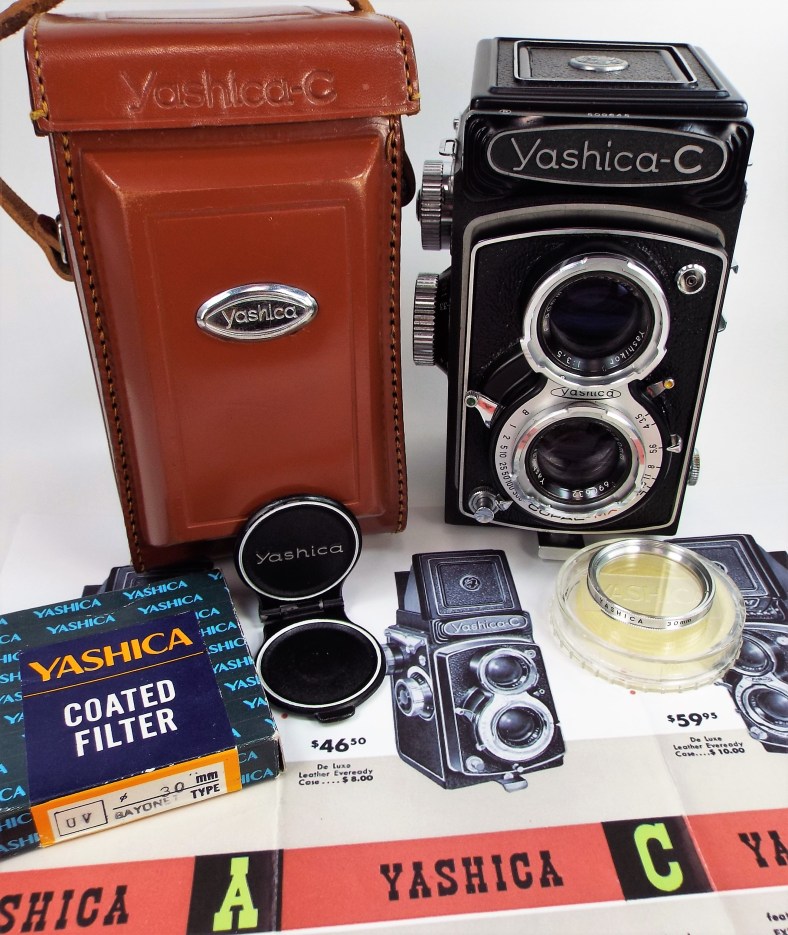
dscf3516

All the goodies!

On a more happy note – this beauty has no mold or fungus and was purchased from a seller in Michigan. Probably a one owner camera – it came with a roll of Kodak Tri-X film loaded inside (at least from the mid 1960s).

Studio Camera: Fujifilm FinePix S9900W

Thanks for your visit and comments are always welcome. C&C ^.^