Single Shot Focus on the Canon AV-1

Introduced in 1979 into an already crowded family of super slick Canon 35mm SLRs, the AV-1 has always been kicked around in the world of auto exposure cameras. Most question the need for such a camera that only features aperture priority AE. Whereas its much more famous siblings like the AE-1 and A-1 have gone down in history as two of the best 35mm AE cameras of all time (my opinion), almost no one has seen an AV-1 let alone use one. Probably the only other lesser known Canon is the AT-1.

Why aperture priority? Simple, you select the aperture (f-stop) on your Canon FD lens based on the lighting available and the depth-of-field that you want in your image. The camera selects the proper shutter speed based on the film’s speed (ASA, ISO, DIN) and the f-stop that you selected. If there’s not enough light to hand hold the camera it’s up to you to know your limitations. If you’re a steady shooter then you may be able to squeeze off a shot at let’s say 1/30th of a second with a wide-angle or normal lens. If you’re like most people you’ll more than likely be much more successful staying north of 1/60th of a second. The AV-1 will auto expose accurately down to (or up to) 2 seconds! You’d better be on a tripod for that shot or have your camera perched on a flat, stable surface.

The other reason for the AV-1’s existence is that it cost significantly less than the other A series cameras – much lower but with no real drop-off in build quality IMO.

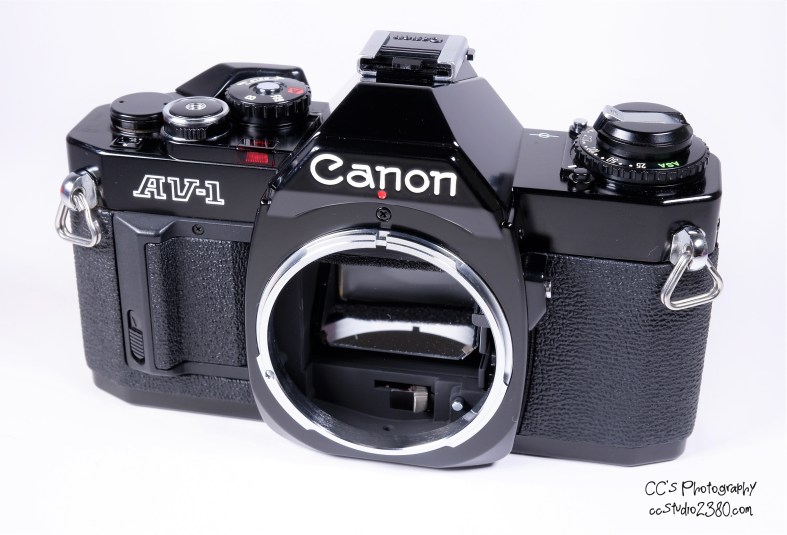
Here’s my AV-1 in the pro-black finish. It’s a beautiful camera and it accepts all of Canon’s FD lenses (which is a major plus) plus it was designed to operate with the Canon Power Winder A and the A2 and it provides full auto flash with the Canon family of Speedlites like the 133A, 155A, 177A and the 199A (all are dedicated electronic flash units for the AV-1). One final plus, it uses the still very easy to find and afford No. 544A silver oxide 6v battery.

So here’s the “Single Shot Focus” of my AV-1

DSCF9943

This one was made in June 1982 (date code is W628K)

Studio Camera: Fujifilm X-A10 set on aperture priority AE

Thanks for stopping by! – Chris

Please respect that all content, including photos and text, are the property of this blog and its owner, Yashica Pentamatic Fanatic, Yashica Sailor Boy, Yashica Chris.

Copyright © 2015-2019 Yashica Pentamatic Fanatic, Chris Whelan
All rights reserved.

A Surprising Find Under All That Dirt – A Hidden Gem Emerges

Recently a client of mine asked me to help him sell some of his vintage cameras from his collection. It’s not a collection in the true sense of the word, more of a gathering of cameras he had acquired over the years. Bob had become interested in photography as a kid in New York in the 1940s and ’50s but lacked the resources to buy cameras until he graduated from law school in the late 1960s.

His first purchase was a good one – a brand new Leica M4 in black lacquer (only 800 or so made in black that year) with a gorgeous Leitz-Leica Summicron 35mm f2 wide angle lens. Both were purchased together in 1969. I was able to arrange a sale of that set within two days of posting it.

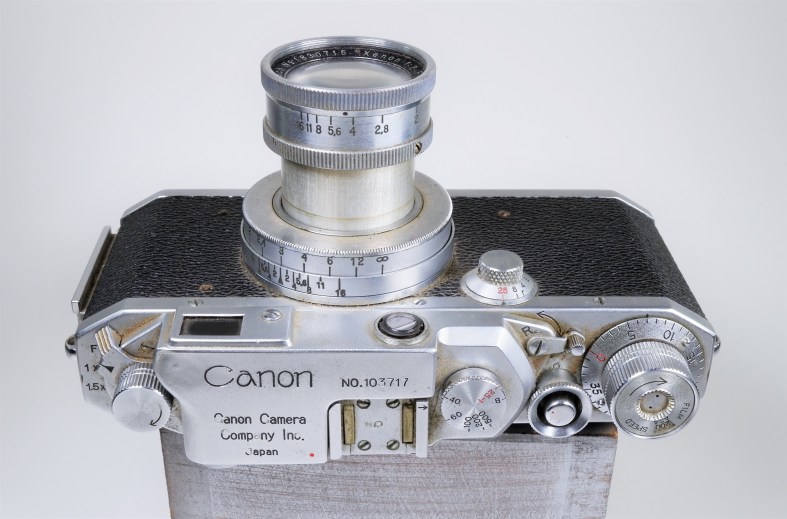
The next camera that Bob showed me I wasn’t impressed with at all – a Canon II 35mm rangefinder with a terrible looking lens that looked like Fred Flintstone may have owned it at one time.

The Canon before its “refreshing” ⇓
DSCF7506

The Canon II from around 1954 with its odd little lens. Dirty little thing.

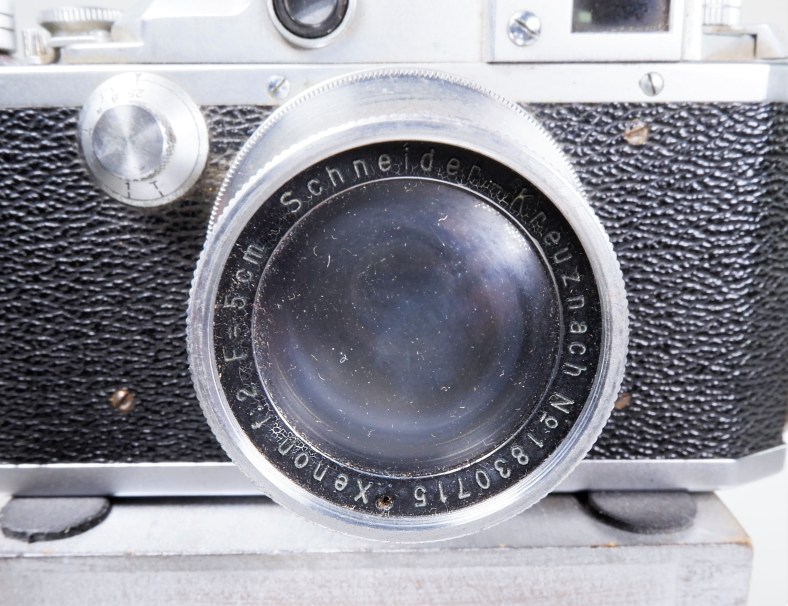
I was familiar with the Canon – one of the dozens of Leica “copies” or “clones” of the venerable Leica III that were made in Japan in the late 1940s and ’50s – the lens, well not so much. I knew that Leica made collapsible Leitz lenses that were extremely popular due to their outstanding quality and compact size, but I was unaware that other companies did so too. One such company was Schneider-Kreuznach of Germany.
DSCF7509

The diamond in the rough.

The Schneider-Kreuzbach Xenon f2 5cm lens (pictured above) was produced for Leitz during World War II. By serial number (1830715) the lens was produced around 1942 to 1943. Schneider Optics has this incredible list of all of its serial numbers – check it out here.

Here’s my write-up from my Etsy shop (www.ccstudio2380.com) listing.

Rare Schneider-Kreuznach Xenon f2 5cm
Collapsible Leica LTM Screw Mount Lens
– Vintage Germany 1942 – Wartime Lens! Limited Production!
– Excellent Functionality!

This is an extremely hard to find Leica screw mount lens made
by the world-renowned German optical company
Schneider-Kreuznach (Schneider Optics).

The lens is in beautiful vintage condition with a lovely
patina on the chrome metal lens barrel. I have inspected
and tested this lens on my Nicca rangefinder and it works
perfectly.

History has it that the Leitz factory could not meet the demands 
made on it by the German government during the height
of World War II and so the Schneider Optical Company
took on the task of building these lenses for Leica-Leitz. They
were made in very limited numbers.

If you can imagine how hard it is to find this lens in the present day
after all these years having survived the war and its aftermath.

This lens made it to a large camera dealer in New York City from the
original owner and was purchased by my client in 1969.

The lens is in perfect function – the aperture blades are clean (a bit worn)
and complete, the focus is smooth and was tested on my Nicca.
The rangefinder focused accurately. The mount (L39) is excellent and
the lens mounts securely to the camera body. The collapsible portion
is smooth and the lens locks in place. The aperture ring is also smooth and
without binding.

The glass elements (I think only the front elements) have a slight fog/haze
but not so much as to diminish the view. There are spots inside the
lens – they look more like dirt and dust spots but they could be
mold. With a bright light, I do not see any fungus filaments however.

The lens is rather rare and apparently very collectible and valuable ($900 to $1500). Who knew? The fact that it was made during WWII in Germany only adds extra interest to its rariety. The Leica lens cap is from the mid 1930s and as the story goes it has been on the lens since new. It would make sense that the Leitz factory supplied these to Schneider Optics to affix to their lenses.
DSCF7590

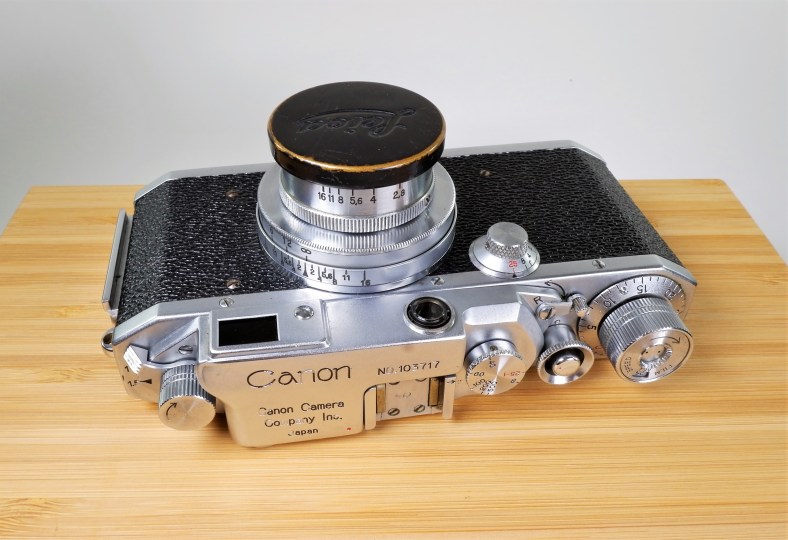
The Canon all cleaned up and ready to go – the lens is shown in its collapsed position.
DSCF7586

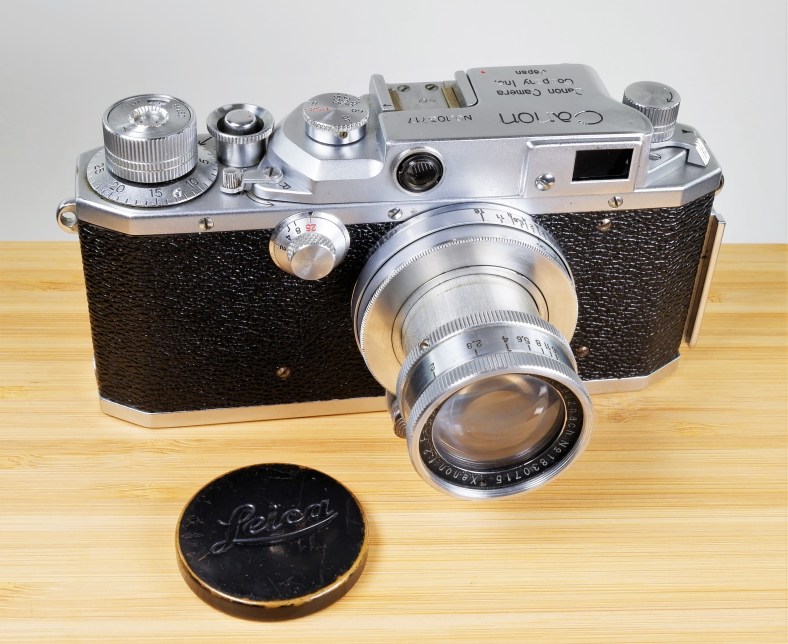
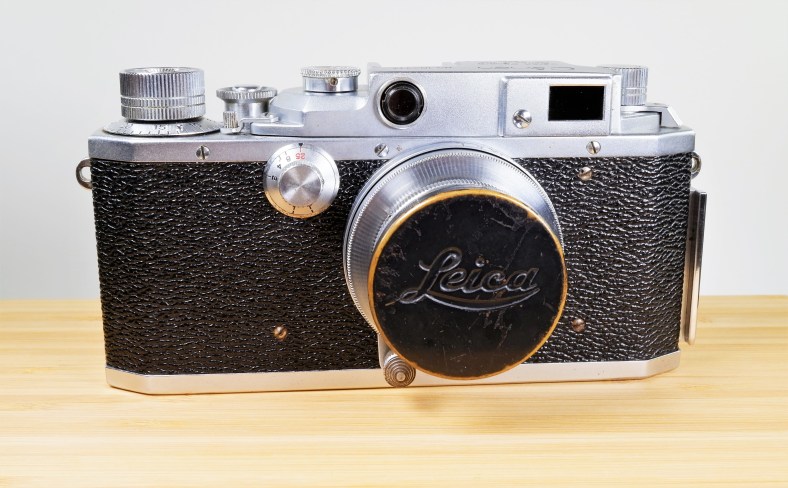
Looking much better after its bath – the cap is extra special too as it is from a very early design. By the way, the cap is padded inside with red felt.
DSCF7587

As a set it makes for a very interesting camera. Canon, Schneider, and Leitz coming together.
schneider lenses 1

For more about Schneider Optics stop by their website.

Thanks for stopping by! If you find vintage Schneider lenses from the 1940s certainly give them a closer look. The popular Kodak Retina line of 35mm SLR cameras used Schneider lenses and some of those are quite valuable too.

Chris


Canon AE-1 Program – An alternative to the more costly A-1

Canon’s A Series of cameras were among the best in the late 1970s and early 1980s. Often overlooked, the Canon AE-1 Program (it was also available in a pro black body) was a fun and accurate SLR during its heyday. Of course the Canon A-1 and the AE-1 were the most popular of all.

DSC00146

DSC00137

The AE-1 Program, like all of the Canon A Series of bodies, used the Canon FD lenses – here with the popular and super lightweight 50mm f/1.8 lens.

DSC00138

DSC00143

DSC00142

AE-1 Program in pro black and Olympic Edition.

DSC02955

DSC02956

If you get a chance to pick one of these up for a fair price we think you’ll be surprised at how well the auto exposure modes do under challenging lighting situations. It’s not built as robustly as the A-1 but can be had for much less.

The AE-1 P makes a nice addition to any Canon collection and certainly would look good in any collection of early Japanese SLRs.

Thanks for stopping by!

Camera: Sony Cyber-shot DSC-W170

Chris

Photo Gear No More – the ones we regret.

As collectors, Carol and I have to make some tough decisions from time to time (actually a lot). While we would love to own every camera, lens and photo thingy that strikes our fancy, we, like most people, have a budget. Well not really a budget per se as a budget requires planning and thought – something we rarely do. What we have in reality is limited space (and funds) just like most people. Compromises must be made – negotiations entered into and decisions rendered.

So our collection is a dynamic thing – a living, breathing thing that must be fed and then purged. Buy – play with – cherish and then sell. Here (in no particular order) is some of the gear that we wish we still owned…

Canon FD 17mm f4 super wide angle lens ⇓

Why? It was in mint new condition with no issues. The glass was pristine and we had the proper Canon lens hood and both Canon lens caps (and case). It just didn’t wow us! I had always wanted it since day one (1978) and had to settle on a Canon Fd 24mm wide angle instead due to the silly cost of the thing. I LOVE the 24mm – it is one of my most widely used Canon lenses. When we finally got this 17mm in 2014 and shot with it, well, nothing special. The images weren’t dramatic enough to justify owning it so it was sold. Why the regret now? We didn’t give it a fair shot. Maybe we shot a roll and a half with it. Not enough time really. The other reason – when it’s mint you freak out all the time about messing it up and messing with the resale value. Stupid reason but it happens.

DSC07303

Asahi Pentax Spotmatic with the Takumar f1.4 lens ⇓

Why? Beautiful camera in nearly perfect condition. We’ve always appreciated the early Asahi Pentax 35mm SLRs and this one fell into our hands. We would have rather had a working H2 or something along those lines but none were available at that time. Why the regret now? See above. Another case of a mint camera (for the collection) and unlikely that we’d ever shoot with it. Now we wish we had kept it to at least shoot some film with it. Oh well, it’s gone and unlikely to be replaced.

DSC07255

Nikonos II ⇓

Why? It was my first ever 35mm camera! Purchased new by me in 1971. I took it everywhere and used it both above and below the surface of the water constantly. She was in great shape when I sold it in 2011- my SCUBA diving days were over and no reason to keep it. Right? Wrong! My regret is purely nostalgic. My first 35mm camera! What was I thinking!!! It’s still the only Nikon I’ve ever bought!

DSC03459

Canon T70 35mm SLR ⇓

Why? Built-in motor drive, multiple auto exposure modes and drop dead simple to use. Uses the complete family of Canon FD lenses and exposures were as accurate as our A-1. Why the regret? We’ve owned about 10 of them over the years and have used them extensively. We’re just used to the little beasts and this happens after each acquisition and sale. We begin to miss that goofy style and its other quirks. (This one was sold to a collector in Australia).

DSCF3255

Fujifilm XP100 FinePix go anywhere digital camera ⇓

Why? Fun little Fuji that we often took to the beach for some awesome surf shots – plus it’s a cool green! We made some neat videos with it too – great images and sound. I decided to sell it as we didn’t need a closet full of seldom used digital cameras. They become relics quickly in the fast paced world of pixel capturing. We regret it now whenever we’re at the beach and the waves are killer!

DSCF3344

Asahi Pentax 6×7 medium format camera ⇓

Why? A gem of a camera! Mint condition and it took some stunning pics! Eye-level finder with meter and we had the big wooden hand grip and at least 2 new lenses for it too. Weighs like 2 kilotons or close to it! The 6×7 format can enlarge very nicely and the Super Takumar lenses were sharp. Why the regret? We can’t find one as nice to replace it without spending crazy money and we let ours go for too little. We have a Fujica GW-690 now so the need for the 6×7 format is lessened. Besides, the Fujica is as beat to hell as anything we own and that’s a good thing. No worries about scratching it up so we actually use it.

DSC02977

Canon FD 300mm f4 telephoto lens ⇓

Why, why, why? We bought it because we’ve always wanted that focal length and couldn’t afford what we really wanted – the FD 300mm f2.8 L white lens. Another case of a mint condition lens that looked like it was made yesterday. In reality it was a dark lens (f4) and a bit clumsy to use. We used it mostly on a tripod and our little town is not a telephoto town. What we mean by that is that our town is made for wide angle shots (old buildings with lots of details) and not tripod mounted lenses. Plus I’m just too old to hand hold 300mm lenses anymore and don’t want to be bothered straining my neck with it. The regret? I wish I could still hand hold a 300mm lens damn it!!! Actually I still want the f2.8!

DSC07364

So there you have it. Certainly it’s not all the gear we miss – just a small sample. If we can round up the images of some of the others there may be a part two.

Do you have a favorite piece of gear that you regret selling (or heaven forbid, gave away)? Let us know. Thanks

Chris and Carol ^.^

Canon AZ 1014 Super 8 Movie Camera… 1977

dscf3404

Purchased new by us in 1977… wow, 40 years ago! It’s still going strong – the automatic exposure is accurate, the Canon electronic zoom lens is flawless, and all controls and gizmos are doing their things. Why? Well number one is it was designed and built super well and it uses readily available double A (AA ‘penlight’) batteries. No out of manufacture mercury batteries and their modern replacements to deal with! Thank you Canon!

dscf3405

The business side of this gem. It’s a TTL Servo EE electronic exposure system using still available Super 8 film. It operates like an SLR in the sense that you focus and adjust zoom and exposure through the lens. Canon’s 7-70mm f/ 1.4 Macro Zoom (10x) Lens C-8 is razor sharp and produces vivid colors and delivers exceptional contrast.

Macro capabilities are incredible – as close as 10mm from the front of the lens! Slow motion, fades, interval shooting and time lapse plus the ability to manually control the aperture!

dscf3400

dscf3402

dscf3412

The camera loaded with a Super 8 cartridge and the six AA batteries weighs in at nearly 2 kg! I can tell you that lugging it through Walt Disney World was no picnic… but fun!

15842522279_0891e7845f_o

Carol exploring her plants via the Canon AZ 1014. This is so 1977! Our home in Yokohama.

20992653009_8f68f5192c_o

The photographer observed! The young lad was friendly and couldn’t figure out what in the world I was filming! Olongapo City, Philippines 1978.

img_20161217_0015_new

Bug hunting in Yokohama… 1978.

Playing with the camera again makes me want to start filming again… well maybe not. 50 feet of Super 8 movie film disappears quickly and so does the money in your wallet. The camera is amazing but outdated – but, for the money, you can’t beat the quality of the Canon optics that cost thousands today.

Carol and I have so many cameras that we can’t ever use them all before we pass on. So we are documenting our cameras just before they go to auction via eBay and Etsy. So sad but the time’s come to thin out the heard.

Photographed with our Fujifilm FinePix S9900. Carol (photo by me) with my Canon F-1 and me (photo by Jim) was taken with some junky old Nikon! Can you imagine!

Thanks for your visit!

Chris ^.^

Canon F-1

dscf3313

First version Canon F-1 with its gorgeous chrome nosed FD 50mm f/ 1.4 lens.

Canon F-1 from April 1972. This was the first version of the F-1 and it sports a rather low serial number. We’ve held this one back all these years with just occasional use (mainly in the studio). Our field tested F-1 (not pictured) was acquired new in 1978 (2nd version F-1) and it’s the one that’s traveled the world – getting seriously wet in Hong Kong, Japan and the US- dropped in a photographic safari bus in Kenya – slid off a train seat in Tokyo – and was briefly “lost” in Diego Garcia!

dscf3304

All original stuff from 1972.

dscf3318

Note that this super early FD lens does not have the SC or SSC markings on the lens ring.

I started 35mm SLR photography with a Nikonos II and then purchased my first Yashica (TL Electro-X) and then into Canon we went. We need to find some time to take this one out and put that classic glass to good use! Nothing like holding an old friend again.

Thanks for stopping by!

Chris

Wat Phra Kaew – Bangkok 1978

Give me lots of nearly cloudless blue sky, my Canon FD 24mm wide angle lens and some fresh Kodak Kodachrome 25 and I’m a happy guy!

This is just a few images from my port visit to Pattaya Beach, Thailand in December of 1978. I managed a couple of off days to make the crazy (back then) trip to Bangkok.

My “follow me everywhere” Canon F-1 (1978 version) loaded with Kodachrome 25 and my FD 24mm f/ 2.8 lens captured these images at Wat Phra Kaew in central Bangkok.

20542556694_14467eab9b_o

This guy always makes me smile.

20503343214_690f4c7b93_o

Young monks taking a break.

20546330753_a2b88f1d9d_o

Very shy ladies practicing their music.

21099940076_feca0a7083_o

Nothing like turning your 24mm lens for a tall vertical shot. The Kodachrome and Canon lens captured every detail.

21126100395_6ced57843c_o

Almost 40 year old Kodachrome. Still as brilliant as ever!

21316883621_b8068b204f_o

The F-1 metered this shot perfectly.

21413066019_b1c9ff5960_o

Gotta have at least one silhouette in the mix.

An amazing country to visit. The colors of everything just popped! Mid December sun angles were never a problem. Bright blue skies helped with capturing the details as I was able to stick with ASA 25 even when hand holding my FD 80-200mm lens.

Thanks for your visit!

Chris

Florence… 1986

img_20161218_0022

Nothing says Florence like the Cathedral of Florence. Canon F-1 with FD 24mm f/2.8 lens on Kodak Kodachrome 25.

In presenting a short series of images of Florence (one of the most beautiful of all cities in Italy), it’s a tough call on which images to include. In Pisa, it has to be the most famous bell tower in the world. I imagine for Rome I would choose the Coliseum – Colosseum or the Vatican. Since there’s so much beauty, history, art and architecture at every turn in Florence it’s nearly impossible to choose the one to use first. My visit to the Tuscony Region was in late October 1986 – the weather was perfect and the visibility was awesome!

My camera was the Canon F-1 (1978 version) with three lenses to use: FD 24mm f/2.8, FD 80-200mm f/4 zoom and the normal FD 55mm f/1.4. Since sunlight would be in abundance, Kodak’s Kodachrome 25 fit perfectly with the days shooting plan (no interiors in the plans).

img_20161218_0028

Vista view to the north… FD 24mm while hanging the camera over the side of the railing (wobbly pieces of metal) loosely attached to 600 year old stone.

img_20161218_0015

The Duomo with its instantly identifiable tiled dome. FD 80-200mm at about 150mm

img_20161218_0016

FD 200mm braced on the railing.

img_20161218_0012

Back to earth… Canon FD 24mm wide angle lens at f/22

img_20161218_0010

More FD 24mm… my go to lens in the tight quarters of a city. It’s not easy to get all three in the same image.

img_20161218_0021

The Canon’s light meter (spot) handled this tricky exposure well. Yep, FD 24mm lens.

Of course what would a visit to any city be without the required “People and Pigeon” shot.

img_20161218_0014

Happy people and happy pigeons.

This of course is only a very small sample of what’s available in and around Florence and the Tuscany Region. I had only one short afternoon to visit so I was lucky to see as much as I did. The old “someday” I hope to travel back and do it right.

Thanks for your visit!

Chris