We’ve been hot on the elusive trail of the Pentamatic family of cameras from Yashica now for well over 8 years. We’ve looked under every rock (auction sites), nook (web searches) and crannies (well, just crannies) for anything related to the Pentamatic. Our search has led us to some interesting conclusions – and wild speculations!

Some Conclusions
The first Pentamatic was “born” in December 1959 but wasn’t available for sale in the U.S. until April 1960. The Pentamatic was Yashica’s first 35mm single-lens reflex camera and was designed with the help of technology obtained from Yashica’s acquisition of Nicca Camera in 1958 and with some involvement with designers from Zunow Optical in 1959. Of course, Yashica designers were involved too as well as collaboration with Tomioka Optical for the first lenses.
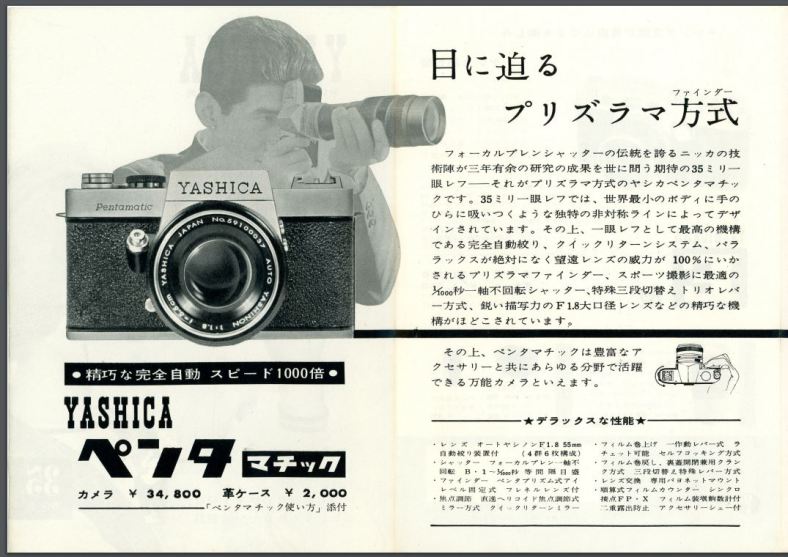
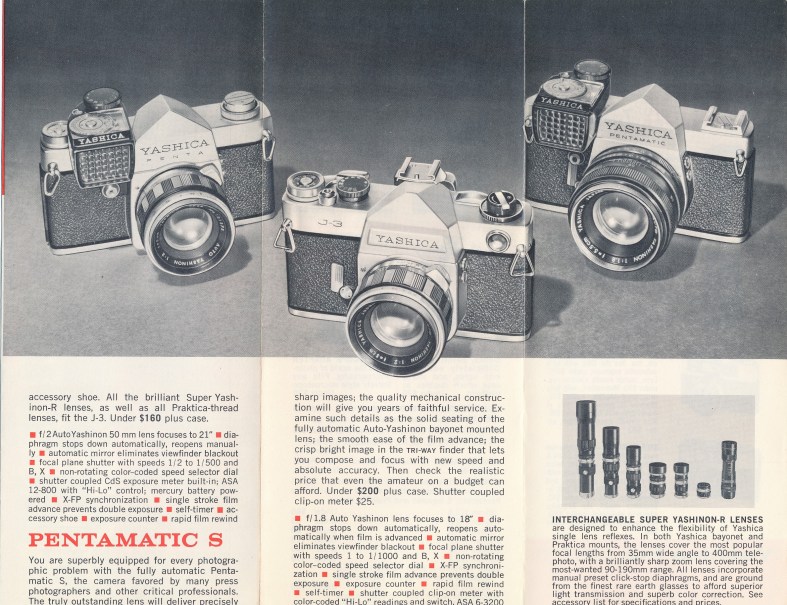
Below is a scan of what appears to be the first sales brochure for the Pentamatic found in Japanese. A machine translation of it proves that Yashica and Nicca designers worked together to jointly develop the camera over a 3-year period. The exact date of this brochure has not been established but it appears to be at least issued in the Spring of 1960. Many thanks to my good friend Paul Sokk for his efforts in researching the Pentamatic with me over the years. His fabulous site can be found at www.yashicatlr.com
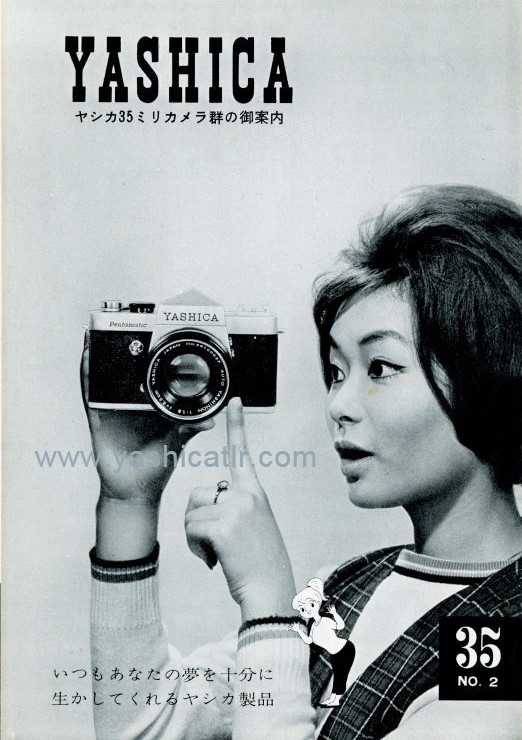
Below is a scan of the cover of that first sales brochure that features the new Pentamatic.
The original Pentamatic was a failure. A beautiful, sleek and modern camera at a great price, but still a failure. A replacement for it (Pentamatic II) was released by September 1960 – just a few short months after the original Pentamatic debuted.
The Pentamatic and the Pentamatic II were both out of production by January 1961. The Pentamatic S didn’t appear until around April 1961. Little was significantly changed over the course of these 3 models during this short timeframe. The Pentamatic II and its one-off lens improved on its semi-automatic capabilities. The body stayed the same with the exception of adding the engraved “II” after the name. No logic to this as Yashica could have simply made the new lens available as an option to the original Pentamatic. There had to be another reason to call it the model II and it appears that there were some internal changes made to accommodate the new lens.
The standard lens that was available for the Pentamatic II was designed and built (quickly?) by Zunow vice Tomioka. Our best guess at this point.
The Pentamatic II was only available for sale in Japan.
The Pentamatic S essentially was the replacement for the original Pentamatic – not the Pentamatic II. The model S added a lug for attaching an accessory exposure meter that coupled to the shutter speed dial. The S also added a self-timer and the body got a redesign (the strap lugs were moved to the front and the shutter release button was no longer at a 45-degree angle).
The Instruction Booklets
The booklets have been an additional source of fun separate from the camera searches. The booklet for the original Pentamatic was relatively easy to find. The first Pentamatic saw about 16,000 units made so the booklet is much more available. The Pentamatic II booklet was the hardest to locate since only around 5,000 cameras were made. The Pentamatic S booklet is even rarer – only around 3,000 cameras produced.

The 3 Pentamatic instruction booklets. Notice that the Pentamatic and Pentamatic II booklets have the same design while the model S differs dramatically. More “clues”.
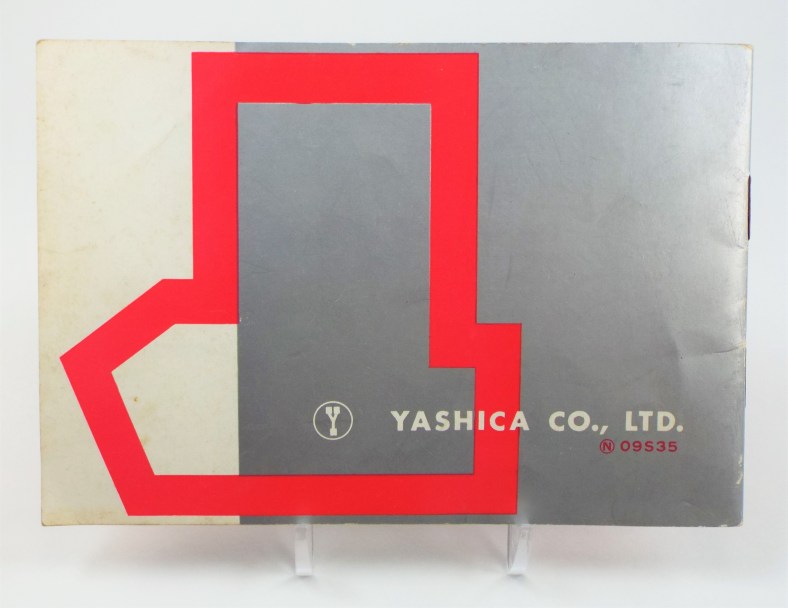
The back cover of the Pentamatic II booklet – the only one to carry a date (lower right corner). This one is dated September 1960. Showa date is 35.
Inside the booklets…

The original Pentamatic.

The Pentamatic II.

The Pentamatic S.
Wild Speculations
Wild Spec 1 – The first Pentamatic was not initially released in Japan. Yashica had a slow go with its early production so only a limited number were available for the April to June debut in the U.S. There were only about 4,000 cameras made by then and that just didn’t support a wide release of it in their home market. However, with the discovery of the as yet undated sales brochure found by my friend Paul Sokk it does appear that some of the first Pentamatics were in fact distributed in Japan. We do feel that Yashica had a suspicion that the original model would not go over well at home. Why do we feel this way? During our quest of all things Pentamatic, we’ve yet to find an instruction booklet for the original Pentamatic in Japanese (or any other language besides English). We’ve seen no early 1960s advertisements either. Although we’ve yet to find these items that does not mean they don’t exist.
Wild Spec 2 – The Pentamatic II was only available in Japan and was never intended for widespread availability in the world marketplace. We further feel that the Pentamatic II was the camera Yashica intended to release in Japan vice the original Pentamatic. Why? Same thing… in over 8 years of searching we’ve never seen a Pentamatic II instruction booklet in English and the only sales brochures we have are in Japanese. No English ads or brochures anywhere (yet). Update: As of April 2019 still no English ads or books.
Wild Spec 3 – The Pentamatic S wasn’t available in Japan. Crazy right? The same thing applies here – no Japanese advertising or brochures and no instruction booklets in anything but English. Again, not finding them does not translate to not being produced but the likelihood looks slim.
Wild Spec 4 – As we stated in the conclusions section above, the standard lens for the Pentamatic II (5.8cm f/1.7) was made for Yashica by Zunow Optical vice Tomioka. This flies in the face of what’s known and we don’t have solid written proof (yet, if ever). Both the original Pentamatic and the Pentamatic II ended production in January 1961. By coincidence, that’s the reported date of Yashica’s acquisition of Zunow (or their bankruptcy). Once Zunow went bust they no longer make lenses for the Pentamatic II.
Wild Spec 5 – Once the Pentamatic II stopped production, Yashica started selling the original Pentamatic in Japan (or at least increased its availability in Japan). We would still like to find a Pentamatic instruction booklet in Japanese to validate this thought.
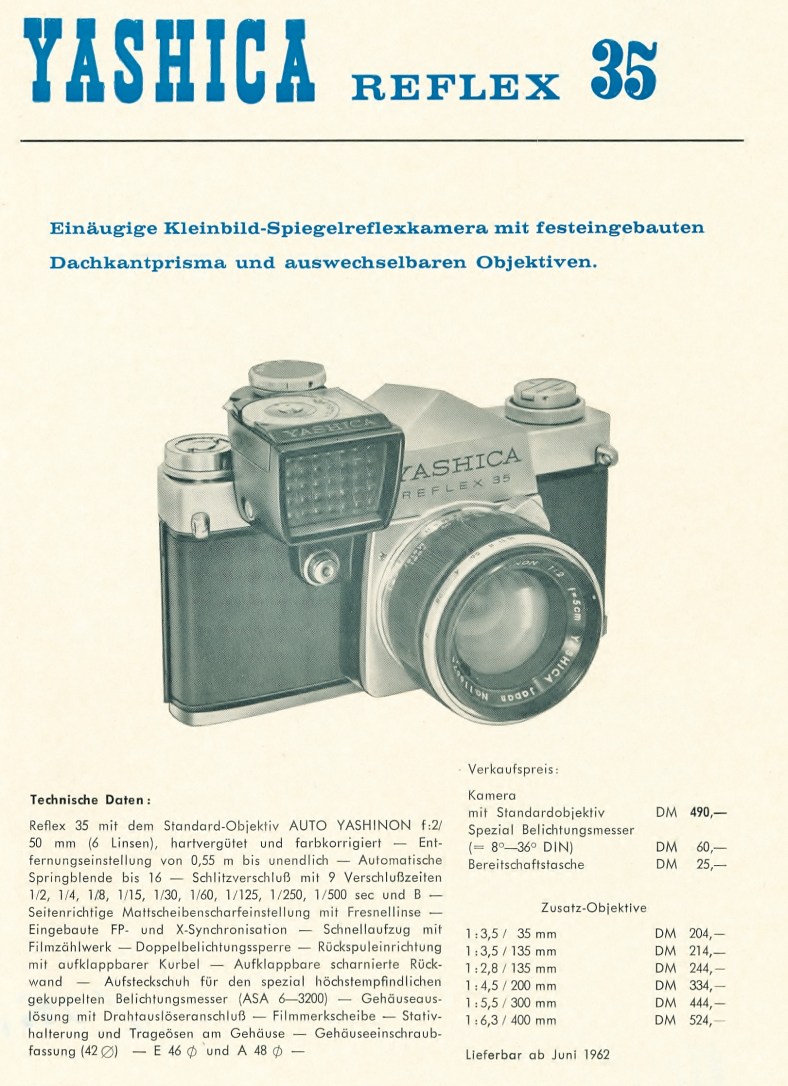
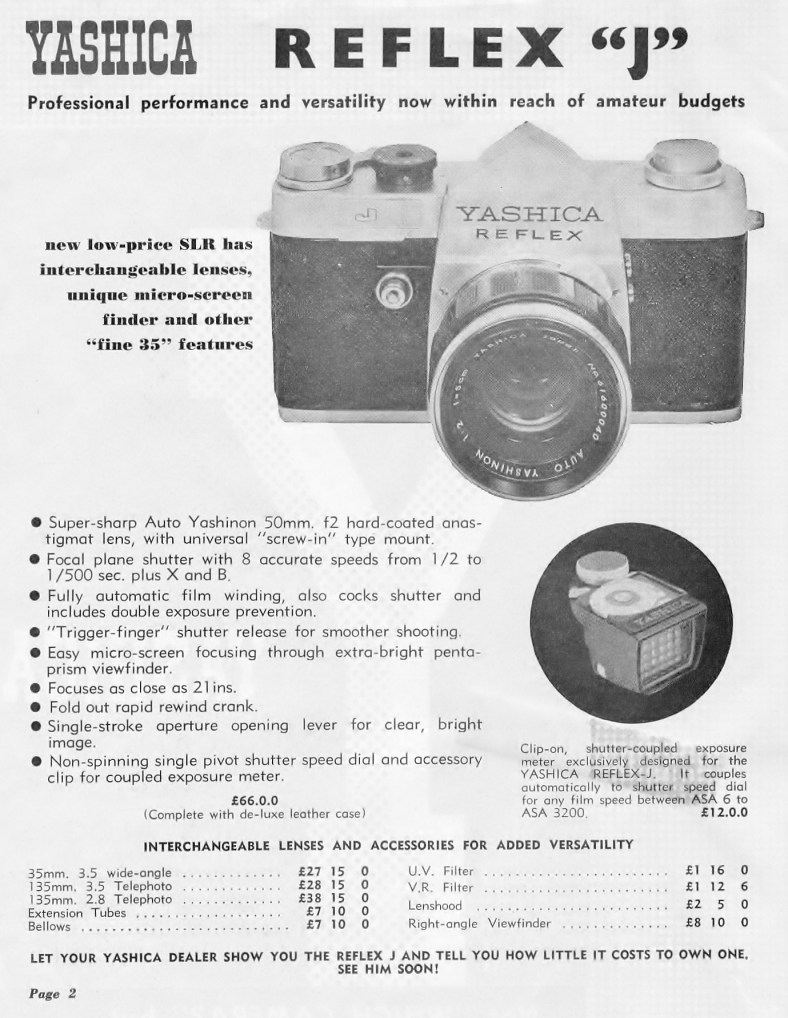
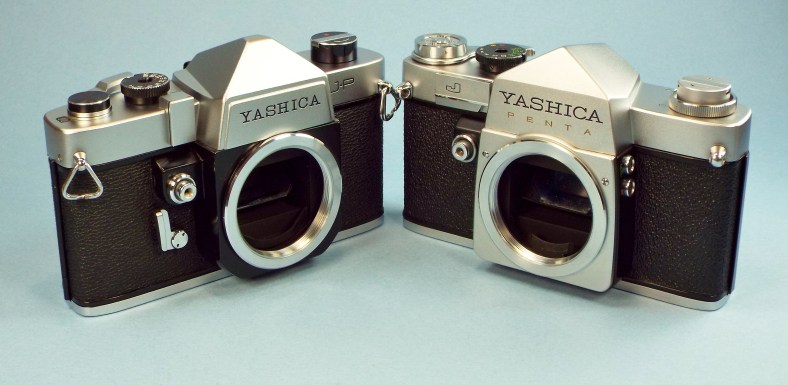
Wild Spec 6 – Since the Pentamatic S wasn’t sold in Japan, there was a rather large gap in Yashica’s SLR availability. The next camera to be sold widely in Japan (and the U.S.) was the Penta J but that didn’t come out until the Summer of 1961.
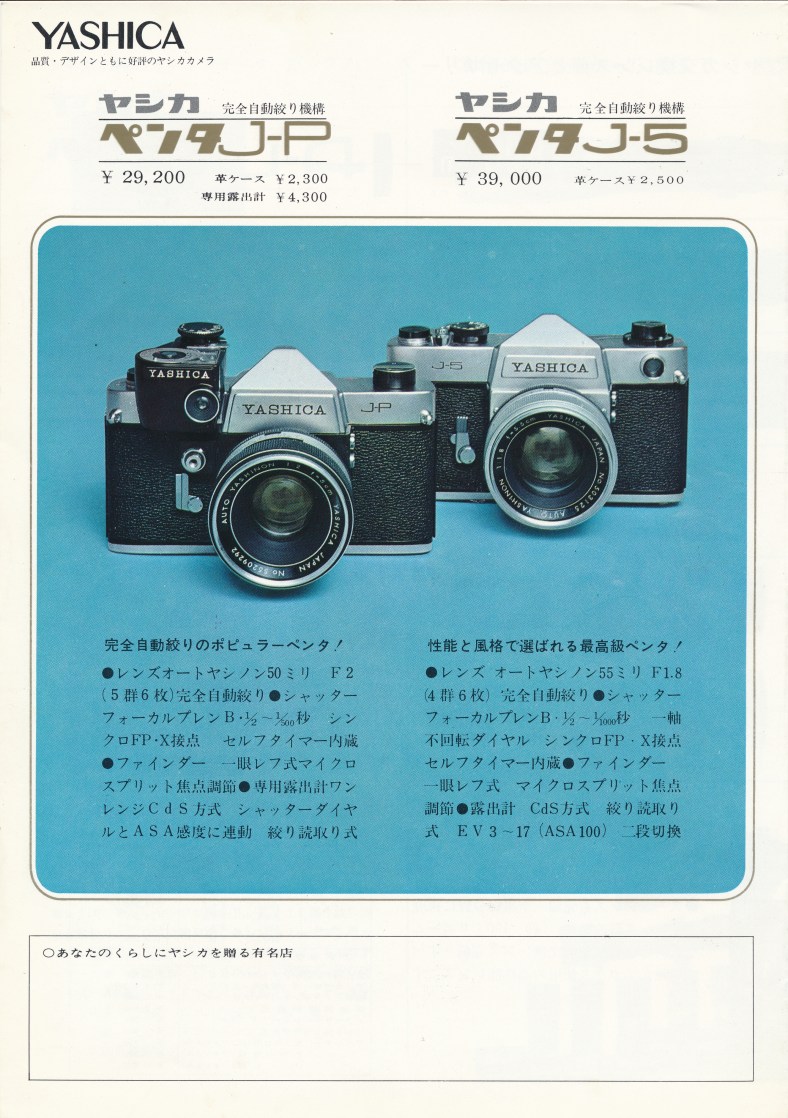
These marketing and production missteps led to a less than stellar debut for Yashica in the world of 35mm SLRs. The competition during this same period was “inventing” much more sophisticated (and mostly more expensive) cameras which had a wider range of interchangeable lenses and accessories. It took Yashica a long time to establish a “foot in the door” with their Penta J and their first internally coupled exposure metered SLR, the Yashica J-3 (Jaguar).
Things we would like to find…
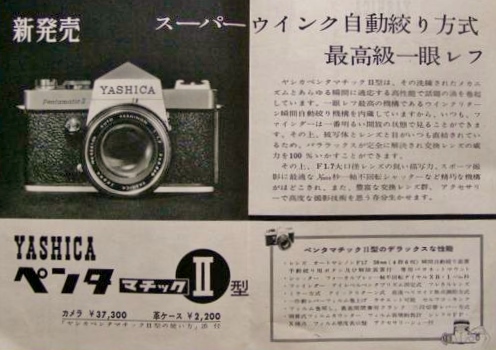
Original sales brochure for the Pentamatic II.
The first thing we would like to discover would be an ad, sales brochure or instruction booklet in English for the Pentamatic II. We don’t think we will as we feel that they don’t exist.
We would like to find a Pentamatic instruction booklet in Japanese. They must exist but we’ve yet to find one.
A Pentamatic S instruction booklet and a sales brochure in Japanese. Don’t think they exist but time will tell.
A Pentamatic II box!!! They must exist – someone’s got to have one in their collection! Update: Finally found one but we missed acquiring it for our collection so we “borrowed” this image –
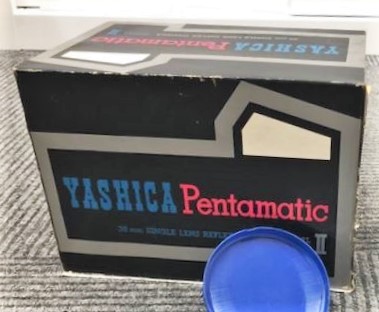
Very similar to the original Pentamatic box but black vice silver.
A Pentamatic (any model) in its original boxes in factory fresh condition. WooHoo!
***Solid proof that the standard lens for the Pentamatic II was made by Zunow Optical.***
Other than these things, I think we’re good! ^.^
Thanks for your visit! If you’ve made it this far in the post give yourself a big pat on the back! You just may be on your way to becoming a ‘Yashica Pentamatic Fanatic’!
Please stop by our online shop at https://www.ccstudio2380.com and check out some of our classic cameras available for sale.
We are active buyers of quality cameras and equipment – especially anything Yashica, Nicca, Fujica or whatever! Contact us at chriscarol@ccstudio2380.com
Please respect that all content, including photos and text, are the property of this blog and its owner, Yashica Pentamatic Fanatic, Yashica Sailor Boy, Yashica Chris.
Copyright © 2015-2019 Yashica Pentamatic Fanatic, Chris Whelan
All rights reserved.










 Chasing Classic Cameras with Chris