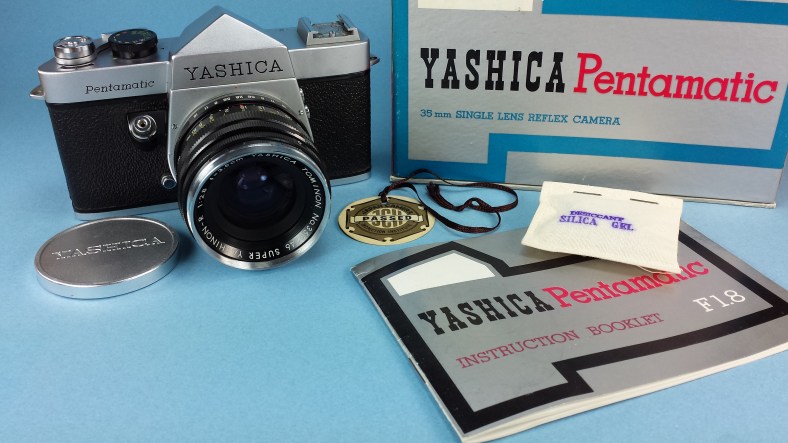
Early Yashica Pentamatic Brochure – US

Very early if not the earliest printed in the US sales brochure for the new Pentamatic.

We’re thinking the summer of 1960…

We haven’t found an earlier brochure that features the Pentamatic then this one – “Printed in the U.S.A.” on the back cover using the 234 Fifth Avenue, New York 1, N.Y. address. The cover is amazing in that other than Yashica’s name and an image of the camera, there’s no other writing. No “Pentamatic” – just an image of the camera. That was a first for Yashica as best as we can tell.

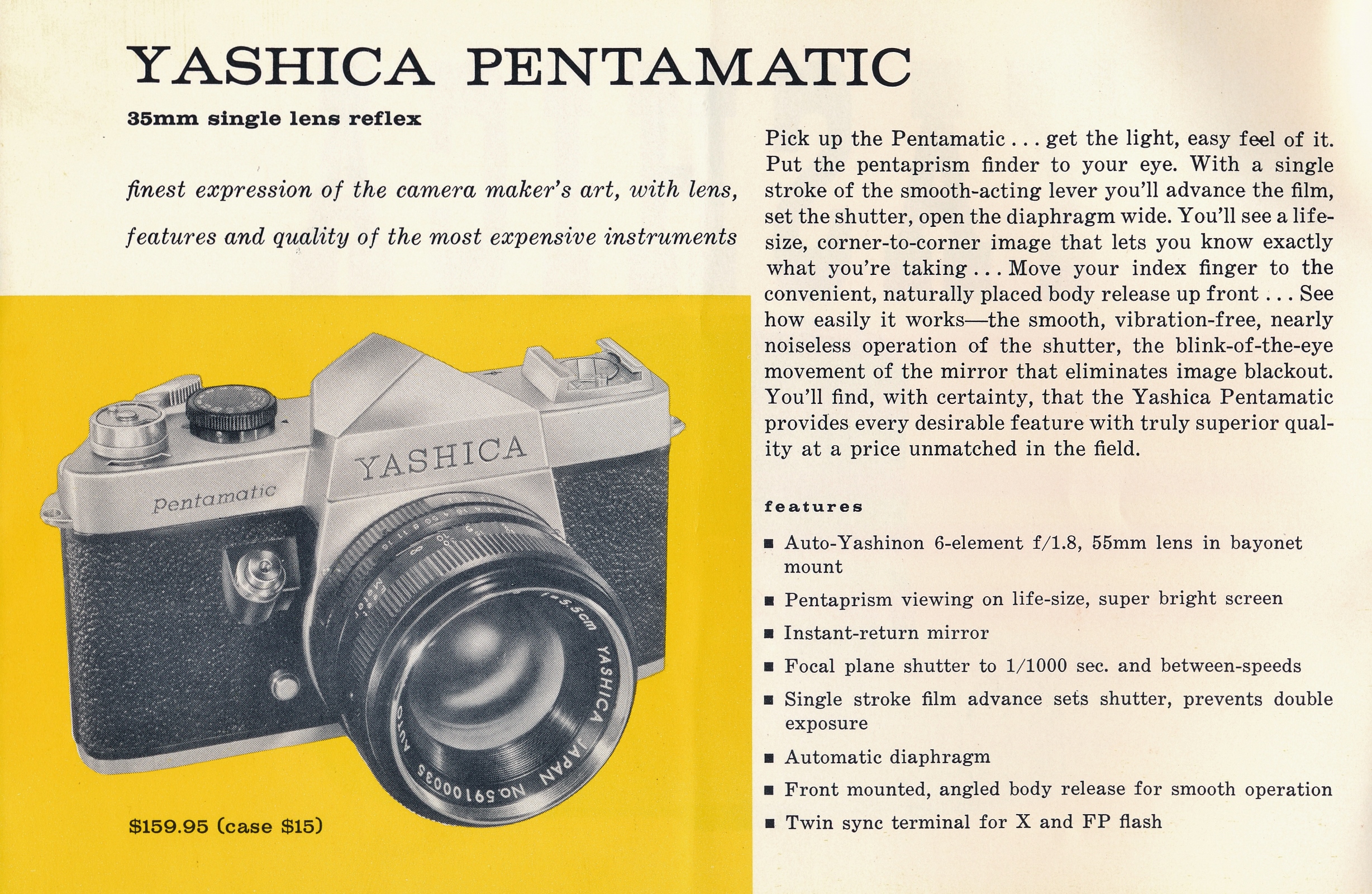
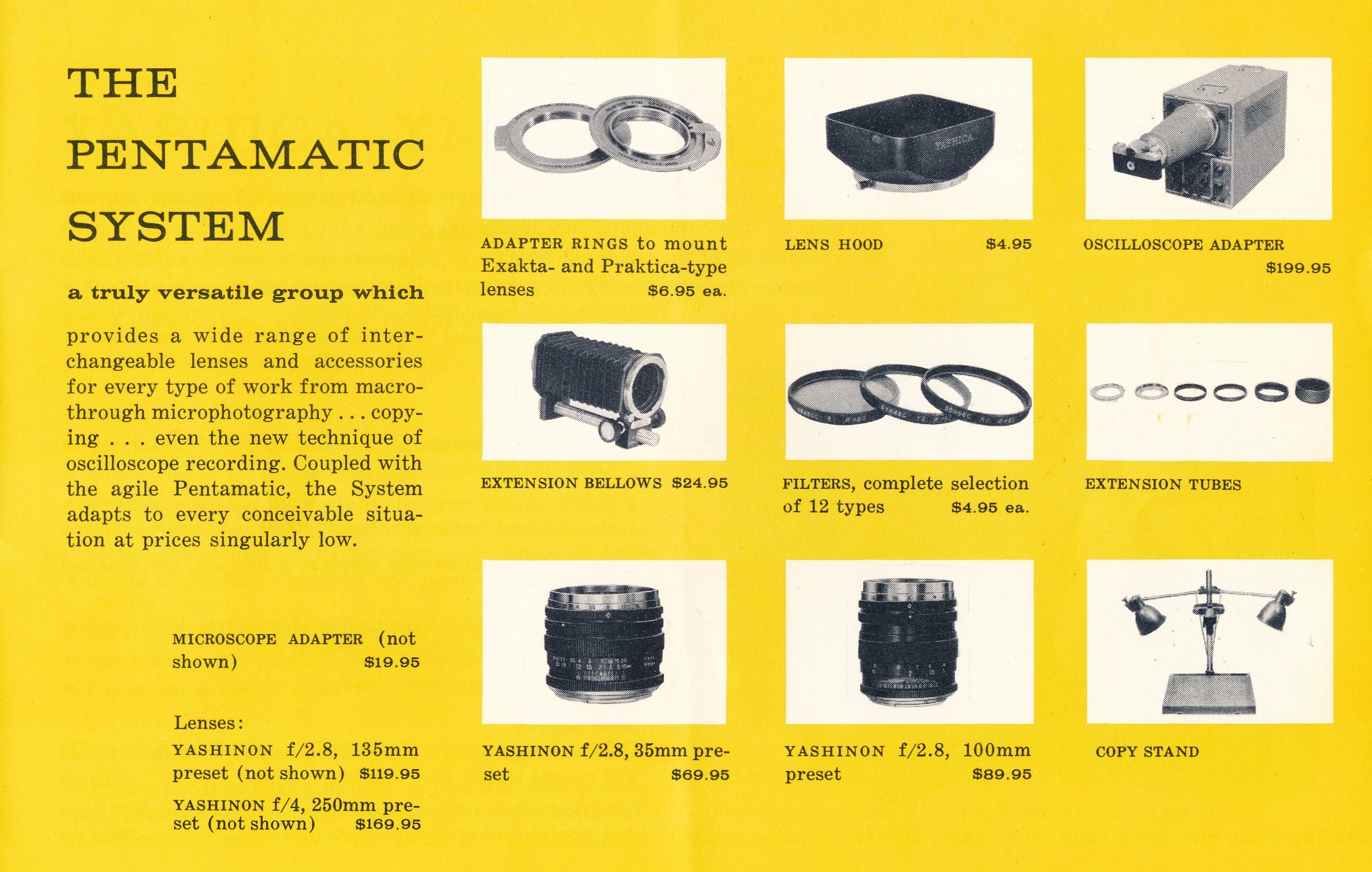
The first magazine advertisement was June 1960 in the US so we don’t believe this brochure was out before that. The only problem with our thinking is that most of the other cameras featured inside this brochure are 1959 model cameras and in some cases late 1958. There could even be a few that came out in early 1960. The two pages we’ve scanned (see below) contain an interesting wealth of info on the features and accessories for the Pentamatic. Of note, the lens serial number (No. 59100036) puts that lens to be one of the first lenses Tomioka made for Yashica with the new Pentamatic exclusive bayonet mount – 59 = 1959, 10 = October, 0036 = the 36th made in the production run.

We know from our research that the October 1959 date for the lens is 2 full months early from the first Pentamatic bodies (December 1960). Our best guess is that Tomioka Optical (the maker of the lens) needed to start production of the standard lens early in order to meet the demand for the camera body itself. No proof exists yet but it’s the best decoding of the lens serial number we can come up.

Page 1 provides a wealth of info for Yashica's first 35mm SLR.

Page 1 provides a wealth of info for Yashica’s first 35mm SLR.

IMG_20150926_0025

Page 2 shows (with prices) a nice selection of accessories for the Pentamatic. It appears that at the time of this brochure that there were 5 lenses available in the Pentamatic bayonet mount.


Yashica Pentamatic ’35’ vs. Pentamatic II

Why did Yashica bring out the Pentamatic II less than a year after releasing the original model?

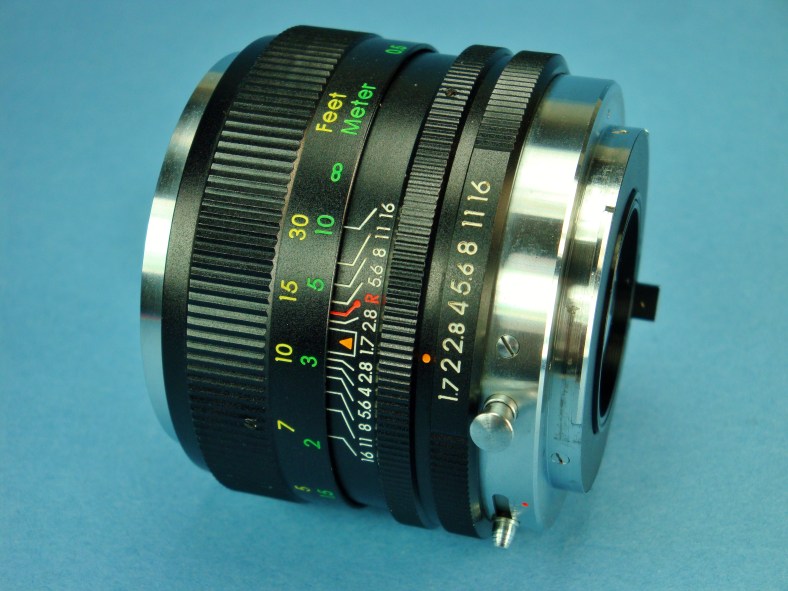
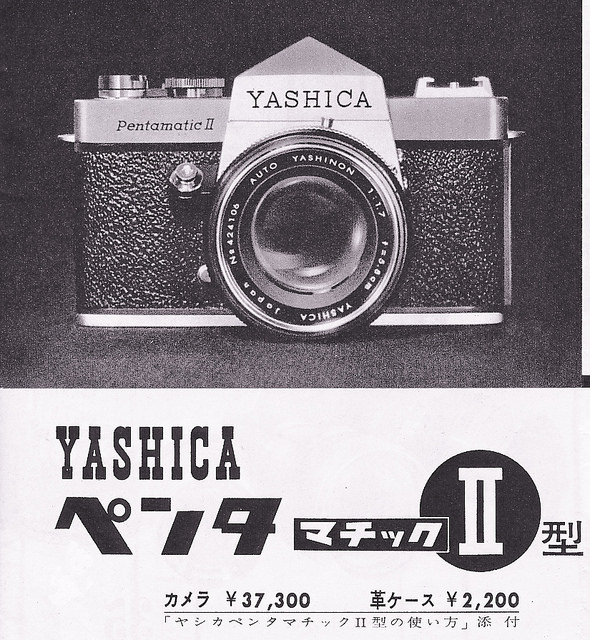
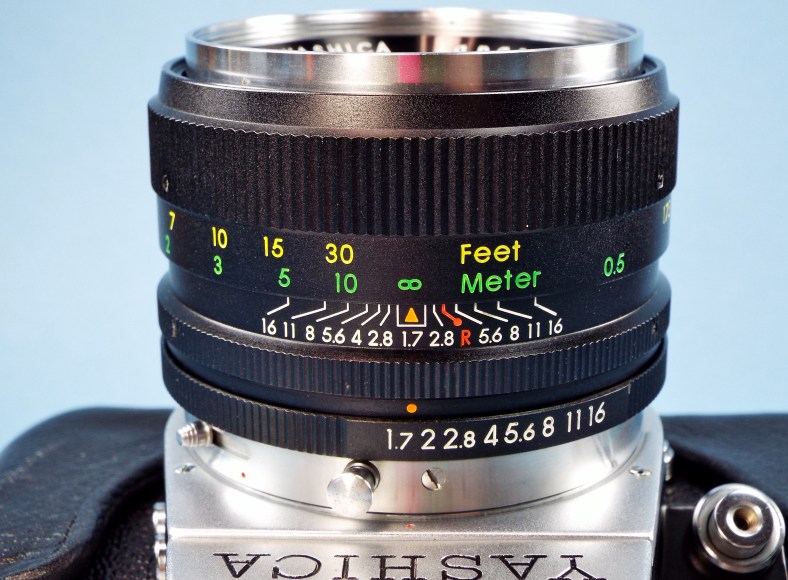
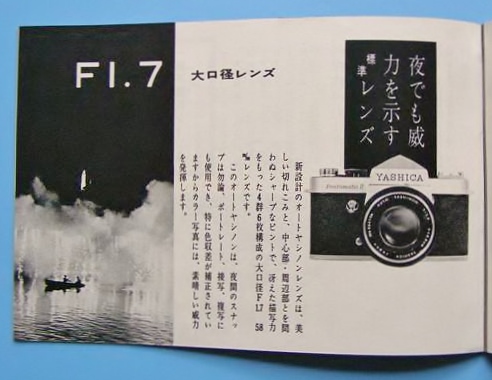
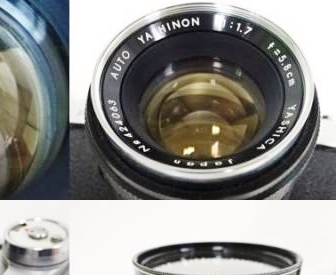
The only difference we can tell between the original Yashica Pentamatic ’35’ and the Pentamatic II (which came out around September 1960), is the standard lens that was mated with the camera body. The original Pentamatic came with the Auto-Yashinon, f/ 1.8, 5.5cm fully automatic 6 element lens. Of course it has the unique Pentamatic bayonet mount and not the M42 screw mount. The Pentamatic II came with the Auto-Yashinon, f/ 1.7, 5.8cm lens (pictured below). Both lenses were made for Yashica by Tomioka Optical of Tokyo. We imagine the 58mm, f/ 1.7 lens was a bit faster than the f/ 1.8… but we don’t see why Yashica changed from the model I to the model II and why they changed the lens… we may never discover the reason either.

DSC07467

The standard lens for the Pentamatic II – 5.8cm, f/ 1.7

27356135700_b0c5ef23fe_z

017

Gorgeous lens for the Pentamatic II.

Brochure c1961

The first sighting of the Pentamatic II in a sales brochure for the Japanese home market.

We’ve yet to find an advertisement for the Pentamatic II in English and along those same lines, have yet to find the Pentamatic II in a sales brochure in English. The Pentamatic S replaced the model II less than a year after its release. The model S went back to using the original 5.5cm, f/ 1.8 lens that was on the original Pentamatic.

That makes the Auto-Yashinon 5.8cm, f/ 1.7 lenses one of the rarest of the early Pentamatic bayonet mount lenses.

06-12-2016 pentamatic II 2 (2)

Happy hunting!

Chris
Fuji Photo Film – Fuji Pet 35

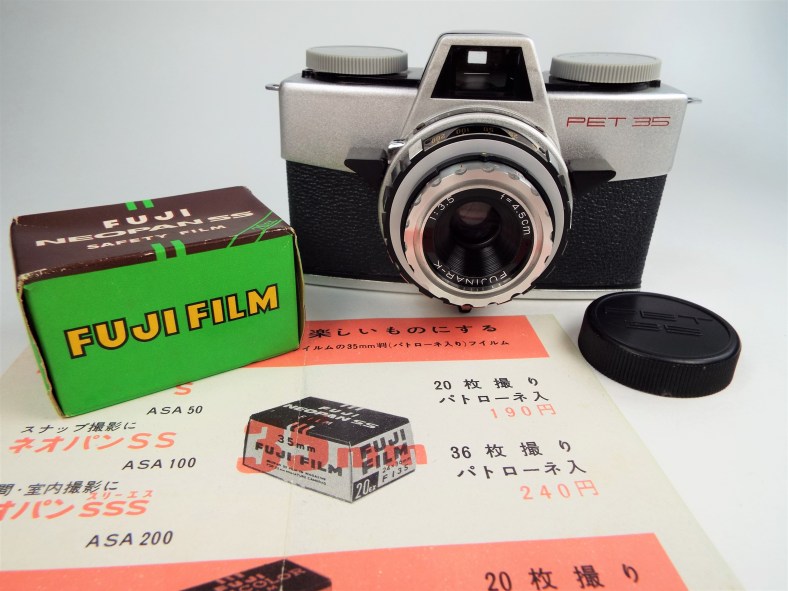
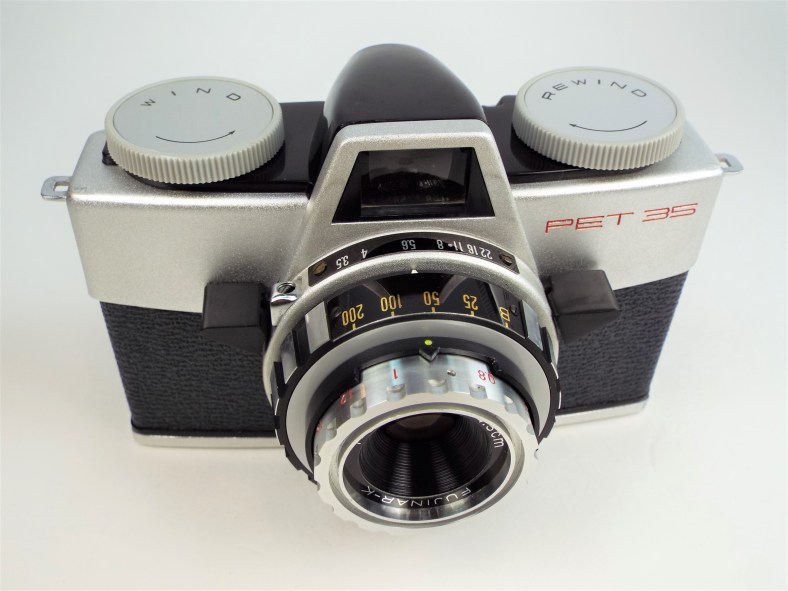
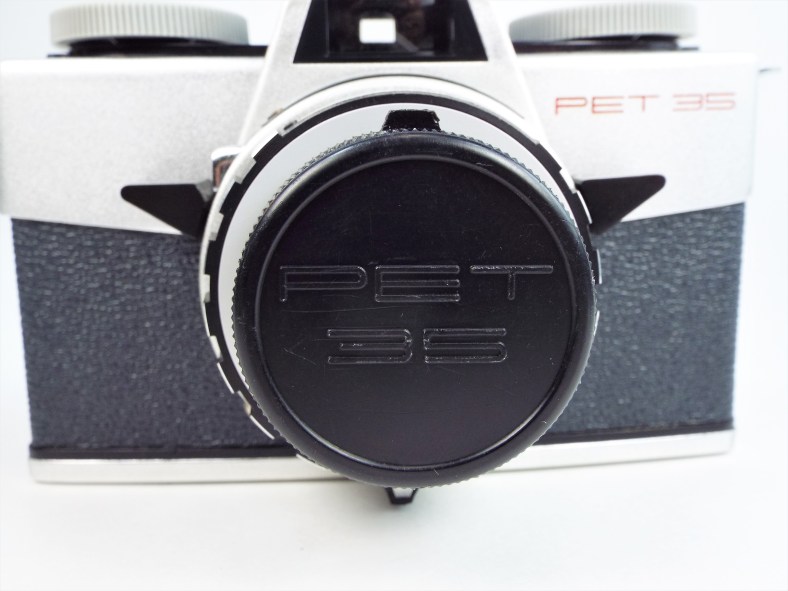
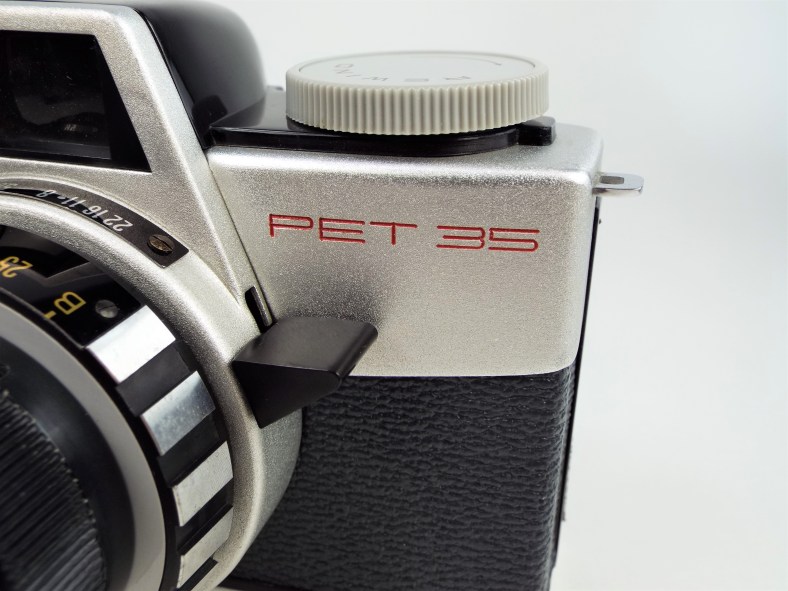
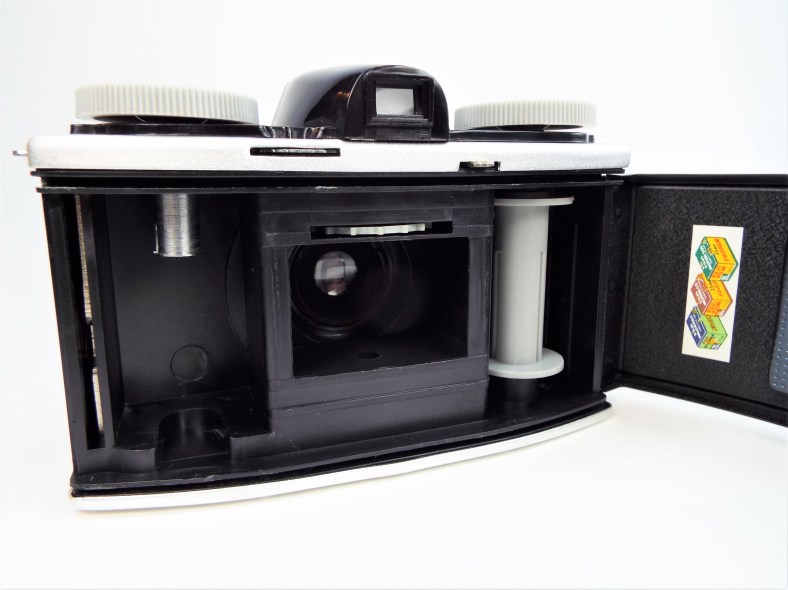
From 1959, Fuji Photo Film Co., Ltd. follow-up to their widely popular Fujipet 120 film camera. The Pet 35 took advantage of the growing popularity of 35mm photography – plus it’s a great way to sell more film!

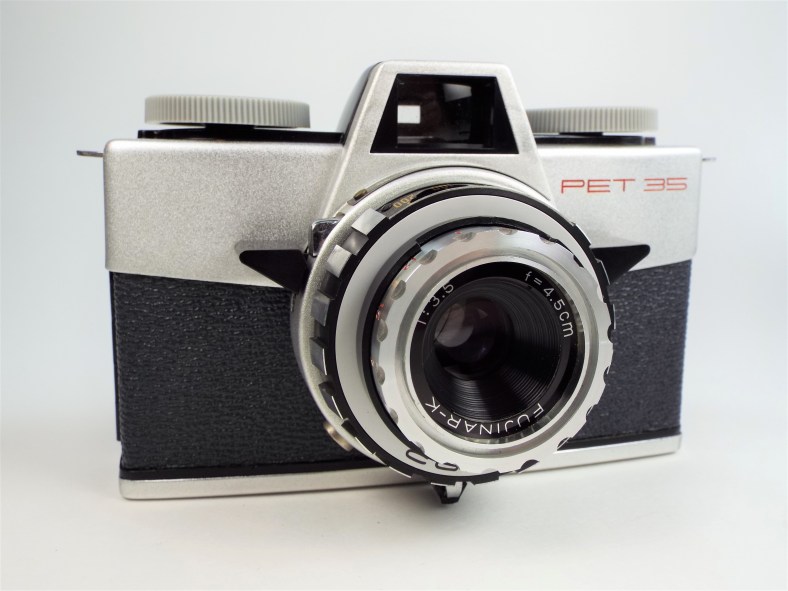
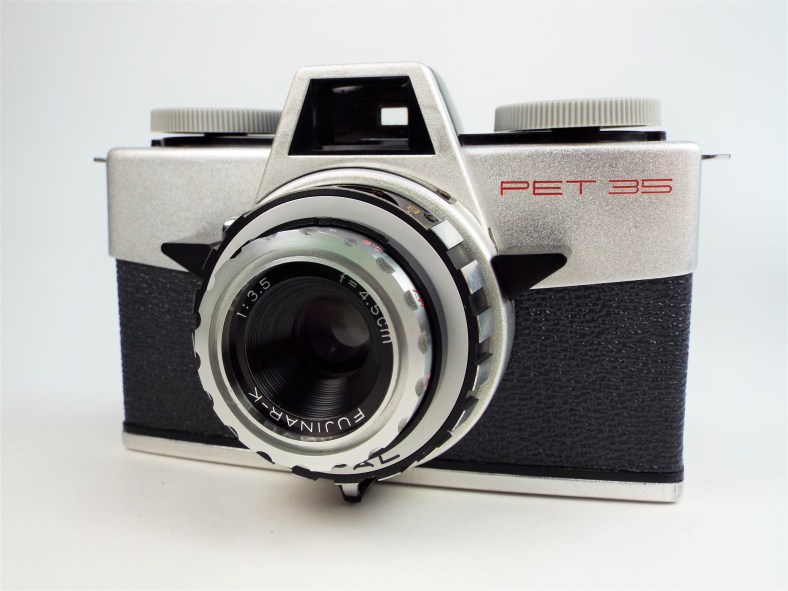
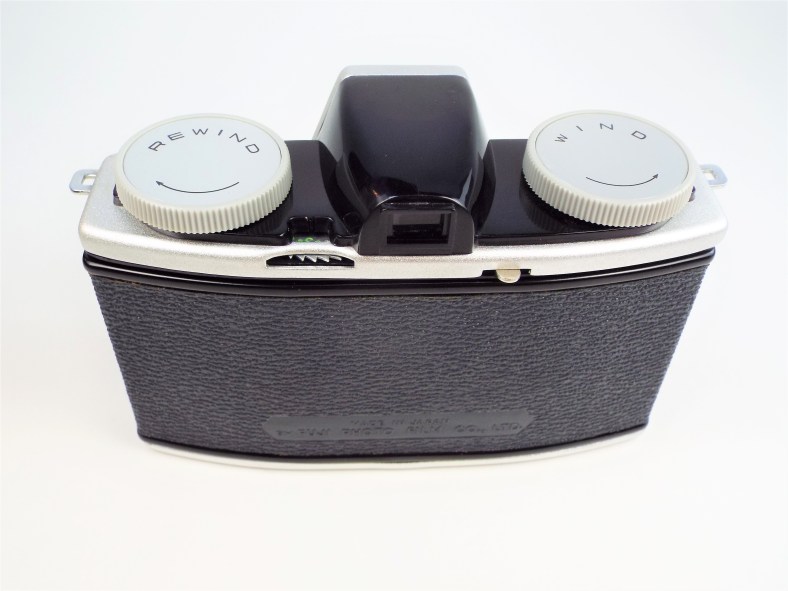
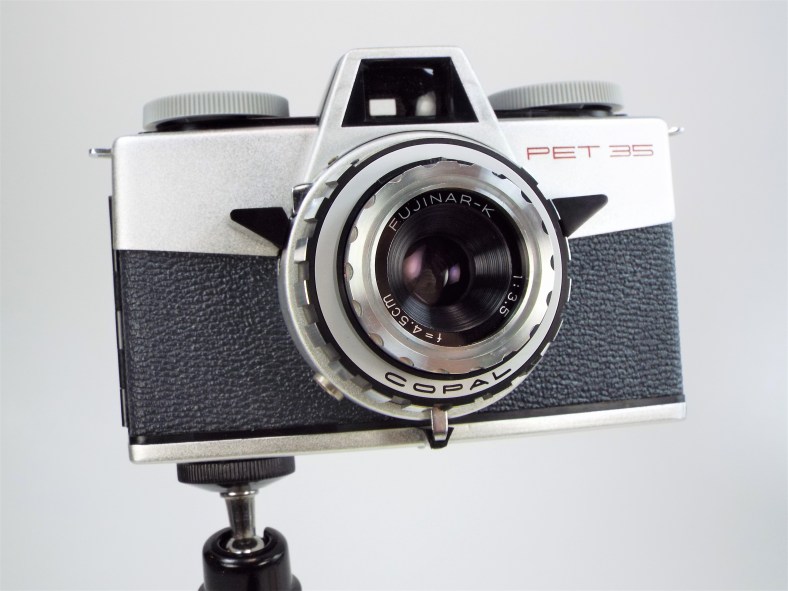
The Pet 35 was way more sophisticated than the Fujipet – but retained the funky charm and quirkiness of the original. Since the Pet 35 is not a common camera, we’ve presented a visual tour of our almost mint condition Pet 35.

DSCF5186

Original set as found. We have the leather case too.

DSCF5188

The lens is a Fujinar-K 3 element glass lens – 45mm with a maximum aperture of f/3.5 with closest focussing to 0.5 meters.

DSCF5189

The lever to the right of the lens cocks the shutter and the left lever trips the Copal B leaf shutter.

DSCF5190

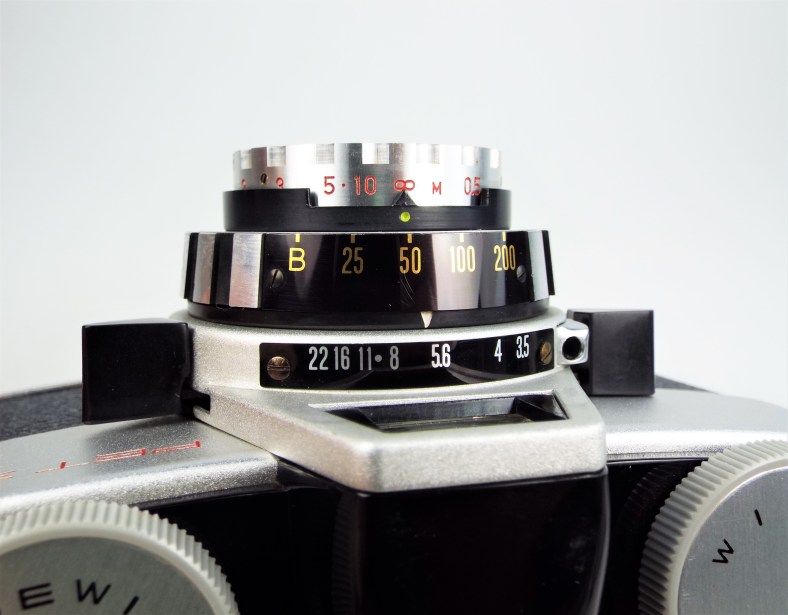
The Copal shutter features speeds of B, 1/25, 1/50, 1/100 and 1/200 of a second.

DSCF5191

In keeping with the funky design – two oversized knobs that left no doubt on how to operate them.

DSCF5192

The body is dark gray on this Pet 35.

DSCF5193

Outer ring is the focus adjustment, next is the shutter speed selector and finally the aperture settings.

DSCF5195

The original Pet 35 lens cap.

DSCF5196

Nicely detailed and finished.

DSCF5197

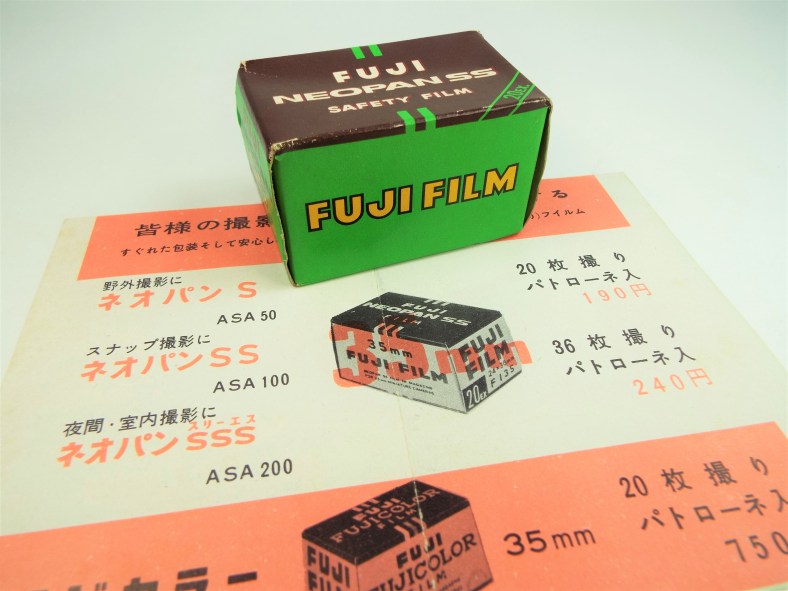
Early 1960s Fuji Film Neopan SS – ASA 100. How about film for only ¥190!

DSCF5202

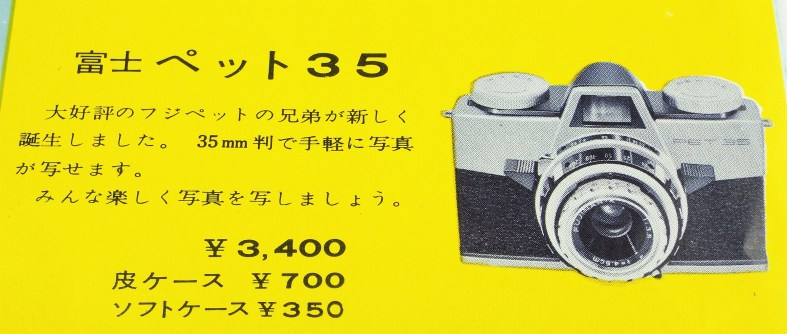
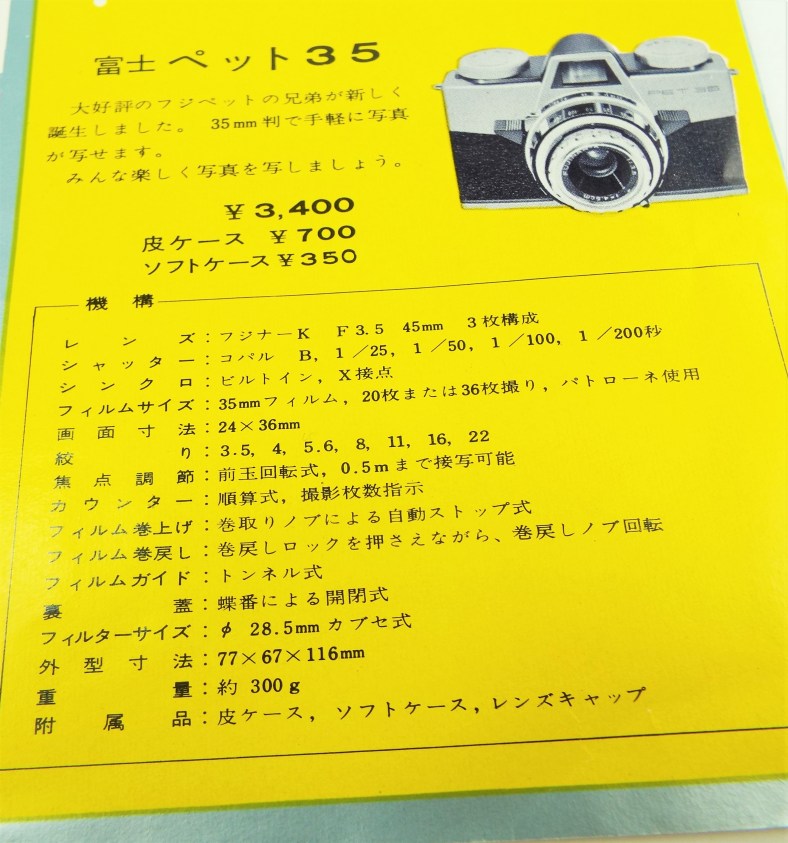
Original selling price was ¥3,400 – the leather case sold for ¥700 and a soft case was available for ¥350

DSCF5200

Original sales brochure specs.

DSCF5208

The viewfinder is bright and clear – and big for such a small camera.

DSCF5207

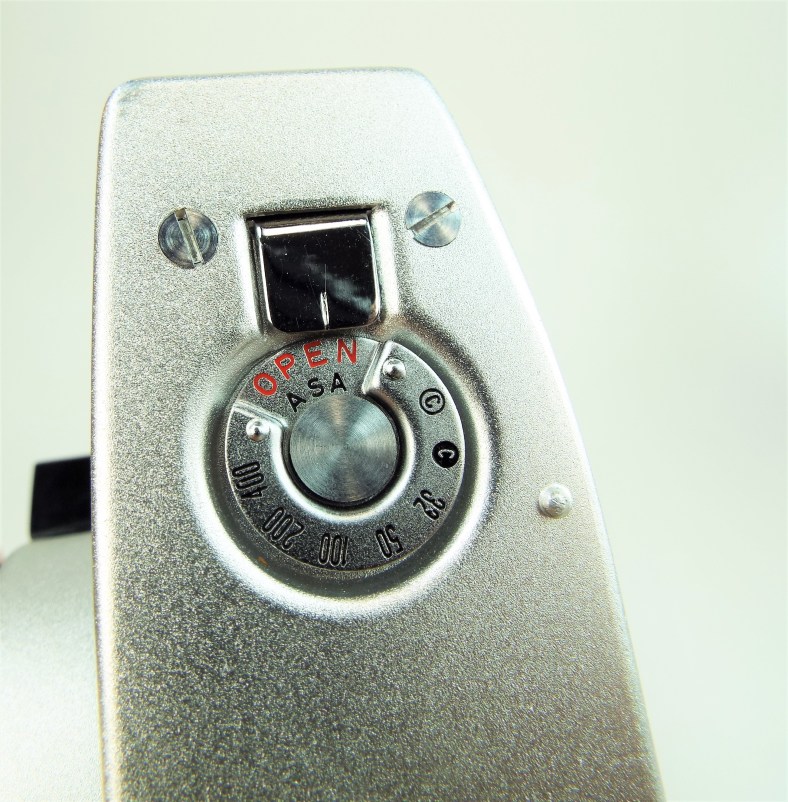
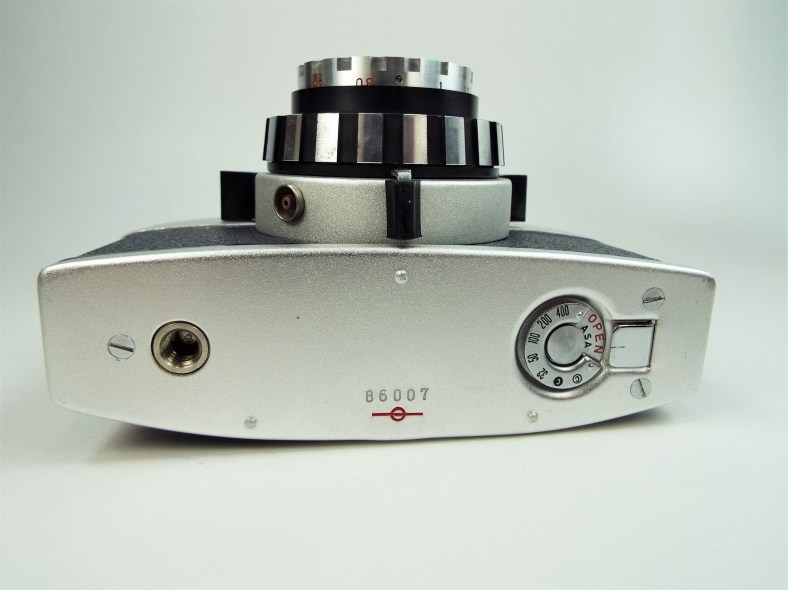
ASA reminder scale and film back release.

DSCF5206

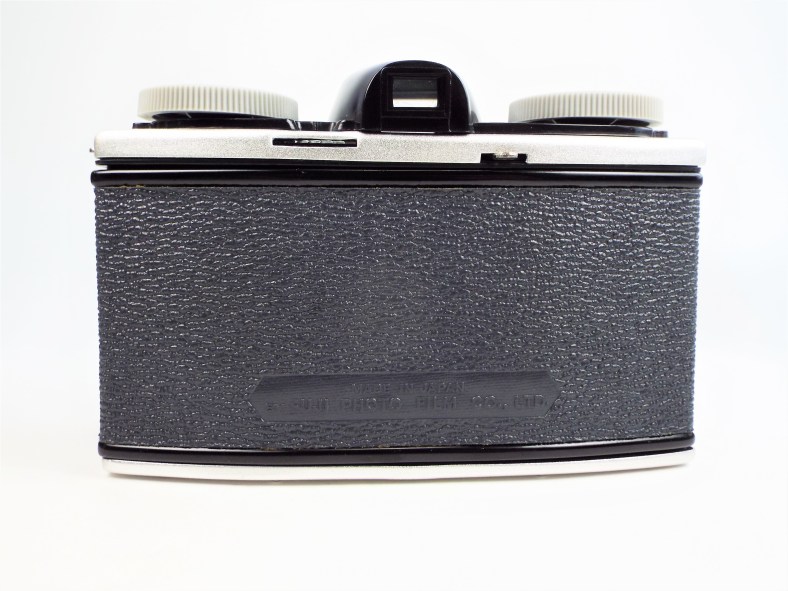
The Pet 35 is far from being a ‘toy camera’ as its build quality is quite high. No foam or yarn light seals to fail – the metal film door fit tightly into the body to seal out light.

DSCF5209

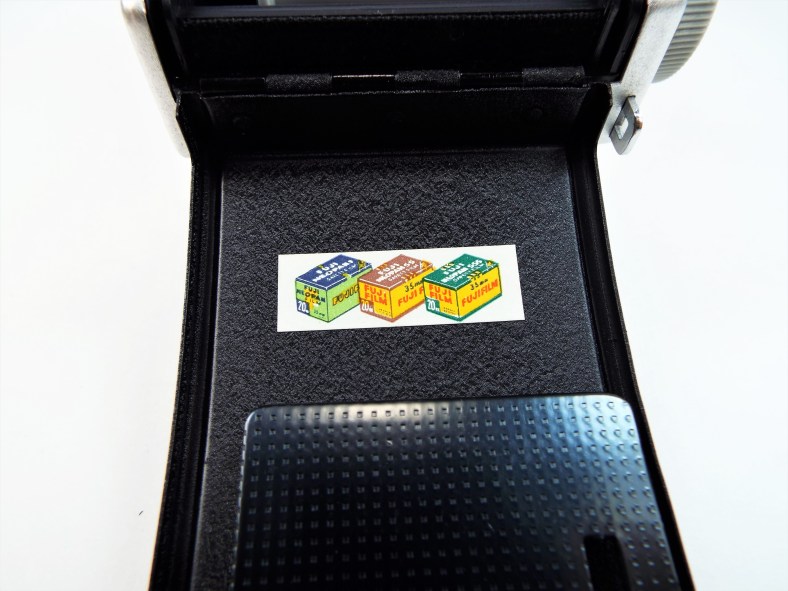
Gotta love the Fuji Film stickers inside!

DSCF5203

Thanks so much for your visit – we hope that you enjoyed our tour of this fantastic Fuji!

Studio Camera: Fujifilm FinePix S9900W

Chris & Carol ^.^
Cool Signs

20170413_134535

As seen on an abandoned souvenir shop along a Florida highway. At first glance I thought that they sold film and what not as they were the first stop in extreme Northeast Florida for southbound tourists. Cold drinks, smokes, candy, stuffed gators and Florida junk like that. But I got to thinking that it might have meant films as in movie films. This building was left to rot many decades ago and right next door is a closed motel on the same property. Some locals say that the souvenier shop showed movies from time to time for the guests at the motel and some of the bored to death locals. Makes sense as it was in the middle of nowhere and back in the 1960s or earlier that would be a draw.

DSCF5048

Anyway, cool old faded signage regardless of what went on. ^.^

Camera: Fujifilm FinePix S9900W, Samsung Galaxy S4

Chris
Yashica Pentamatic Refreshed –

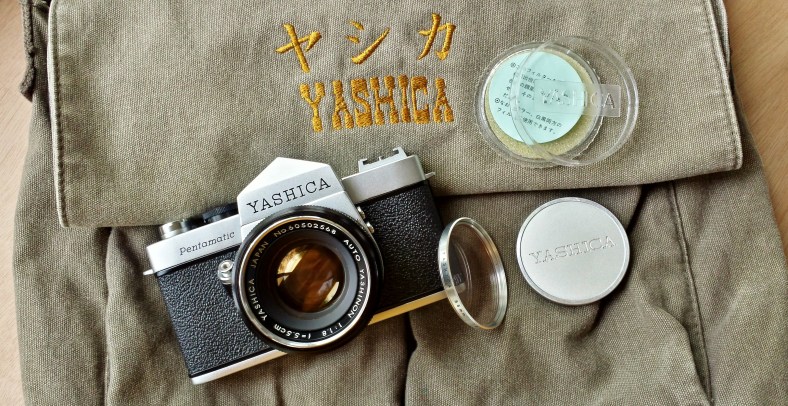
20160326_164016_richtonehdrThe beautiful, simple and clean lines of Yashica’s first SLR.

If you’re new to the Yashica Pentamatic then you’re in luck as this is the best place to be for the most accurate information about the mysterious Pentamatic. First envisioned when Yashica acquired the Nicca Camera Company in the summer of 1958. Yashica needed the technology and manufacturing know-how that Nicca had – focal plane shutters and the ability to build small complicated 35mm SLRs.

The timeline as best as we can tell looks like this – Yashica “invents” the Pentamatic in the summer of 1959. Yashica files for the trademark ‘Pentamatic’ in Japan September 18, 1959. The first Pentamatic bayonet mount lenses are made by Tomioka Optical for Yashica in October 1959. The first Pentamatic bodies roll off Yashica’s line by December 1959.

Yashica files for a patent/trademark in the US on February 12, 1960. The Pentamatic ’35’ is revealed at the ’36th Master Photo Dealers & Finishers Association Trade Show’ (St. Louis) in late March 1960. The lens shown on that Pentamatic is an Auto Yashinon 5.5cm f1.8 lens (SN 59100035). By April-May 1960, the first pictures appear in photography magazines in the US from the St. Louis show. The first Yashica Pentamatic ’35’ advertisements appear in both ‘Popular Photography’ and ‘Modern Photography’ magazines in their June 1960 issues. Ads within those publications have dealers in New York selling Pentamatics for $159.95.

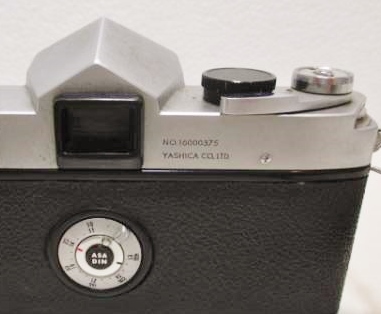
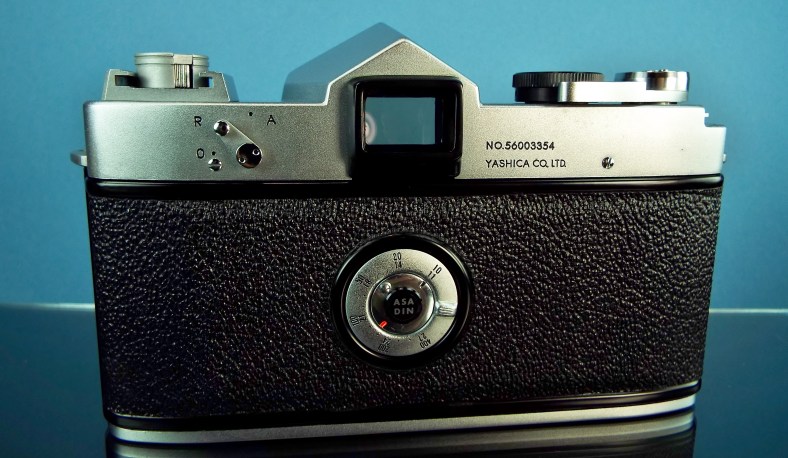
JN Pentamatic SN 16000375Decoding serial numbers… Yashica has never been upfront with the dating of their cameras, lenses or printed materials. Instruction booklets and sales brochures are only occasionally dated and those were mostly in the 1950s and then again in the 1970s. Camera bodies and lenses (and accessories) remained a mystery until now. We believe we’ve finally decoded the serial numbers of Yashica’s first 35mm SLR, the Pentamatic. Look closely at this camera’s serial number… 16000375… knowing a little bit about when this camera was “invented” helped us decode the number. The trademark “Pentamatic” was filed by Yashica in September 1959 in Japan. The first lenses were built in October 1959 with the first bodies produced by December 1959. This camera (above) dates… 1 = January / 60 = 1960 / 00375 = 375th unit made since December 1959. The latest camera in our database has a serial number of 16115756. This decodes to… January 1961 and was the 15,756th unit produced since December of 1959.

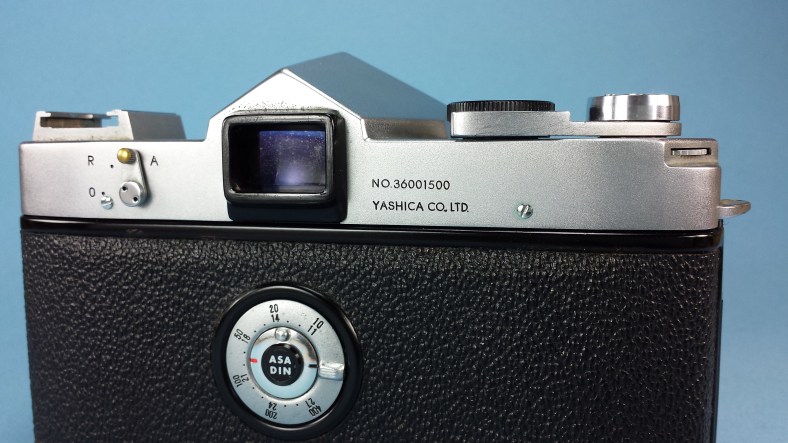
16233739912_d43f6fb30f_oThis Pentamatic body (above) decodes to… 3 = March / 60 = 1960 / 01500 = 1,500th made up to that point.

Bold bright colors...

Clean simple lines. Show the customers that this camera was a SLR! Not your dad’s TLR.

30602743445_1099c73935_o

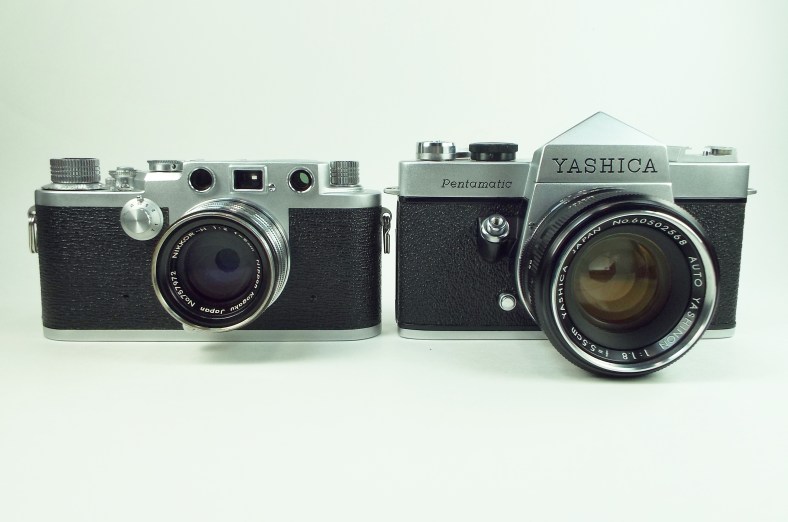
Inspiration and the technical know-how came from the Nicca Camera Company. Pictured on the left is an early Nicca 3-F.

25991482796_f4202464c2_o

By May 1960, number 3,354 had been made.

31843606654_3798679907_o

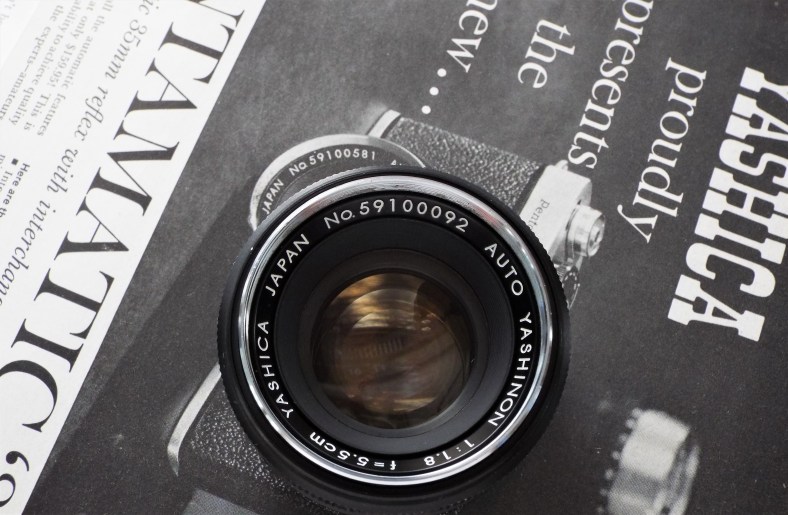
Earliest lens serial number (in our collection) decodes to – October 1959, the 92nd made. The ad behind it is a much higher serial number and appeared in a June 1960 ‘Popular Photography’ magazine ad.

The original Pentamatic ’35’ is a fun and challenging camera to collect. Knowing a little something about the serial numbers may add to your enjoyment of the chase. There was a short lived Pentamatic II (well less than 10K made) and another short run of the Pentamatic S which was the last model before Yashica ditched the Pentamatic bayonet mount in favor of the universal M42 mount.

Happy hunting! Questions? We’ve got answers.

Chris & Carol
 

Earliest Pentamatic Lenses Found… Yeah!

Nerd heaven! After years of speculation and almost constant searching, we’ve been able to confirm that Tomioka Optical began making lenses for Yashica’s new Pentamatic 35mm SLR camera in the latter part of 1959. The two lenses pictured below confirm (via serial numbers) of an October 1959 start of production. Yashica had filed for a trademark of the name ‘Pentamatic’ in September 1959 (in Japan). Since their new camera used an exclusive mount for its lenses, Yashica designers had to have shared their design with Tomioka as early as the summer (August ?) of 1959.

Using the rule of twos, these lenses are the earliest in our collection.

DSCF3824

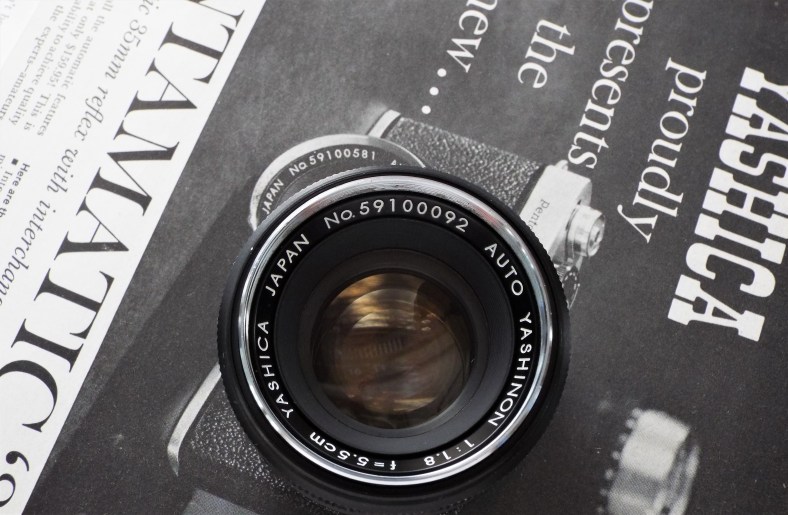
By serial number the left lens was built in October 1959 and it was the 92nd lens made. The right lens was built in December 1959 and by then Tomioka had built 1,630 lenses for Yashica.

No.  59 = 1959   10 = October  0092 = 92nd made

DSCF3826

No.  59 = 1959  12 = December  1630 = 1,630th made  

DSCF3827

dscf3477

Here’s our lens matched up to an advertisement in ‘Popular Photography’ magazine from the June 1960 issue. The lens in the ad is No. 59100581 which decodes to – October 1959, lens number 581 in the sequential production run. So in October, Tomioka had made nearly 600 lenses and by December they were up to 1,630 made. Certainly possible that they were averaging nearly 600 lenses per month in late 1959.
It’s a good find for us as the early serial numbers were just a guess on our part as to how they decoded. Having two lenses made before 1960 helped firm up our speculation. Lenses made in 1960 drop the month code in favor of a model number or code. A typical 1960 lens would have a serial number of:  No. 605xxxxx which would be 60 = 1960  5 = model code  xxxxx = production sequence number.

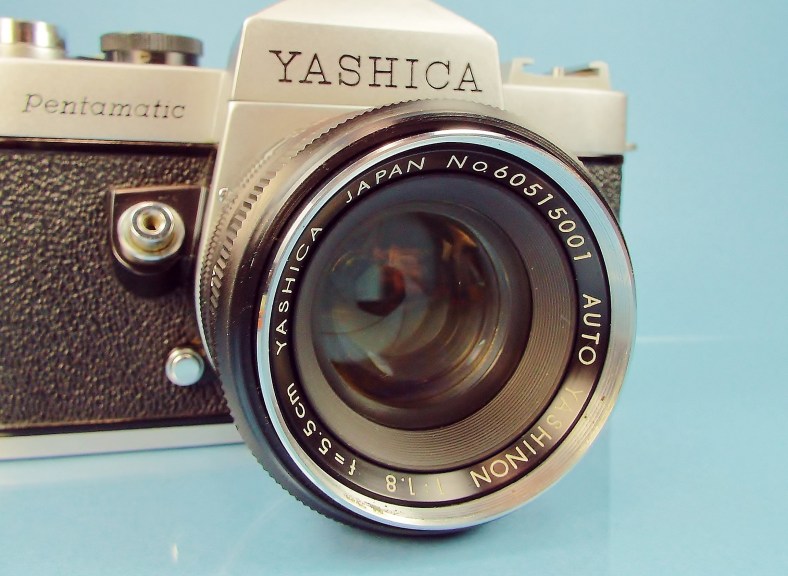
008

Serial number No. 60515001 decodes to 60 = 1960  5 = model code  15001 = 15,001 made since production began in October 1959.

If you’re a collector of Pentamatics or are just interested in Yashica cameras in general, this is important info. We know, total nerd stuff!

Thanks for your visit.

Chris

Serious Photography!

15133132085_d1fc422098_z

If you’re a regular reader (or curious visitor) you’ve hopefully picked up that we (Chris & Carol) enjoy sharing images of cameras that have crossed our paths over these many years. You may have also noticed that while we post countless images of cameras, lenses and what not, we’re not overly technical when it comes to photo gear. We’re not going to “beat you over the head” with needless specs of the gear we share – just (hopefully) good imagery of the wide-world of  photography.

With that said, we’d like to share an image of a camera that never fails to make us smile –

25599964075_bb91c0ac63_o

Our son Timothy’s first (and only) camera – a Pikachu 35mm with genuine Pokemons inside! Tim just loved this camera and it’s an important part of our collection still.

23902504384_60e724c9f5_o

As always, many thanks for your visit. We hope it made you smile – after all, that’s what photography is all about…

Chris & Carol and Pikachu and Ash too!

Yashica J-7 …1966 / update 1

The last in Yashica’s “J” series of 35mm single-lens reflex cameras. These wonderful cameras carried Yashica through the dynamic changes in 35mm photography during that decade.

The J-7 is not a common camera. We don’t have a feel for the amount of sales for this model. The Yashica TL Electro-X was on the horizon – the J-7 was the last of the old technology bodies. Soon thru-the-lens (TTL) metering would turn things around for Yashica.

Here’s a photo essay of this classic and classy camera…

15770384319_32d66f4622_o

15133139072_28f50f8021_o

Yashica J-7 35mm SLR film camera. The last of the ‘Penta J’ series of cameras from Yashica. The J-3, J-4, J-5 and then the J-7. All were well-designed heavyweights… lots of brass and glass. No TTL metering.

16591620423_d11b2a7ebb_o

Also of note is that this is the first time that Yashica lists “Yashica Trading Co., Ltd.” at its Jingumae, Shibuya-ku headquarters. The J-7 was the last of the “J” series and the TL-Super was Yashica’s first TTL exposure metered 35mm SLR.

There are two slight variations on the TL-Super. Version 1 is shown here. Look closely at the film advance lever… it is all silver very similar to the J-3. On the Version 2 of the TL-Super the lever is very similar to the later TL-Electro X with part of the lever silver and the rest black plastic.

15770394769_242be5fc0a_o

CdS light meter sensor “window”.

15954427261_0cfb17e24d_o

15954848841_c16d47ab60_o

Rare complete set with the original box.

15956171512_d769767f45_o

The J-7 is about as hard to find (in nice condition) as the J-4. The J-5 and J-3 being the most common. Each model makes a very fine camera to get into film photography with as most average (working) bodies going for well less than $50. Since the Yashica uses the universal M42 screw-in lens mount, there’s a whole world of outstanding lenses to choose from and not break the bank.

Good luck!

Chris and Carol ^.^


Yashica Pentamatic S & a “new” old school copy stand –

Every now and then as a collector of all things Yashica, you get a little lucky. In this case my luck was finding an accessory that I wanted so badly back in the day (early 1970s). It’s not actually an accessory – more of what I’ll call ‘studio support equipment’.

dscf3748

Pentamatic S on the copy stand.

I know. It’s just a simple copy stand. They’re for sale everywhere. But not a built in 1971 Yashica branded copy stand – and in its original box too! Collector heaven.

20170301_092007

dscf3738

The grids are about 20 x 20 so it’s actually quite large.

dscf3743

img_20170228_0007

It’s definitely from another time and place. No official name for it – just a copy stand. It’s built pretty well – lots of real steel parts and no plastic. I believe the plastic looking parts are Bakelite. I’ll need to modify the tripod screw bracket a bit for use by my digital Fuji.