Yashica 35 YL – 1959 Rangefinder

A classic 35mm rangefinder film camera from Yashica. This one was built in November 1959. I like the feel of this camera – it’s a tad heavy at just over 700 grams with no film loaded and it feels “heavy” in your hands. It’s “chunky” design with the prominent black top plate is either a love it or hate it feature. I will say this, the view through the large viewfinder is outstanding. Bright and clear with an easy to focus double image focusing spot.

DSCF8401 logo

I kinda like the feel of the odd and different black plastic rectanglar shutter release button – it has a nice touch. The film advance lever is silky smooth and it’s easy to load a film cartridge – lots of space in there for chunky fingers.

DSCF8410 logo

If you’re looking to get into using a late 1950s Japanese made rangefinder I highly recommend the YL or its similar cousin the Yashica 35 YK.

Thanks for stopping by! – Chris

Please respect that all content, including photos and text, are the property of this blog and its owner, Yashica Pentamatic Fanatic, Yashica Sailor Boy, Yashica Chris.

Copyright © 2015-2018 Yashica Pentamatic Fanatic, Chris Whelan
All rights reserved.

Happy SUNday! Collecting

Part of the fun of collecting older film cameras is all of the neat “bits” that often come from finding the actual camera. There’s boxes, cases, instruction booklets, caps, auxiliary lenses, silica packs, brochures, ads and dozens of other silly stuff that adds depth to the find. I enjoy restoring and preserving the original boxes that the camera was sold with – often these items were simply tossed away after the camera was put into use. Boxes are actually harder to find and collect than the camera in many cases.

Here’s an example of a recent find – a nice Yashica 35 YL rangefinder set that I purchased from England.

collage yl box

The image on the left is from the seller’s listing. The box has some obvious damage and serious staining but was overall still very solid. This camera set was made in November 1959 so it’s seen its share of shelf time and it shows. On the right is my first run in the process of restoring (preserving) the box. I gave it a good cleaning – yes, cleaning a paperboard box. I use a Mr. Clean Magic Eraser and gently scrub away nearly 60 years worth of soot, dirt and DNA from the surfaces of the paper. I can’t stress enough how careful you need to be with the eraser. Just a little bit of moisture and the right amount of pressure will do the trick. Let the paper tell you when you’re about to go “too far”. Let the box dry (it’s not really wet) before moving on to the next steps.

DSCF8387 logo

The next steps in the process of restoring a box are to carefully glue down any loose bits of the paper covering to prevent further damage and loss of details. In the image above, the box has been cleaned, loose paper secured and the bare edges where given a color coat with an alcohol marker in colors close to the original box colors. It’s a process of layering the color coats and blending them to achieve the desired results. I use these types of markers because of the wide variety of colors that are available and the fact that they apply a super thin layer of color without hiding details.

collage yl box 22

The box is much brighter and in my opinion, appealing. There’s still some additional coloring to be done but I’m happy with the results. The deep gouge shown in the upper left picture will be filled in with a mixture of colored paper and glue. It’s a bit of work but enjoyable.

Thanks for stopping by! – Chris

Please respect that all content, including photos and text, are the property of this blog and its owner, Yashica Pentamatic Fanatic, Yashica Sailor Boy, Yashica Chris.

Copyright © 2015-2018 Yashica Pentamatic Fanatic, Chris Whelan
All rights reserved.

Fungus Among Us – “Is that a snow globe in your lens”?

A nice Nikkor lens from around 1951. When a lens is stored improperly you get a snow globe.

20181102_165044

I’m calling it fungus but I don’t see the typical filaments associated with fungus. Mold tends to be spotty. Haze is, well hazy. This whiteout is on the surface of the last internal lens element and is not reachable without a teardown of the lens. I’m sending this one off to a professional camera and lens repair service shortly. No promises made but for $90 its worth a try. The lens is in nearly mint condition otherwise.

The seller did offer a refund of $40 on my purchase to help with the repair costs which was appreciated. A lot of problems could be averted by simply shining a bright LED light through a lens before listing it. But this lens is on a rangefinder camera so simply looking through the range/viewfinder wouldn’t have spotted these issues.

Below is a scan of a page from the Sears Camera Catalog from Fall 1952. It goes into an extensive background of the Nikkor lenses that were available for the Tower 35 – aka Nicca Type-3.

DSCF8385 logo

I’ll let you know how it looks when it’s back from service. Thanks for stopping by! – Chris

Please respect that all content, including photos and text, are the property of this blog and its owner, Yashica Pentamatic Fanatic, Yashica Sailor Boy, Yashica Chris.

Copyright © 2015-2018 Yashica Pentamatic Fanatic, Chris Whelan
All rights reserved.

Tower 10 – Made by Olympus for Sears, Roebuck and Company

This one (a later model) is from 1959 or so. It’s a fun little camera that weighs a ton especially given its small size (lots of metal and glass).

It’s an Olympus 35-S II that’s co-branded with Tower which I think is a bit odd. Nowhere on the body is it marked “Tower 10” – the only clue can be found in the instruction booklet. The model with the E. Zuiko f2.8 lens is the Model 10.

DSCF8283 logo

My camera is in surprisingly good operating condition considering it’s been sitting in a little vinyl camera case in a shed for more than a few years! Only three issues with it – “bulb” does not work, what appears to be typical for this model, there’s “brassing/corrosion” around the film advance lever, and lastly, the rangefinder/viewfinder windows had become detached from inside the camera and were misaligned. Oh, and it was a tad bit dirty.

tower parts

No self-timer on my later model.

tower finder

20181029_191814 logo

It was pretty straightforward taking the top plate off from the body. A minimum of parts to remove and the viewfinder window was easy to get to and repair with some fresh glue and a steady hand. The viewfinder was actually very clean and thank goodness there was no mold or fungus to deal with.

20181029_191842

As best as I can figure, the “Luminous Frame Window” (center) helps to bring more light into the viewfinder to aid in focusing. The view is impressive. It’s bright, clear and sharp inside that thingy.

20181030_121422 logo

It’s a rather simple camera – I like that! The three windows identify that this is the 35-S II vice the original 35-S

20181030_121507 logo

The corrosion around the film advance lever gives the camera some character – or that’s the story I’m sticking with! The lens, as described by Olympus, is a “fast” f2.8 made up of 5 elements in 4 groups (4.8cm).

DSCF8276

Thanks for stopping by! If you can find a nice Tower/Olympus 35-S II I think you’ll find it a fun little camera to own. – Chris

Please respect that all content, including photos and text, are the property of this blog and its owner, Yashica Pentamatic Fanatic, Yashica Sailor Boy, Yashica Chris.

Copyright © 2015-2018 Yashica Pentamatic Fanatic, Chris Whelan
All rights reserved.

Nicca & Tower Instruction Booklets

Not often seen, here’s a few instruction booklets for the classic Nicca and Nicca-Tower rangefinders. No dates on these but by the look of the cameras on the covers, I’d say the earliest is 1950.

collage logo

The Nicca Type III (Type-3) pictured above and below.

IMG_20181027_0003 logo

The Nicca 3-S and Type 4 (below).

collage logo 1299

The Tower Type III made by Nicca for Sears, Roebuck and Company (below).

tower type III booklet

Do you have a Tower or Nicca instruction booklet? How about some early ads? We are interested buyers of anything relating to Nicca and the Tower rangefinder cameras of the 1950s. Let us know. Thanks – Chris

Please respect that all content, including photos and text, are the property of this blog and its owner, Yashica Pentamatic Fanatic, Yashica Sailor Boy, Yashica Chris.

Copyright © 2015-2018 Yashica Pentamatic Fanatic, Chris Whelan
All rights reserved.

Tower Type-3 35mm Rangefinder – Made by Nicca for Sears

One of the better made Leica type of 35mm rangefinder cameras from the early 1950s. This one dates back to the period during the occupation of Japan following WWII. The occupation formally ended in April 1952.

I believe the Nicca-Towers are extremely attractive in their design and some (like this gem) have aged very well (1951 on this one).

DSCF8226 logo

The Tower brand was made by Nicca Camera Company for Sears, Roebuck and Company for sale in the United States through their stores and in their catalogs.

DSCF8230 logo

DSCF8231 logo

DSCF8244 logo

Nippon Kogaku Nikkor – H.C f2 5cm lens from my Nicca s-3

These cameras accept all L39 screw-in (Leica type) lenses made by a ton of manufacturers – Canon, Nikkor, Leitz and more than I care to think about. Oh yeah, Nicca even made one with their own name and Yashica made a few too. Happy hunting!

Chris

Please respect that all content, including photos and text, are the property of this blog and its owner, Yashica Pentamatic Fanatic, Yashica Sailor Boy, Yashica Chris.

Copyright © 2015-2018 Yashica Pentamatic Fanatic, Chris Whelan
All rights reserved.


Yashica YF – aka Fair-Way, 35 YF Nicca

A bunch of ways to identify the same camera from Yashica. One of the few cameras that made it to the marketplace with both the Yashica and the Nicca names. Yashica had just acquired the Nicca Camera Company in 1958 and this was the last interchangeable lens 35mm rangefinder camera from both.

This is a picture from my archives that was found on the web some time ago. The main reason for including it on the blog is that few (myself included) have ever seen the original presentation box before. This box is in wonderful condition and gives us a glimpse into Yashica’s marketing in 1959. The box has Yashica, YF and Nicca but not the “Fair-Way” name as it was sometimes referred to in Japan.

Nicca-Yashica YF Box 2

Nicca-Yashica YF BoxIMG_20181017_0007 logo

I hope to add a YF to my collection shortly and I’ll be sure to post about my impressions of it here.

Thanks for stopping by and of course my camera shop is always open at http://www.ccstudio2380.com – Chris

Yashica’s First 35mm Cameras – 1958-59

IMG_20181016_0010 logo

From a rather hard to find (OK, kinda rare) sales brochure (above) from late 1960 or early 1961.

IMG_20181017_0009 logo

The Yashica 35 YK (identified here simply as the “K type”) is the least expensive of the cameras and was produced in large numbers starting in June 1959. The camera is marked with the “YK” on the front right of the body in gold while the top has Yashica engraved in it next to the serial number (pictured below).

DSCF8501 logo

Yashica 35 K type – aka the YK

IMG_20181017_0008 logo

The Yashica 35 (above) was the first 35mm rangefinder camera from Yashica. In this brochure, the marketing department has added an “S” as part of the description of the camera (f2.8 lens). It appears from my translation that the “S” may have to do with something about the lens – either a new coating or some other design feature(s) which makes it new. Of course, it may be simple marketing hype as the 35 was getting on in years by this time.

IMG_20181017_0007 logo

The Yashica 35 Fair-Way (YF) is the only one in this series that was given a name that I’m aware of. It’s also the only one marked Yashica and Nicca. It was a transition camera as Yashica had just acquired Nicca in 1958. It’s one of the most expensive in this series to acquire as sellers recognize the relative rarity of the model especially in mint or excellent condition.

IMG_20181017_0006 logo

Yashica’s first interchangeable lens 35mm rangefinder camera – basically a Nicca in Yashica cladding.

The Yashica 35 E type (above) is also known as the Yashica YE which is engraved in the top plate. Here again, it’s a case of the marketing department manipulating the name of the camera – either to make it appear as a new model of it may be that the Japanese market tends to simplify the names of cameras. I believe that the unifying theme here is that Yashica wanted each of these cameras to feel connected to one another. By using the common name Yashica 35 “X” type the cameras couldn’t be mistaken for anything but a 35mm camera from a company known for TLRs and 8mm movie cameras.

DSCF6188

My one and only Yashica YE

DSCF6186

Thanks for stopping by and be sure to visit my shop at http://www.ccstudio2380.com for some classic collectible cameras and photo gear. – Chris

Please respect that all content, including photos and text, are the property of this blog and its owner, Yashica Pentamatic Fanatic, Yashica Sailor Boy, Yashica Chris.

Copyright © 2015-2018 Yashica Pentamatic Fanatic, Chris Whelan
All rights reserved.

Time Capsule – 1960

yashica pentamatic set

The original Pentamatic.

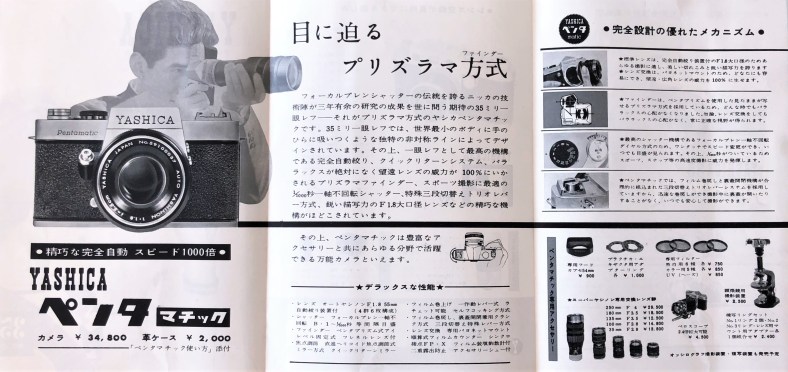
A nice example of Yashica’s first 35mm SLR – the Pentamatic. Also known as the Pentamatic ’35’ in its earliest advertisements and sales brochures. This particular camera is from August 1960 – the same month that Yashica started production of the Pentamatic II – a model that was destined for the Japanese home market and not for world export. The Pentamatic II stayed in production only until January 1961 when it was replaced a few months later with the Pentamatic S. The original Pentamatic was first produced in December 1959 but widescale production didn’t begin until January 1960. As of this update (Oct 11, 2018), I still haven’t found evidence of an instruction booklet printed in Japanese – only English booklets so far. I would think that there must be booklets in Japanese and at least 2 or 3 other languages but none found. The Pentamatic II booklet is in Japanese and no English editions have been found.

As always, thanks for stopping by and please check out my camera shop at http://www.ccstudio2380.com – Chris

Please respect that all content, including photos and text, are the property of this blog and its owner, Yashica Pentamatic Fanatic, Yashica Sailor Boy, Yashica Chris.

Copyright © 2015-2019 Yashica Pentamatic Fanatic, Chris Whelan
All rights reserved.

My First Pentamatic – the quest begins

It was “love” at first sight! Well, kinda like love – more like a very strong attraction.

The starkness of the Pentamatic’s design caught my eye straight away. Here was a Yashica the likes of which I’d never seen before.

I thought I would share a very popular image of my first Yashica Pentamatic. I say popular because it’s been viewed more times than anything else I’ve ever posted on my Flickr page.

yashica p1 in blue

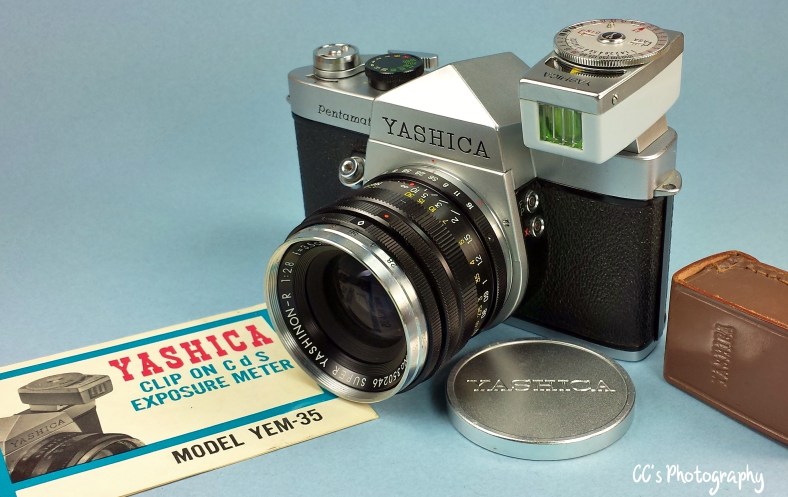
Designed in middle 1959, Yashica’s first 35mm single-lens reflex camera is a stunning beauty. It appears it was a collaborative effort between Yashica and Nicca with some “help” from the designers at Zunow. The first lenses for the Pentamatic were made by Tomioka and most carried the Yashinon name – a few, like this one, sported the Tominon branding along with Yashica’s Yashinon name. By the way, the serial number on this lens is fairly easy to “decode”. The first 2 digits indicate the focal length of the lens – in this instance, the lens is a 3.5cm wide angle so the first digits are “35”. The next 4 digits are a simple production number that I’m guessing started at “0001”. This lens would have been the 246th lens made (0246).

Thanks for stopping by! I hope this little tease is enough to cause you to explore my blog (and Flickr site) to learn more about the Pentamatic and its sister models – the Pentamatic II and the Pentamatic S. – Chris

Please respect that all content, including photos and text, are the property of this blog and its owner, Yashica Pentamatic Fanatic, Yashica Sailor Boy, Yashica Chris.

Copyright © 2015-2018 Yashica Pentamatic Fanatic, Chris Whelan
All rights reserved.