I saw this camera on Instagram and I was smitten. Look at it, LOOK!! Can you see it? It is very well camouflaged. I searched on eBay and low, there was one, just one…and it was in Japan. But it is an APS, dwindling film supplies. Then along came Asographic and there was new hope […]
Tag Made in Japan
How to date a pretty little Yashica… *
More exactly, how to decode the serial numbers on the Yashica YE 35mm rangefinder camera.
*Not an official Yashica dating site.
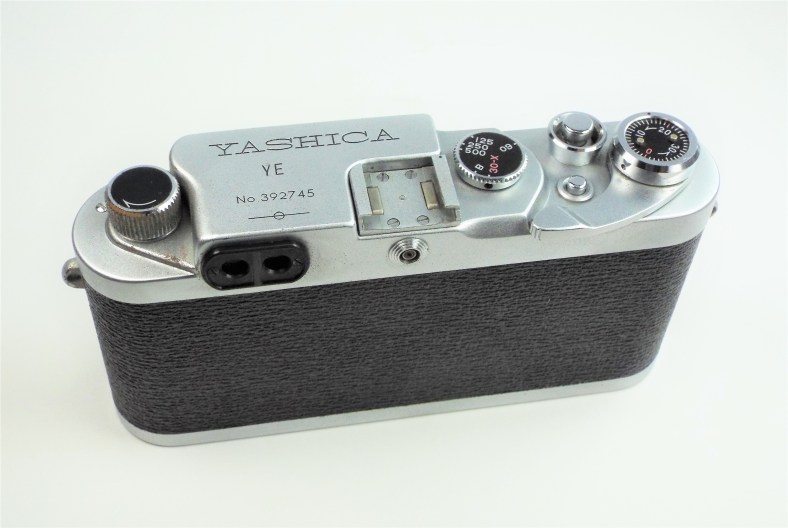
We touched on this briefly the other day, but the Yashica YE serial number might have a date code embedded in it. We say might have because we are working off only a 25 camera database – possibly not enough to make a definitive call.
In the example above, the serial number (No. 392745) appears to decode to: 3 = March, 9 = 1959 and 2745 = 2,745th made.
The earliest camera in our database is: (No. 128049) which would be 12 = December, 8 = 1958 and 049 = the 49th made.
The latest in the database is: (No. 699821) which is 6 = June, 9 = 1959 and 9821 = 9,821st made.
Reports on some sites on the Internet claim that only 4,000 cameras were made. The serial numbers, if consecutive and continuous would seem to contradict that. For the moment, let’s keep an open mind about the serial number decoding. More info is needed to fill in the December 1958 and post June 1959 production numbers from Yashica.
If you have some additional info or serial numbers to share, please feel free to share that with us.
Thanks!
Be sure to check out some of our fine art prints available at https://society6.com/ccstudio2380
Chris and Carol
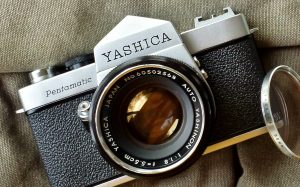
Finally! A Pentamatic II will be joining our Yashica family!
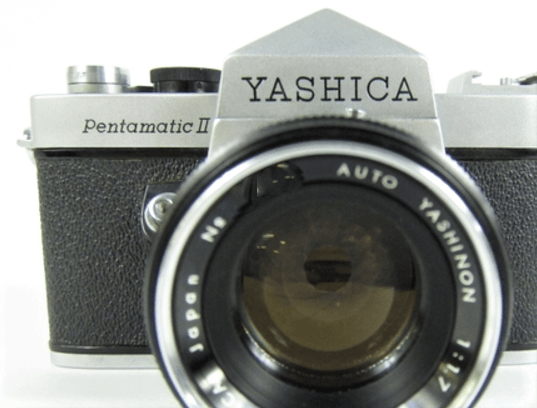
Success! After literally years of searching and countless missed bids, we’ve acquired a Yashica Pentamatic II. One of Yashica’s lowest production cameras – ever. Estimated at less than 5 thousand – and since it failed in the marketplace and wasn’t distributed outside of Japan, it wasn’t considered a collector’s camera and many were simply dumped whenever they broke. It’s hard to estimate how many exist today, but a wild guess would be around 1 to 2 thousand (and that may be high). Production started in August 1960 and for the most part ended in very early 1961 (late January) when the Pentamatic S came out worldwide.

Yashica Pentamatic II – the hardest Pokemon of all to catch!
Our camera has the original short lived Auto Yashinon f1.7 5.8cm lens. It also has the correct leather strap and strap hangers and comes with the original Yashica metal lens cap and lower leather case.
This has been a long chase – but fun! The camera was sold as “junk” – Yahoo Japan Auction speak for a camera that is not functioning properly or has not been fully tested. Sometimes junk cameras are little gems and sometimes they are as the word junk implies.
We’ll have more about our exciting find in the next few weeks as our little Yashica sails or flies across the Pacific to our studio (at many thousands of yen).
Thanks for your visit and stay tuned!
Chris ^.^
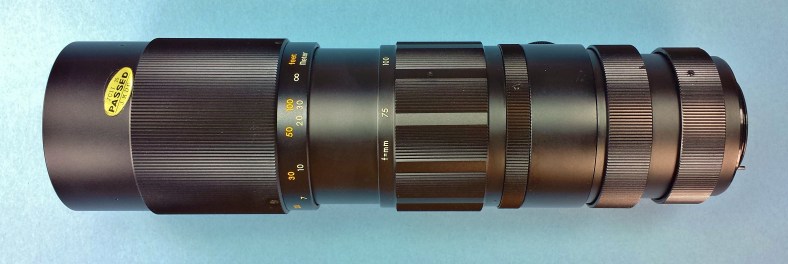
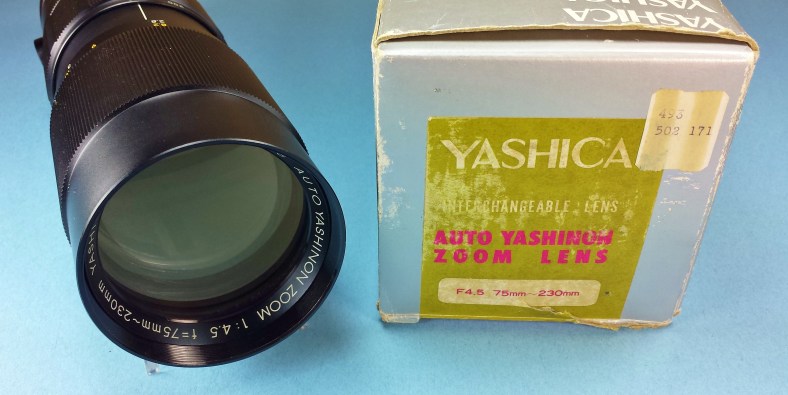
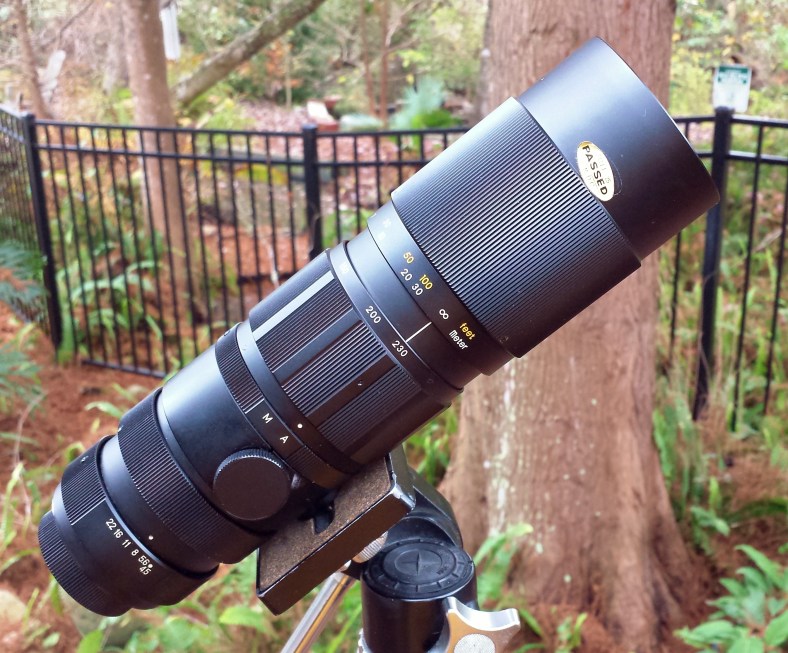
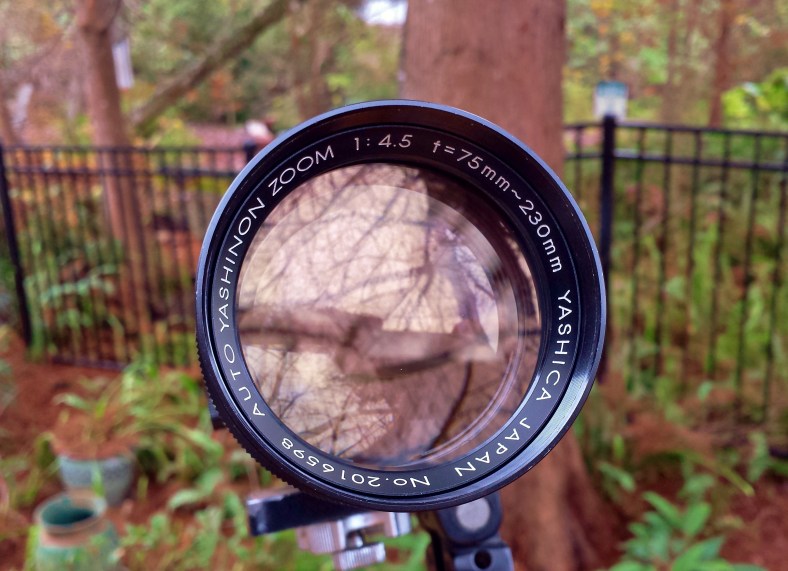
Yashica-Tomioka 75-230mm f4.5 Zoom Lens
One of Yashica’s largest zoom lenses – from the mid 1970s. M42 mount. Beautiful lens in mint condition with the original box and all papers. We’re waiting on our M42 to Fujifilm X adapter to arrive. Can’t wait to see what this can do on the Fuji X body.


It’s a large lens that’s easy to focus when mounted to the TL Electro X ITS body with its bright viewfinder. It might be a tad overwhelming when mounted to the Fujifilm X-A10. We’ll see.
Thanks for your visit and if you’re interested in purchasing some of our fine art photographic prints stop by https://society6.com/ccstudio2380
Thanks… C&C ^.^
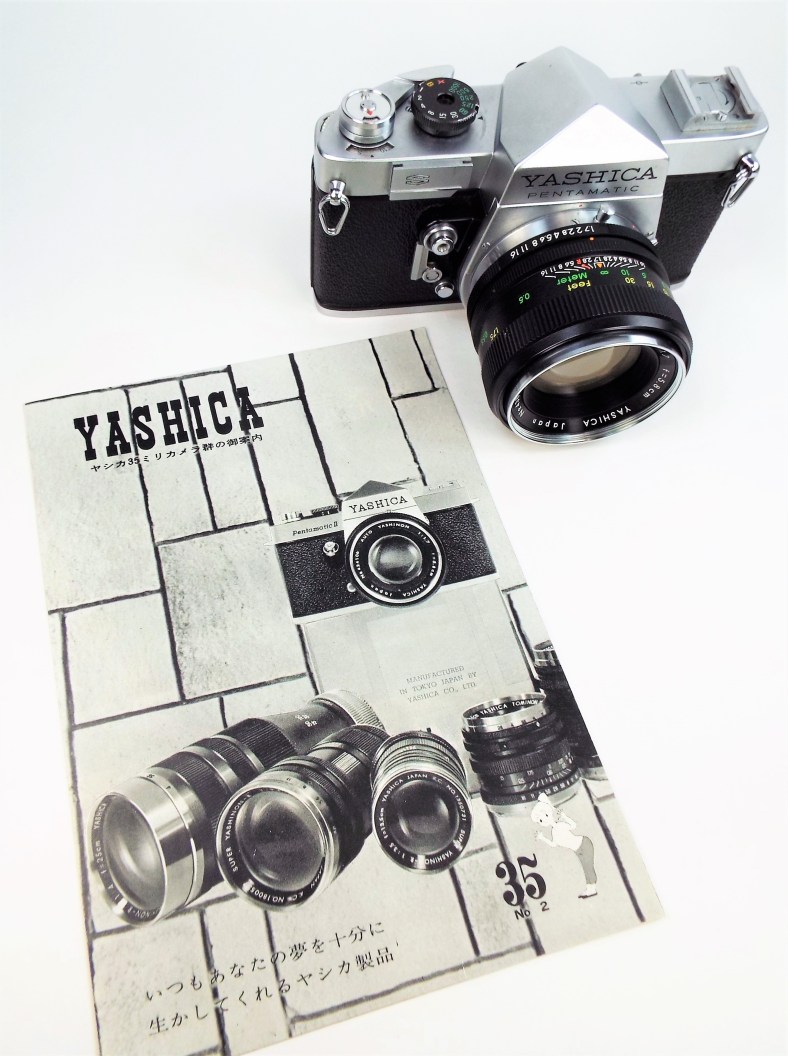
Japanese Pentamatic II Brochure
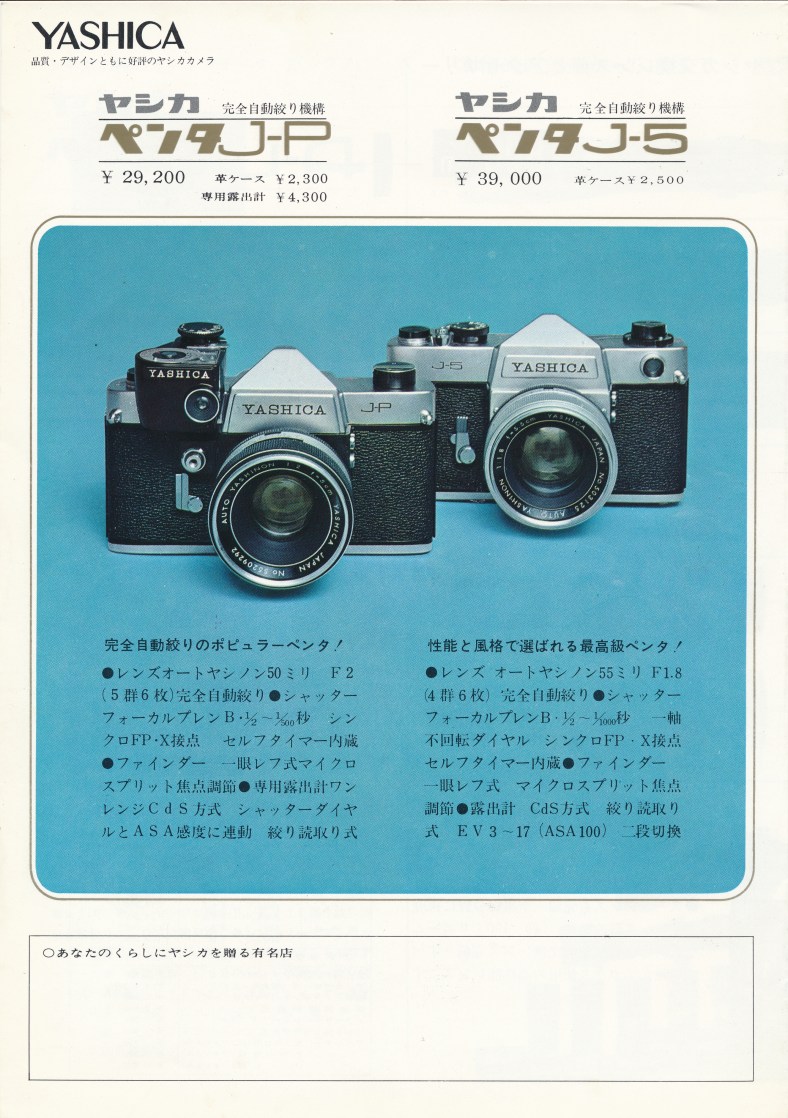
Sales brochure from early 1961. Rather rare (here in the US and I’m sure everywhere now) sales brochure for the Yashica Pentamatic II. It appears now, after much research and blind luck, that the Pentamatic II was for sale only in Japan and only for a few months. Studies of the body serial numbers and of the serial numbers of the exclusive lens for the Pentamatic II (many thanks to my friend Paul Sokk of http://www.yashicatlr.com fame) confirms this finding.

The Japanese market sales brochure from February 1961. Also pictured is the Pentamatic S from our collection.
It’s still a mystery to us as to why the Pentamatic II never made it to markets outside of Japan and why it was only available for a short time before the model S was released. Short of being able to interview a former member of Yashica’s marketing team, we may never know. We’re still searching for a Yashica sales brochure in English with the Pentamatic II featured. Obviously we’re also interested in sales brochure from any country outside of Japan for proof. Do you have one? We’d love to see anything – even an ad would be nice.
Many thanks!
Chris & Carol
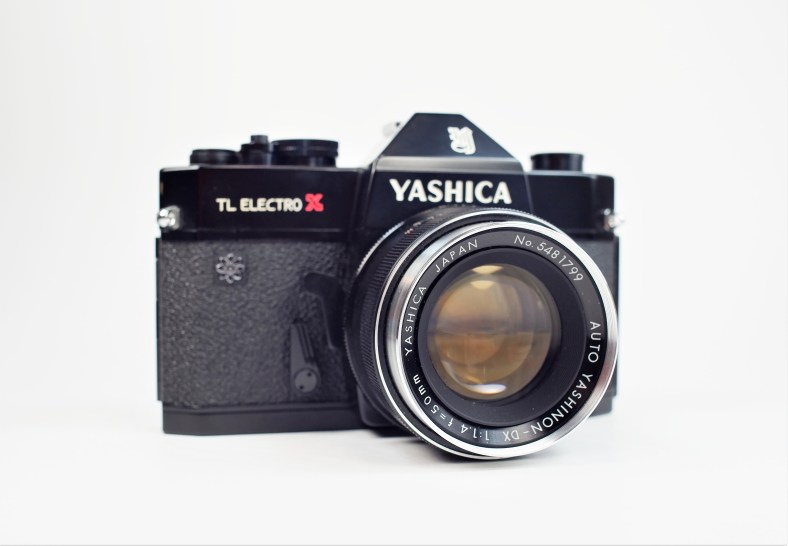
Yashica TL Electro X – Pro Black


Yashica’s most successful SLR… the TL Electro X set the standard for pioneering electronics in photography.
This nice example is from 1971.
Hybrid Camera: Fujifilm X-A10 with Canon FD 24mm f2.8 lens
Chris
Studio Sunday – Fujifilm X-Series
We recently found a slightly used Fujifilm X-A10 mirrorless camera with the APS-C sensor (without lens) on eBay for a very good price. Our goal was to use it, with an adapter, with some of our vintage Canon FD lenses in the studio.
We couldn’t be happier with the results – the adapter (FotodioX PRO) is solidly built and fits both the Canon lenses and the Fuji body nicely.

Our favorite lens in the studio at the moment is our Canon FD 24mm f2.8 SSC lens that we purchased in Japan in 1978. It is our “go-to” lens for film photography and it stands to reason that it would work out in the studio as well. With the APS-C sensor on the Fujifilm X-A10, the 24mm focal length is a 36mm equivalent so we get the nice wide view close-up we love.

f16

f2.8
In the two images above, the difference in the depth-of-field between f16 and f2.8 is dramatic – in the lower image the DOF is about 2 inches! The front of the lens is in sharp focus while the camera body is out of focus. Focussing is critical.

f5.6

The Yashica is the rather rare (outside of Japan) model A-III in gray on gray from 1959.
If you can find the X-A10 (body only) it makes the perfect poor man’s mirrorless set-up. 16.3 MP and the APS-C sensor is well suited for general photography and works extremely well in the studio.
Thanks for your visit and Happy SUNday y’all.
Chris
Yashica FR II by Camera Go Camera!
I have been exchanging emails with the owner of a great website about Yashicas. As I live in Japan I sometimes see hard to find models and have sent him a few. He wanted to do something in return, so I suggested he send me a camera in return. He did, and this is the […]
via Yashica FR II — Camera Go Camera
A must visit blog with great camera reviews and excellent photography! Check out her wonderful posts! Chris ^.^
Yashica Penta J and the J-P
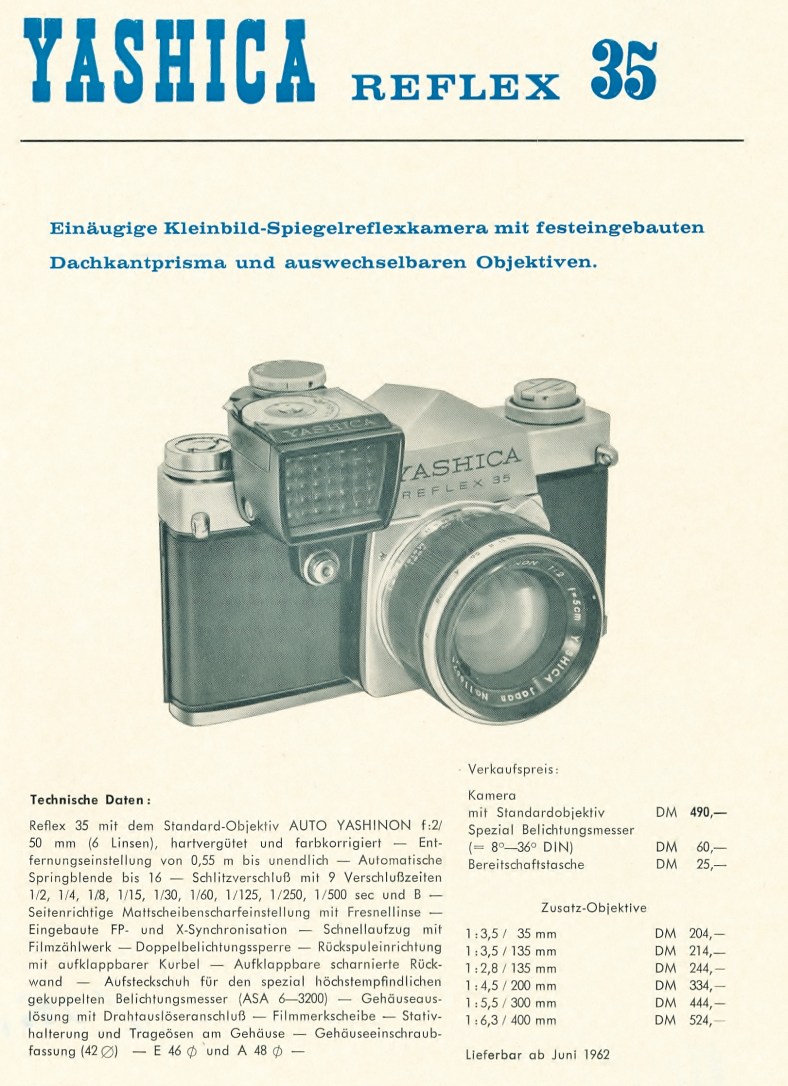
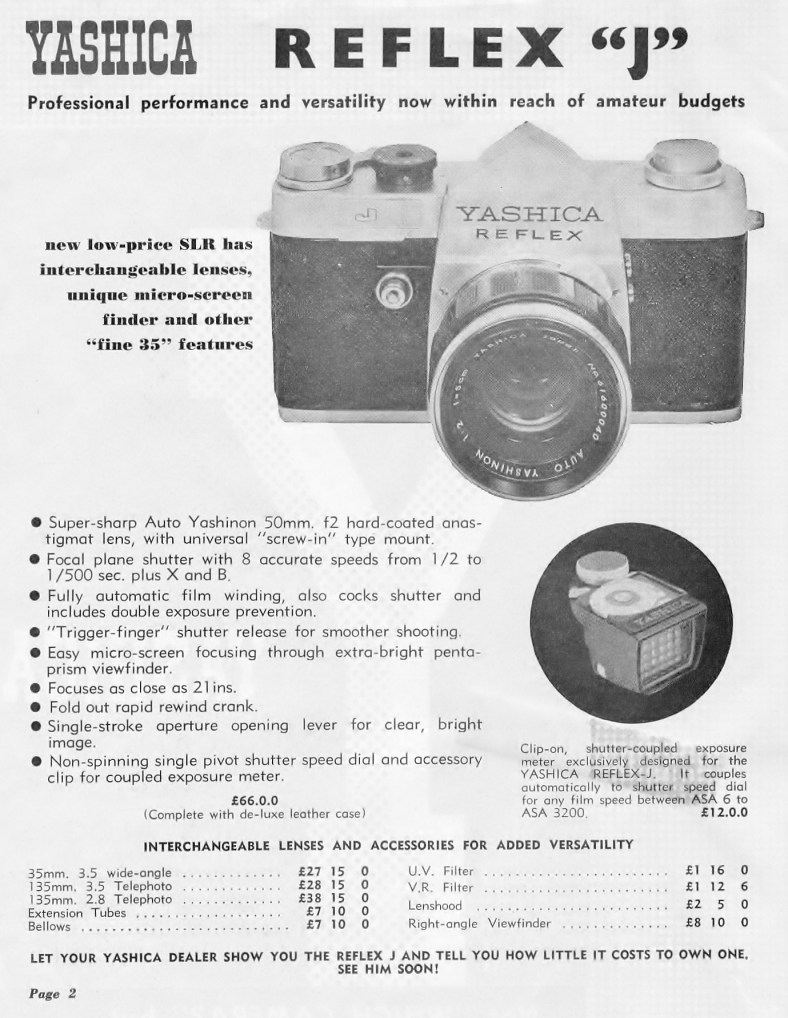
Yashica’s first 35mm single-lens reflex camera with the Praktica-thread (M42) mount lenses was the Yashica Penta J… at least here in the United States and in Japan. Elsewhere (most of the world) the camera was known as either the Yashica Reflex 35 or Reflex J (Australia and possibly the U.K.). As best we can tell, they were all the same cameras with different top plates to accommodate the different names (logos).
Part of the demise (lack of sales success) of the well-built Pentamatic series of cameras that preceded the Penta J, was that Yashica decided to go with a Pentamatic exclusive bayonet mount lens system. Sturdy and well designed to be sure, but being unique limited the available lenses that could be swapped between cameras. The Praktica design M42 screw thread mounting system was in widespread use at the time and Yashica’s bayonet design just went against the flow.


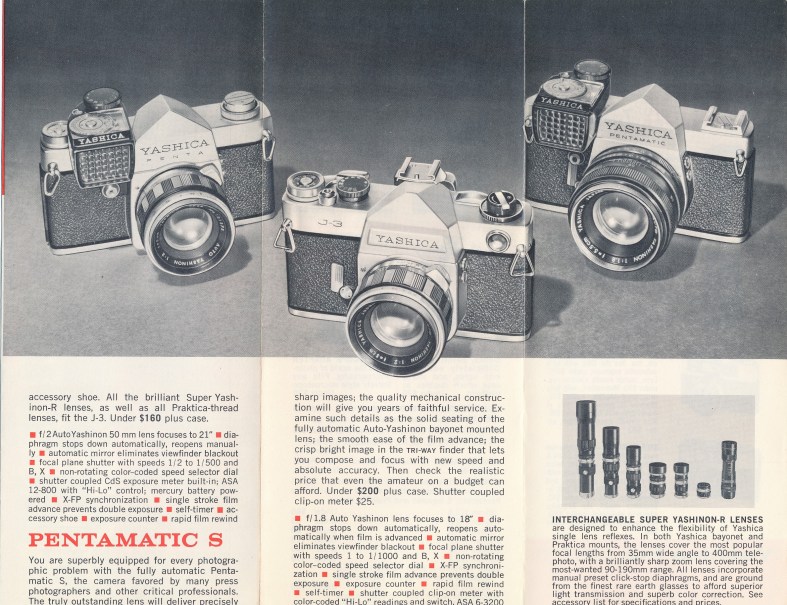
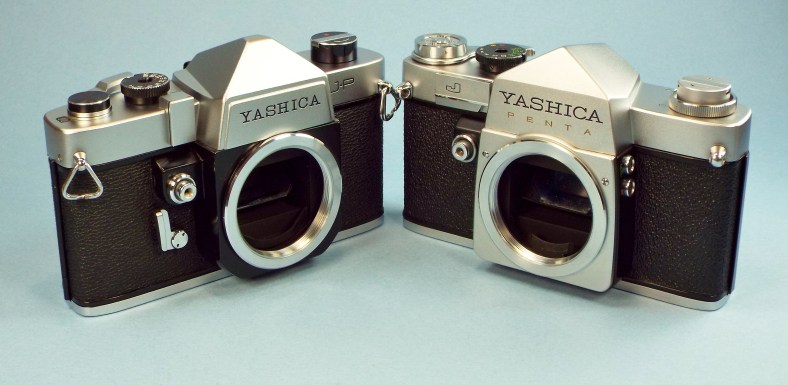
Now fast forward to 1965 ish… Yashica introduces the new J-5 AND the J-P! In between those years Yashica had introduced the J-3 and J-4. Why would Yashica go back in time and bring out another 35mm SLR in 1965 that was the cousin to the 1961 Penta J? Notice we say cousins… not brothers. They shared the same platform with one another but as you can see in the image below the top plates were of a different design.


Stay tuned… more to come on these Yashica classics.
Many thanks, Chris and Carol
Yashica Penta J – the Pentamatic that wasn’t!

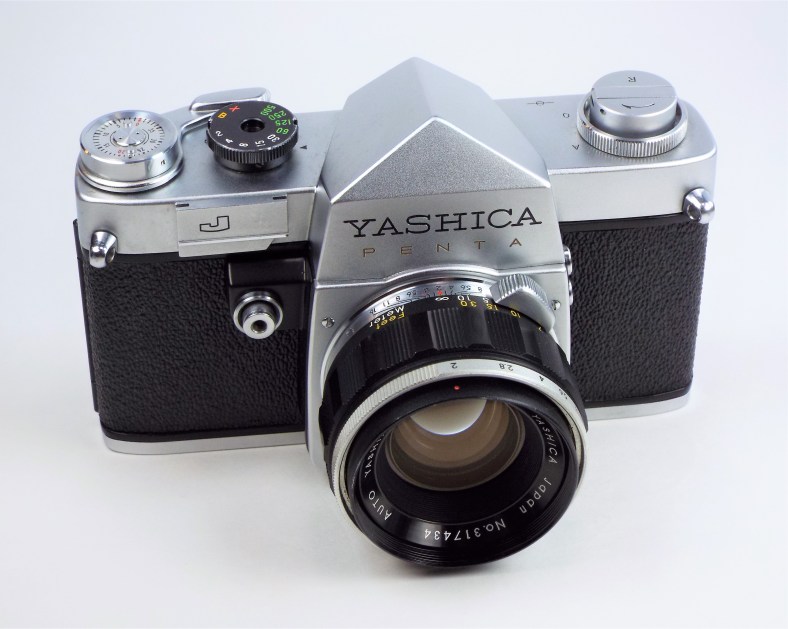
Clean design and simple controls. A stunning camera.
Released in 1962, the Penta J (Reflex 35 J in other markets) was Yashica’s first 35mm SLR designed to accept the popular M42 screw mount lenses vice Yashica’s exclusive Pentamatic bayonet mount that preceded it. The Penta J shared more body parts and took its design cues from the Pentamatic S (1961-62). Interestingly the Penta J lost the self-timer lever that the Pentamatic S fought so hard to get.

The Penta J was designed to accept a clip-on exposure meter that coupled to the shutter speed dial. No TTL metering – that was a long way off!

The ASA/DIN dial was not coupled to anything. It was a reminder to the photographer as to what the speed was of the film that was loaded in the camera.

The standard lens for the Penta J was the semi-automatic Yashinon 5cm f2 lens.
The Yashica Pentamatic S (below)… the Penta J’s cousin.

The Pentamatic S pictured with the standard lens for the Pentamatic II.

So there you have it. The Yashica Penta J and the Pentamatic S. Cousins in the Yashica family.
Comments? Please feel free to share what you know and what we may have missed. Thanks
Studio Camera: Fujifilm FinePix S9900W
Chris