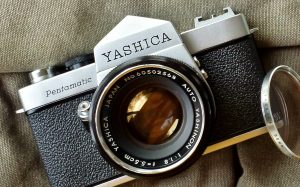
Happy SUNday! – Have you been flashed lately?

It’s easy to forget that at one time getting the right amount of light on your subject was no easy task…

Every one of us with a smartphone carries around a powerful “photo machine” in our pockets or purses. Not that long ago, well really a long time ago now when you think about it, these monsters were the epitome of high tech flash units and cameras in the 1950s and 1960s.
23804633236_80f738fa68_o (1)

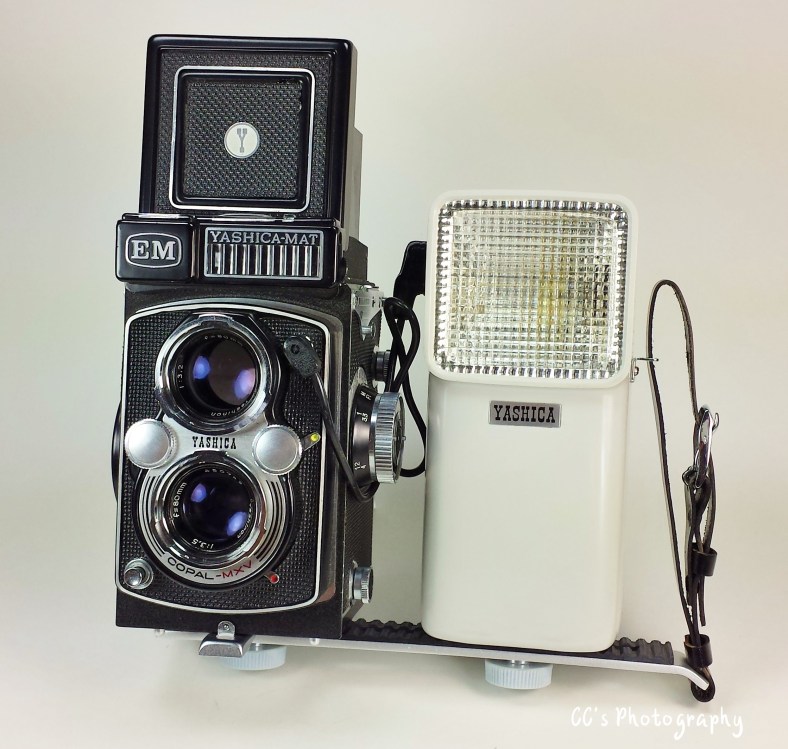
Yashica Mat EM – 1964

Pictured above are a fully functional Yashica-Mat EM and Yashica PRO 40 Quick-Lite electronic flash. This was “as-simple-as-it-gets” with a medium format camera in that era. The EM has a built-in exposure meter (not a thru-the-lens type) and the PRO 40 was a straight forward light machine. Both units together with the 8 AA batteries and a roll of 120 film weigh in at nearly 4 pounds! Yikes!

25051924236_c8965f9d22_o

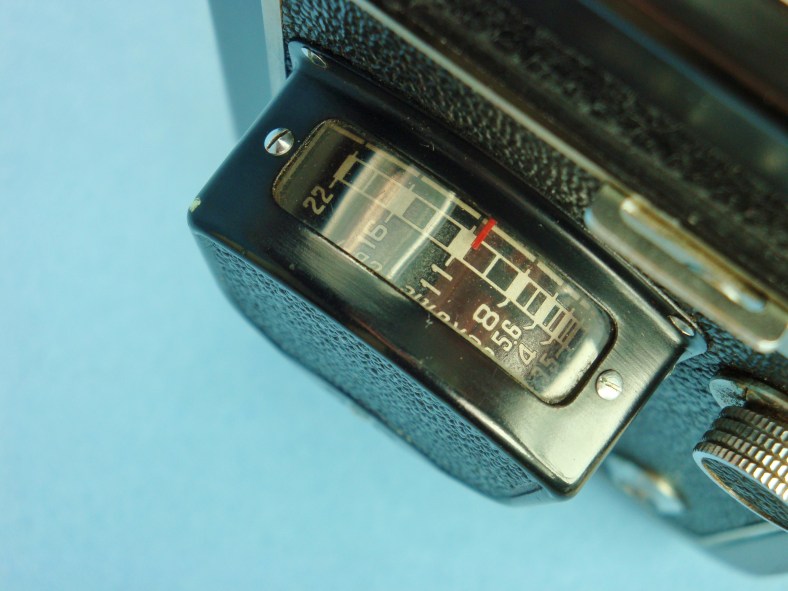
A close-up view of the exposure meter and scales on the Yashica Mat EM.

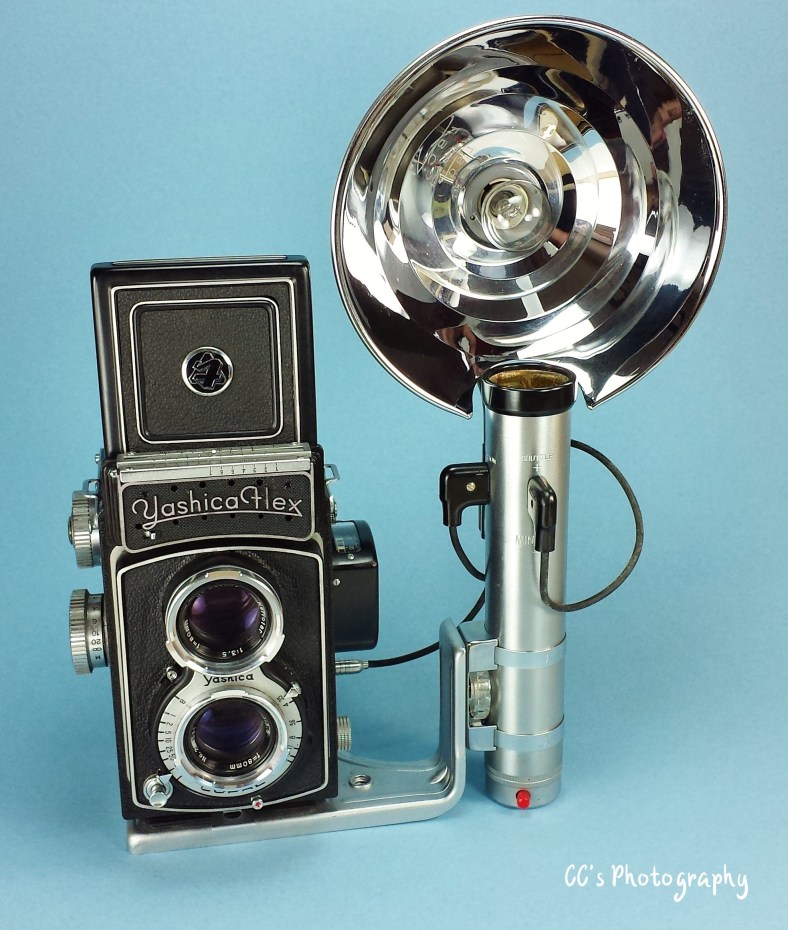
Going even further back in time, this Yashica Flex S is mated with a Minicam flash unit.
16663440081_0346b92713_o (1)

Yashica Flex S – 1956 with Minicam flash. Powered by two “D” cell batteries.

The Yashica Flex model S also has a built-in selenium cell light meter made by Sekonic (that little thingy attached to the side of the camera). The cells are located behind the nameplate flap which can be opened to gather more light in low-light situations.
15277870608_de84055002_o

The attached light meter made by Sekonic for Yashica. Here pictured on a Yashica AS-II camera.

The Minicam flash advertised itself as “sunlight at night”! If you can remember back to the days that these types of flash units were used you can agree – they did make “sunlight at night” as you were often blinded for quite some time afterward.

Thanks for stopping by and be sure to visit my camera shop at http://www.ccstudio2380.com for some great vintage cameras and photo gear. – Chris

Please respect that all content, including photos and text, are the property of this blog and its owner, Yashica Pentamatic Fanatic, Yashica Sailor Boy, Yashica Chris.

Copyright © 2015-2019 Yashica Pentamatic Fanatic, Chris Whelan
All rights reserved.


Heavyweights 1954-1955

DSCF8482 logo

On the left is the Fujicaflex Automat by the Fuji Photo Film Company – Fuji’s first and only twin-lens reflex (TLR) camera. On the right is the Yashica Flex S (aka Yashicaflex S) by Yashima Kogaku Seiki Company.

Yashima (later to be known as Yashica) went on to build TLRs until 1986 producing thousands encompassing over thirty models.

The Fujicaflex was under development by Fuji since around 1948 and the direction they took was to build a high-quality camera geared to the serious amateur and semi-professional photographer. By all accounts, it was a bust in the marketplace (way too expensive) as Fuji never attempted to follow it up with a second model and ending production in just about a year.

The Fujicaflex is noticeably larger than the Yashica Flex S – the Fuji weighs 1,323 grams and the Yashica comes in at 1,117 grams. Both cameras were weighed with a roll of 120 film loaded.

DSCF8485 logo

The Yashica Flex S was the first ever TLR with an attached exposure meter. I imagine you could say built-in as the meter’s cells were located behind the nameplate flap and were connected to the meter on the camera’s left side via wires. The non-coupled selenium cell meter was built by Sekonic and was marked “Sekonic CB-1”.

We’ll continue to feature the Fujicaflex in upcoming posts and hopefully soon we’ll be able to post some images taken with it. I’ve got a roll of Fujichrome Velvia 100 in it now.

Thanks for stopping by and be sure to check out some of our unique photo gear in our shop at http://www.ccstudio2380.com

Chris

1954… Yashica Flex Model S

When Yashima started making twin-lens reflex cameras in a small factory along the shores of Lake Suwa in Nagano Prefecture, they were but one of hundreds of “start-ups” entering the already crowded Japanese camera manufacturing business. Many would fail – and fail quickly they did. But little Yashima, with two brothers from Nagano at the helm, managed to take a big step – to make a second and then third camera.

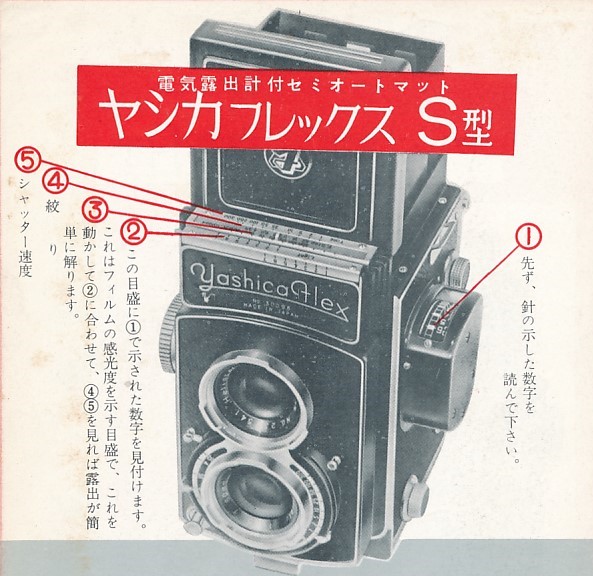
The first was the Pigeonflex (great name but how do you grow with a name like that), then came the Yashima Flex and Yashica Flex B. In 1954 (late) they built the now famous Yashica Flex Model S. The first TLR in the world with an attached exposure meter! Yep, in the world! None of the already established players had produced one like that. The meter was supplied by Sekonic and screwed to the side of the body and hidden light sensors under the name flap sent electricity to the meter. Bingo. Meter and camera merged! 1954

img_20161129_0004

Cropped scan from a rather rare (in the US) Yashima sales flyer for the Yashica Flex Model S. It’s one of the earliest pamphlets around for this camera.

The light sensing cells were built-in under the flap that was the nameplate. You would open the flap and the maximum amount of light would strike the cells and send an electrical signal to the meter  (#1 above). You then used # 2, 3, 4, and 5 to “compute” your exposure settings. Simple except that you needed the eyesight of an eagle to actually see the numbers on the scale. It it was real sunny out, you didn’t need to lift the flap to get an accurate reading – there were 12 holes in the flap that would let in enough light to set the exposure.

In a testament to the designers, many of these early exposure meters still function even after 6 decades of use. But, many have fail too mostly caused by a failure of the wire to meter connection. The cells are fine (no batteries, sun powered).

As always we appreciate your visit. We’re glad to share some of our collection of early sales material and of course to chat up our Yashima-Yashicas. In the spirit of fair play, we ask that you do not copy or post our images in your blog or post without our permission. Thanks.

Chris & Carol