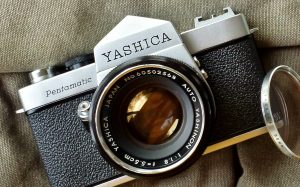
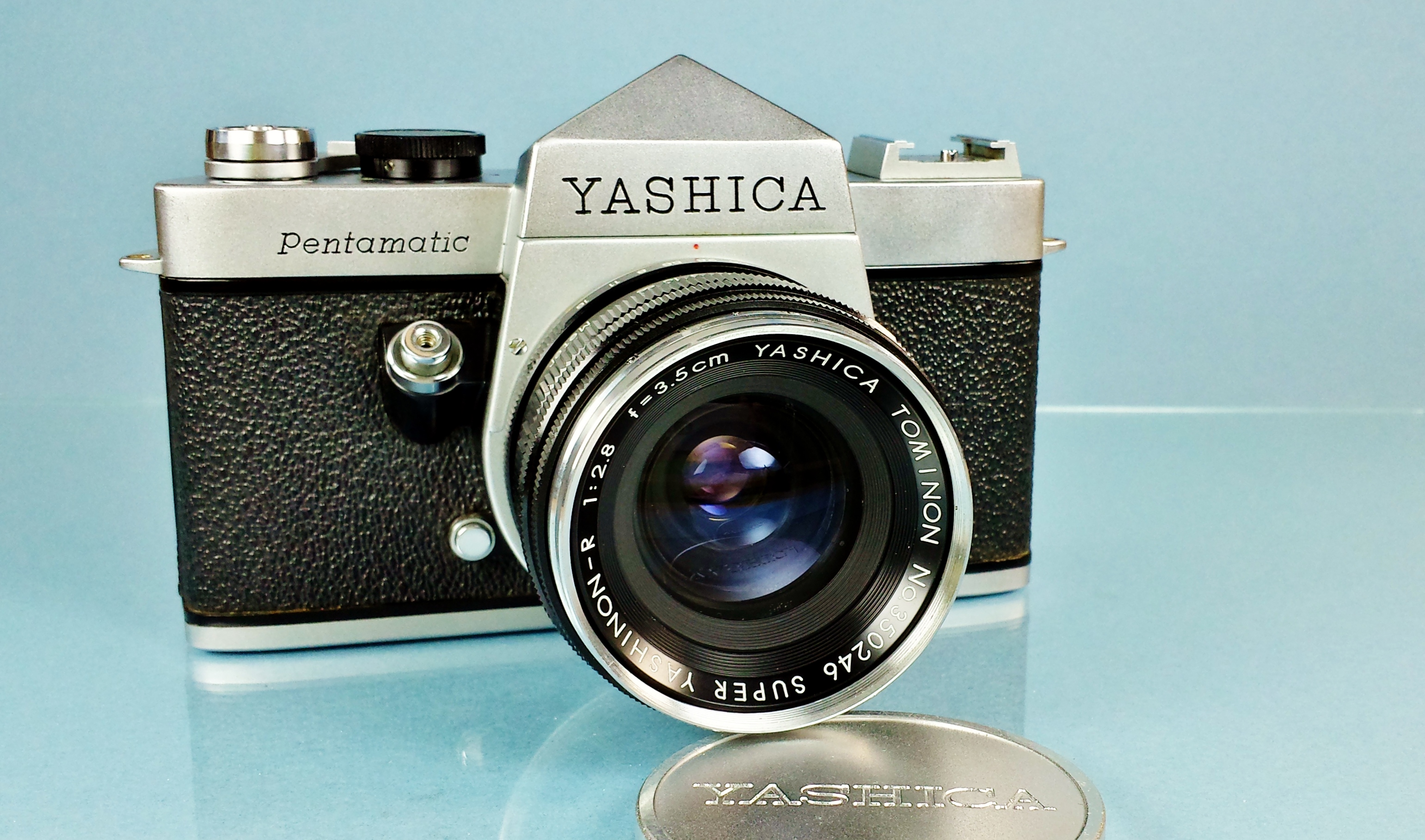
Yashica’s first ever 35mm SLR. Designed with the help from Nicca, the first Pentamatics were produced in late 1959 and made their debut in the US by the Spring of 1960. Tomioka Optical made a majority of the lenses that were used on all three models of the camera – Pentamatic ’35’, Pentamatic II, and the Pentamatic S. My good friend Paul Sokk has written an excellent piece about the development of this important camera for Yashica. Paul’s site can be found at http://www.yashicatlr.com/Pentamatic.html
Thanks for stopping by and have a happy and safe day!
Comments are always welcomed as I’ve learned quite a bit from reader feedback. As always, thanks for stopping by and while you’re at it, feel free to visit my camera shop at http://www.ccstudio2380.com (CC Design Studios hosted by Etsy). – Chris Whelan
Please respect that all content, including photos and text, are the property of this blog and its owner, Yashica Pentamatic Fanatic, Yashica Sailor Boy, Yashica Chris, Chasing Classic Cameras with Chris.
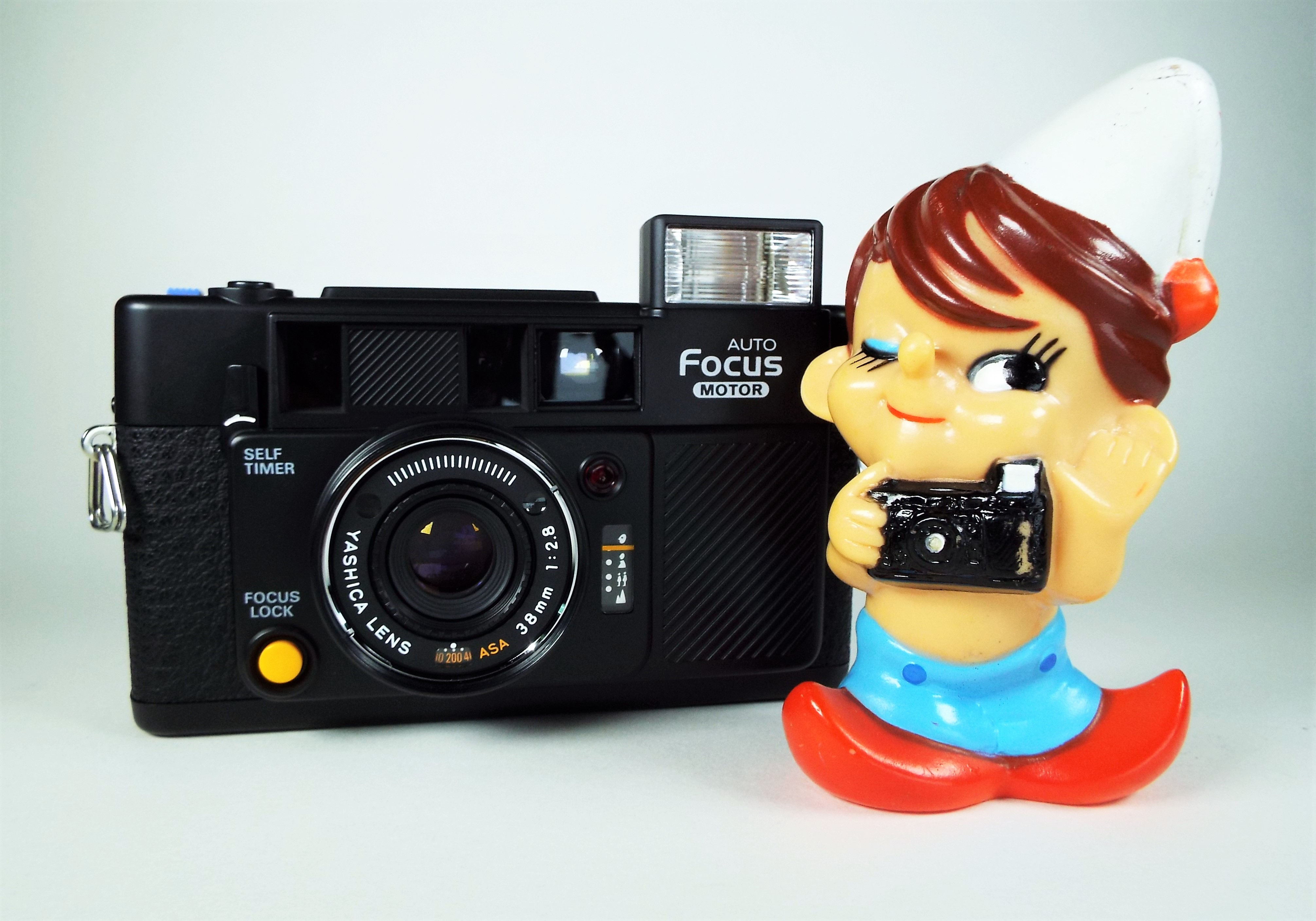
The Yashica ‘Sailor Boy’ advertising figurine was brought back for the launch of this nifty point and shoot compact. The figurine made its first appearance in 1962 and has cycled through a few retirements since his introduction. He’s holding that camera in this version of the ‘Sailor Boy’.
I’m not sure when Yashica started using the term ‘5 Star’ with this model as the only place I see it mentioned is on the original presentation box.
Comments are always welcomed as I’ve learned quite a bit from reader feedback. As always, thanks for stopping by and while you’re at it, feel free to visit my camera shop at http://www.ccstudio2380.com (CC Design Studios hosted by Etsy). – Chris Whelan
Please respect that all content, including photos and text, are the property of this blog and its owner, Yashica Pentamatic Fanatic, Yashica Sailor Boy, Yashica Chris, Chasing Classic Cameras with Chris.
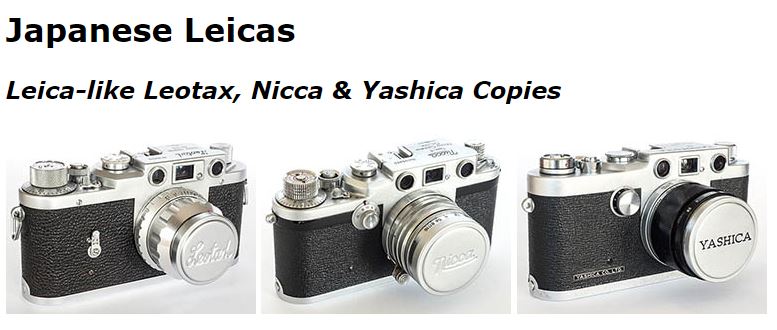
My good friend Paul Sokk in Australia has one of the best camera sites you’ll ever come across. Paul covers in great detail cameras from Yashica, Nicca, and Leotax to name just a few. Here’s the link to a rather new section that Paul added just recently. http://www.yashicatlr.com/LeicaCopies.html
If you decide to give his site a read be sure to let him know what you liked specifically and please share anything of interest as Paul is always seeking out new information and ideas to share with his readers.
Comments are always welcomed as I’ve learned quite a bit from reader feedback. As always, thanks for stopping by and while you’re at it, feel free to visit my camera shop at http://www.ccstudio2380.com (CC Design Studios hosted by Etsy). – Chris Whelan
Please respect that all content, including photos and text, are the property of this blog and its owner, Yashica Pentamatic Fanatic, Yashica Sailor Boy, Yashica Chris, Chasing Classic Cameras with Chris.
Comments are always welcomed as I’ve learned quite a bit from reader feedback. As always, thanks for stopping by and while you’re at it, feel free to visit my camera shop at http://www.ccstudio2380.com (CC Design Studios hosted by Etsy). – Chris Whelan
Please respect that all content, including photos and text, are the property of this blog and its owner, Yashica Pentamatic Fanatic, Yashica Sailor Boy, Yashica Chris, Chasing Classic Cameras with Chris.
I haven’t used my Fujifilm X-A10 mirrorless camera in a bit so tonight I thought I would dust it off (only an expression as I keep my gear clean) and try some new settings. The lens is a Super EBC XC 16-50mm f3.5-5.6 OIS II model which I believe is considered a kit lens. I did buy the body and lens separate though. It’s about the most inexpensive way to experience the Fujifilm X Series without breaking the bank. You can check it out in greater detail here.
My subject of the day is my recently acquired Contax RTS with it’s sexy new leather half-case from TP Original, color is “volcano”.
PROVIA film simulation mode, shallow depth of field, 5600K studio lighting.Shallow depth of field (again) focused on the from of the Yashica lens. Black & White film simulation mode, 5600K studio lighting.
I use the Fujifilm mostly for testing vintage lenses by using the appropriate adapters to mount the lens to the mirrorless camera body.
Here’s my Canon FD 28mm f3.5 lens mounted to the Fujifilm X-A10 using an adapter from Fotodiox.
Since I take lots of images for my listings in my camera shop I believe I’ll go back to using this camera and take a break from the camera I normally use. (Fujifilm FinePix S9900W)
Final image. This time I focused on the CONTAX logo and the shallow depth of field throws off the focus on the front of the lens and the RTS. Maybe only the “TAX” is in true focus.
If you’re looking for a simple and potentially inexpensive mirrorless body than I highly recommend this camera from Fujifilm.
Comments are always welcomed as I’ve learned quite a bit from reader feedback. As always, thanks for stopping by and while you’re at it, feel free to visit my camera shop at http://www.ccstudio2380.com (CC Design Studios hosted by Etsy). – Chris Whelan
Please respect that all content, including photos and text, are the property of this blog and its owner, Yashica Pentamatic Fanatic, Yashica Sailor Boy, Yashica Chris, Chasing Classic Cameras with Chris.
My good friend Paul Sokk from Australia has complied a wonderful site dedicated primarily to the history (in great detail) of the Yashica TLR and its place in the overall history of this great Japanese company. Paul’s research has many branches and this is one of his latest.
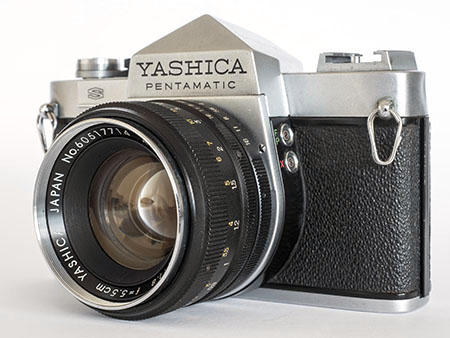
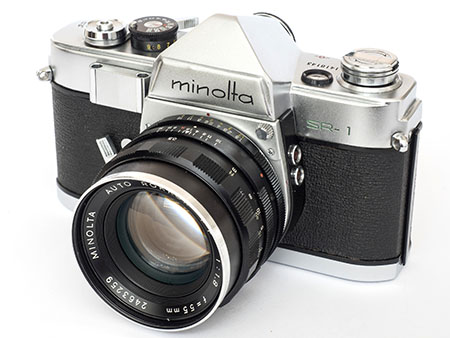
Comparison of Yashica and Minolta SLRs
Yashica Pentamatic SMinolta SR-1
(1961 Pentamatic S and 1962 Minolta SR-1, same body as 1958 SR-2 but with 1/500 top speed and by now, exposure meter mount like the Yashica plus fully automatic aperture.)
Why Minolta models? Similar specs, some parallels in market positions but an SLR success story at the time. Minoltas were made by Chiyoda Kōgaku (adopting its camera’s name in 1962) which was a much older photographic company than Yashica with it’s origins dating back to 1928. Yashica was Japan’s largest TLR maker, since 1958 looking to expand further into 35 mm. Chiyoda Kōgaku was probably Japan’s second largest TLR maker, a little more upmarket than Yashica but significantly lower volumes. On the the other hand, it was involved with other formats and had been making 35 mm rangefinder cameras since 1947. Neither were top tier makers at Nikon/Canon level but both had aspirations in that direction.
In 1958, Chiyoda Kōgaku released its first SLR, the Minolta SR-2. It offered no firsts but was noteworthy because it brought together all the advances in basic SLR camera design so far, except for the fully automatic aperture introduced by Zunow in the same year. In several ways, it was a more modern camera than the well-received Pentaxes from the period. Apart from including automatic film counter reset and a self-timer, the specifications were very similar to Yashica’s Pentamatic released in 1960 including a proprietary bayonet lens mount and the need to wind on the film to open the aperture again after it had automatically stopped down. In the late 1950s, even accomplishing the first half automatically was a major step so Minolta can perhaps be forgiven for initially calling their camera “automatic” but by 1960-61, it was marketing hyperbole for both makers.
Although well regarded and advanced for the time, it was expensive and competitors were challenging so Chiyoda Kōgaku followed up in 1959 with a budget version, the SR-1, which replaced the standard f/1.8 lens with an f/2 version (reverting to f/1.8 in 1962 as in the example above) and dropped the 1/1000 top speed to 1/500. Whilst the other specs and appearance remained the same, the lens line-up, particularly the auto lenses, was steadily increasing. The price of the SR-1 was much closer to the coming Pentamatic and whilst the sales of the flagship model were not earth shattering, the SR-1 sold truck loads. In 1961, the slightly updated SR-2 replacement, the SR-3, and the budget SR-1 both adopted fully automatic aperture diaphragms.
The table below compares features and price. In some respects the features are not all that different at first release. However, the Minolta SLR models had two years head start to establish themselves, as did other worthy competitors. In comparing the final 1961 cameras, the Minolta SR-3 with f/1.8 lens was the same price as the Pentamatic S. Both now had a self-timer and a mount for an external shutter coupled exposure meter (as did the SR-1 and Minolta even offered to upgrade earlier versions of the SR-1). The Minolta still had the advantage of the auto counter reset and later in the same year came the fully automatic diaphragm. It had 4 auto aperture accessory lenses and 7 preset lenses available, the Yashica just 5 preset lenses (the actual number of lenses is slightly rubbery depending on when they became available). The Yashica simply did not seem to offer enough at its price point to be a compelling newcomer.
Feature
Minolta SR-2
Minolta SR-1
Minolta SR-3
Yashica Pentamatic
Yashica Pentamatic II
Yashica Pentamatic S
Release
1958
1959
1960
1960
1960
1961
Aperture
Semi- auto
Semi, auto in 1961
Semi, auto in 1961
Semi auto
Auto
Semi auto
Shutter
1/1000
1/500
1/1000
1/1000
1/1000
1/1000
Lens
f/1.8
f/2, f/1.8 from 1962
f/1.8 f/1.4
f/1.8
f/1.7
f/1.8
Reset
Auto
Auto
Auto
Manual
Manual
Manual
Self-timer
Yes
Yes
Yes
No
No
Yes
Meter Mount
No
From 1962
Yes
No
No
Yes
No. of Accessory Lenses at Release
3 preset
4 auto, 2 preset
4 auto, 7 preset
2 preset
5 preset
5 preset
Price USA
$249.50
$169.50
$199.50 $229.50
$159.95
n/a
$199.95*
* guess, advertised at “under $200 plus case”
Paul’s entire site features this kind of detail with little known facts about some familiar and not so familiar cameras. Please give Paul a shout out by visiting his site athttp://www.yashicatlr.com
Thanks for stopping by and have a beautiful day!
Comments are always welcomed as I’ve learned quite a bit from reader feedback. As always, thanks for stopping by and while you’re at it, feel free to visit my camera shop at http://www.ccstudio2380.com (CC Design Studios hosted by Etsy). – Chris Whelan
Monster glass from Tomioka. The lens has a super low serial number that puts it within the first few months of production. The camera is the Yashica TL Electro X – ITS made in April 1973.
This image first posted on my Flickr site in November 2019 and so far has been a very popular image amassing over 70 favorites. Image was taken with my Samsung Galaxy S8+ using natural light.
Comments are always welcomed as I’ve learned quite a bit from reader feedback. As always, thanks for stopping by and while you’re at it, feel free to visit my camera shop at http://www.ccstudio2380.com (CC Design Studios hosted by Etsy). – Chris Whelan
Please respect that all content, including photos and text, are the property of this blog and its owner, Yashica Pentamatic Fanatic, Yashica Sailor Boy, Yashica Chris, Chasing Classic Cameras with Chris.
My Contax RTS (Real Time System) 35mm SLR camera with its new “skins”. These cameras which were first released back in 1975 are notorious for shedding their original factory applied coverings. If you search online selling sites you’ll find plenty of these cameras for sale but very few have their leatherette covers still attached as they tend to peel away from the metal bodies and shrink (dry out) over time. The good news is that the old coverings are a breeze to remove and there’s a wide selection of aftermarket replacement options to choose from. Black is no longer the only color as bold colors like red, blue, and even green have become popular and textures like lizard skin to well, whatever you think you may like. I wanted to stay with the more traditional look and feel so I went with recycled leather from Hugo Studio’s Custom Camera Covers (hugostudio.com).
The previous owner of my RTS had attempted to reattach the original leatherette with some type of contact adhesive but even that failed over time. Yashica’s choice of coverings just didn’t stand the test of time no matter how they were reattached.
While waiting for the new coverings to arrive I added a new to me Yashica ML 50mm f1.7 lens which I was able to chase down in near mint condition. I went with the Yashica made (likely Tomioka-Zeiss) f1.7 based solely on cost. The original Carl Zeiss designed glass for the RTS is way out of my comfort zone pricewise so I went with what I know. Besides, both lenses were made in Japan probably on the same factory line by Yashica anyway.
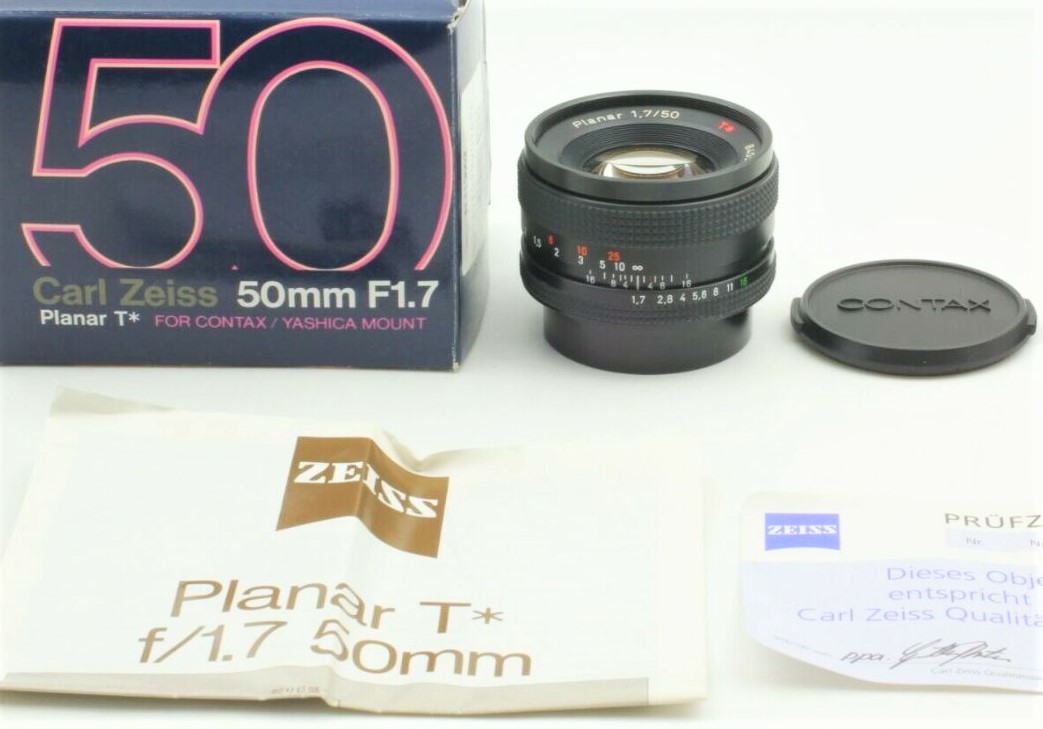
This would be the standard lens that would have been on the RTS. Here is an empty box that I found for sale on an auction site with everything but the lens. A nice find for any serious collector (and if I had the lens I would buy this in a second).Here’s a nice Zeiss lens kit that sold recently from a seller in Japan for around $280.
So there it is. Recovered and looking much better. Now to recover the data back so everything matches.
Contax Data Back for the original RTS with it’s slightly detached leatherette.
Comments are always welcomed as I’ve learned quite a bit from reader feedback. As always, thanks for stopping by and while you’re at it, feel free to visit my camera shop at http://www.ccstudio2380.com (CC Design Studios hosted by Etsy). – Chris Whelan
Please respect that all content, including photos and text, are the property of this blog and its owner, Yashica Pentamatic Fanatic, Yashica Sailor Boy, Yashica Chris, Chasing Classic Cameras with Chris.
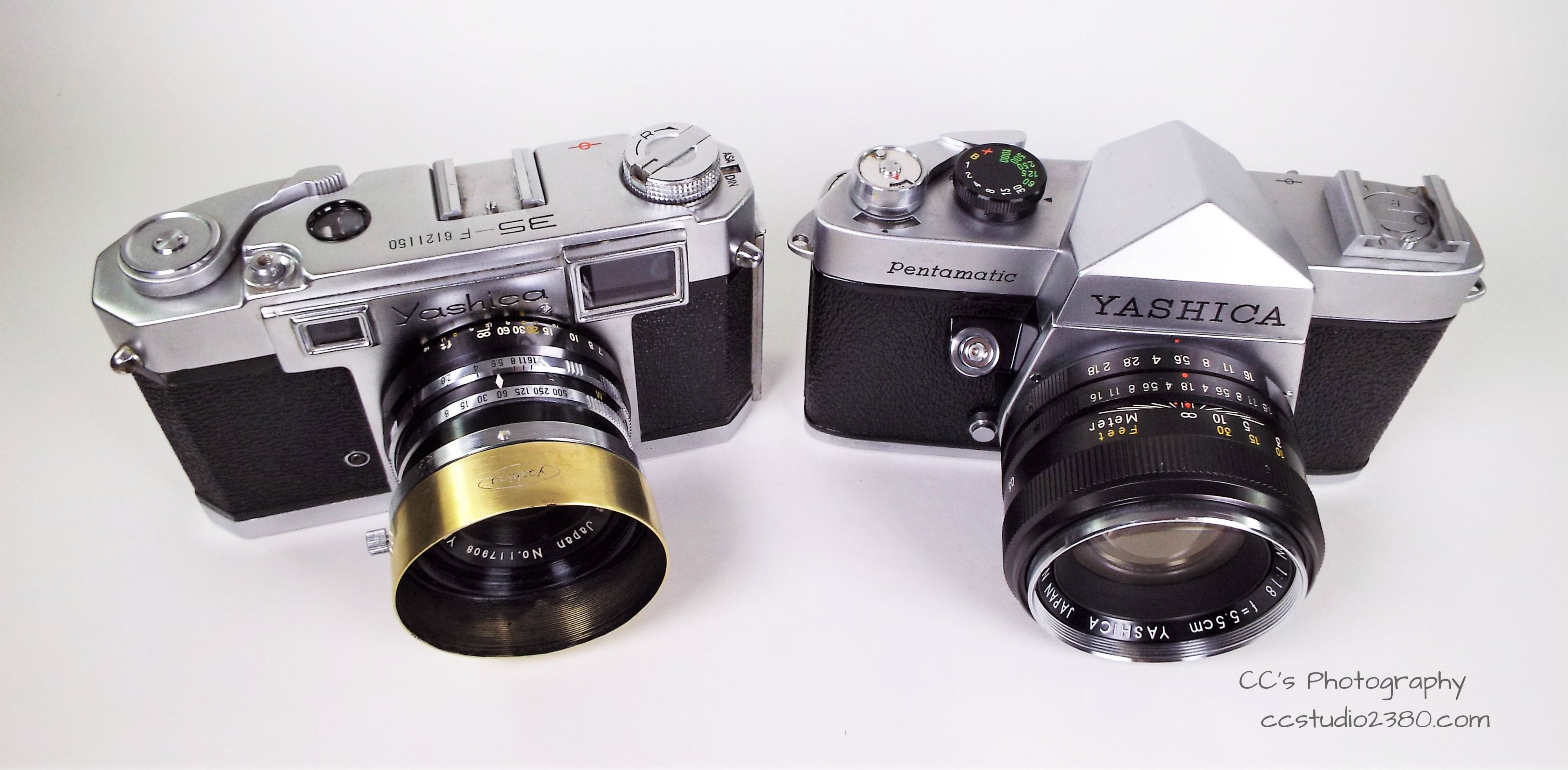
On the left, the Yashica ’35’ released in 1958 was Yashica’s first 35mm rangefinder (fixed lens) camera and on the right the Pentamatic ’35’ which was Yashica’s first 35mm single-lens reflex (SLR) camera. The Pentamatic was designed in 1959 and released by the Spring of 1960. Up to this point Yashica was know for building high-quality value priced twin-lens reflex (TLR) cameras. These two handsome examples are proudly displayed in my collection. The good news if you’re chasing these classics are that the rangefinder model is readily available online with many excellent examples for sale. The Pentamatic is not hard to find but chasing down a solid working model is a bit harder.
Comments are always welcomed as I’ve learned quite a bit from reader feedback. As always, thanks for stopping by and while you’re at it, feel free to visit my camera shop at http://www.ccstudio2380.com (CC Design Studios hosted by Etsy). – Chris Whelan
Please respect that all content, including photos and text, are the property of this blog and its owner, Yashica Pentamatic Fanatic, Yashica Sailor Boy, Yashica Chris, Chasing Classic Cameras with Chris.
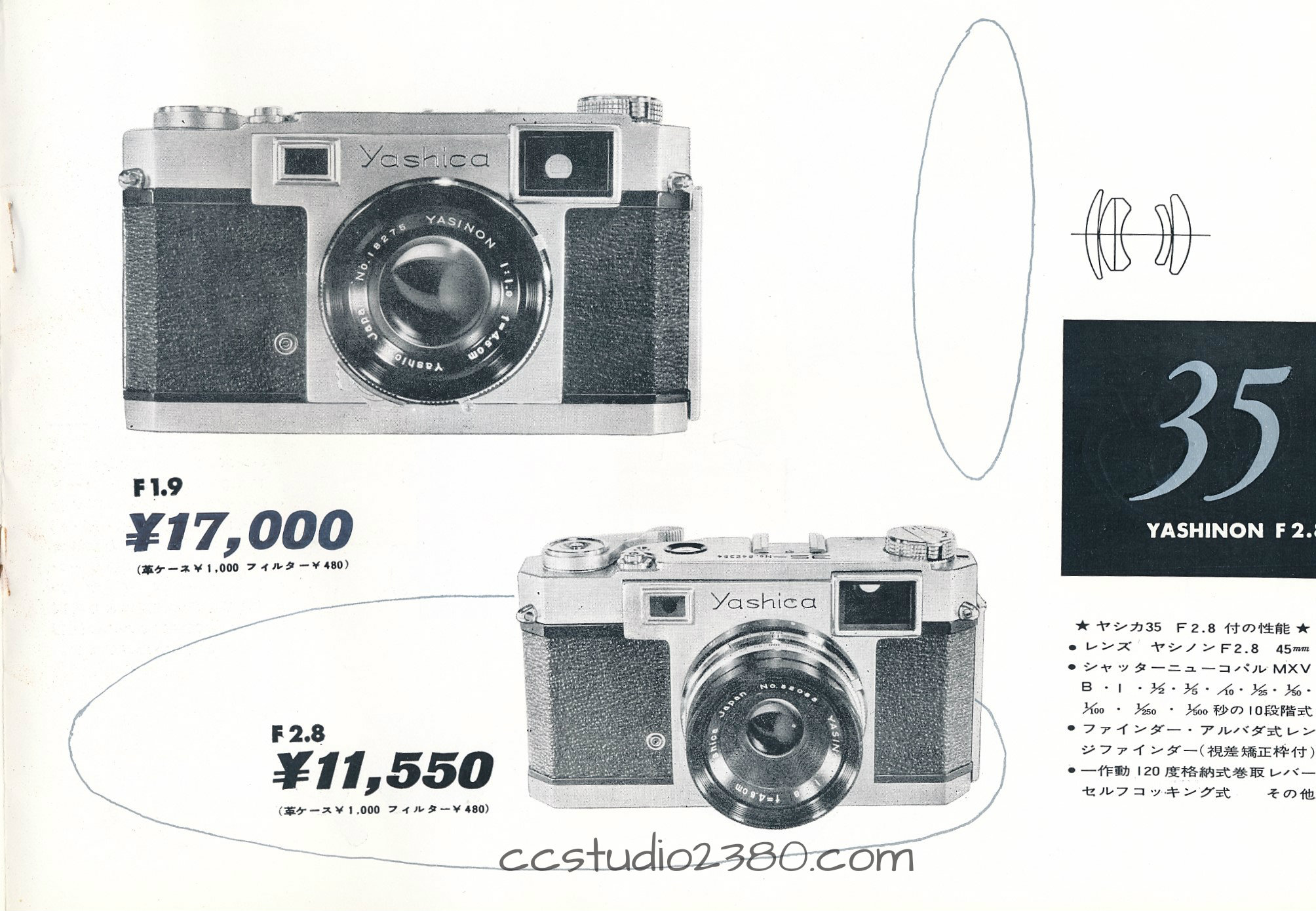
63 years of dirt. Here’s the before image of my recently acquired Yashica 35 by Yashima. It was made in April 1958 which makes it one of the earliest known examples of this historic camera. Sharp eyed viewers will also notice that the lens says Yasinon vice the name that was eventually used, Yashinon.
Nice and clean now. This one was assembled in April 1958 at Yashima’s Shimosuwa factory on the shores of Lake Suwa, Nagano Prefecture, Japan.
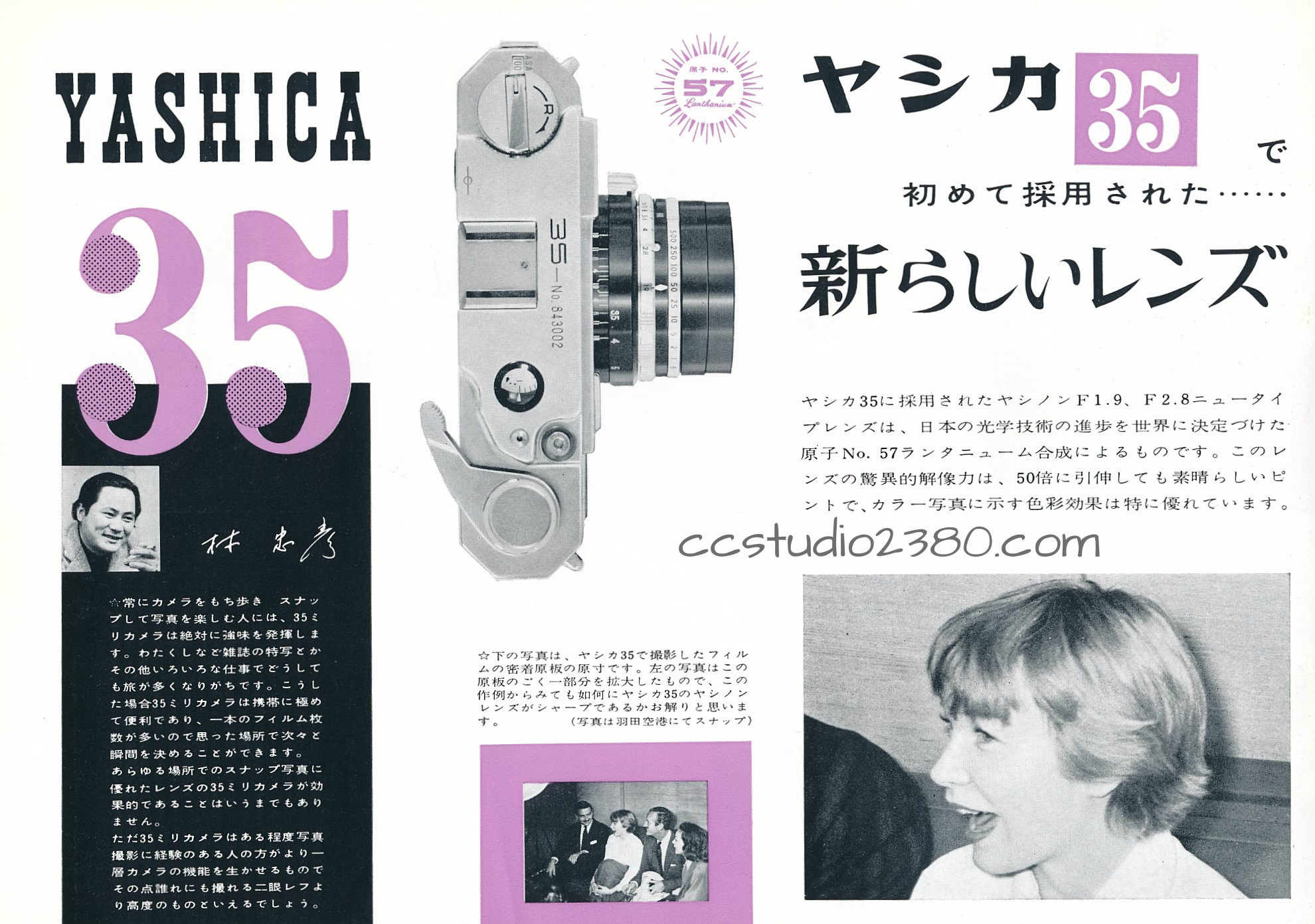
This one features the Yasinon (vice Yashinon) f/1.9 lens. It’s one of the earliest known examples still in the wild. Earliest known advertisement.
Comments are always welcomed as I’ve learned quite a bit from reader feedback. As always, thanks for stopping by and while you’re at it, feel free to visit my camera shop at http://www.ccstudio2380.com (CC Design Studios hosted by Etsy). – Chris Whelan
Please respect that all content, including photos and text, are the property of this blog and its owner, Yashica Pentamatic Fanatic, Yashica Sailor Boy, Yashica Chris, Chasing Classic Cameras with Chris.












 Chasing Classic Cameras with Chris