1955 Camera Case Mystery

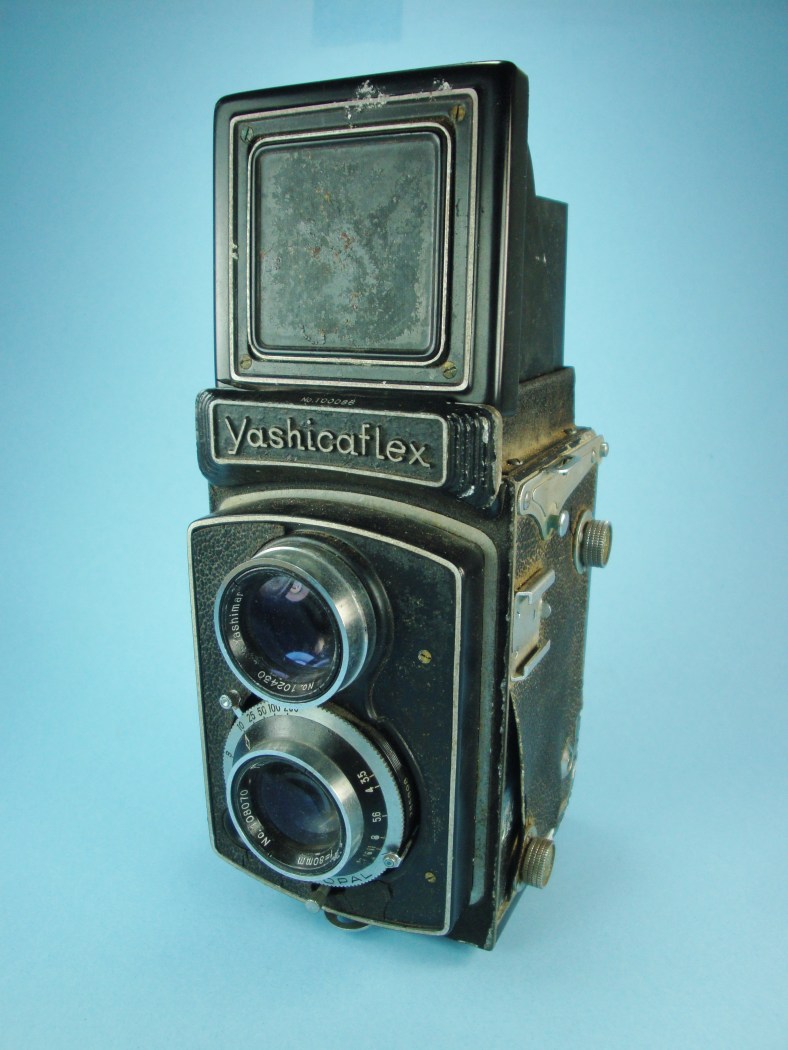
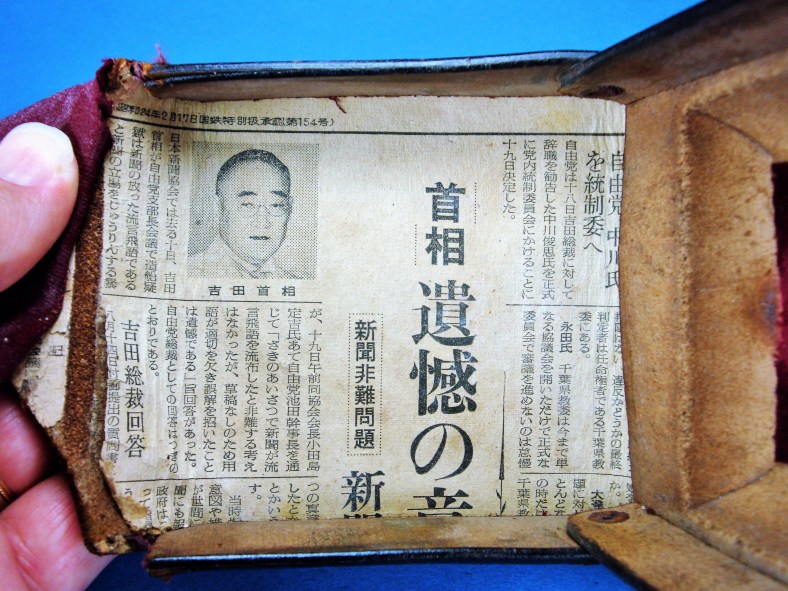
During a recent restoration of our 1955 Yashicaflex A-II twin-lens reflex camera, we discovered that the leather case held an interesting surprise!
15070722327_0d4b9e785b_o

The thread below is taken from our Flickr page (Yashica Sailor Boy).

Chris “As part of a restoration of my c1955 Yashima (Yashica) twin lens camera’s leather case, I discovered that the red felt material inside the case used backing made from Japanese newspapers! Leave it to the Japanese during the mid 1950’s to make good use of something that would normally have had one use and then thrown away here in the West. What really surprised me was how easy the felt pulled away from the newsprint without destroying the paper. I hope to get the writing translated… maybe some interesting clues as to where the case was made and when.”

Chris “The leather case was made for a Yashica Flex model A-II from 1955. The camera was purchased from a seller from Hiroshima, Japan. The camera was made in Tokyo and I am not sure if Yashima (Yashica) made their own leather cases or if they were made by a supplier. Maybe the newspaper will yield some clues as to where.”

Chris “I now know that it is a picture of Prime Minister Yoshida. This was a special edition newspaper made for (?) the Japanese National Railways (JNR). It appears that the paper is dated 17 February 1949. ‘Special Treated Approval Number 154 Issue’.”

Ken “The caption at the top actually records the newspaper’s national railways special handling permit #154, and does not identify the actual date of the issue in question. The article has to do with a controversy the prime minister created when he criticized a newspaper for allegedly spreading rumors about a political scandal concerning the shipbuilding industry. The scandal erupted in January 1954 and became one of the main causes of the fall of Yoshida’s government. It is not clear which newspaper this article comes from, but from the anti-government tone of the writing it is possibly the Asahi.”

Chris “Thank you so very much KenjiB_48. It helps to know this as it makes more sense for the Japanese company that made the leather case would have used a current (1955) newspaper for a camera made in 1955.”

15070781568_4fc3b2577b_o

The inside front of the leather case held a similar surprise. It would appear that in the mid 1950s, some Japanese manufacturers found ways of recycling almost everything produced. Used newspapers, I would think, could be had for free. Why not use them for backing the felt to the leather. Pretty smart!

Thanks for your visit!

Chris ^.^
Costly Mistake…

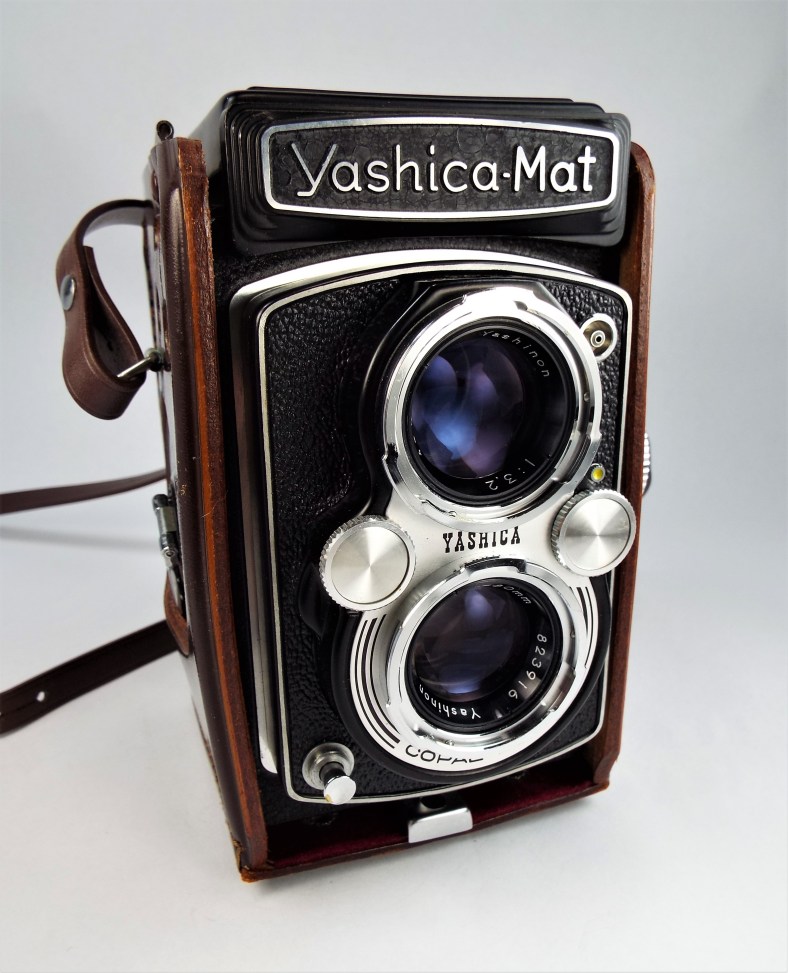
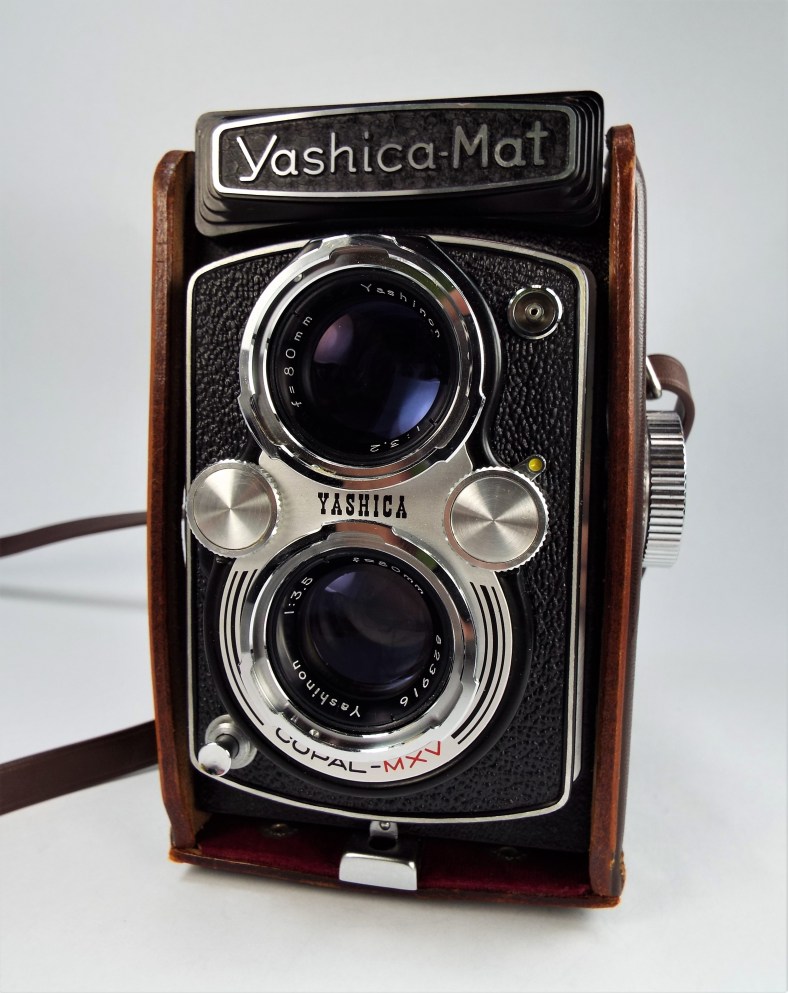
It’s the best looking non-working Yashica TLR in our collection! There. Got that out of the way. This Yashica-Mat medium format camera is from 1968 and is in mint condition. The Mat had a super long run for Yashica – 1957 to 1973. Lots of pretty Mats out there to be had. Lots of dogs too. Sometimes the dogs work great and sometimes the pretty ones are dead in the water (DIW).

This one is DIW (nautical term meaning not moving). In my haste to add a good looking Mat to our collection, I overlooked a fatal flaw that often happens with these cameras…

dscf3332

Do you see the flaw that I missed?

How about now?

dscf3331

Look closely… do you see it yet?

How about more of a hint?

dscf3333

Okay, I’ll point it out.

dscf3334

Missing self timer lever. Did you see it right away? Pat yourself on the back if you did.

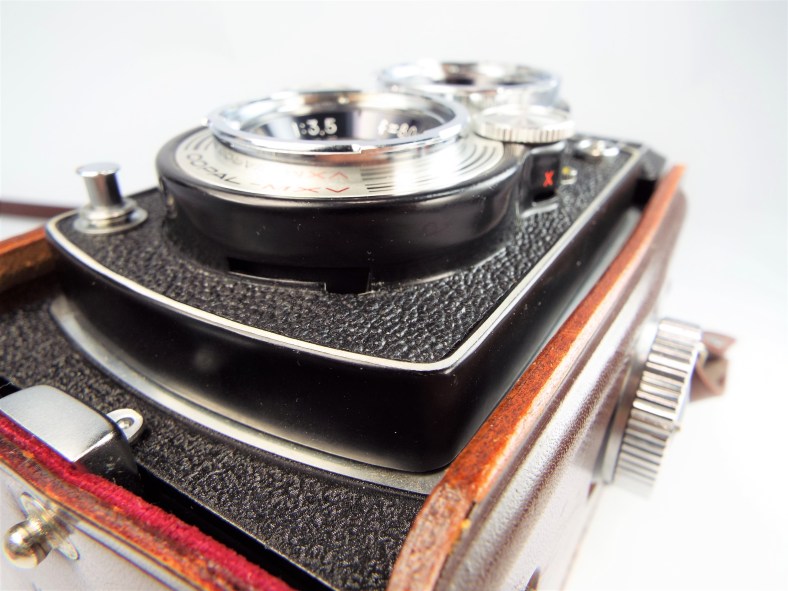
As I mentioned in the beginning of this post, in my haste to add a nice Mat to our collection, I failed to notice that the self timer lever was missing. No big deal right? It is and I know better. The lever is a small thingy with a little red dot of paint on the end of it. When it’s there, it should be all the way to the right (when looking straight on at the camera’s face). If it’s missing (as in this case) don’t buy it unless you enjoy repairing cameras. If it’s all the way to the left then ask questions of the seller. What happens is that the self timer lever should not be missing and should not be engaged to the left. In the instruction booklet, Yashica clearly cautions – “Be sure to move the synchro selector to the X position when using the Self-timer”.

The synchro selector lever is the little thingy sticking out just above the right thumb wheel as seen in image 1 (it has a little yellow dot of paint on it). The X position is pushing the level down (you can just make out the red X in the image above).

dscf3332-2

Syncro selector lever (yellow dot thingy) in the up M position (M is in yellow on the camera body).

Remember, yellow dot thingy lever up is in the M position. Yellow dot lever pointing down is in the red X position. A review: no self timer lever = run! Usually someone has forced the lever one way or another because the lever is stuck to the left. If the lever is in the left position and the yellow dot lever is in the up or M position then ask the seller a bunch of questions. Please ask if the shutter button trips the shutter when pressed. More then likely the answer will be no.

In closing, if the camera you’re interested in is photographed slightly turned as in this example below, it’s easy to overlook the missing self timer lever. Ask questions before purchasing it.

dscf3335

s-l1600-27

Here is an example of a Yashica-Mat with the self timer lever almost all the way to the left. I checked another image of this camera and the syncro selector lever is on M (which is in the up position). This is a classic case of what I’ve been talking about. You need to ask the seller if the shutter fires. More likely it does not. Run!

Completely my fault for not checking the lever and not asking questions of the seller.

Thanks for your visit… comments are always appreciated.

Chris

Yashima Yashicaflex A-II

Our Yashicaflex A-II is headed for the finish line – soon! These images were from day one and day 100 (just kidding about the 100). There have been so many issues to deal with restoring this 63 year old camera that it’s been a slow go. While this restoration has been an ongoing process for us, we’ve used some of our time to address some of the other cameras in our collection that needed only small repairs and a good cleaning.

Day one is pictured below. After prying the camera from its leather case (literally), the rust and corrosion were widespread and had eaten deep into the metal. Dirt everywhere! But the camera functioned! Glass was mold and fungus free but dirty and the shutter was accurate.

22024859392_8ffe58f0a3_o

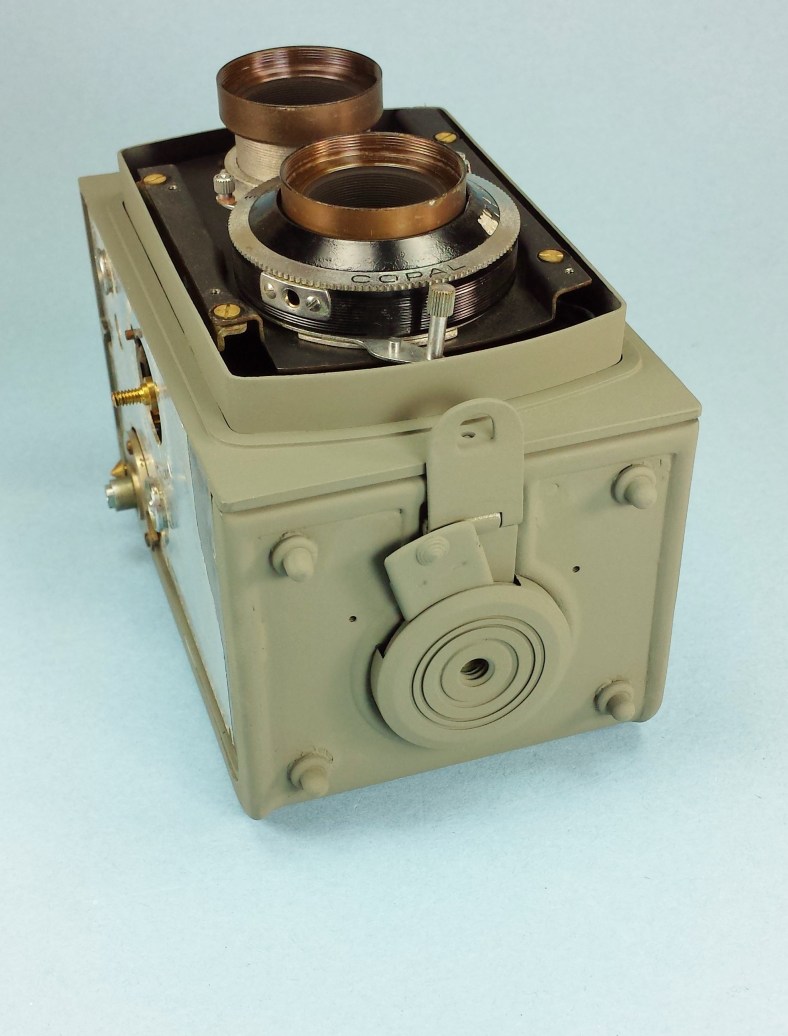
The die cast aluminum body and back door were corroded big time. The thin metal parts were rusty and pitted. The leatherette was dry and brittle with many missing pieces.

Below the same area after 3 coats of etching primer and filler putty to “replace” the missing aluminum due to the depth of the corrosion.

22555908617_27904de611_o

By this point some of the final finish coats of primer and filler could be applied. Lots of sanding between coats. At least the corrosion was gone and something of a finish could be imagined.

The camera will be re-imagined and restored. Since it’s not a rare Yashica model, Carol and I feel free to express some creativity in the re-build. Stay with us as I believe we’ll be able to have the finished product ready to show by early spring. The Yashima Yashicaflex A-II ‘Sakura’.

Thanks for your visit!

Chris and Carol

Yashica MF-2 Super… 1986

We don’t often collect modern Yashica cameras – especially during Yashica’s last days after Kyocera (Kill-a-Yashica) took over.

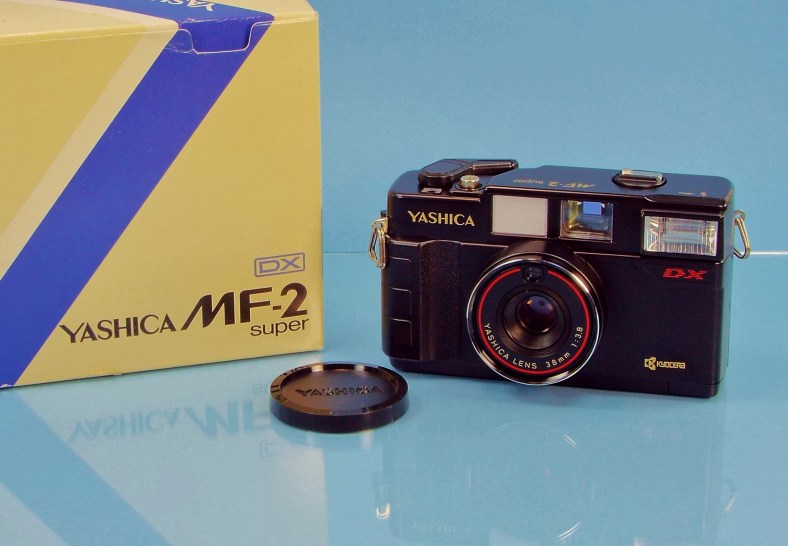
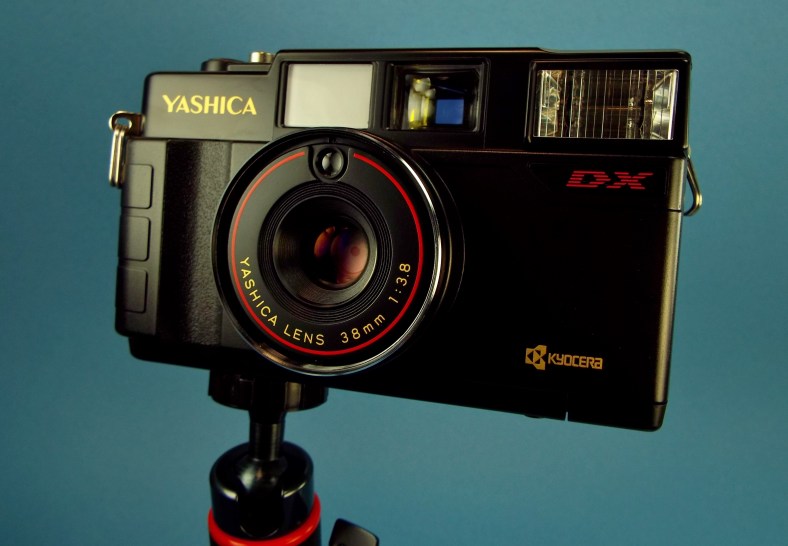
This one was sent to us by a Flickr friend and as you can see, it’s new in the original box. The MF-2 Super is a DX camera which sensed the DX code on the 35mm film canister and set the appropriate ASA / ISO / DIN.

25965272473_a80d24519c_o

Yashica MF-2 Super 35mm film camera set from 1986.

26295606350_65700d54b4_o

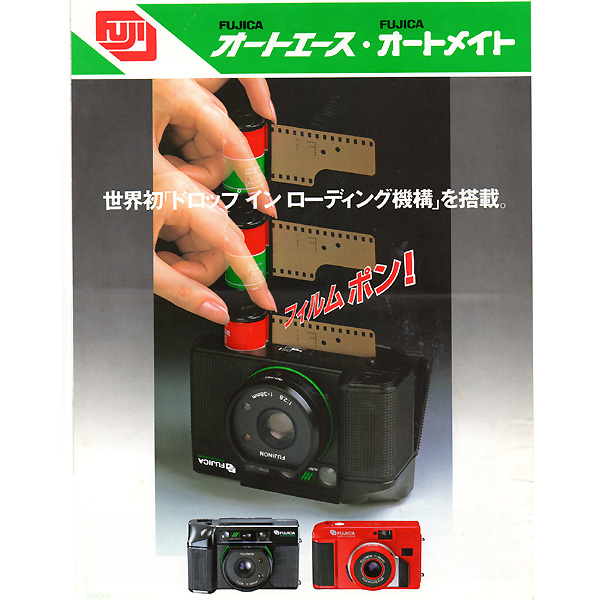
We haven’t found the time to load a roll of film and check out this little beauty… soon we hope. We like the black, red and gold details on the body and lens and the auto everything (almost) features. As a comparison, we also have the Fujica DL-20 as pictured below in the sales brochure.

%e2%97%8f%e3%83%81%e3%83%a9%e3%82%b7

DL-20 in black and red.

The DL-20 is a mid-1990s camera from Fujica. We have the red body model and it would be fun to take the two (Yashica MF-2 Super and the Fujica) out for a side by side photo shoot. Sounds like we’re going to be busy in 2018 shooting a bit more film.

Thanks for your visit!

Chris & Carol

Pentamatic in ‘Explore’

30889835606_871e994088_o

This simple studio shot made it to Flickr’s ‘Explore’ group recently. It may be the first and only Pentamatic in ‘Explore’.

Natural window light on an overcast Florida afternoon. Camera used? Samsung Galaxy 4S. No post production by me but the Galaxy may have been on HDR. Sometimes simple is better.

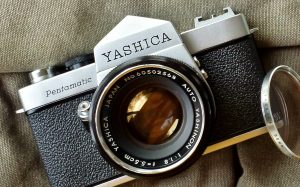
Yashica Pentamatic 35mm single-lens reflex from early 1960.

Chris

Hit the Road 2016! Hello 2017!

Thank goodness 2016 is almost history! I’ve heard from friends in Australia that 2017 is going well (so far). Let’s not muck it up!

On a positive note – here on our blog, we’ve seen a significant increase in activity over last year (2015). Visitors to the site and views are through the roof! We (Carol and I) are thrilled that what started out as a repository of bits and tidbits of Yashima-Yashica information would gain the traction that it’s had. We thank you!

We enjoy the feedback we get and I can say that I’ve learned more than a few things from it. We’ve met some super talented people – photographers and bloggers that are out of this world amazing! We hope our readers got a little something special in return too. That was the goal of the ‘Yashica Pentamatic Fanatic’ -a sharing of knowledge about a silly camera that Yashica invented in 1959 that most people have never heard of.

29926651073_d141fae764_o

This year’s favorite.

In looking through the hundreds of film and digital images that we shot in 2016, this one turns out to be our favorite. We believe that every vintage camera is worth preserving (in some way or another) – we think of cameras as holding the heartbeats of all who may have gazed through its lenses, pressed its buttons and then anxiously awaited the results. We can imagine the thousands of faces and smiles that were captured and the thousands of important events in people’s lives that were saved for the future. Classic cameras do that for us.

Don’t get us wrong… we love the  world of digital photography but we also embrace the beautiful, often awkward analog machines of our past. We hope that photographers in the future will remember (every now and then) to pick up a classic camera, load some film into it and then set out to capture images with a camera older than yourself. Enjoy!

Happy New Year… we wish only the best for all!

Chris and Carol ^.^


Yashima Yashicaflex A-II… 1955 – A restoration like no other!

21849128528_7702ca2714_o

Restoration challenge! Six decades of dirt, grime, soot and corrosion have taken their toll on this once beautiful Yashicaflex. There isn’t a part that escaped the corrosion – except the workings. The glass is just fine, shutter works, aperture blades are problem free – film advance works as does the focus. 

I’m finally on the home stretch of this year plus project. My desire to re-imagine this camera into the modern age has been the biggest holdup. Actually I’m calling it an “interpretative restoration” – that allows the artist and designer in me to reconcile with the fussy photographer that I am.

Watch the blog over the next two weeks or so as I bring it all together for the final reveal.

Thanks – Chris

Montauk Point Lighthouse, Long Island

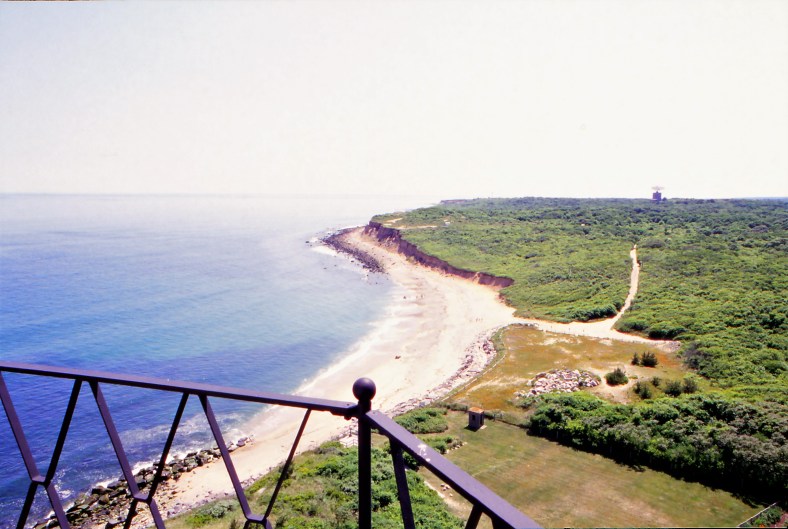
The lighthouse at Montauk Point, Long Island, New York is one of my favorite spots to visit ever since I was a child growing up on Long Island. As a kid, the main attractions for me were – the ocean, the countless rocks in that ocean (big and small), the hills (Long Islanders are hill challenged) and finally the lighthouse itself. As I got older, the main attraction was the lighthouse with the other ‘likes’ fading into the background. When I earned my New York driver’s licence, Montauk was my first long drive from my home by myself. When I became a certified SCUBA diver, the waters near the lighthouse looked tempting for a dive but the great whites known to frequent the cold waters off Eastern Long Island kept me ashore – so I headed to Florida instead.

While going through some of my many mountains of slides from my collection, I came across these images of the lighthouse. The first set of photographs are from August 1972 and were shot with my Yashica TL Electro-X mostly using the normal Yashinon 50mm lens. The second set of images are from 2002 when I traveled to New York with my family for their first visit to Montauk. The 1972 images show how completely the original Kodak Ektachrome slides have degraded over the years.

img_20161217_0001

August 1972. Yashica TL Electro-X with f/ 1.7 50mm Yashinon lens with 2x teleconverter on Ektachrome 64.

img_20161217_0002

August 1972. The lighthouse in need of a serious restoration. I believe it was still under the control of the U.S. Coast Guard at that time. It’s obvious that 40+ year old Kodak Ektachrome didn’t hold up well – even when stored properly. Most of the vivid original colors have faded and the slide lacks depth.

img_20161216_0028

July 2002. The lighthouse and grounds were looking much better after the restoration. Canon F-1 with FD24mm f/ 2.8 lens on Kodachrome. My son is the little one climbing up the hill (as I had done hundreds of times before).

img_20161216_0030

July 2002. Canon F-1 with FD24mm f/ 2.8 lens on Kodachrome.

img_20161216_0036

T.J. on the rocks… just like me in the 1950s.

img_20161216_0033

The automated light of 2002. Wonderful view from up top too.

img_20161216_0023

Captivating views from up top.

img_20161216_0037_new

Gotta love the rocks!

If you ever get a chance to travel to Long Island, then the Montauk Point Lighthouse must be on your “to visit list”. It’s very photogenic and lends itself well to the digital age. There are images that a good camera phone today can capture that were a serious challenge to film photographers just 15 years ago. Happy shooting!

Chris


Kamakura Daibutsu

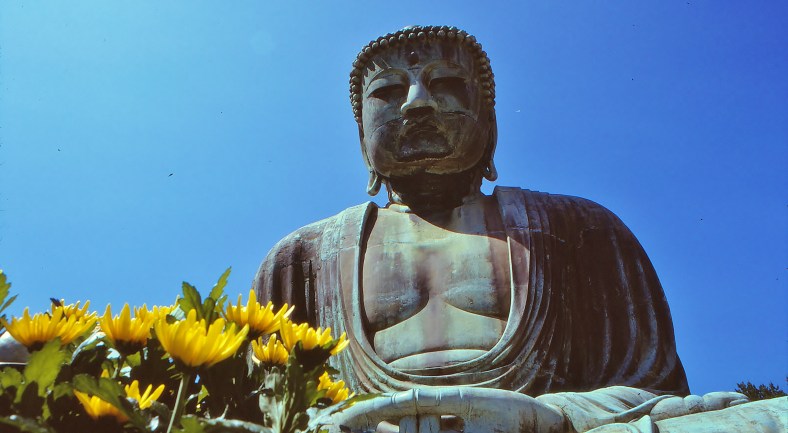
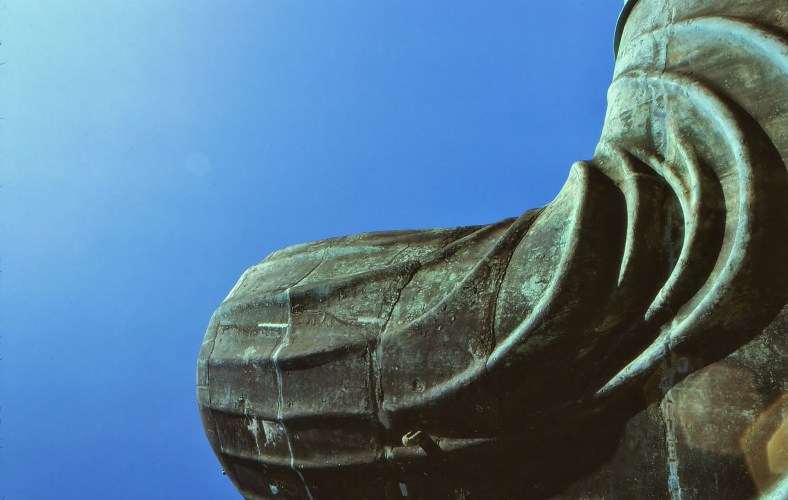
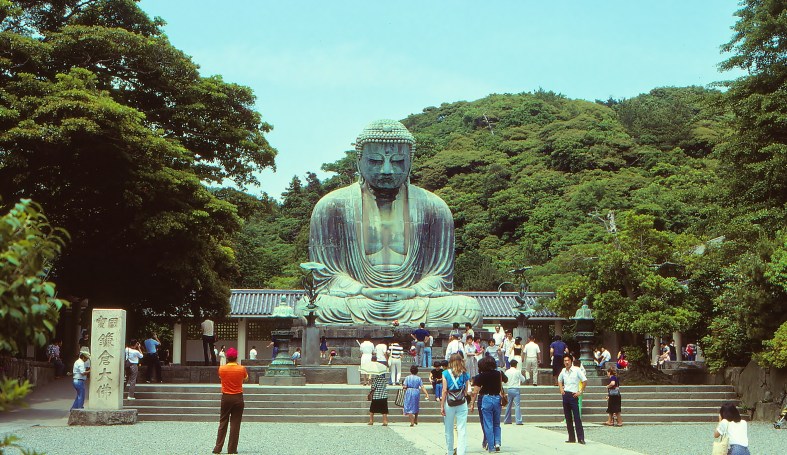
My wife and I lived in Yokohama, Naka-ku (Honmoku) from the Summer of 1977 to early Spring of 1980. We totally enjoyed our time in this wonderful country and are hopeful we will be able to return again. We had our favorite spots – Sankei-en and Kamakura being two of our most favorite. As with any well known attraction, the Great Buddha at Kamakura has been photographed from every angle imaginable. I’ve always enjoyed exploring angles that may not have been tried before.

19987739784_b6b238428b_o

July 1979. Canon F-1 with FD 24mm lens on Kodachrome 25.

21915088979_a912894e1a_o

Kodachrome 25. Bright sun. Canon F-1 with FD 24mm lens. It’s what film photography was (is) all about.

20847829440_15c046a3df_o

More traditional view of the Great Buddha. Steaming hot July day on the Kanto Plain. Yashica TL Electro-X on Kodachrome 64.

21478741664_f6ef540008_o

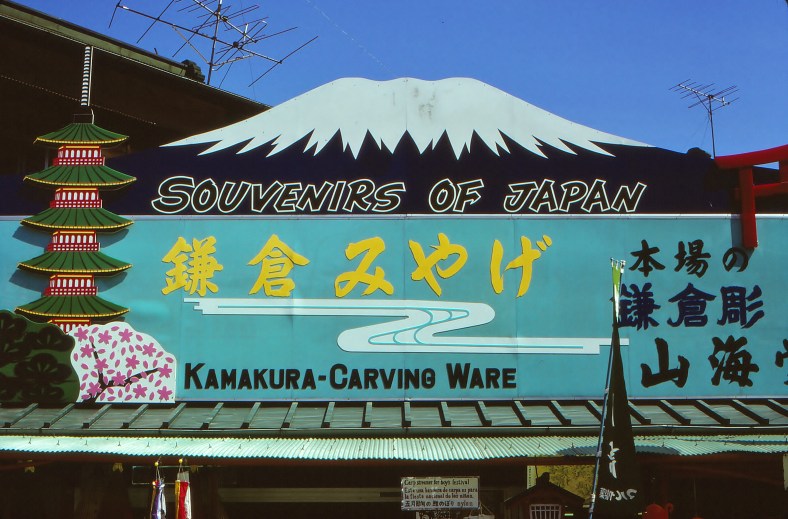
Gotta have a tourist shot! We love the antennas on top of Mt. Fuji!

So many things will have changed in Japan since we were last there but they’ll be plenty that will stay the same… forever. Kamakura is one of them.

Thanks for the visit!

Shooting in squares…

It’s tough to think square again! I’m spoiled (aren’t we all) by the ease of digital photography – nice proportions – wide screen – big images – bold colors – lots of megapixels. Exposures? Shutter speeds? Composition? No worries – the technological gems we hang from our necks will think for us. I’m as guilty as anyone – I love what digital can do and what it can’t.

Now try to think of the world in little squares – 6 x 6 centimeter squares to be exact. It’s hard to do – modern formats are always elongated squares. Who loads square images on their blog? The square format went out with the Instamatic! But if you’re lucky enough to own (or have access to) a medium format (6×6) camera then you too can shoot in squares.

I recently took one of my Yashica TLRs out on a date – threw in some fresh Fujifilm and off I went. I must confess – I love color! Sure I like an occasional fling with some black and white (Neopan 100 Acros) but color gets me going. Not “computer generated color” – the subtle color you see only on film. It’s there (just like in real life) but it doesn’t tackle you to the ground like some overly saturated digital image. Just nice and easy color.

These following images were taken with my Yashica-Mat EM twin-lens reflex (TLR) camera. Exposures were determined (suggested actually) by the EM’s on board exposure meter. Yashica claims that it’s built-in but it’s really just attached to the left side of the body by three screws and a wire. No TTL or coupled metering here… just a bunch of tiny numbers on top of more tiny numbers with an almost invisible pointer pointing at those tiny numbers. I chose Fujifilm’s Fujicolor PRO 400H color negative film because I enjoy shooting with Fujifilm and usually like the results. I will point out that no post production was done on these images. No cropping, no color adjustments – they’re just as they were when developed and scanned by the lab (which was The Darkroom).

53580001

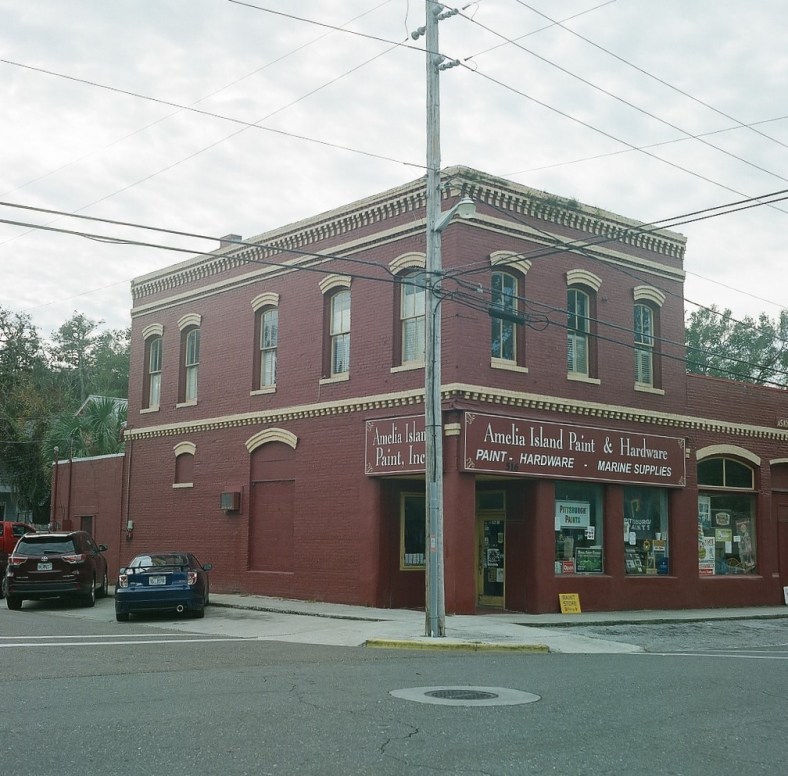
This is actually image 12 on the roll. Taken on day 2 of my travels. Perfect small town America shot. I lost my bright sun from the day before but the Fujicolor 400 made up for the dull sky. Is it properly exposed? Probably not. Off by about 1 stop or so.

53580006

Day 1 – image 7 on the roll. The Fujicolor handled the strong contrast between the sky and building. The Yashica’s meter did a fantastic job. About 1/500 at f/ 16-22.

53580008

Faded Florida – along U.S. Highway 17 in North Florida. High contrast with strong shadows. f/ 16 at 1/500.

53580012

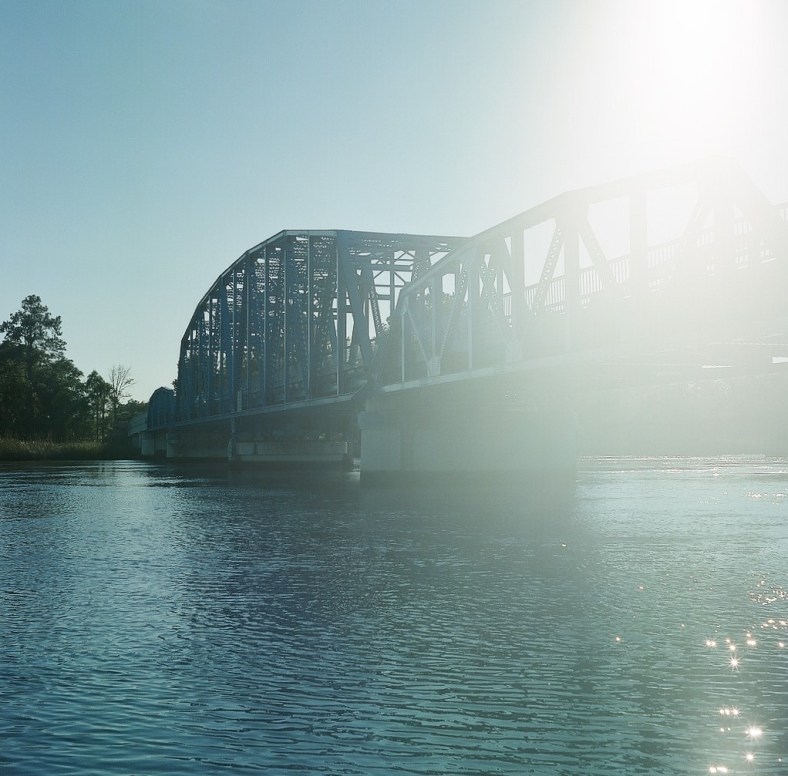
A nice test for the Tomioka 80mm lens. No flare and some nice highlights on the water. 1/250 at around f/ 11-16. I metered to the left of the bridge. Looking south into Florida from Georgia. Highway 17 bridge over the St. Marys River.

53580009

Looking north towards Georgia. The Yashica’s meter did a wonderful job suggesting the proper shutter speed and aperture setting. 1/250 at f/ 16.

Shooting in squares can be fun and challenging. Do I think some of the images would be better in a 6 x 4.5 or 6 x 7 format? Yes – definitely. Can I learn to enjoy squares again? Yes – definitely.

Comments are always appreciated and welcomed. Thanks for your visit!

Chris