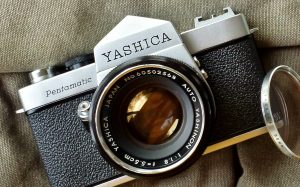
Yashica-Mat EM… on assignment… update 12.9.2016

Another look at one of my favorite Yashicas to use – my Yashica-Mat EM is still going strong (since 1964) and the meter is as accurate as ever. Take a peek at the original post – if you please.

Chris and Carol's avatarChasing Classic Cameras with Chris

This month’s assignment (actually from September) is to load some Fujifilm into our Yashica-Mat EM and enjoy the benefits that only medium format film photography can fulfill.

Oh the joys of composing 6 x 6 cm images through a pop-up viewing hood in bright sunlight. What I do find nice is that the focusing dial is on the camera’s left side… a natural place for it to me. The EM has a built-in exposure meter and a ‘computer’, slide rule actually, to adjust the aperture and shutter speeds which you then set by using the two thumb wheels. I’ve learned over the years to use the guess method of focusing – I’ve learned how to judge distances by eye and then I set the focus on the marked dial. If you’re shooting in bright light and use the smallest apertures then the dept of field will cover most inaccuracies in…

View original post 578 more words
Happy SUNday! – Have you been flashed lately?

It’s easy to forget that at one time getting the right amount of light on your subject was no easy task…

Every one of us with a smartphone carries around a powerful “photo machine” in our pockets or purses. Not that long ago, well really a long time ago now when you think about it, these monsters were the epitome of high tech flash units and cameras in the 1950s and 1960s.

23804633236_80f738fa68_o (1)

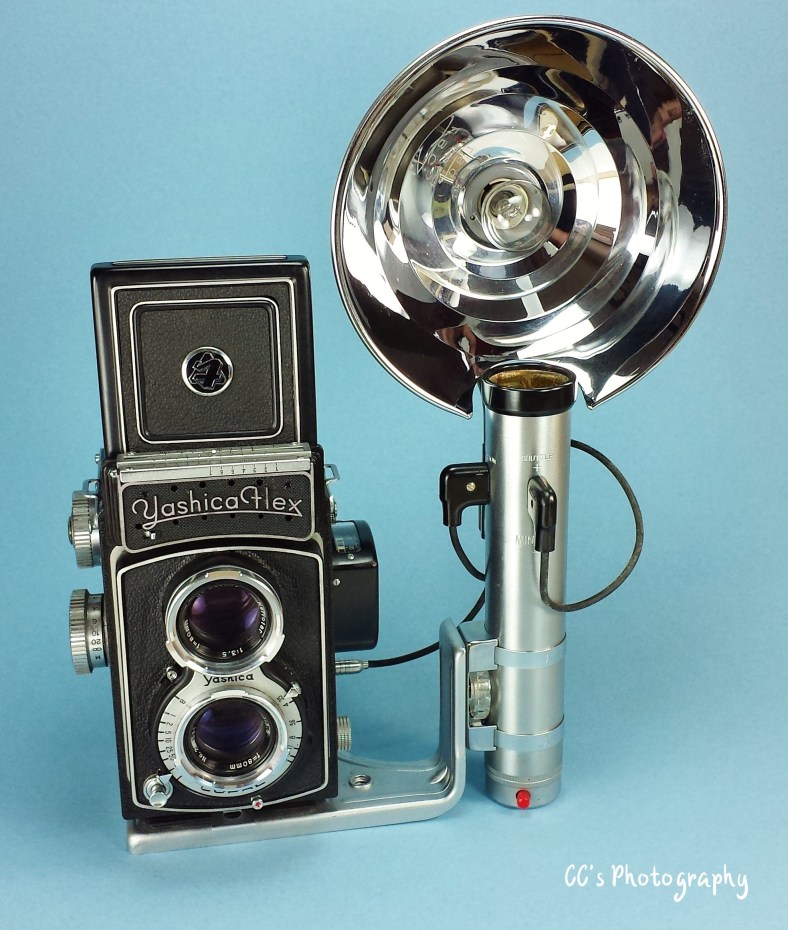
Yashica Mat EM – 1964

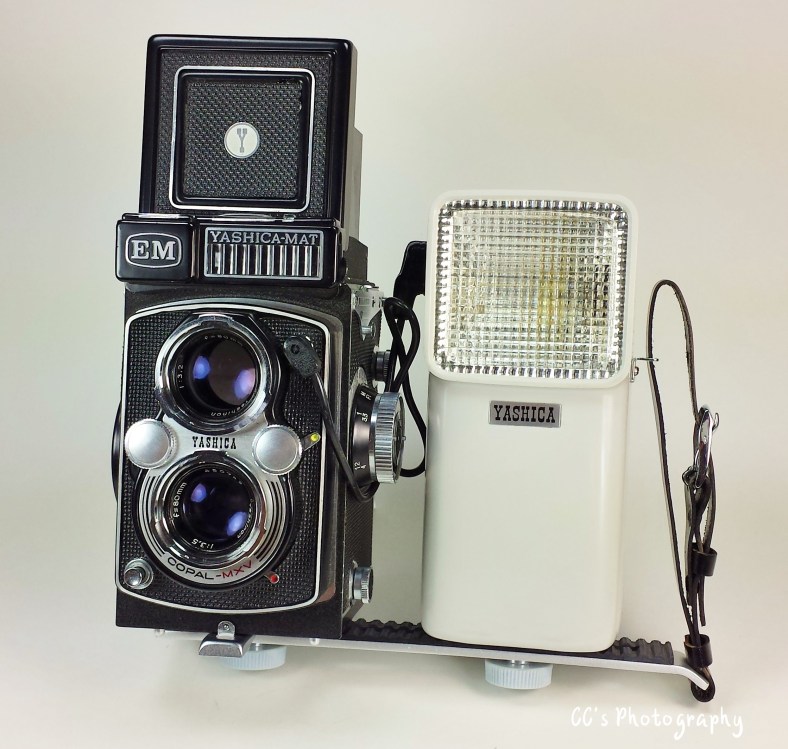
Pictured above are a fully functional Yashica-Mat EM and Yashica PRO 40 Quick-Lite electronic flash. This was “as-simple-as-it-gets” with a medium format camera in that era. The EM has a built-in exposure meter (not a thru-the-lens type) and the PRO 40 was a straight forward light machine. Both units together with the 8 AA batteries and a roll of 120 film weigh in at nearly 4 pounds! Yikes!

25051924236_c8965f9d22_o

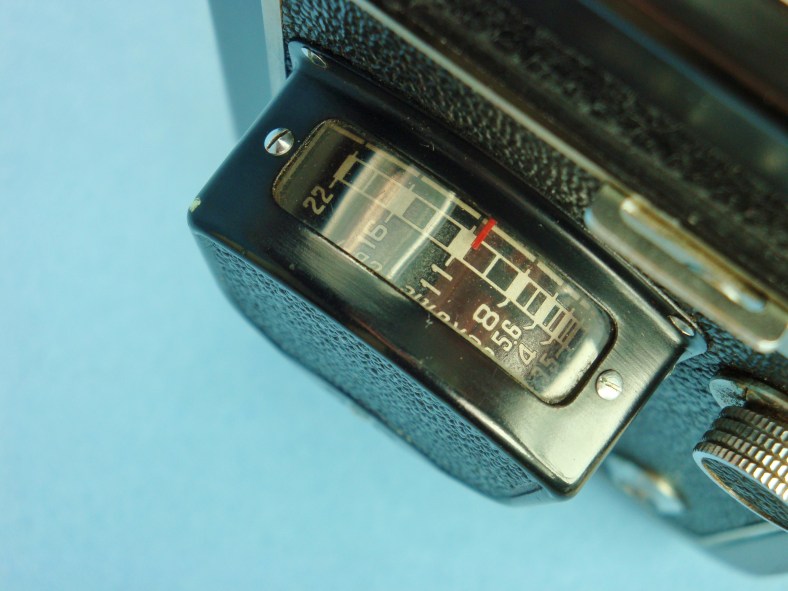
A close-up view of the exposure meter and scales on the Yashica Mat EM.

Going even further back in time, this Yashica Flex S is mated with a Minicam flash unit.

16663440081_0346b92713_o (1)

Yashica Flex S – 1956 with Minicam flash. Powered by two “D” cell batteries.

The Yashica Flex model S also has a built-in selenium cell light meter made by Sekonic (that little thingy attached to the side of the camera). The cells are located behind the nameplate flap which can be opened to gather more light in low-light situations.

15277870608_de84055002_o

The attached light meter made by Sekonic for Yashica. Here pictured on a Yashica AS-II camera.

The Minicam flash advertised itself as “sunlight at night”! If you can remember back to the days that these types of flash units were used you can agree – they did make “sunlight at night” as you were often blinded for quite some time afterward.

Thanks for stopping by and be sure to visit my camera shop at http://www.ccstudio2380.com for some great vintage cameras and photo gear. – Chris

Please respect that all content, including photos and text, are the property of this blog and its owner, Yashica Pentamatic Fanatic, Yashica Sailor Boy, Yashica Chris.

Copyright © 2015-2019 Yashica Pentamatic Fanatic, Chris Whelan
All rights reserved.


In the Shop – Yashica D Presentation Box

In the shop today we have a bit of a collector’s special. I’ve listed one of my early Yashica presentation boxes – those colorful boxes that were often tossed when new so 60 years on it’s getting harder to find these fun collectibles. They add instant appeal to your collection.

Stop by our shop at http://www.ccstudio2380.com for complete details and additional pictures of the box. It can be purchased here or in the shop.

Vintage Yashica D Presentation Box

Vintage Yashica D presentation box from the first run of these iconic cameras (1958-1963 or so). Later boxes (1964 onward) were radically changed to a more modern style. This box represents the earliest days of Yashica. The colors are unique - a pinkish gray with the letter 'D' in yellow, green, and black. It is missing one of the lids end flaps which could be easily duplicated by the serious collector or left as is. The box is solid and complete otherwise. For additional details and pictures pop on over to the shop at http://www.ccstudio2380.com You can purchase this item here by simply clicking on the payment button or buy it in our shop. Shipping in the US is via USPS Priority Mail for $8.50 and I'll ship basically worldwide - just ask for a quote before ordering. Chris

$19.75

Time Capsule – 1960

yashica pentamatic set

The original Pentamatic.

A nice example of Yashica’s first 35mm SLR – the Pentamatic. Also known as the Pentamatic ’35’ in its earliest advertisements and sales brochures. This particular camera is from August 1960 – the same month that Yashica started production of the Pentamatic II – a model that was destined for the Japanese home market and not for world export. The Pentamatic II stayed in production only until January 1961 when it was replaced a few months later with the Pentamatic S. The original Pentamatic was first produced in December 1959 but widescale production didn’t begin until January 1960. As of this update (Oct 11, 2018), I still haven’t found evidence of an instruction booklet printed in Japanese – only English booklets so far. I would think that there must be booklets in Japanese and at least 2 or 3 other languages but none found. The Pentamatic II booklet is in Japanese and no English editions have been found.

As always, thanks for stopping by and please check out my camera shop at http://www.ccstudio2380.com – Chris

Please respect that all content, including photos and text, are the property of this blog and its owner, Yashica Pentamatic Fanatic, Yashica Sailor Boy, Yashica Chris.

Copyright © 2015-2019 Yashica Pentamatic Fanatic, Chris Whelan
All rights reserved.

Yashica Super Yashinon-R f/3.5 13.5cm Telephoto Lens

Nice little addition to our Pentamatic family of lenses. Purchased in Japan and was with an early model Pentamatic’35’ set in “well used” but stable working condition. It came with the original Yashica brown leather case, unbranded plastic rear lens cap, Yashica front metal 52mm push-on lens cap, unbranded lens hood, and a very nice looking Walz chrome metal and glass Skylight C. (cloudy) 52mm filter.

dscf2868

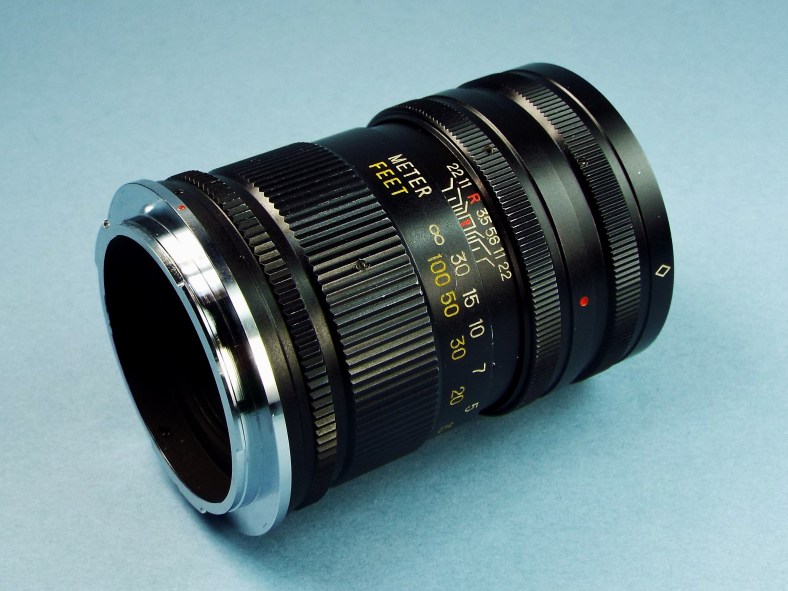
Pentamatic bayonet mount 13.5cm short telephoto lens… f/3.5 with rather low serial number. Early Yashica lenses were often given a serial number that starts with the focal length of the lens. In this example, ‘135 0722’ shows it to be a 135mm lens with a sequential production number of 722. Best guess is that this lens was made in early to mid-1960. We have another Super Yashinon-R 13.5cm lens with a serial number of ‘135 0927’.

The above image shows the lens partially disassembled for cleaning and inspection. No fungus or mold, but I’ve found some funky streaks on the face of the first removable lens element (large lens element to the right).

dscf2872

The chrome nose removed.

dscf2873

The main lens group removed. If you look closely, you may see the funky streaks across the face of the lens.

dscf2876-2

Aperture blades set at f/ 22. No oil and no problems (looking into the lens barrel from the front of the lens). Note the 12 aperture blades.

super yashinon p mount 25cm

Here is a similar lens with the 12 blades that was for sale recently. The seller identified the lens as having been made by Kyoei Optical Co., Ltd.  using the brand name “Acall” Kyoei was also abbreviated as “KOC” which may be the reason for the red “K.C.”

New info as of Feb 5, 2020 – At first, I guessed that my lens was made by Tomioka Optical as they were responsible for most of Yashica’s lenses. A reader has pointed out the similarities between my lens and the design of the Acall lenses with both  Pentamatic and M42 mounts. I must say that I agree with them upon further review. Thank you for your input!

dscf2877

Partially assembled body. Nice clear markings and solid-looking bayonet mount.

These first Pentamatic lenses were pre-set and not automatic and were the kings of the heavyweight division. Lots of metal and glass here! When properly stored they were not prone to fungus… but almost all classic lenses will have some sort of mold, dust or fungal issues when left in the dark and in their leather cases.

Thanks for the visit!

Chris and Carol

You’re invited to visit our online store at https://www.ccstudio2380.com for some great vintage and collectible cameras, lenses, and accessories.

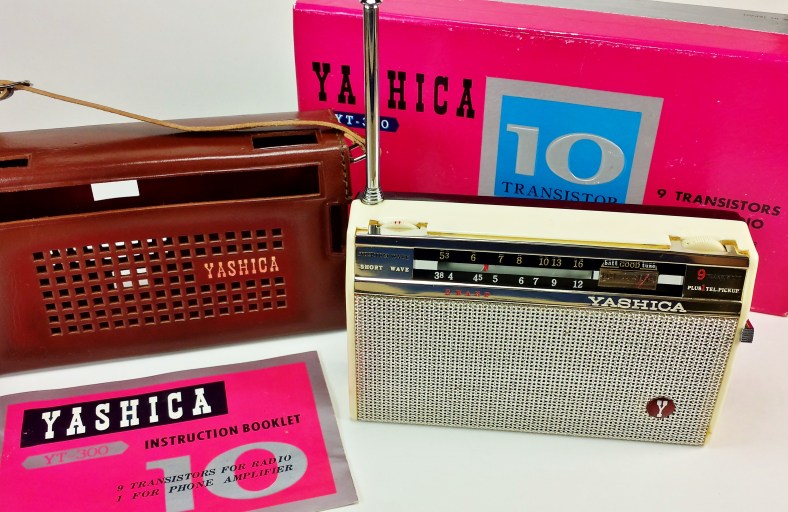
Yashica’s YT-300… a neat little radio from 1959

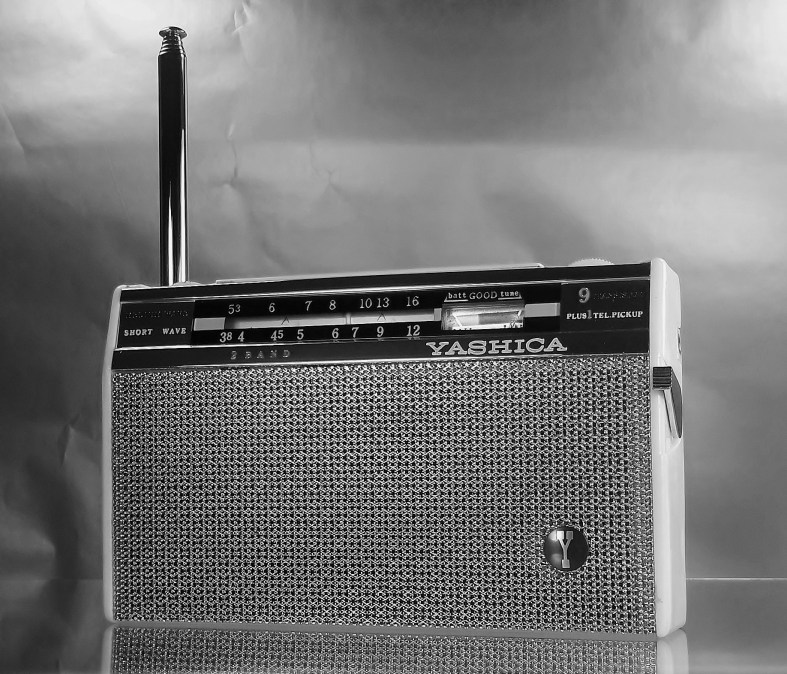
Yashica produced more than just cameras during its boom years. As a leader in the field of electronic photography in the middle to late 1960s, Yashica’s early electronic devices ranged from such diverse items as transistor radios, record players, movie projectors, editing equipment and tape recorders to name but a few.

Most of the earliest electronic devices are rather rare now (as one would expect after 50 years) and only occasionally does something come up in auctions both on the web and in estate sales. I suspect that the more common electrical items such as projectors and editing equipment are still flooding eBay and other on-line auction sites.

Finding an early radio such as the YT-300 and YT-100 is a bit harder. Here we share some of what we’ve been able to collect over the years.

20150716_203028_Richtone(HDR)

Nice complete set from around 1960.

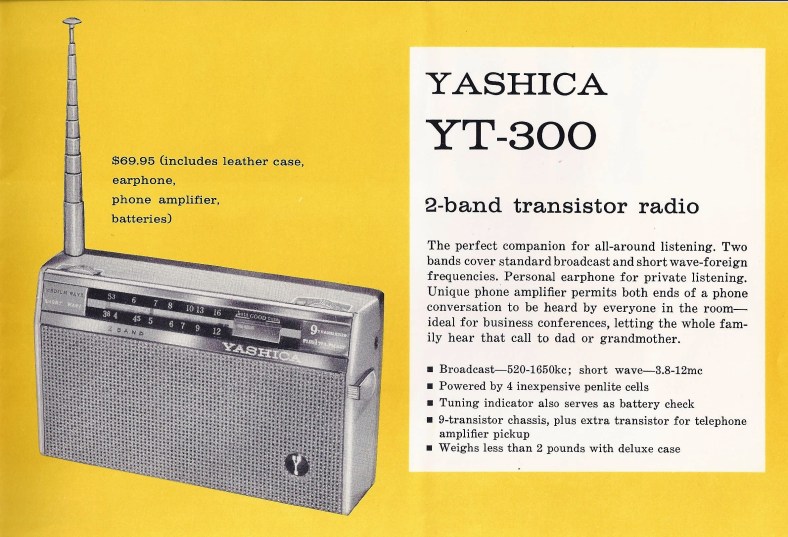
Yashica YT-300 Radio Brochure

Not a bad price for such a sophisticated radio.

20150726_120249_Richtone(HDR)

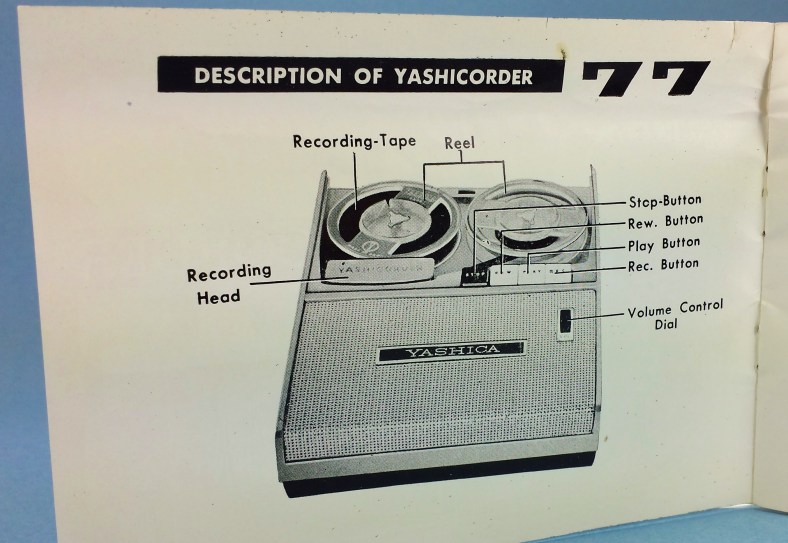
Really really rare to find a working Yashica tape recorder!

20150726_115718_Richtone(HDR)

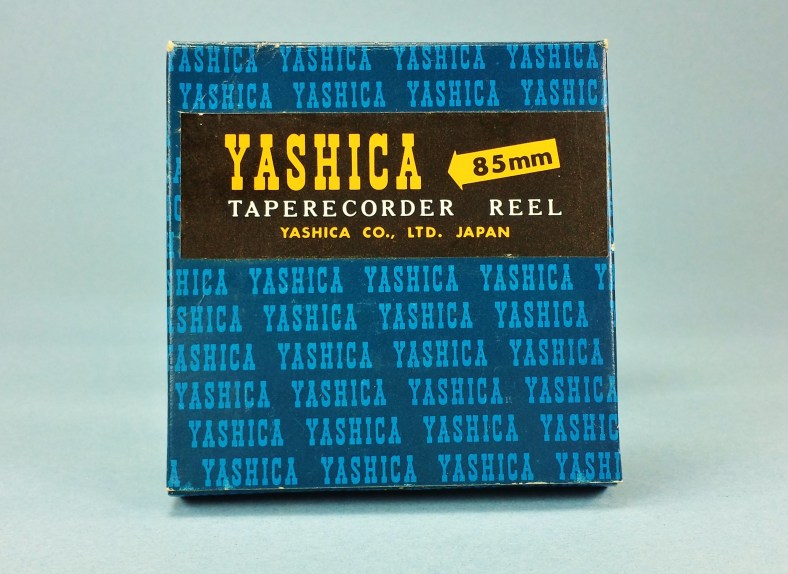
Yes Yashica even branded their own magnetic tape for their recorders.

20160113_213553

Yashica YT-300 portable transistor radio. Designed in late 1959 it was very popular in the early 1960s and was one of the many electronic devices that helped Yashica develop their hyper successful electronic cameras that followed.

20150717_152009_Richtone(HDR)

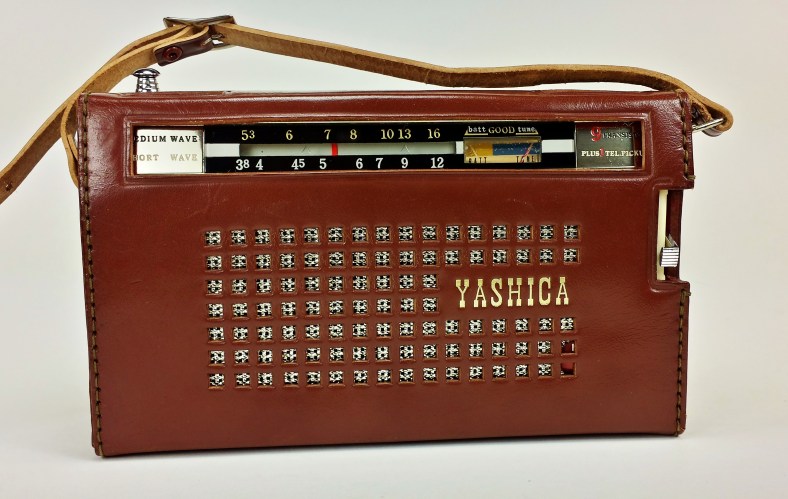
Yashica YT-300 in its very elegant leather case. The case itself is a work of art and craftsmanship.

Thanks for your visit! If you come across a working Yashica radio or tape recorder snag it! They’re really rare and a fun little reminder of the first transistor radios and how cool they were.

Chris

First Look!

The exciting first look (in print) of the Pentamatic…

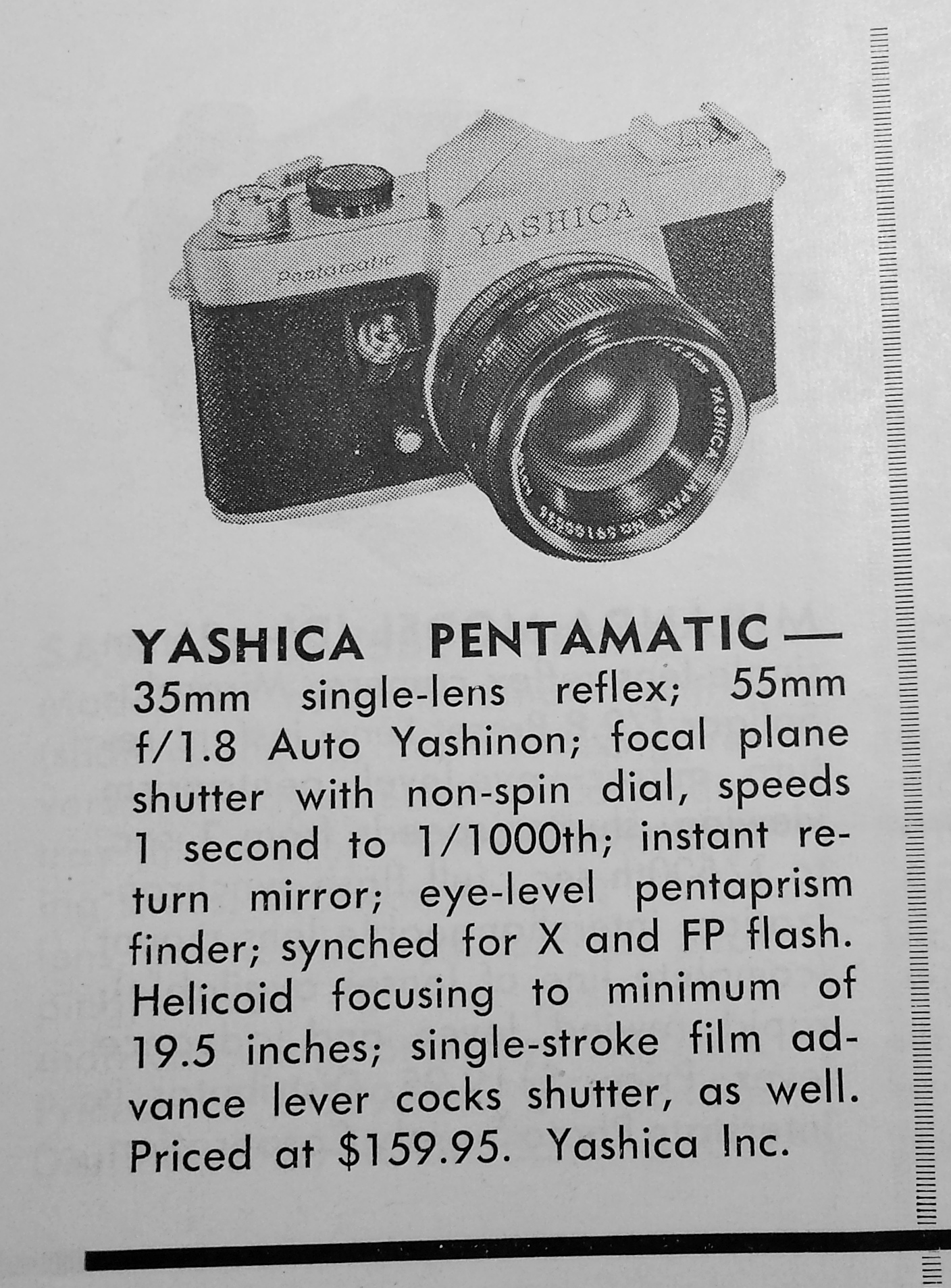
First official appearance of the Pentamatic occurs in the May 1960 issue of Modern Photography magazine. In the June 1960 issues of Modern Photography, U. S. Camera and Popular Photography, the first full-page ads appeared for the Pentamatic ’35’ reflex camera. The actual release date in the United States has almost always been considered by many to be March of 1960.

As of yet, I haven’t found evidence in print to support the March date. I do know that the Pentamatic was shown at the 36th annual ‘Master Photo DeaIers & Finishers Association’ trade show (MPDFA) held in St. Louis from March 21-25, 1960. I don’t know if the Pentamatic was released in Japan at an earlier date. From the progression of the serial numbers, by March 1960, about 1,500 cameras had been produced since production began in December 1959 at the Yashica Suwa factory. I doubt that there were enough cameras by March to support any widespread release in Japan or in Asia at that time. By June 1960, about 6,000 cameras had been built. There may have been enough to ship to the world markets starting in April and May. At their peak of production (summer 1960), it looks like Yashica was rolling out about 1,200 to 1,400 cameras each month.

Have a

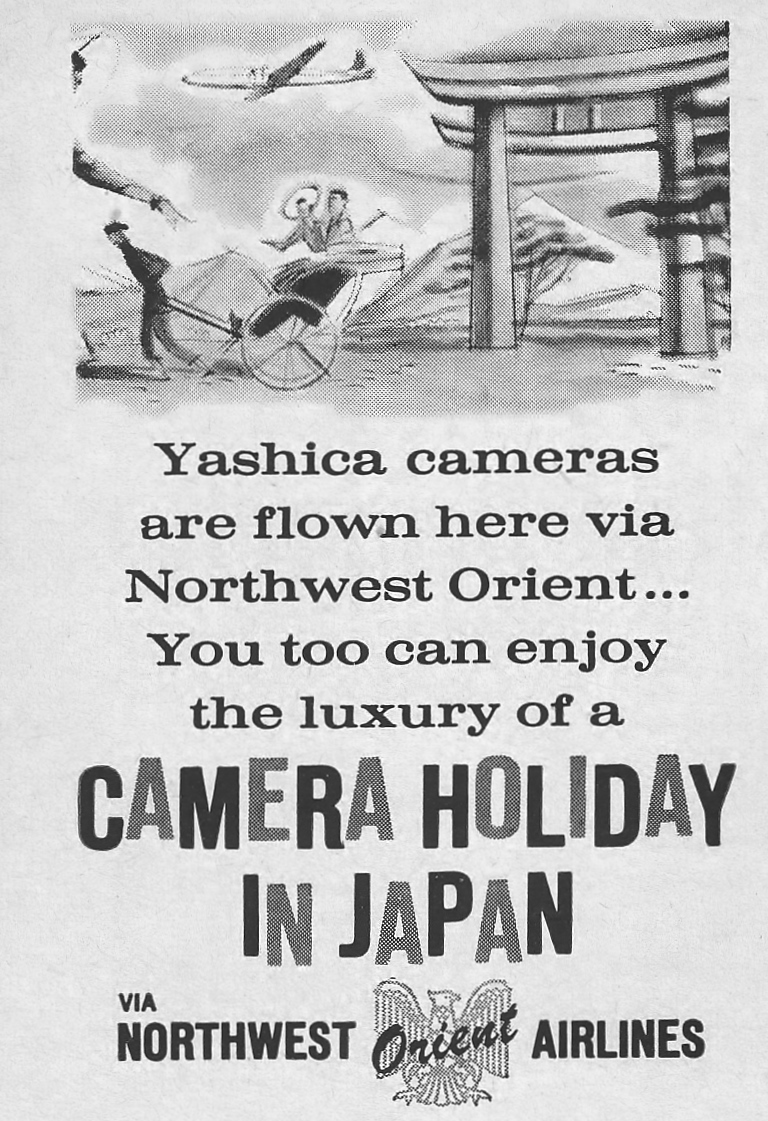
Have a “Camera Holiday” in Japan. May 1960 magazine ad.

Part two of the

Part two of the “Camera Holiday” in Japan promotion. Very nice mention of Yashica’s factory in Suwa and the wonders of Japan!


Yashica provided this first ever look at their new Pentamatic SLR at the March 1960 MPDFA trade show in St. Louis.

Yashica provided this first ever look at their new Pentamatic SLR at the March 1960 MPDFA trade show in St. Louis.

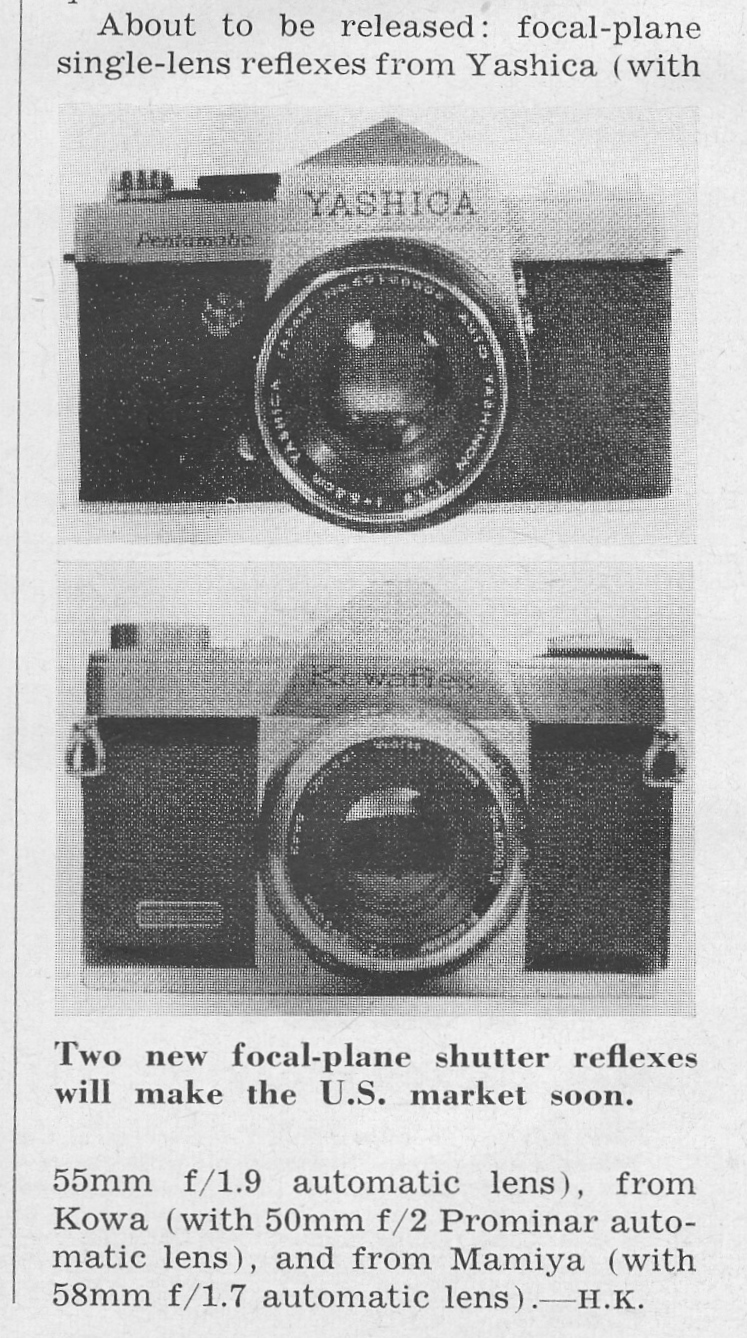
First published look at the new Pentamatic from Yashica. May 1960

First published look at the new Pentamatic from Yashica. May 1960