Yashica Arrivals – Pentamatic S & 635

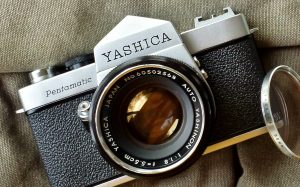
As if the collection needed more Yashica anything – but collections are dynamic things and as such, something “new” arrives which paves the way for a duplicate(s) to go.

Although we have some very nice Pentamatic-S models in the family, this one is close to mint new and is in fully working condition (including the “no name” exposure meter). So we’ll take a hard look at the others and decide which will be listed for sale in our online store.

The Yashica-635 is another story.

The first one we acquired (about a year ago) looked perfect – new in fact – but it had a fatal flaw – the shutter was jammed because the “M-X” lever was in the wrong position when someone tried to use the self-timer. That one was sold for parts. This one came to us from England and was likely purchased new in Singapore in the late 1950s. A guess on our part but there’s a cleaning cloth with it from a camera store in Changi Village, Singapore which was located right outside the gates of the RAF Changi airbase. This 635 is super clean and works! It even came with the hard to find large Yashica-635 carry case in excellent condition. We can’t wait to try the 35mm feature on it.

DSCF5638


The Yashica-635 is a dual format TLR which was released in 1958 (this model) and the Yashica Pentamatic-S came out in early 1961 – possibly January (this one September 1961).

DSCF5626

DSCF5635

Much more to come on the Yashica-635. We hope to restore the large leather carry case that came with it and we’ll do a complete feature on the dual formats. The ability to shoot 12 6x6cm negatives with 120 roll film and with a few easy change outs inside, switch to shooting a roll of 35mm film with the same camera. Cool.

Thanks for stopping by!

Studio Camera: Fujifilm FinePix S9900W

Chris


Modern Classic – Fujifilm Zoom Date 140

Released around late 1999 or early 2000 – another of Fujifilm’s high zoom 35mm autofocus compact cameras. 

DSCF5606

It’s a good looking camera that fits well in my hand. Not too small but not overly big either. Still handles like a quality point and shoot camera from the 1990s. Features a nice Fujinon zoom lens so it handles a wide range of shooting situations. Of course when it extends the lens it looks a bit goofy at 140mm but at least the motor is kinda quiet.

DSCF5611

The Fujinon lens features 5 components, 5 elements, 38-140mm zoom f/ 7 to 13 with closest AF focusing from 0.9 meters to infinity.

DSCF5609

DSCF5610

Quality materials used throughout – solid construction.

DSCF5612

Nice bright viewfinder – recessed on/off button and an easy to use zoom lever (gray thingy) for zipping through the different focal ranges.

DSCF5613

DSCF5614

Easy to set date modes and of course an easy to see and read LCD. Big shutter button feels good under your finger.

DSCF5615

Easy to load and has some what looks like glass over the rear element. Nice touch.

DSCF5619

Of course it has a self timer, auto film advance and rewind, autofocus, autoflash with red-eye reduction and DX coding from ISO 50-3200. Uses the still easy to find CR123A lithium battery. Weighs 240 grams without the battery.

DSCF5617

Comes with a roll of Fujicolor Superia film – expired in 2002.

Should you collect these plastic fantastic P&S compact 35mm cameras from the 2000s? Yes of course – if you can find one still new in the box, why not? They don’t make them anymore and if you’re looking to find a good 35mm film camera as a user, this one has enough features and a quality zoom to handle most demanding shooting situations.

This set can be viewed at our online store, CC’s Studio Twenty-3 Eighty at http://www.ccstudio2380.com if you’re interested.

Thanks a bunch for your visit and as always, Carol and I appreciate your comments and likes.


Birth of the United States Navy – 1775 U.S. Mint issued bronze medal.

Bicentennial medal issued by the U.S. Mint and the U.S. Navy on the occasion of the bicentennial of the U.S. Navy (October 13, 1975).

DSCF5587

U.S. Mint bronze medal (3 inches). Awesome design – eagle with anchor and flag and warship under full sail.

DSCF5588

The modern “Nuclear Navy”. CVN 65 is the USS Enterprise.

IMG_20170420_0010

Proud to have served. NAS Jacksonville 1985

Happy Birthday America – and almost 242 years of the United States Navy.

Studio Camera: Fujifilm FinePix S9900W

E.P Marked Photo Gear. Is it really worth more?

Photo gear made in Japan will sometimes carry a strange marking  <E.P>

20170603_191236

In the above example, the <E.P> mark is engraved on the rewind knob of this Nicca camera. This camera is from the 1955 to 1957 period.

s-l1600 (23)

In the example above, this Nikkor 13.5cm lens has the <E.P> mark engraved on a small lever near the base of the lens. On the lens case below, the <E.P> mark is stamped into the leather just below the JAPAN stamp. The case belongs with the lens pictured above.

s-l1600 (22)

First time we’ve seen the mark on a lens case. To us that implies that the case was mated with that lens from the factory (or wherever the mark was applied).

So what’s up with the <E.P> mark anyway?

As we understand it, the Japanese government needed a way to identify which pieces of photo gear were sold through military facilities and duty free shops in Japan. We feel that the mark means “Exempt Product” – cameras or electronic gear purchased without paying taxes to the government of Japan and purchased by authorized personnel (military members and their families, tourists and by diplomatic members and their families). We’ve seen alternate meanings as “Post Exchange” (military base stores) but U.S. Navy stores are called “Navy Exchange – NEX” and U.S. Army/Air Force stores are “BX/PX or Base Exchange/Post Exchange”. It’s hard to make “NEX or BX” into “EP”.  Other explanations of <E.P> include: Export Permitted (or Export Permit), Exchange Program and Export Production.

The “Black Market”.

The majority of the photo gear we have in our collection that bears the <E.P> mark, was in fact purchased through military facilities and not at duty free shops. Another cause for concern after the War, and we know this first hand from having lived in Japan in the late 1970s, was the so called black market that may have existed (it did) in Japan. The difference between what a service member could buy a camera for at the Navy Exchange (reduced cost and no taxes) and what that same item sold for at a Japanese camera store was just too great not to tempt some selling on the black market. The military stores kept tabs on the amount of tobacco and liquor that a family could purchase and big ticket items (cameras and stereo equipment) included a statement on the receipt that the service member would check and then sign that the item was for their personal use. A direct reminder that you were not to resell the item to unauthorized individuals. Our guess would be that if a Japanese citizen had a camera in their possession with the <E.P> mark it would be easy to question where it was purchased. However, the <E.P> marks were normally on parts of the camera that could be removed and replaced with non marked parts. No system is perfect so if there’s a will they’ll be a way.

DSCF3795

The <EP> mark on a Yashica-Mat from 1960.

So, does the mark make my photo gear more valuable? Yes. Collectible? Yes. Desirable? Yes. But to whom?

Like anything that’s collected, if someone wants it just because of the mark (in this case), then the <E.P> mark makes your item more desirable. In the real world, the gear is no different except for the mark. But – and it’s a big but – there are fewer of them out there. In the case of the nice Yashica-Mat pictured above, let’s say that Yashica sold 1,000 of them in 1960 throughout Japan. Maybe 5% were marked <E.P> (and that may be way high). So if you want to collect a mint condition Yashica-Mat made in 1960, there may be, let’s say only 10 available worldwide at any one time, and if one of those has the mark, well that adds a nice bonus of rarity to the mix. Another way to look at the mark is that the gear was less likely purchased by a professional photographer and therefore may have been better taken care of by its owner. Lots of exceptions to that line of thinking but it does have some merits.

So there you have it. Something of an explanation. If you have photo gear from the 1950s, 1960s and sometimes from as late as the early 1970s and you have the mark, well now you know a bit more about it. If you’d like us to appraise it for you we will be more than happy to. Just contact us here on the blog and we can get something going for you.

Studio Camera: Fujifilm FinePix S9900W

Chris

Fujicaflex Automat – Fuji Photo Film’s 1st TLR – 1954

Vintage camera wish list item 101.

The Fuji Photo Film Co., Ltd., Fujicaflex 

フジカフレックス

Designed to incorporate the best features that were available in the medium format twin-lens reflex camera market, the Fujicaflex debuted in 1954 – at a very premium price, we might add. While surfing today, we stumbled upon this wonderful site from Fujifilm Europe. You can check it out here

It’s nice to see a large corporation like Fujifilm blog about some of the really cool cameras that helped make their company great. In another blog, they go on to talk about the amazing Fujipet from 1957.

Twin-Reflex-Cam-433x375

For more about this wonderful camera, take a trip here too to see Mr. Yoshinobu Koyasu’s camera collection… it is not to be missed!

It’s certainly interesting to read (Fujifilm Europe’s blog) – the older posts that pay tribute to the cameras of their roots are so interesting.

43736184315_b71cdcee7d_o

My Fujicaflex acquired in 2018 from a collector in Thailand. Finally!

Thanks for stopping by! – Chris

Please stop by my camera shop at http://www.ccstudio2380.com


Pentamatic S on a walkabout.

Here’s one of our nicer S models outfitted with the “no name” add on light meter (clip on exposure meter) from Yashica.

20186770749_3906ae1138_o

Another in Yashica’s short lived series of the Pentamatic 35mm SLR. This one c1961. Yashica’s first SLRs had a steep learning curve for the company. Groundbreaking for Yashica to be sure but a miss overall against the competition. Yashica’s best was still to come. We happen to appreciate the rock solid construction of this often overlooked camera… the Tomioka Optical “normal” lens focal length of 5.8cm was a bit odd but the bayonet mount lenses were sharp and attached very solidly to the body. This was not the lens that was supplied with the S – Yashica went back to the 5.5cm, f/1.8 lens. No batteries needed for either the camera or meter.

20150110_153411

The Pentamatic S wasn’t made in large quantities over a long period of time. Nice working examples are still available and some very nice collector quality examples are still out there. You are much more likely to find a Pentamatic S for sale than a Pentamatic II – probably by a 4 to 1 margin.

Happy hunting!

Chris