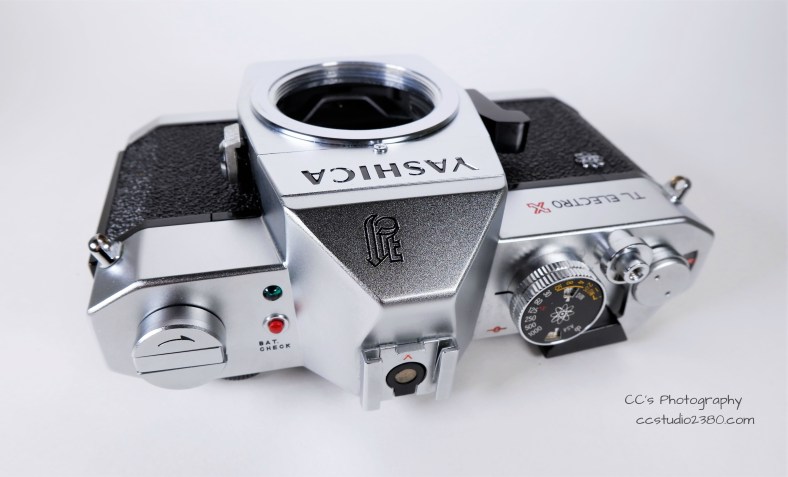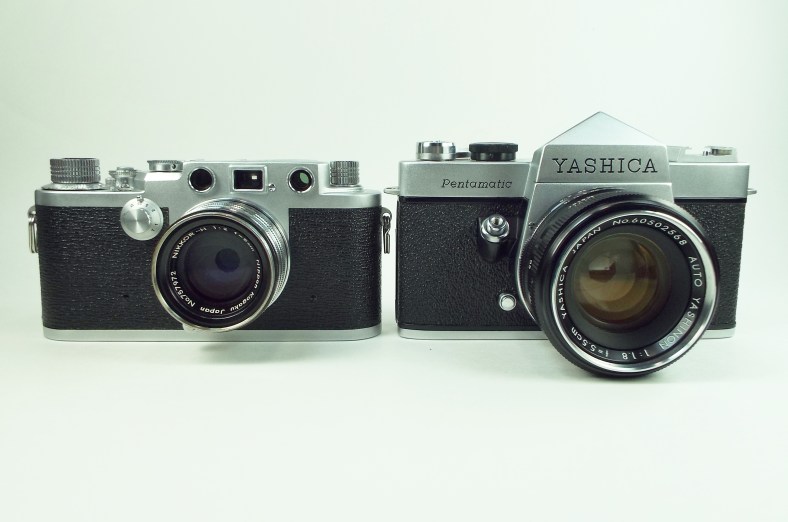
Yashica TL Electro-X

Another look at a recent post about my all-time favorite Yashica. This one was sold to another collector hours after listing it in my shop.

Chris and Carol's avatarChasing Classic Cameras with Chris

One of the best cameras that Yashica made – in 1968 Yashica produced an exciting 35 mm SLR with a built-in computer! Well, integrated circuits and an electronic “brain”.

It was my first SLR and I fell in love with its looks and the feel of it in my hands. This one is from my rather silly large collection of Yashica cameras and I’ve decided to make it available in my online shop at http://www.ccstudio2380.com

This one is from around 1970 and besides being in stunning mint condition it works like new!

dscf8890 logo

Gotta love the gothic “Y” on the pentaprism – pure Yashica!

dscf8888dscf8893

The battery for this camera is still readily available today and isn’t very expensive.

dscf8892

I’ve always felt that the satin silver finish on this model was the best – it holds up well and it’s easy to keep clean.

The camera will come with a fresh (new)…

View original post 104 more words

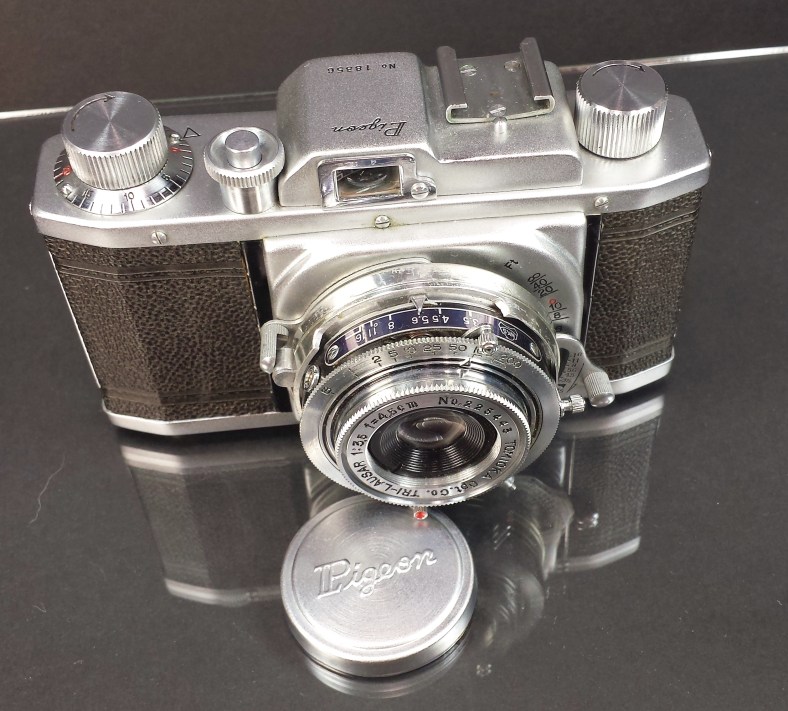
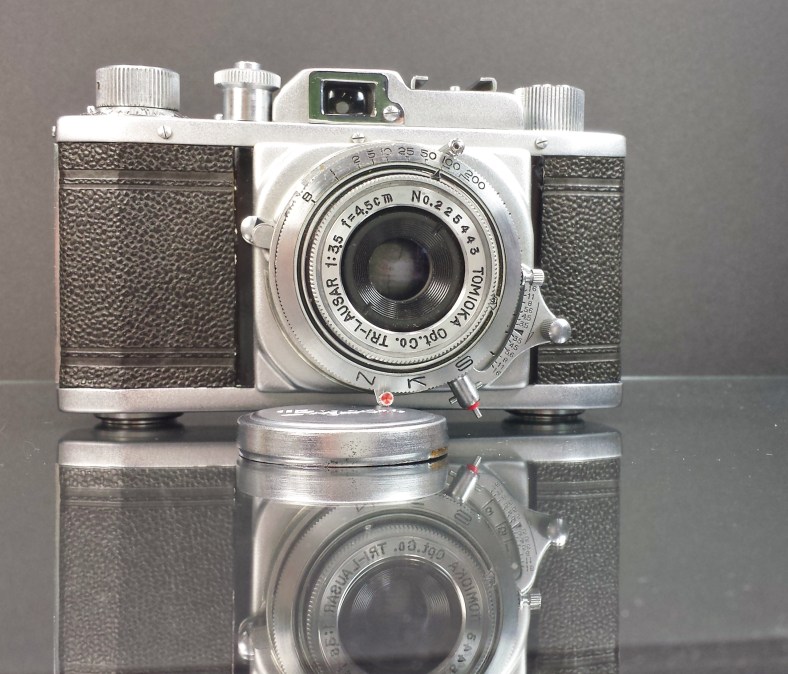
Pigeon 35 by Shinano Camera Co., Ltd.

A reblog of an earlier post about this amazing and seldom seen 35mm rangefinder camera made in Japan in the early 1950s.

Chris and Carol's avatarChasing Classic Cameras with Chris

Why show a 35mm viewfinder camera on a blog about the Yashica Pentamatic? Well, Shinano and Yashima-Yashica share a common history. The first camera that carried the Yashima name was the Pigeonflex… a twin-lens reflex (TLR) camera!

Anyway here’s a nice example of a gorgeous 35 mm viewfinder camera that we acquired recently. The lens is made by Tomioka… a sharp (we hope) Tri-Lausar f/ 3.5 4.5 cm lens. NKS shutter B – 1/200.

It’s a nice heavyweight camera that has a good feel to it. In our opinion, it’s far from being a cheaply built camera as some would say. In fact, it still functions as intended after 6 decades of use. Most leather cases would be a complete mess after this amount of time but the leather is nice and the stitching is intact.

20160801_183736 1952 Pigeon 35 by Shinano.

20160801_183800 Nice view of the Tomioka lens.

20160801_184255 Beautiful logo on…

View original post 68 more words

Just Arrived! New items in the shop.

Some new items have just been listed in my camera shop at http://www.ccstudio2380.com

DSCF9874

Canon EOS nylon camera strap from the 1980s. New, never used. Super nice.

DSCF9858

A must have original (not a copy) Canon Booster T Finder instruction book. Near mint condition.

DSCF9826

Hyper rare Minolta Six 6×6 cm medium format 120 roll film camera from 1936. This was the first camera to carry the Minolta name and was the first 6×6 cm camera made in Japan.

DSCF9736

Classic early 1970s Mamiya/Sekor 35mm SLR – the 1000 DTL was a landmark camera from Mamiya.

DSCF9759

Super cool camera case (camera not included). Made by Marsand. I still have the key and the lock still locks!

DSCF9589

Not often seen outside of Japan, this SLR slayer from Fuji Photo Film Company is like new in its original package – with all the goodies included it’s ready to be a street photog’s dream.

DSCF9624

Brand new Canon Olympics fanny pack. Step back to the future with this HTF collectible from Canon.

There you have it – a small sample of some of the neat items I’ve added to my shop recently all at 10% off in my big Spring sale! Check it out at http://www.ccstudio2380.com

Thanks – Chris

Please respect that all content, including photos and text, are the property of this blog and its owner, Yashica Pentamatic Fanatic, Yashica Sailor Boy, Yashica Chris.

Copyright © 2015-2019 Yashica Pentamatic Fanatic, Chris Whelan
All rights reserved.
Happy SUNday! – Yashica Cousins

Yashica’s advertising figurine (doll?) from the early 1960s. Officially nameless but I’ve tagged him with “Sailor Boy” for obvious reasons.

DSC07067

My camera shop display sized (20 cm) Yashica “Sailor Boy”. This one was still in its sealed plastic bag and original box from Modern Plastics of Japan.

yashica sailor boy big

Another dealer display model (not mine) of Yashica’s “Sailor Boy” – this one looks as though he’s been in a bar fight in Tokyo!

I’m not sure which one was first but my guess is that the “tough guy” version may have been a prototype as I’ve never seen another one for sale in all my years of collecting Yashica branded items.

Have a great day y’all! – Chris

I’ve listed some neat items in my camera shop at http://www.ccstudio2380.com – pop on over and check it out!

Please respect that all content, including photos and text, are the property of this blog and its owner, Yashica Pentamatic Fanatic, Yashica Sailor Boy, Yashica Chris.

Copyright © 2015-2019 Yashica Pentamatic Fanatic, Chris Whelan
All rights reserved.
Are TLRs a good way to discover medium-format photography?

I guess another way to pose the question would be “are TLRs still relevant”?

Film photography appears to be holding its own in this digital world but have twin-lens reflex cameras lost their appeal? Obviously, not all vintage and classic camera sales go to just collectors – many of these 40 and 50-year-old cameras are being purchased and used by today’s crop of film photographers looking for a way to explore medium-format images without breaking the bank.

dscf3787

Typical twin-lens reflex (TLR) film camera.

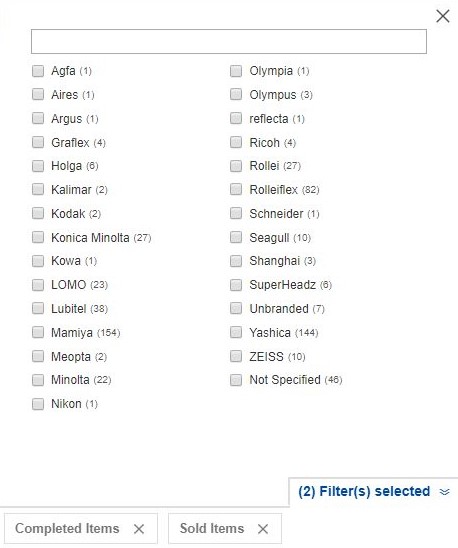
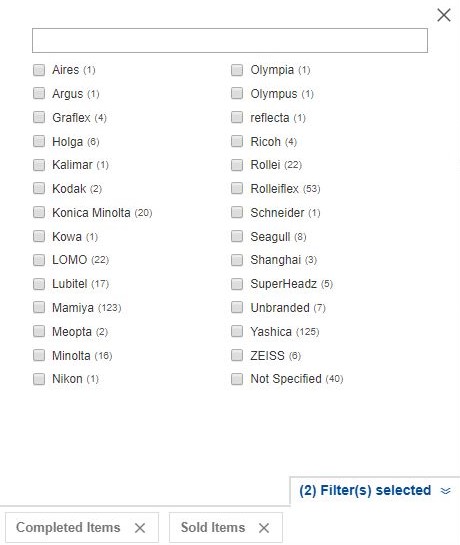
I decided to take a snapshot of just completed sales of cameras that were listed as “TLR – Film Cameras – Sold” on eBay.

tlr sold list

The top six are –

  • Mamiya
  • Yashica
  • Rolleiflex
  • Lubitel
  • Rollei
  • Konica Minolta

This list goes back to the last few days of January 2019 and does include some accessories (lenses, lens caps, cases) that are not cameras. So the total numbers will be a bit skewed.

Here’s the list searching for “TLR Camera – Film Cameras – Sold” on eBay which removed accessories like lenses, cases and other minor parts.

tlr list

The top six are –

  • Yashica
  • Mamiya
  • Rolleiflex
  • Rollei
  • Konica Minolta
  • Minolta

This represents an unscientific look at the popularity of TLRs as a viable tool for enjoying medium-format (6×6 cm) photography. 120 roll film is still widely available and it’s easy to find online companies that develop the film.

53580006

6×6 cm image taken with my Yashica-Mat EM TLR. Learning to compose and shoot this square format takes a bit of practice but the quality of the finished picture is worth it.

dscf3060

Thanks for stopping by! – Chris

My camera shop is always open and it can be found at http://www.ccstudio2380.com – I’ve got a big sale in progress with some super savings… check it out!

Please respect that all content, including photos and text, are the property of this blog and its owner, Yashica Pentamatic Fanatic, Yashica Sailor Boy, Yashica Chris.

Copyright © 2015-2019 Yashica Pentamatic Fanatic, Chris Whelan
All rights reserved.

Nicca Pentamatic!?

Stay with us and we’ll try to make our case. Recently discovered information has filled-in some of the missing links in the development of our favorite obsession camera. The mysterious and seldom seen Pentamatic ’35’… Yashica’s first SLR.

dscf2740

A few interesting bits of info have come to our attention recently. We were alerted to an auction by our friend Paul Sokk (http://www.yashicatlr.com) that listed a 13.5 cm f/ 2.8 lens made by Taiho Optical Company –  Nicca Lens. Having never heard of the company, Taiho Optical, and knowing about Nicca’s history, we couldn’t figure out where and how there could be a Nicca connection.

taiho_optical_co_nicca_135mm_f28_04

Let’s backtrack a bit with a quick history lesson. Yashima-Yashica was a very successful maker of high quality, low-cost twin-lens reflex cameras but hadn’t moved into the 35 mm market as of early 1957. It appears that the president and founder of Yashima-Yashica, Mr. Yoshimasa Ushiyama could see that although Yashica was successful building TLRs, the market for them would slowly diminish as new, smaller and easier to use 35 mm cameras would grab the marketplace. He wanted in but how?

Yashica had no experience with 35 mm cameras, especially rangefinder cameras with cloth focal-plane shutters. There were dozens of Leica copy cameras in Japan (and the world for that matter) but possible patents protected specific manufacturer’s shutter designs. If he could buy into an established company then he could use their shutter design and incorporate it with early Yashima-Yashica designs. In May of 1958, an opportunity presented itself. Nicca Camera Company was apparently experiencing financial difficulties and may have been on the brink of bankruptcy. Nicca cameras were well known and well respected – they made high quality 35 mm rangefinder cameras with focal-plane shutters. They used Nikkor lenses with the L39 screw mount. Mr. Ushiyama was in a rush to purchase Nicca before they went belly up. Advisers cautioned to wait until Nicca went bankrupt arguing that they would be able to acquire it for a better price. Mr. Ushiyama knew that that outcome of a bankruptcy could take longer than he was willing to wait and there would certainly be more suitors to compete with. So the deal went through… sort of. As best as we can glean from our research, a “religionist” “admonished” Mr. Ushiyama for rushing into the deal and cautioned that Yashica itself would suffer a “decline” if all of the transfer were made immediately.

record-image_939x-h3sn-v1

OK, OK! We give!!! We share your feelings dear reader –  what’s the connection between Nicca and the Pentamatic? Taking the advice of the religionist, Mr. Ushiyama created a new company. Nicca would become Taiho Optical Company. Say what? Nicca wasn’t absorbed into Yashica in May of 1958, instead, they became another company that could continue to operate with Yashica but without becoming Yashica. Simple. Confused? Mr. Ushiyama listened to his adviser so nothing bad happened. It appears that the former Nicca employees were now free to develop new processes and designs with the financial and technical support of the much larger Yashica. What did Yashica get for its money? Plenty it would seem. Access to years of 35 mm rangefinder manufacturing experience and access to a proven focal-plane shutter. Important steps in building a 35 mm single-lens reflex camera. We don’t know (yet) which one of the two companies came up with the design of what would become the Pentamatic. Was it mostly a Yashica design that had been kicking around for a while lacking a focal-plane shutter, or was it mostly a Nicca design that lacked the financial means to bring it to market? We feel that it was more than likely a 60 – 40 split with Nicca as the 60%. Just a hunch, no facts at the moment.

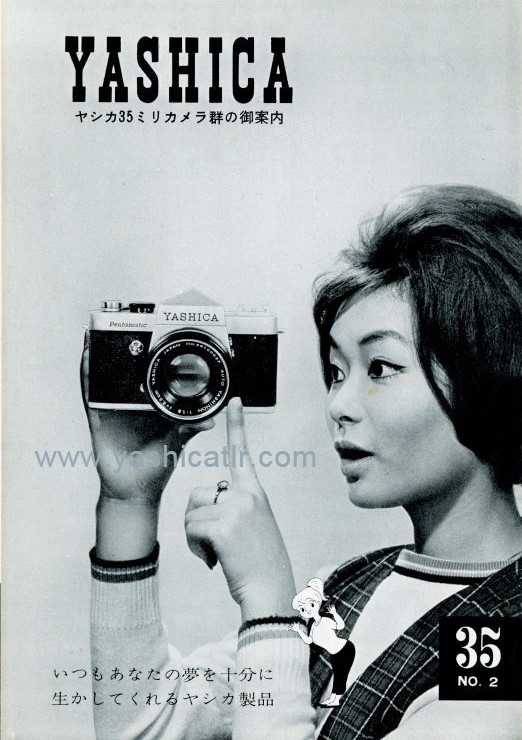
Yas Cover P1 bro (1)

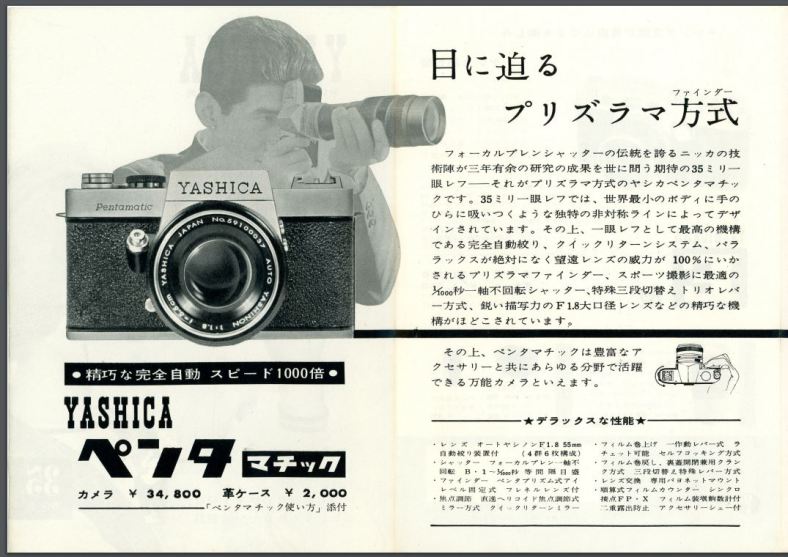
Earliest known sales brochure for the Pentamatic ’35’. The best guess is that it was printed in the Spring of 1960.

Yas inside P1 bro

A machine translation of this page from inside of the brochure states clearly that Nicca and Yashica developed the Pentamatic.

dscf2743

But what did the Taiho Optical Company make? Yashica didn’t make their own lenses, Tomioka Optical of Tokyo did. Was the former Nicca, now that it had become Taiho Optical, going to suddenly start making lenses? At the start of this blog, we mentioned that we were alerted to the existence of a 13.5 cm lens for sale with the Taiho Optical Company-Nicca Japan markings. Other than that, nothing.

So when did Mr. Ushiyama merge the two companies? He apparently listed to his adviser and waited eight long years before merging the two. From 1960 (when the Pentamatic was released) until 1968, when he not only made Yashica whole, but he also acquired long time lens supplier Tomioka Optical.

Now we know how the Pentamatic came to be and why it could be called the Nicca Pentamatic.

dscf2748

Thanks for sticking with us. – Chris

Please respect that all content, including photos and text, are the property of this blog and its owner, Yashica Pentamatic Fanatic, Yashica Sailor Boy, Yashica Chris.

Copyright © 2015-2019 Yashica Pentamatic Fanatic, Chris Whelan
All rights reserved.
Zoom Cardia 900 – SLR Slayer from Fuji

It’s available through my Etsy camera shop at http://www.ccstudio2380.com or buy it direct here. Thanks – Chris

Chris and Carol's avatarChasing Classic Cameras with Chris

Released in Japan in February 1990, this powerful (and not so little) point and shoot 35mm film camera was designed to bring all of the best auto features into one small package. It listed for ¥ 43,800 ($300 at that time) and compared to other P&S compacts of that period that wasn’t a bad price.

It’s a good looking camera in my opinion and its got some heft to it with all of the micromotors built-in and that big Fujinon zoom lens (400 grams with the CR-P2 battery installed).

DSCF9592 Excellent coverage from this sophisticated Fujinon zoom lens – wide-angle to a perfect portrait and short telephoto focal length.

The Cardia Zoom models are considered to be one of the best of the best in the compact 35mm film camera segment – certainly worthy of being called a Modern Classic!

Some of its impressive specs:

  • Fujinon Z 38-85mm f/3.8 (2.2x zoom)…

View original post 380 more words

FRIday Fun – Random Pics

There are so many details, both large and small that add a richness to living in a small town. A short walkabout is a photographer’s dream as all of these images were captured within a few blocks of one another.

Fernandina Beach, Amelia Island, Florida

20140105_163021 (2)

20140117_152759_Richtone(HDR)

20140117_160856

20140117_161602_Richtone(HDR)

20140212_143028 (2)

20140117_163404_Richtone(HDR)

30510006

78690020

Fernandina Beach can be found in the extreme northeast corner of Florida – it’s located on the first barrier island (Amelia Island) along Florida’s east coast just across the border from St. Marys, Georgia.

It’s certainly worth a visit – there’s nowhere else in Florida like it and we’ve got 13 miles of beautiful unspoiled sandy beaches too!

Ocean Wave

Thanks for stopping by! – Chris

BTW, I’ve got some interesting new items in my camera shop which can be found at http://www.ccstudio2380.com

Please respect that all content, including photos and text, are the property of this blog and its owner, Yashica Pentamatic Fanatic, Yashica Sailor Boy, Yashica Chris.

Copyright © 2015-2019 Yashica Pentamatic Fanatic, Chris Whelan
All rights reserved.

The Yashica Pentamatic – Our 8 Year Search – Some Conclusions & Wild Speculations

20171125_133916 (2)

Some Conclusions

The first Pentamatic was “born” in December 1959 but wasn’t available for sale in the U.S. until April 1960. The Pentamatic was Yashica’s first 35mm single-lens reflex camera and was designed with the help of technology obtained from Yashica’s acquisition of Nicca Camera in 1958 and with some involvement with designers from Zunow Optical in 1959. Of course, Yashica designers were involved too as well as collaboration with Tomioka Optical for the first lenses.

Below is a scan of what appears to be the first sales brochure for the Pentamatic found in Japanese. A machine translation of it proves that Yashica and Nicca designers worked together to jointly develop the camera over a 3-year period. The exact date of this brochure has not been established but it appears to be at least issued in the Spring of 1960. Many thanks to my good friend Paul Sokk for his efforts in researching the Pentamatic with me over the years. His fabulous site can be found at www.yashicatlr.com

Yas inside P1 bro

Below is a scan of the cover of that first sales brochure that features the new Pentamatic.

Yas Cover P1 bro (1)

The original Pentamatic was a failure. A beautiful, sleek and modern camera at a great price, but still a failure. A replacement for it (Pentamatic II) was released by September 1960 – just a few short months after the original Pentamatic debuted.

The Pentamatic and the Pentamatic II were both out of production by January 1961. The Pentamatic S didn’t appear until around April 1961. Little was significantly changed over the course of these 3 models during this short timeframe. The Pentamatic II and its one-off lens improved on its semi-automatic capabilities. The body stayed the same with the exception of adding the engraved “II” after the name. No logic to this as Yashica could have simply made the new lens available as an option to the original Pentamatic. There had to be another reason to call it the model II and it appears that there were some internal changes made to accommodate the new lens.

The standard lens that was available for the Pentamatic II was designed and built (quickly?) by Zunow vice Tomioka. Our best guess at this point.

The Pentamatic II was only available for sale in Japan.

The Pentamatic S essentially was the replacement for the original Pentamatic – not the Pentamatic II. The model S added a lug for attaching an accessory exposure meter that coupled to the shutter speed dial. The S also added a self-timer and the body got a redesign (the strap lugs were moved to the front and the shutter release button was no longer at a 45-degree angle).

The Instruction Booklets

The booklets have been an additional source of fun separate from the camera searches. The booklet for the original Pentamatic was relatively easy to find. The first Pentamatic saw about 16,000 units made so the booklet is much more available. The Pentamatic II booklet was the hardest to locate since only around 5,000 cameras were made. The Pentamatic S booklet is even rarer – only around 3,000 cameras produced.

DSCF6534

DSCF6540

Inside the booklets…

DSCF6543

DSCF6545

DSCF6544

Wild Speculations

Wild Spec 1 – The first Pentamatic was not initially released in Japan. Yashica had a slow go with its early production so only a limited number were available for the April to June debut in the U.S. There were only about 4,000 cameras made by then and that just didn’t support a wide release of it in their home market. However, with the discovery of the as yet undated sales brochure found by my friend Paul Sokk it does appear that some of the first Pentamatics were in fact distributed in Japan. We do feel that Yashica had a suspicion that the original model would not go over well at home. Why do we feel this way? During our quest of all things Pentamatic, we’ve yet to find an instruction booklet for the original Pentamatic in Japanese (or any other language besides English). We’ve seen no early 1960s advertisements either. Although we’ve yet to find these items that does not mean they don’t exist.

Wild Spec 2 – The Pentamatic II was only available in Japan and was never intended for widespread availability in the world marketplace. We further feel that the Pentamatic II was the camera Yashica intended to release in Japan vice the original Pentamatic. Why? Same thing… in over 8 years of searching, we’ve never seen a Pentamatic II instruction booklet in English and the only sales brochures we have are in Japanese. No English ads or brochures anywhere (yet). Update: As of April 2019 still no English ads or books.

Wild Spec 3 – The Pentamatic S wasn’t available in Japan. Crazy right? The same thing applies here – no Japanese advertising or brochures and no instruction booklets in anything but English. Again, not finding them does not translate to not being produced but the likelihood looks slim.

Wild Spec 4 – As we stated in the conclusions section above, the standard lens for the Pentamatic II (5.8cm f/1.7) was made for Yashica by Zunow Optical vice Tomioka. This flies in the face of what’s known and we don’t have solid written proof (yet, if ever). Both the original Pentamatic and the Pentamatic II ended production in January 1961. By coincidence, that’s the reported date of Yashica’s acquisition of Zunow (or their bankruptcy). Once Zunow went bust they no longer make lenses for the Pentamatic II.

Wild Spec 5 – Once the Pentamatic II stopped production, Yashica started selling the original Pentamatic in Japan (or at least increased its availability in Japan). We would still like to find a Pentamatic instruction booklet in Japanese to validate this thought.

Wild Spec 6 – Since the Pentamatic S wasn’t sold in Japan, there was a rather large gap in Yashica’s SLR availability. The next camera to be sold widely in Japan (and the U.S.) was the Penta J but that didn’t come out until the Summer of 1961.

These marketing and production missteps led to a less than stellar debut for Yashica in the world of 35mm SLRs. The competition during this same period was “inventing” much more sophisticated (and mostly more expensive) cameras which had a wider range of interchangeable lenses and accessories. It took Yashica a long time to establish a “foot in the door” with their Penta J and their first internally coupled exposure metered SLR, the Yashica J-3 (Jaguar).

Things we would like to find…

600x450-2015111900010

The first thing we would like to discover would be an ad, sales brochure or instruction booklet in English for the Pentamatic II. We don’t think we will as we feel that they don’t exist.

We would like to find a Pentamatic instruction booklet in Japanese. They must exist but we’ve yet to find one.

Pentamatic S instruction booklet and a sales brochure in Japanese. Don’t think they exist but time will tell.

Pentamatic II box!!! They must exist – someone’s got to have one in their collection! Update: Finally found one but we missed acquiring it for our collection so we “borrowed” this image –

yashica P2 Box

Pentamatic (any model) in its original boxes in factory fresh condition. WooHoo!

***Solid proof that the standard lens for the Pentamatic II was made by Zunow Optical.***

Other than these things, I think we’re good! ^.^

Thanks for your visit! If you’ve made it this far in the post give yourself a big pat on the back! You just may be on your way to becoming a ‘Yashica Pentamatic Fanatic’!

Please stop by our online shop at https://www.ccstudio2380.com and check out some of our classic cameras available for sale.

We are active buyers of quality cameras and equipment – especially anything Yashica, Nicca, Fujica or whatever! Contact us at chriscarol@ccstudio2380.com

Please stop by our camera shop at http://www.ccstudio2380.com

Please respect that all content, including photos and text, are the property of this blog and its owner, Yashica Pentamatic Fanatic, Yashica Sailor Boy, Yashica Chris.

Copyright © 2015-2019 Yashica Pentamatic Fanatic, Chris Whelan
All rights reserved.

Yashica-Mat 120 Film Camera Set – 1960

For those who may have missed this post from two years ago here’s a reblog of it. This is one of the nicest sets we’ve ever come across in all our years of collecting Yashicas.

Chris and Carol's avatarChasing Classic Cameras with Chris

dscf3786 Pretty close to the way it looked when it was unboxed back in 1960. This one was part of a short production run of only a handful of cameras. It was for sale at US Military Exchanges (stores) in Japan as it is marked *EP* which meant and exempt purchase. No taxes paid but it could not be purchased or sold on the Japanese domestic market. 

dscf3787 It was Yashica’s first crank film advance TLR and it had auto cocking of the shutter. First released in April 1957.

dscf3798dscf3799dscf3800dscf3801dscf3805dscf3806dscf3812

The quality of the images taken with a Yashica-Mat are outstanding – Yashica used high quality Yashinon f3.5 80mm lenses made for them by Tomioka Optical of Tokyo.

They are a joy to use and it’s a great camera to get into medium format photography. It produces large 6 x 6 cm negatives or slides.

Thanks for your visit!

Chris and Carol  ^.^

View original post