Nicca 3-S vs. Nicca 3-F

We’ve always assumed that the Nicca cameras were pretty much the same size from one model to another. The early 1950s models look for the most part, the same as the 1958 models. Now that we have two Niccas in our collection it’s time to do some comparisons.

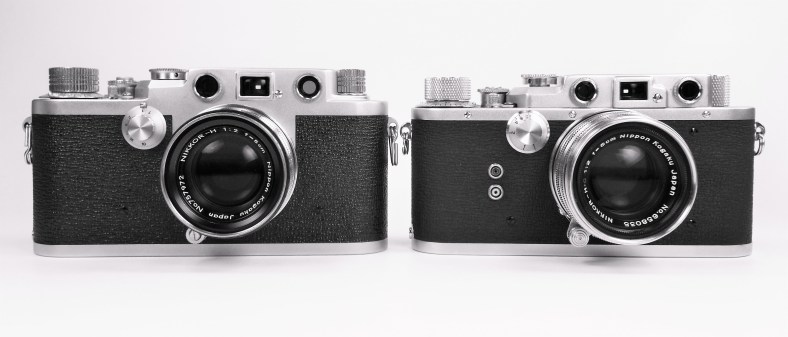
Nicca 3-F on the left and the Nicca 3-S on the right.
DSCF5424

First off, without the lenses attached, there is a slight difference in weight between the two with the 3-F weighing in at 445 grams and the 3-S weighing 432 grams.

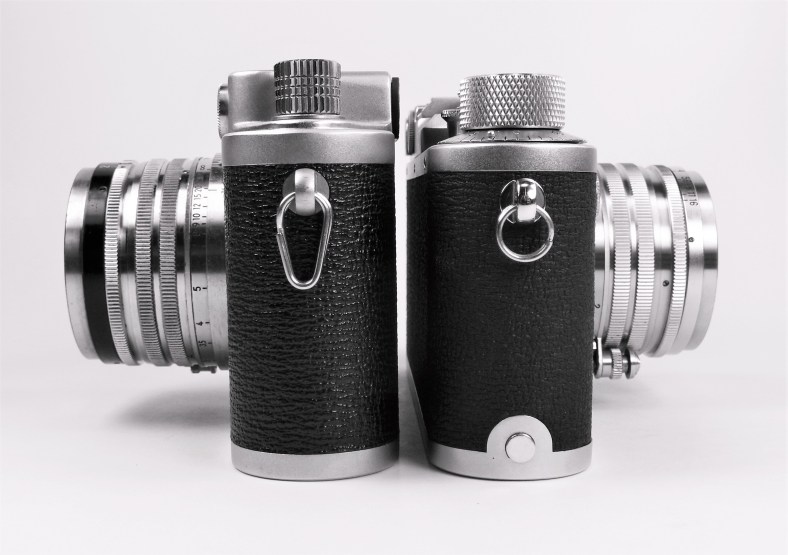
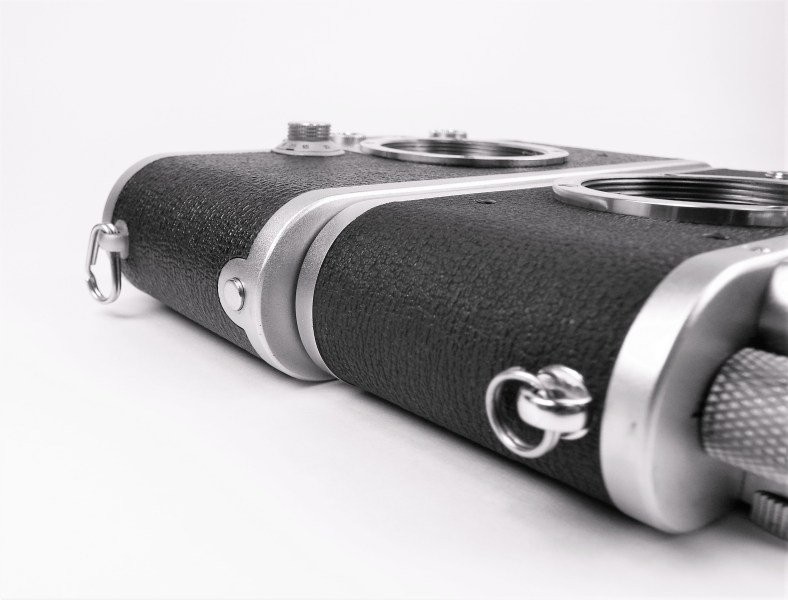
There is however a difference in size which surprised us. The later model 3-F (left) is taller than the 3-S (right) by about 4mm.
DSCF5425

DSCF5427

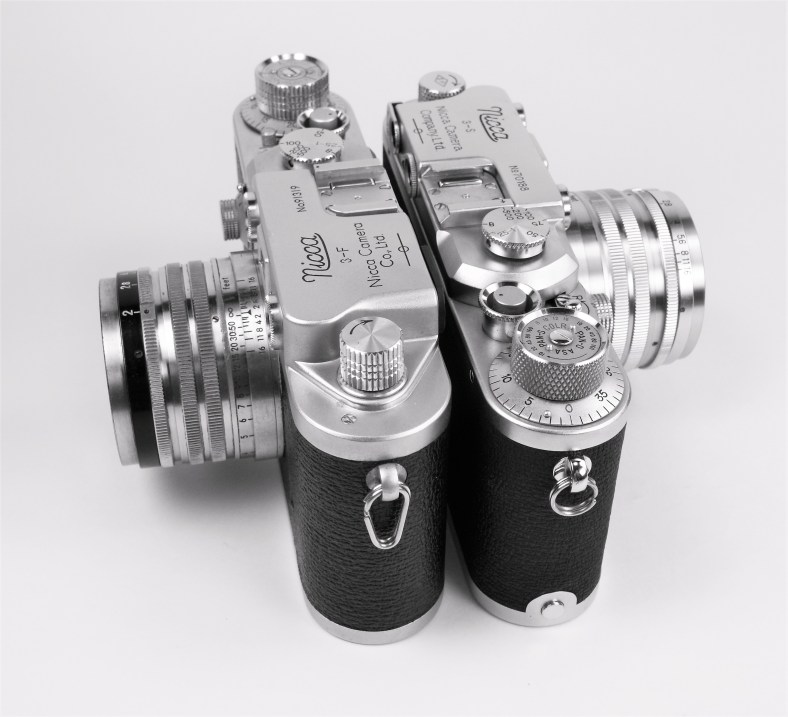
The 3-F is also longer than the 3-S by about 7mm.
DSCF5428

The 3-F is about 7mm longer and 1mm wider than the 3-S.
DSCF5429

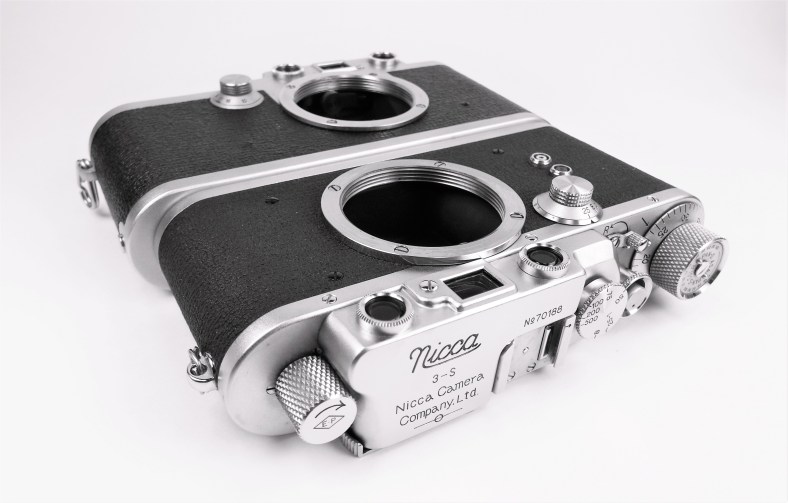
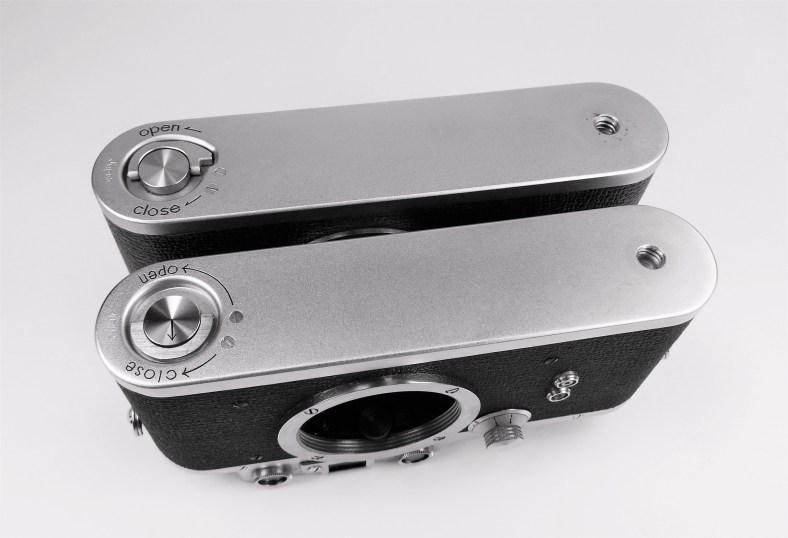
The 3-F is the top body with the 3-S on the bottom.
DSCF5430

Since these Niccas share the same specs it’s surprising that Nicca expanded the body of the 3-F.

Our best guess is that the later model (3-F) uses its extra length to improve the film path. Measuring the distance between the spindles with the baseplates off, the 3-F is 5mm longer than the 3-S (108mm vice 103mm).

So nothing earth shaking – just some subtle differences. As we have stated before, these are high quality cameras with exceptional fit and finish. Adding a Nicca will enhance any collection of 1950s Japanese made rangefinder cameras.

Studio Camera: Fujifilm FinePix S9900W

Chris
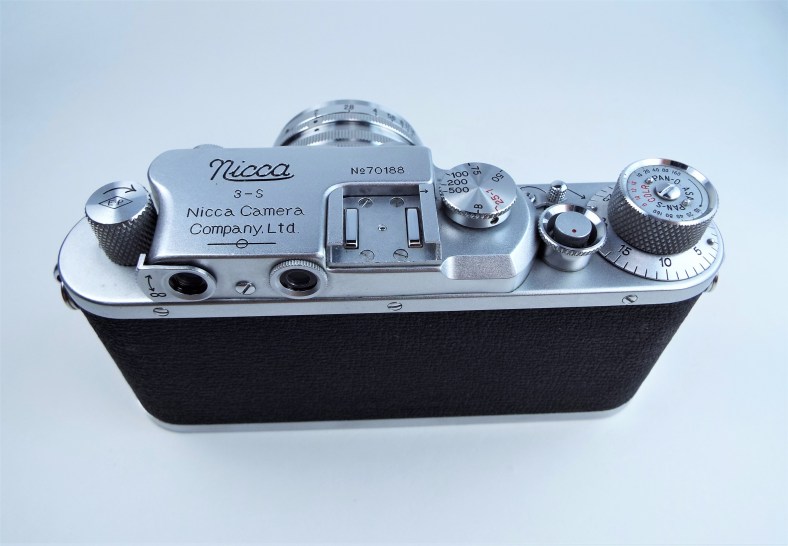
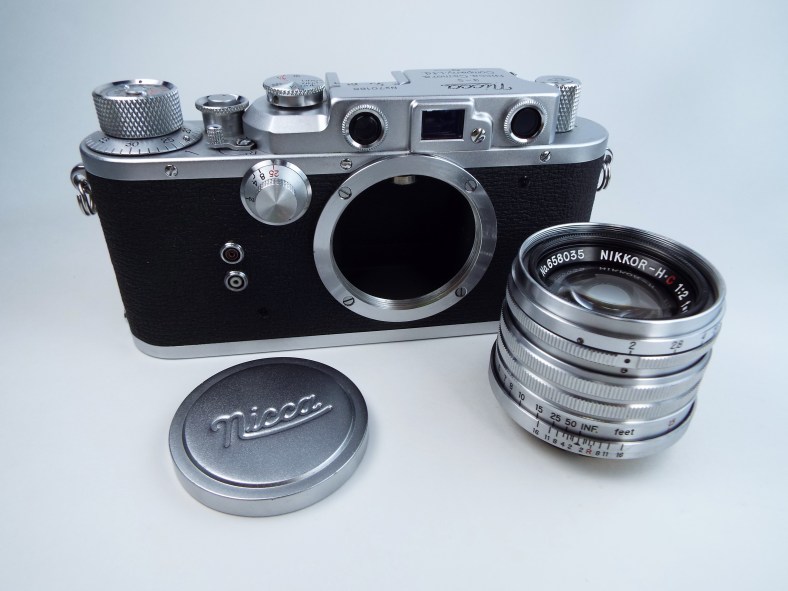
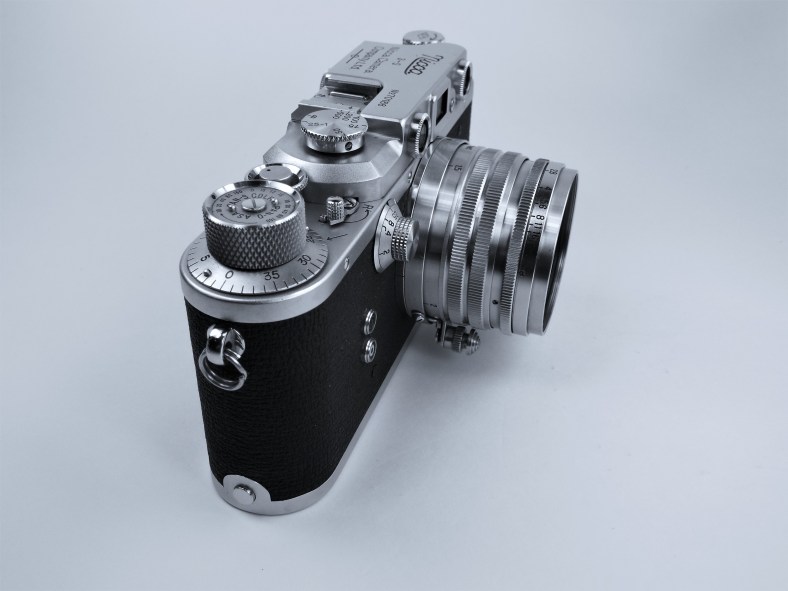
Nicca 3-S… Quality Rangefinder from 1955

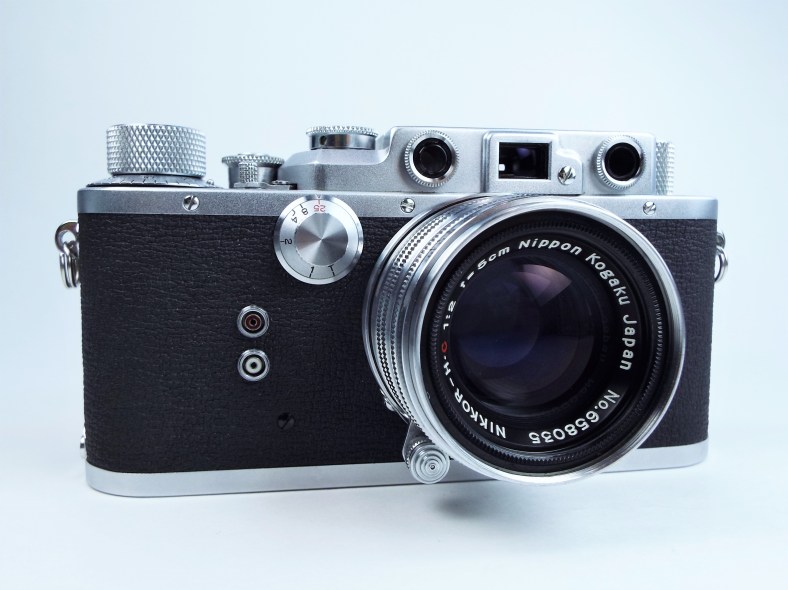
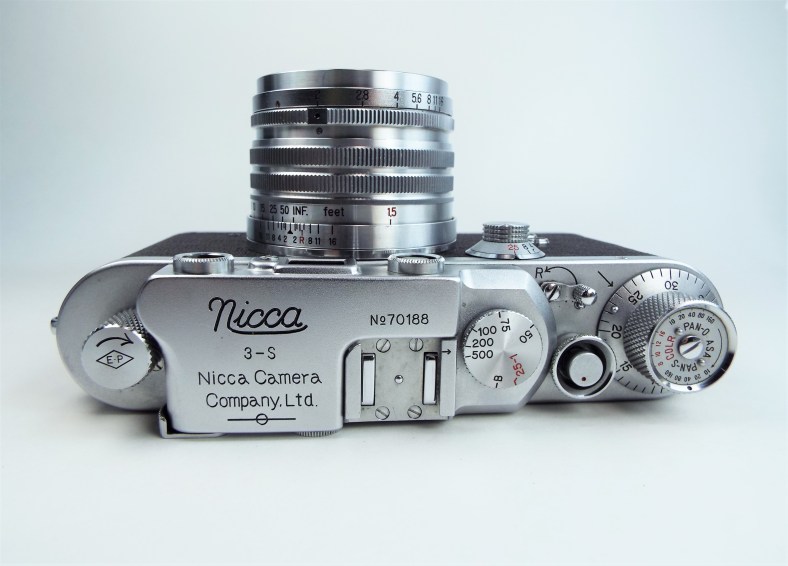
A beautiful example of a mid 1950s 35mm rangefinder camera – made by Nicca Camera Company, Ltd.DSCF5405

Mated with a sharp Nippon Kogaku Nikkor f/ 2, 5cm lens.

DSCF5406

Main shutter speeds of 1/25 to 1/500th of a second.

DSCF5414

Added bonus on this Nicca – marked <E.P> for exempt purchase. Normally marked for purchases made at military facilities and duty free shops.

DSCF5407


DSCF5419

Nicca cameras were considered to be well made cameras during the 1950s. This example is at least 62 years old and the fit and finish is almost flawless. Nicca was acquired by Yashica in 1958 and the merger of the two companies helped Yashica to design and release their first 35mm single lens reflex camera in 1960 – the Yashica Pentamatic.

Studio Camera: Fujifilm FinePix S9900W

Chris

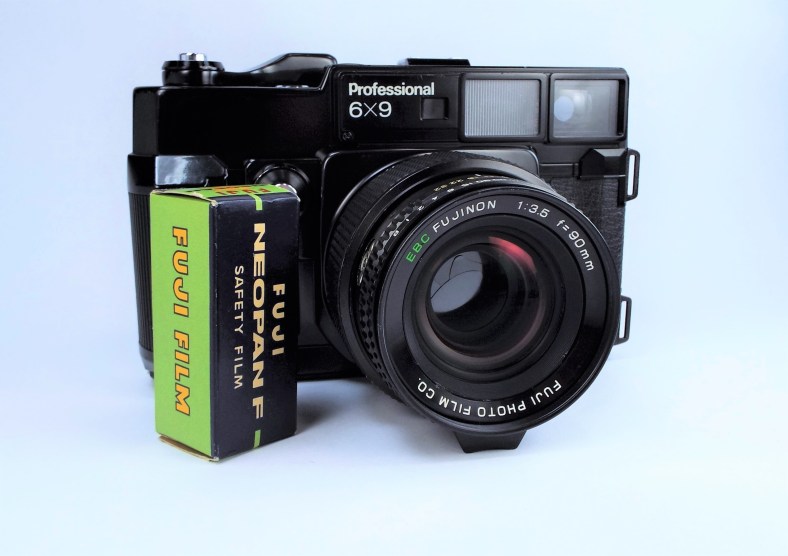
Fujica GW690 from 1978

We acquired this beast early this year and fell in love with its capabilities. The only problem with it is that you only get 8 6x9cm images on a roll of 120 film. Talk about planning your shot!

dscf3358

Last camera to carry the Fujica name.

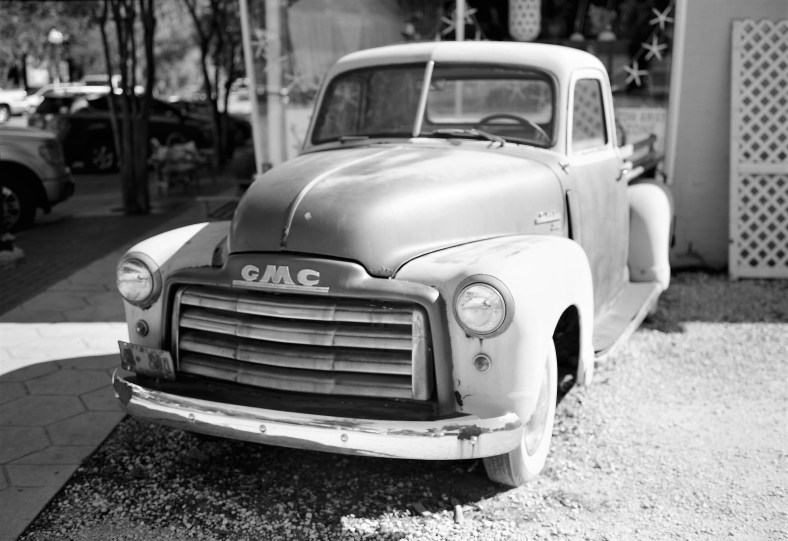
One of our favorite images from the first roll – far from perfect – the focus is a tad off but we love the shallow depth of field and the amazing tonal range of the Neopan Acros.

30510001

The 6x9cm format is, in our opinion, nearly perfect for big time enlargements. This image by the way, is not cropped and hasn’t received post production.

If you want to go big in medium format, the Fujica GW690 and the Fuji GW690II and III are worth a look.

Chris


Original Pentamatic Accessories

Some of the original accessories that were available for the new Pentamatic…

When Yashica’s first single lens reflex (SLR) 35mm camera hit the world markets in the May-June 1960 time period, they were ready with a host of well designed accessories. From simple screw-in filters to extension tubes and the new bayonet mount lenses, Yashica had a nice selection to choose from. Here are just a few examples…

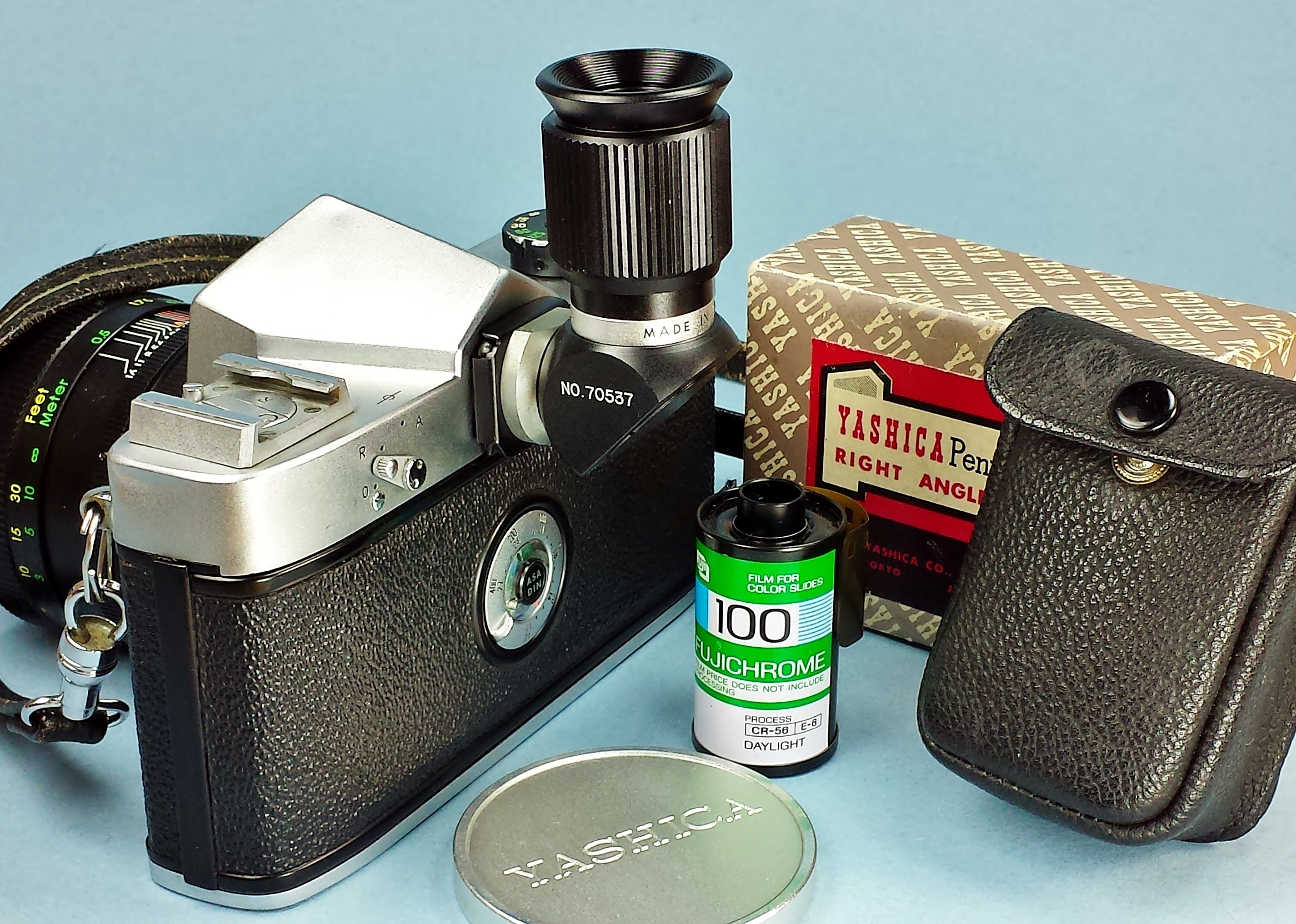
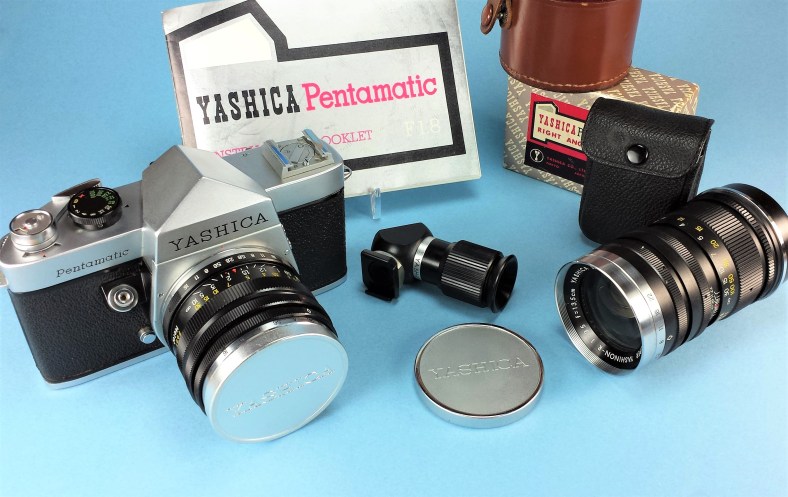
Pentamatic Right Angle Finder for low angle and close-up photography. This simple finder mounted securely to the camera's eyepiece and had adjustments for focus and could be rotated 90 degrees to the left for vertical copy work. The image is reversed so it does require some getting used to. Here it's mounted to my Pentamatic-S.

Pentamatic ‘Right Angle Finder’ for low angle and close-up photography. This simple finder mounted securely to the camera’s eyepiece and had adjustments for focus and could be rotated 90 degrees to the left for vertical copy work. The image is reversed so it does require some getting used to. Here it’s mounted to our Pentamatic-S.

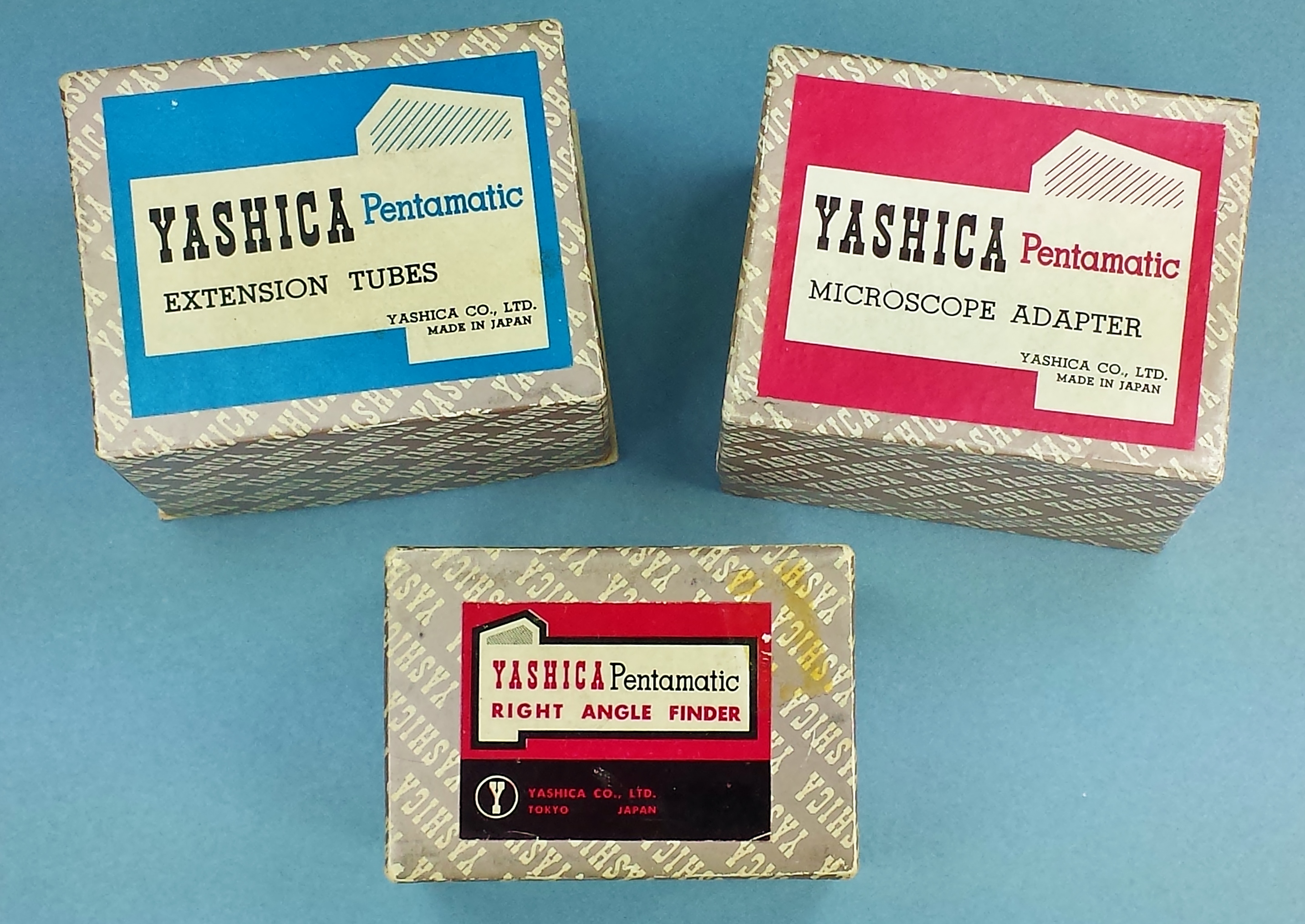
A small collection of boxes gives some idea as to the diversity of the early accessories. Note the general theme of the design... each shows-off the "pentaprism" design of the camera. The right angle finder box appears to be from a slightly later design as it has a different look from the other two.

A small collection of boxes gives some idea as to the diversity of the early accessories. Note the general theme of the design… each shows off the pentaprism design of the camera. The right angle finder box appears to be from a slightly later design as it has a different look from the other two.

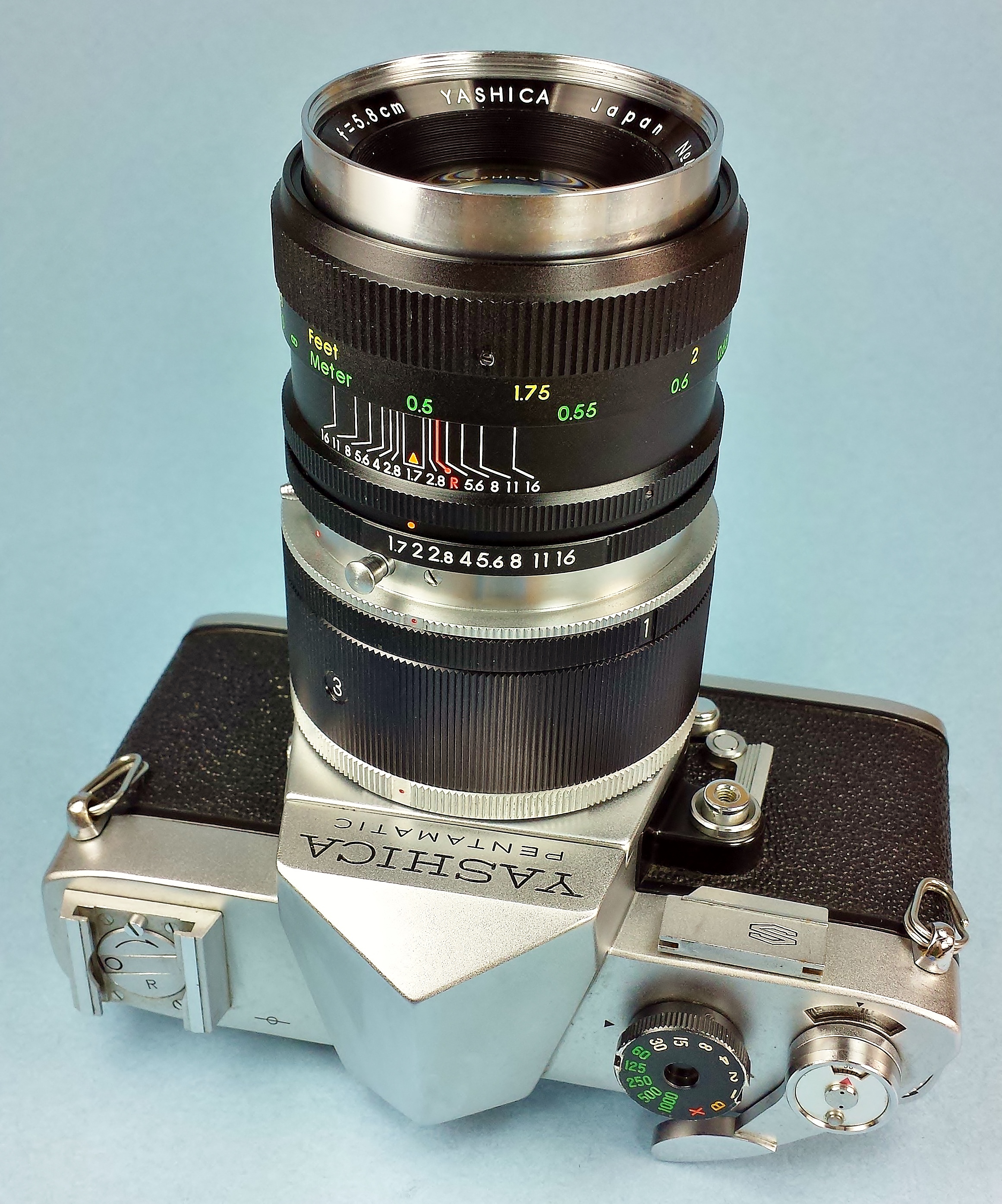
Pentamatic Extension Tubes mounted on my Model-S Pentamatic camera body and Auto-Yashinon 5.8 cm (58 mm) f/1.7 standard lens. The lens is super bright and is super heavy! Camera and lens weigh-in at 2 lbs 5 oz (1056 g)!

Pentamatic ‘Extension Tubes’ mounted on our Model-S Pentamatic camera body and Auto-Yashinon 5.8 cm (58 mm) f/1.7 standard lens. The lens is super bright and is super heavy! Camera and lens weigh-in at 2 lbs 5 oz (1056 g)!

20150108_150847

IMG_20151218_0003

Thanks for stopping by!

Chris

Early Yashica Pentamatic Brochure – US

Very early if not the earliest printed in the US sales brochure for the new Pentamatic.

We’re thinking the summer of 1960…

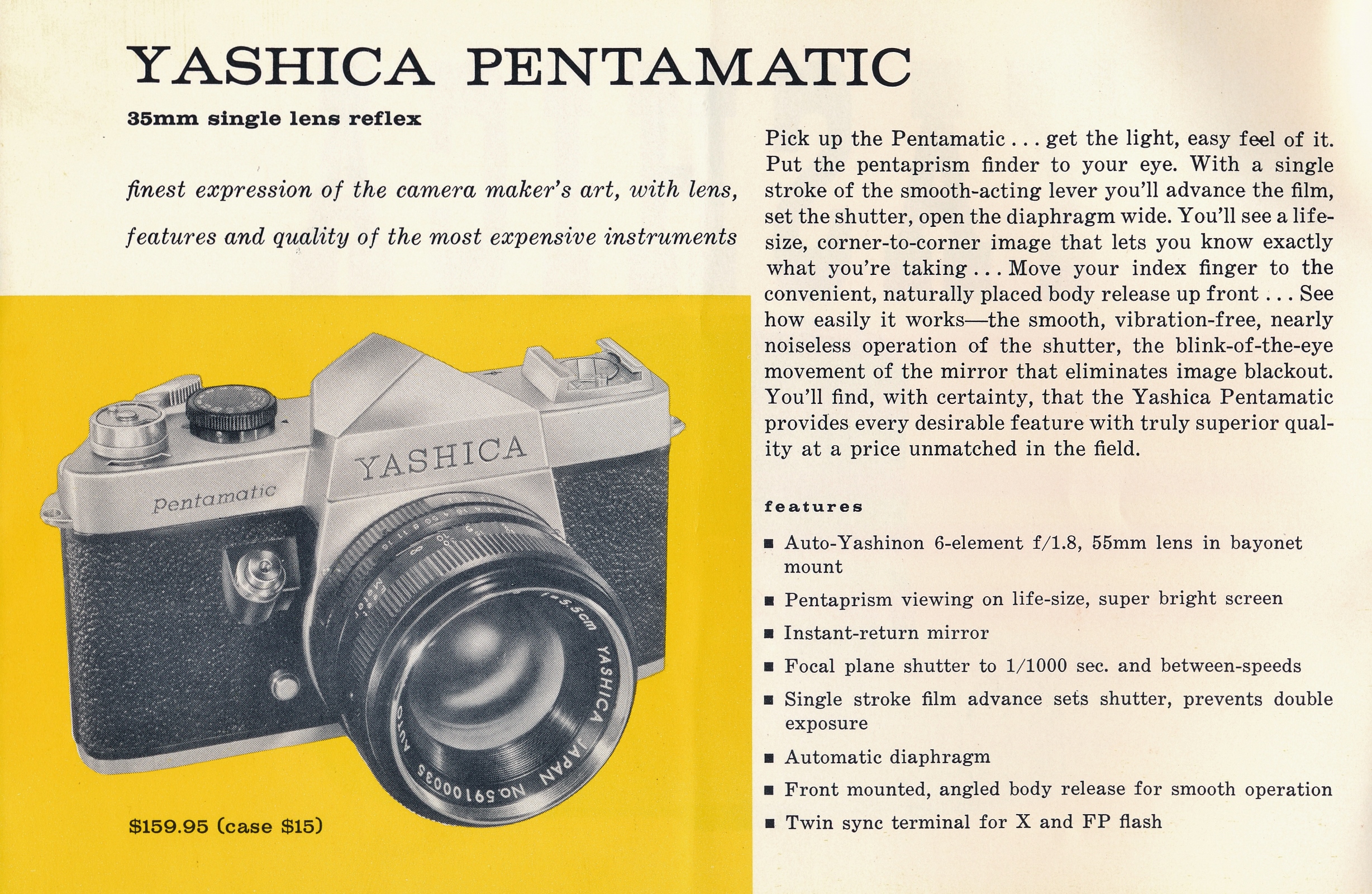
We haven’t found an earlier brochure that features the Pentamatic then this one – “Printed in the U.S.A.” on the back cover using the 234 Fifth Avenue, New York 1, N.Y. address. The cover is amazing in that other than Yashica’s name and an image of the camera, there’s no other writing. No “Pentamatic” – just an image of the camera. That was a first for Yashica as best as we can tell.

The first magazine advertisement was June 1960 in the US so we don’t believe this brochure was out before that. The only problem with our thinking is that most of the other cameras featured inside this brochure are 1959 model cameras and in some cases late 1958. There could even be a few that came out in early 1960. The two pages we’ve scanned (see below) contain an interesting wealth of info on the features and accessories for the Pentamatic. Of note, the lens serial number (No. 59100036) puts that lens to be one of the first lenses Tomioka made for Yashica with the new Pentamatic exclusive bayonet mount – 59 = 1959, 10 = October, 0036 = the 36th made in the production run.

We know from our research that the October 1959 date for the lens is 2 full months early from the first Pentamatic bodies (December 1960). Our best guess is that Tomioka Optical (the maker of the lens) needed to start production of the standard lens early in order to meet the demand for the camera body itself. No proof exists yet but it’s the best decoding of the lens serial number we can come up.

Page 1 provides a wealth of info for Yashica's first 35mm SLR.

Page 1 provides a wealth of info for Yashica’s first 35mm SLR.

IMG_20150926_0025

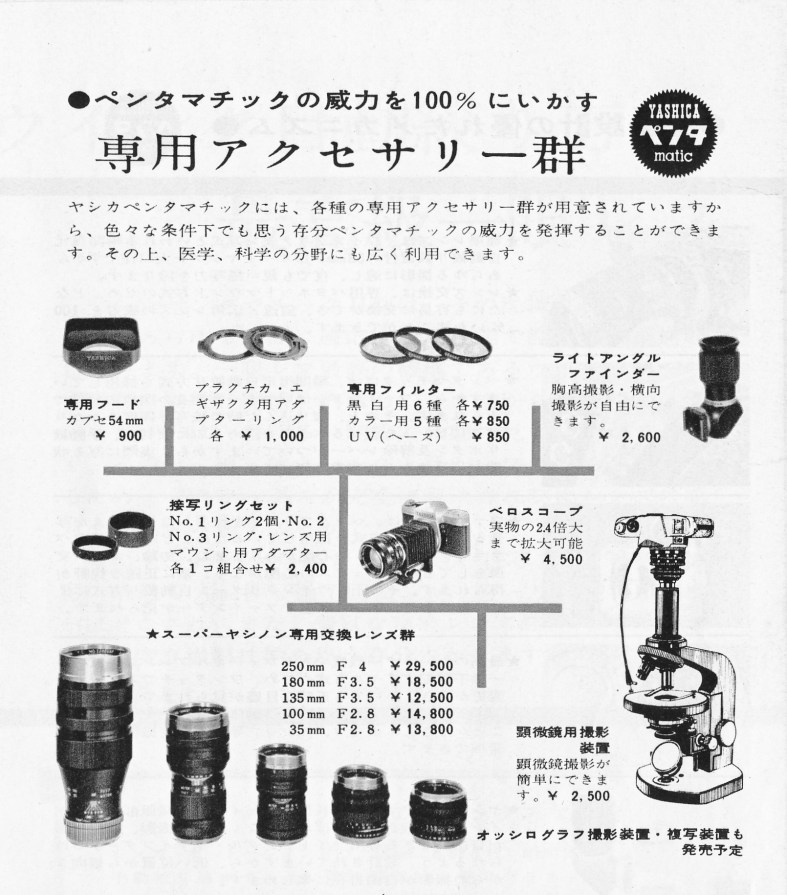
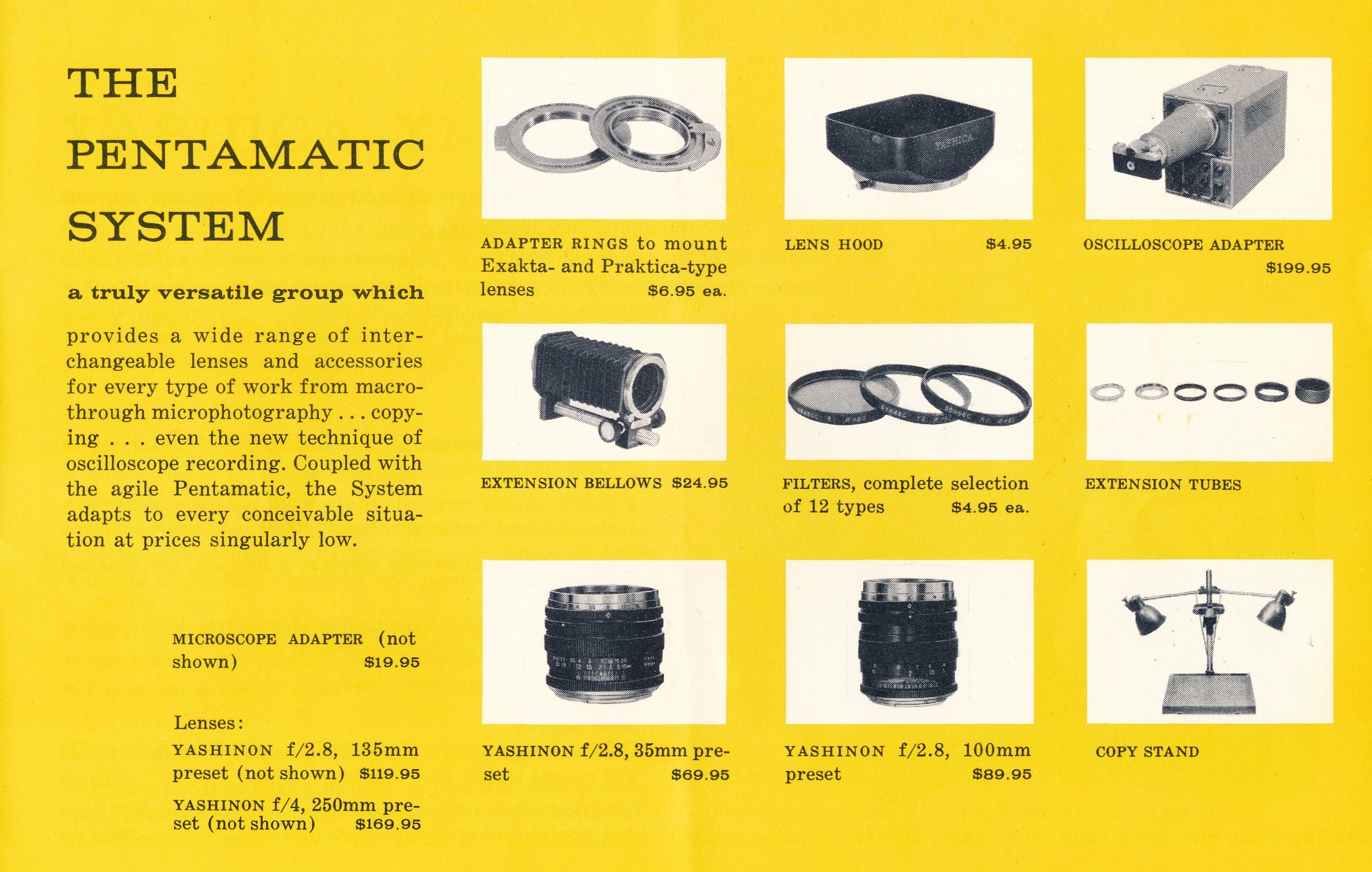
Page 2 shows (with prices) a nice selection of accessories for the Pentamatic. It appears that at the time of this brochure that there were 5 lenses available in the Pentamatic bayonet mount.


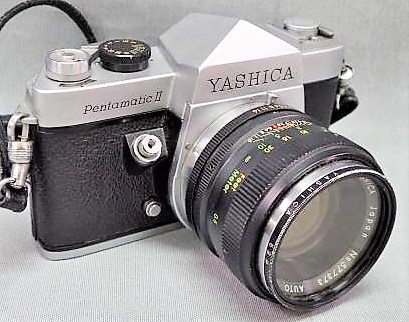
Yashica Pentamatic II at a recent auction.

If you’ve been following our blog about the Yashica Pentamatic II, then you know that it had one of the shorter production runs of any 35mm Yashica SLR camera. Released in September of 1960 – only a few months after the original Pentamatic went on sale in May of 1960, the model II was replaced by the Pentamatic S by January 1961.

So few of these come up at auction that’s it difficult for a collector to find a good example of one to bid on. This Pentamatic II (pictured below), just sold on an online auction for ¥8,500 with fairly robust bidding activity. While that’s not an extremely high final sales figure, it was rather high in our opinion for a camera that may not be functional with a lens that may have some issues (fungus, mold). Having said that, given just how rare the Pentamatic II is, it is certainly undervalued by some collectors. The camera set looks to be in good condition overall – no major issues seen with the body and it looks complete.

rep3673-img600x428-1495611839ebiivl30328

88c87729c0ad

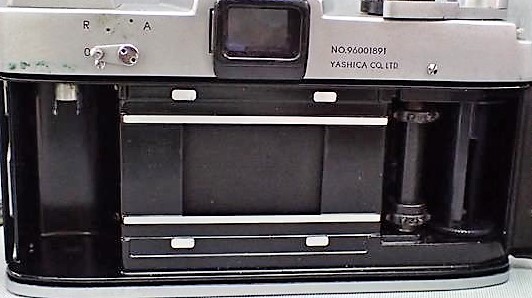
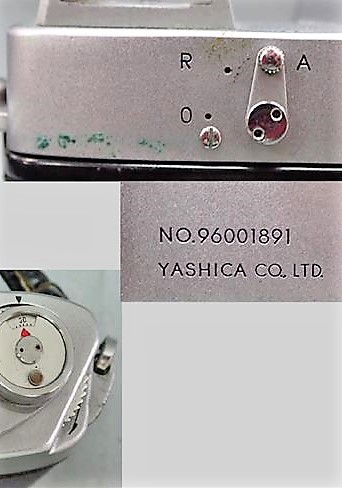
The serial number (NO. 96001891) would indicate that this body was made in September 1960, and that it was number 1,891 in the production run. For one month that is actually a high amount produced compared to the monthly totals of the original Pentamatic. We will point out that the only change that we’ve been able to find between the two models is that the model II uses a different standard lens – 5.8cm, f/ 1.7 Auto-Yashinon vice the original’s 5.5cm, f/ 1.8 A-Y lens.

88c87729c0ad (1)

So there you have it – a Pentamatic II with the correct lens, strap and a genuine Yashica filter sold for around $80. You should expect to pay in the vicinity of $100 for a clean version with certified working shutter.

Thanks for your visit and as always, happy hunting!

Chris

The Red Bridge

On a cloudy day, the red bridge stands out – the fish swim and the water flows.

At the Japan Pavilion, Disney’s World Showcase, Epcot.

DSC06781

DSC06785

DSC06780

A “Disney Duck” waits for a treat.

DSC06778

And a “Hidden Mickey” brings a smile.

DSC06782

Have a wonderful Monday!

Camera: Sony Cyber-shot DSC-W170

Chris & Carol

Fuji’s Pet 35 – 1959

Fuji Photo Film Company’s Pet 35 was introduced in 1959. As best as we can tell, the Pet was only available in the home market. Few nice examples exist today and even fewer with their original leather case.

Here’s an example of a very popular camera for Fuji during the late 1950s and early 1960s.

DSCF5295

DSCF5296

A Pet 35 leather case in all of its 1950s glory!

DSCF5306

The Pet 35 fits snugly into its leather case – the front does not detach so it always flops around (and weakens the crease).

DSCF5298

One of the coolest logos around.

If you run across a nice Fuji Pet 35 don’t pass it by. They are very much a real 35mm camera with excellent qualities – a glass lens with selectable apertures and adjustable focus. We haven’t run a roll of film through it yet but it’s on our list.

Camera: Fujifilm FinePix S9900W

Chris

Yashica “J” Series of 35mm SLRs – 1960s

The Yashica ‘J’ series of 35mm SLR film cameras. Top body is the J-7, next is the J-4, then the J-5 and finally the first one in the series the J-3. These were heavyweight cameras in their day…the best (for the most part) that Yashica produced from their factory in Nagano Prefecture (Shimosuwa).

18148859756_47887c898d_o

Produced in 1962 to around 1967 to early 1968. The black body J-3 was Yashica’s first 35mm SLR ‘Pro Black’ camera. They were released in the following order… J-3, J-5, J-4 and J-7. These cameras feature lots of brass and glass. They also represent Yashica’s first SLRs with built-in exposure meters. TTL exposure metering was just around the corner for Yashica after the release of the J-7 in the form of the TL Super.

18171648782_0bb09fdce8_o

16358708177_7df772c4d4_o

The J-5 was super popular in the mid 1960s.

15954848841_c16d47ab60_o

Another tough one in the series to find complete and in mint condition.

17389471134_d7a33a381e_o

One of the harder ones in the series to find in mint condition.

16148830641_bdc0bbed4c_o

A J-3 all set for just about anything.

Thanks for your visit.

Chris

Yashica’s ‘Sailor Boy’ – 1962

Yashica’s advertising figurine the ‘Sailor Boy’ first appeared in 1962 – closely associated with the launch of Yashica’s J-3 35mm single-lens reflex camera. It was made for Yashica by Modern Plastics of Japan and was produced in a variety of sizes – from a 20cm shop and dealer display model down to this little 10cm guy.

This one ⇓ came to our collection from Germany and man was he a dirty guy!

DSCF5218

Covered with a coat of nicotine and grime, he looked like he was in a bar room fight! But he has a good casting and the paint looks good. Notice how grungy his hat is.

DSCF5219

Since he was covered with a thin film of nicotine he was sticky!

DSCF5220

Looks like he has a black eye!

After some restoration work in the studio, he’s looking ⇓ much better and brighter.

DSCF5221

Nice and shiny! Still a hint of a black smudge near his right eye.

DSCF5222

His hat is white again. If you look to collect one, be sure to look closely at the hat. Often the casting will be a bit porous there and show some pitting. This one is nice and smooth.

DSCF5228

The manufacturer’s marks on the bottom. The round spot was meant to insert a small magnet so as to keep him in his place.

Made in Japan by Modern Plastics for Yashica. He’s never been given an official name from Yashica so we’ve always called him ‘Sailor Boy’ for obvious reasons. Some of the figurines will have ‘Yashica’ in katakana characters on the hat. We don’t have one like that – yet.

15133132085_d1fc422098_z

The 20cm shop model with the J-3. The eyelashes are different on the larger models otherwise they’re the same.

yashicasailorboys-japan-store

Not our collection! Wish it was! There is one missing – a 10 cm ‘Sailor Boy’ with green shoes otherwise this collection is complete. Notice the large doll on the back left does not have Yashica on his hat but does have green shoes. The one with the camera was released for the launch of the Yashica Electro 35 and as best as I can tell he’s modeled after Wee Willie Winkie from the Scottish nursery rhyme. These are on display at a Tokyo store that specializes in collectible figurines and dolls.

Thanks for your visit! And yes, we take donations of unwanted ‘Sailor Boys’!!! JK

Camera: Fujifilm FinePix S9900W

Chris