Yashica L AF vs. Kyocera T Scope

In case you missed this post the first time around here’s another look at these two exceptional cameras by Yashica-Kyocera.

Chris and Carol's avatarChasing Classic Cameras with Chris

Round 1 – The Introduction

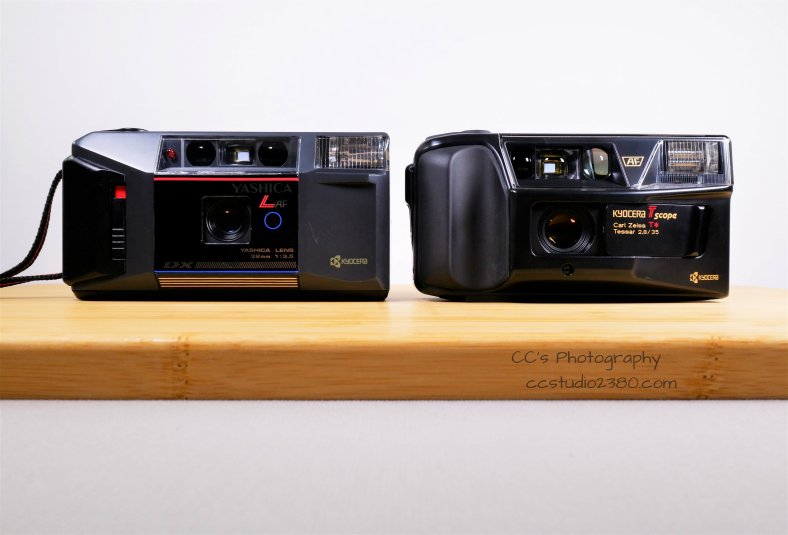
The Yashica-Kyocera L AF from 1986 and the Kyocera T Scope (Japanese name, T3 elsewhere). The L AF was assembled in Hong Kong with parts made in Japan and the T Scope was made in Japan.

Key feature – waterproof (more like weatherproof) – not a dive camera.

kyocera t scope

DSCF7805 logo N.A. Scope = “New Angle Scope”

The scope is just like a waist-level finder – pretty cool actually.

DSCF7813 logo

ky and laf logo Cousins

I’ll be doing a side by side field test of these two cameras shortly. Is the T3 really worth the extra money over the Yashica? The T Scope features a Carl Zeiss T* Series Tessar f/2.8 35mm lens against the Yashica (Tomioka?) f/3.5 32mm lens. I have a hunch that the Yashica’s lens was also made by Zeiss at the Tomioka factory in Tokyo. We’ll see if the vaunted T* coating makes a noticeable difference.

DSCF7808 logo Not often seen…

View original post 19 more words

Tuesday 2’s

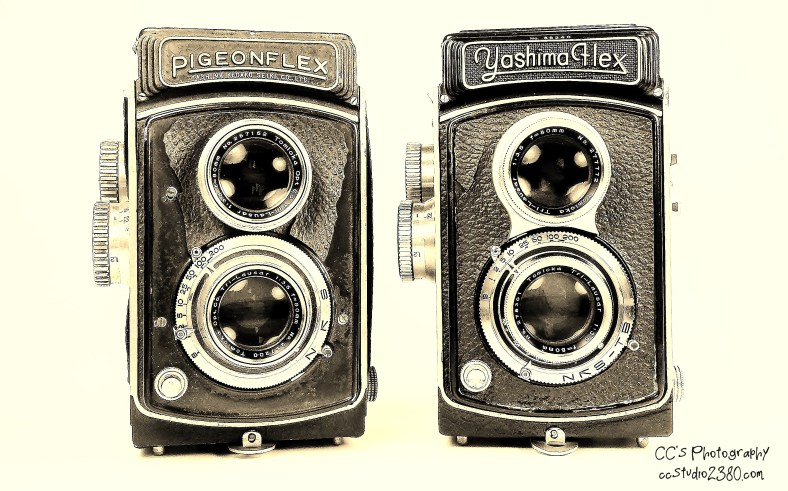
Yashica’s first two TLRs – 1953 1954

23866141666_82052528d0_o (1)

Twenty years of Yashica development – 1950s 1970s

15406127075_f309af6603_o (1)

Studio Cameras:     (Top) Samsung Galaxy S4      (Bottom) Sony DSC W-170

Thanks for stopping by! – Chris

BTW, my camera shop is always open at http://www.ccstudio2380.com – lots of specials!

Please respect that all content, including photos and text, are the property of this blog and its owner, Yashica Pentamatic Fanatic, Yashica Sailor Boy, Yashica Chris.

Copyright © 2015-2019 Yashica Pentamatic Fanatic, Chris Whelan
All rights reserved.

Hinomaruya ひのまるや and Nicca Camera

Nicca camera made one of the better 35 mm rangefinder cameras in the 1950s. The style of camera is typically referred to as a Leica copy or Leica clone which is an unfair label to attach to the cameras of this design. One could argue that all cameras are copies of some previous camera – someone had to be first.

Here’s one of my favorite cameras in my collection – the Nicca 3-S rangefinder from about 1955.

DSCF9984

Seldom seen outside of Japan, here’s a nice lens hood with Nicca branding. It was distributed by Hinomaruya Co., Ltd. of Tokyo, Japan. The hood (or lens shade) was designed to be used with the Nikkor 50 mm f/2 lens and had a mount size of 40.5 mm.

DSCF9989

The attention to even the smallest details is what makes collecting these vintage bits of photo gear interesting and fun. The Yashica branded lens shades from this period look exactly the same so I will assume that the same manufacturer made them all. Could it have been Hinomaruya? No proof that they actually “made” things.

DSCF9992

The back of the leather case carries the Hinomaruya (in Japanese it’s ひのまるや) logo in a similar font as the Nicca logo (or at least close to it).

DSCF9991

Side view of the box – the translation is “Nicca Lens Hood”.

DSCF9995

There’s very little about the company Hinomaruya available on the web. It’s last known address was Tokyo-to, Chuo-ku, Nihonbashi Muromachi 4-3 (which was just around the corner from Yashica). The company was the exclusive distributor of Nicca up until 1958 when Yashica acquired Nicca. They also distributed the rather cool Melcon 35 mm rangefinder camera and the Nikkor lenses used on both the Melcon and Nicca.

Hiromaruya in hiragana is ひのまるや

t-98_not-0015 1

Here’s a bag that has Nicca and Hinomaruya on it. Another direct link between the two of them.

I’m not sure if they made this slide projector or if they distributed it but this item is from about 1959 – interesting because it’s a year after the Yashica acquisition of Nicca.

Maruya Pet hinomaruya

There are a few (very few) advertisements floating around on the web from Hinomaruya and I haven’t seen that name anywhere on paperwork from Nicca associated with the camera. It’s unknown if they handled warranty registrations and related paperwork for Nicca or Nikkor.

Thanks for stopping by and BTW, if you have additional information about Hinomaruya or Nicca please feel free to share it with me! Thanks – Chris

Studio Camera: Fujifilm X-A10

Please respect that all content, including photos and text, are the property of this blog and its owner, Yashica Pentamatic Fanatic, Yashica Sailor Boy, Yashica Chris.

Copyright © 2015-2019 Yashica Pentamatic Fanatic, Chris Whelan
All rights reserved.
Single Shot Focus on the Canon AV-1

Introduced in 1979 into an already crowded family of super slick Canon 35mm SLRs, the AV-1 has always been kicked around in the world of auto exposure cameras. Most question the need for such a camera that only features aperture priority AE. Whereas its much more famous siblings like the AE-1 and A-1 have gone down in history as two of the best 35mm AE cameras of all time (my opinion), almost no one has seen an AV-1 let alone use one. Probably the only other lesser known Canon is the AT-1.

Why aperture priority? Simple, you select the aperture (f-stop) on your Canon FD lens based on the lighting available and the depth-of-field that you want in your image. The camera selects the proper shutter speed based on the film’s speed (ASA, ISO, DIN) and the f-stop that you selected. If there’s not enough light to hand hold the camera it’s up to you to know your limitations. If you’re a steady shooter then you may be able to squeeze off a shot at let’s say 1/30th of a second with a wide-angle or normal lens. If you’re like most people you’ll more than likely be much more successful staying north of 1/60th of a second. The AV-1 will auto expose accurately down to (or up to) 2 seconds! You’d better be on a tripod for that shot or have your camera perched on a flat, stable surface.

The other reason for the AV-1’s existence is that it cost significantly less than the other A series cameras – much lower but with no real drop-off in build quality IMO.

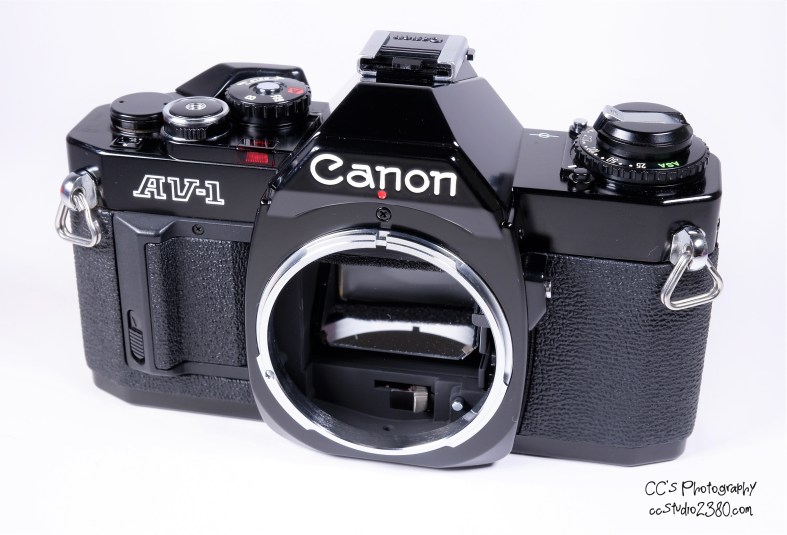
Here’s my AV-1 in the pro-black finish. It’s a beautiful camera and it accepts all of Canon’s FD lenses (which is a major plus) plus it was designed to operate with the Canon Power Winder A and the A2 and it provides full auto flash with the Canon family of Speedlites like the 133A, 155A, 177A and the 199A (all are dedicated electronic flash units for the AV-1). One final plus, it uses the still very easy to find and afford No. 544A silver oxide 6v battery.

So here’s the “Single Shot Focus” of my AV-1

DSCF9943

This one was made in June 1982 (date code is W628K)

Studio Camera: Fujifilm X-A10 set on aperture priority AE

Thanks for stopping by! – Chris

Please respect that all content, including photos and text, are the property of this blog and its owner, Yashica Pentamatic Fanatic, Yashica Sailor Boy, Yashica Chris.

Copyright © 2015-2019 Yashica Pentamatic Fanatic, Chris Whelan
All rights reserved.

Pentamatic Microscope Adapter – 1960

I have yet to use a microscope adapter in nearly 50 years of 35mm photography – but that doesn’t mean that I haven’t collected them and enjoyed the thought of someday using one. I’ve had a few Canon adapters over the years too.

The first step would be actively looking for a microscope to purchase on one of the many online auction sites. Something I will do.

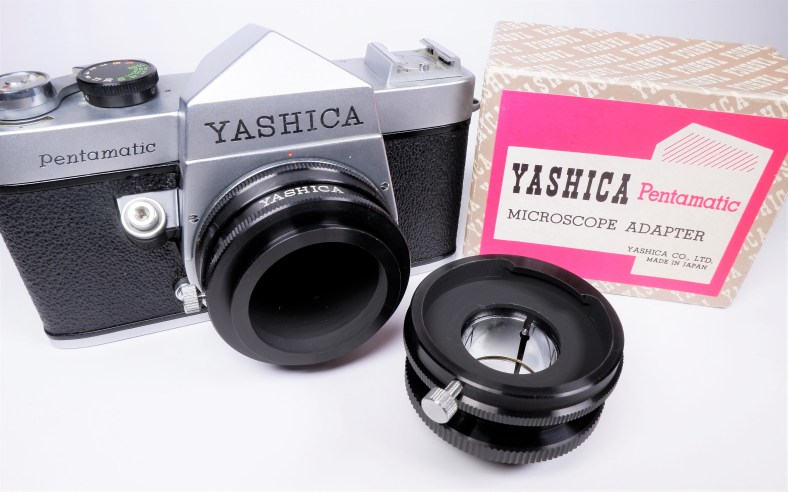
Here’s a nice adapter from Yashica with the Pentamatic bayonet mount. It’s one of the first accessories to appear in the early Pentamatic instruction booklets from 1960. List price was ¥2,500 which was fairly expensive back in the day.

DSCF9889

The adapter mounts directly to the body of the camera – no lens needed.

p1 acc page

A scan from an early Pentamatic sales brochure.

DSCF9890

DSCF9893

These instructions are from a later booklet featuring the adapter for the M42 screw mount.

DSCF9892

DSCF9895

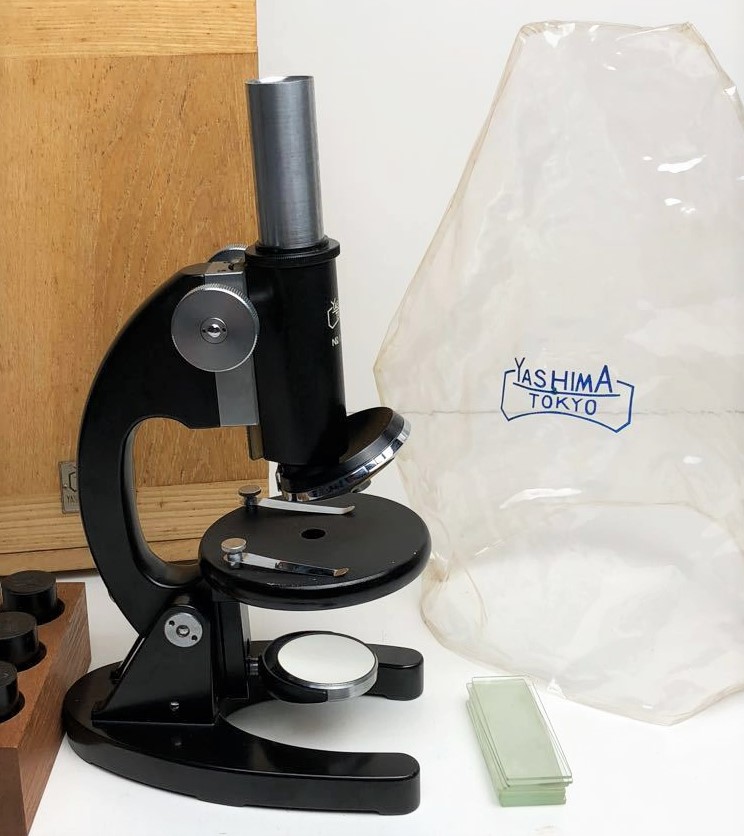
I believe that the microscope depicted here is a Yashima microscope but it’s not made by Yashica. Yashima was the first name that Yashica went by in the early 1950s.

d302624294.1

Not made by Yashica but still a super cool vintage microscope.

22533200692_c8120c1a4e_o

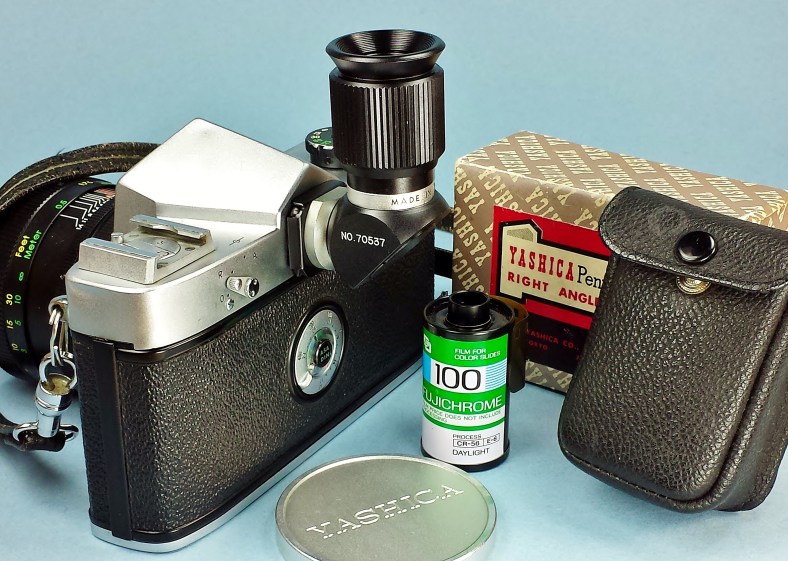
Typically you’d use a right angle finder such as this one to make it a bit easier to use the adapter on a microscope.

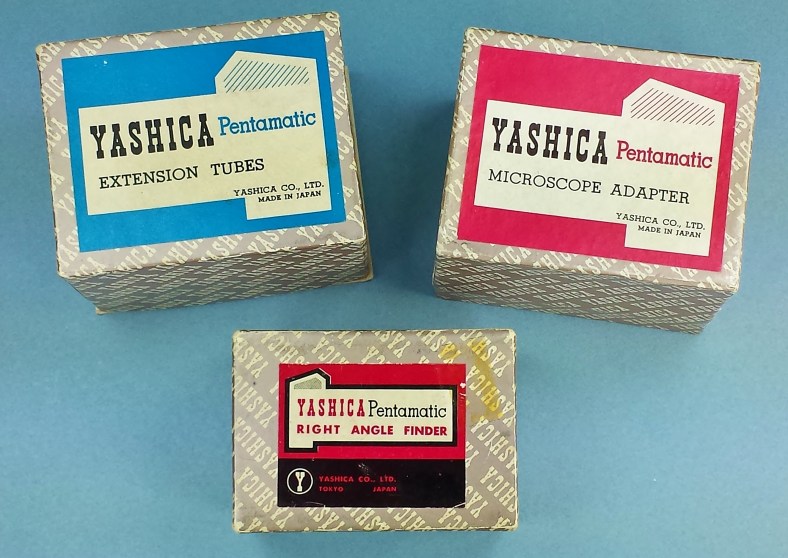
What’s always amazed me is just how many different camera manufacturers made microscope adapters – Canon, Olympus, Nikon just to name a few and how many are still available for purchase online from various auction sites that are unused, still new in their boxes.

22366435879_1e932f39ba_o

Thanks for stopping by! – Chris

Please respect that all content, including photos and text, are the property of this blog and its owner, Yashica Pentamatic Fanatic, Yashica Sailor Boy, Yashica Chris.

Copyright © 2015-2019 Yashica Pentamatic Fanatic, Chris Whelan
All rights reserved.

Yashica TL Electro-X

Another look at a recent post about my all-time favorite Yashica. This one was sold to another collector hours after listing it in my shop.

Chris and Carol's avatarChasing Classic Cameras with Chris

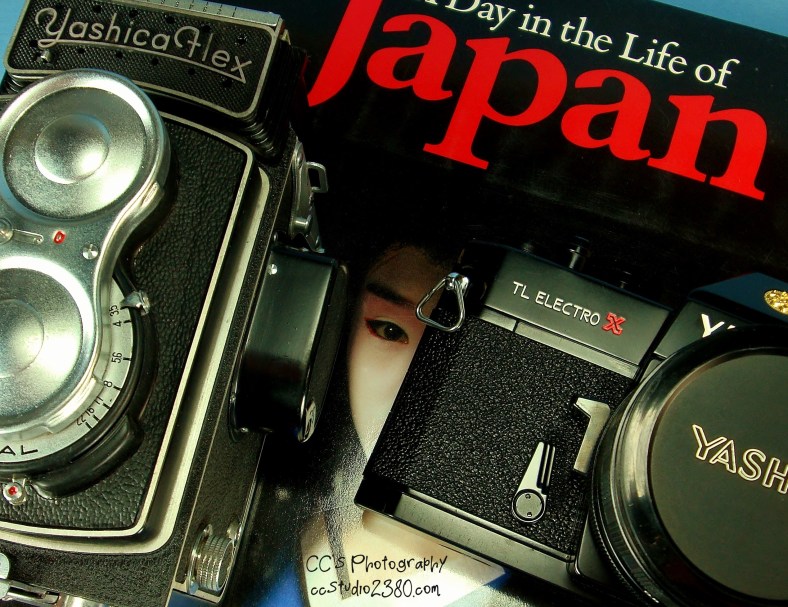
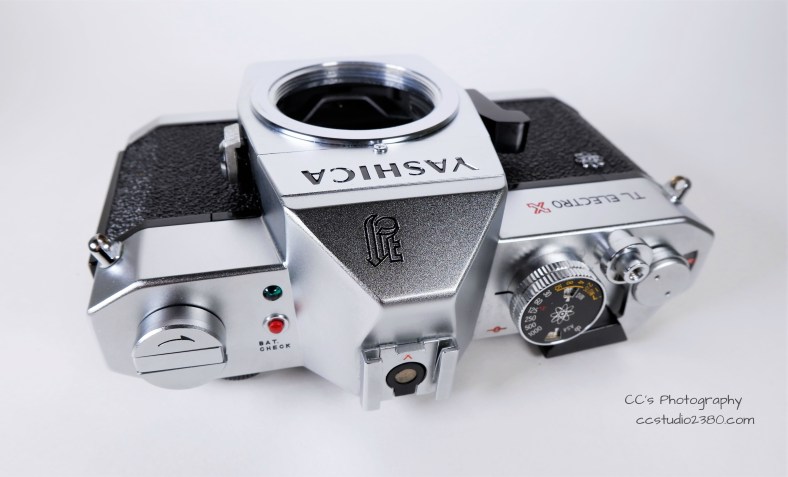
One of the best cameras that Yashica made – in 1968 Yashica produced an exciting 35 mm SLR with a built-in computer! Well, integrated circuits and an electronic “brain”.

It was my first SLR and I fell in love with its looks and the feel of it in my hands. This one is from my rather silly large collection of Yashica cameras and I’ve decided to make it available in my online shop at http://www.ccstudio2380.com

This one is from around 1970 and besides being in stunning mint condition it works like new!

dscf8890 logo

Gotta love the gothic “Y” on the pentaprism – pure Yashica!

dscf8888dscf8893

The battery for this camera is still readily available today and isn’t very expensive.

dscf8892

I’ve always felt that the satin silver finish on this model was the best – it holds up well and it’s easy to keep clean.

The camera will come with a fresh (new)…

View original post 104 more words

Pigeon 35 by Shinano Camera Co., Ltd.

A reblog of an earlier post about this amazing and seldom seen 35mm rangefinder camera made in Japan in the early 1950s.

Chris and Carol's avatarChasing Classic Cameras with Chris

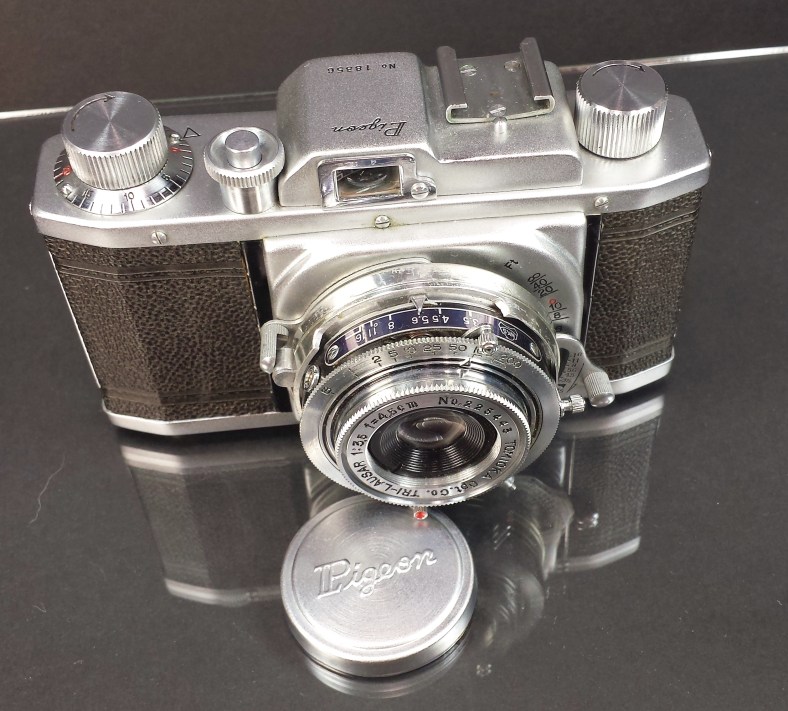
Why show a 35mm viewfinder camera on a blog about the Yashica Pentamatic? Well, Shinano and Yashima-Yashica share a common history. The first camera that carried the Yashima name was the Pigeonflex… a twin-lens reflex (TLR) camera!

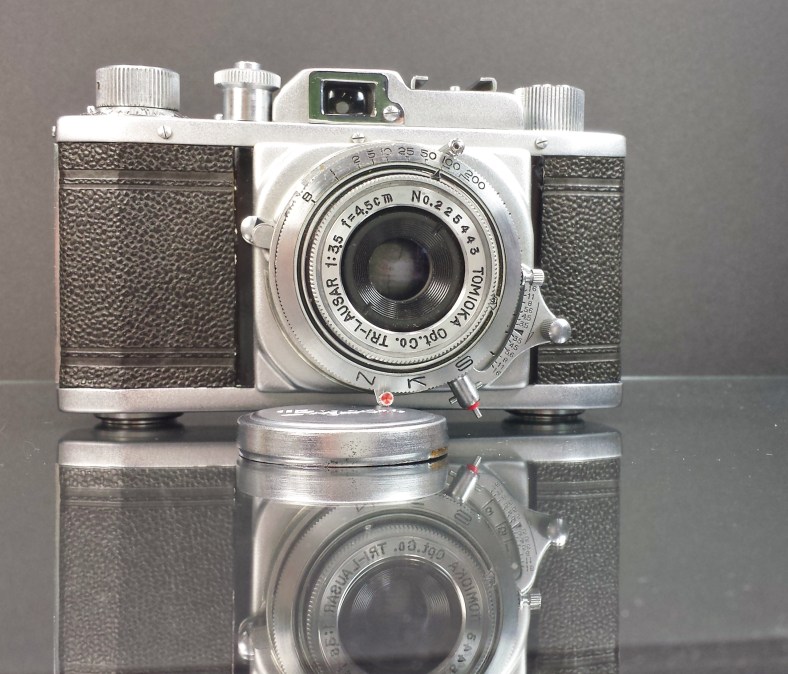
Anyway here’s a nice example of a gorgeous 35 mm viewfinder camera that we acquired recently. The lens is made by Tomioka… a sharp (we hope) Tri-Lausar f/ 3.5 4.5 cm lens. NKS shutter B – 1/200.

It’s a nice heavyweight camera that has a good feel to it. In our opinion, it’s far from being a cheaply built camera as some would say. In fact, it still functions as intended after 6 decades of use. Most leather cases would be a complete mess after this amount of time but the leather is nice and the stitching is intact.

20160801_183736 1952 Pigeon 35 by Shinano.

20160801_183800 Nice view of the Tomioka lens.

20160801_184255 Beautiful logo on…

View original post 68 more words

Just Arrived! New items in the shop.

Some new items have just been listed in my camera shop at http://www.ccstudio2380.com

DSCF9874

Canon EOS nylon camera strap from the 1980s. New, never used. Super nice.

DSCF9858

A must have original (not a copy) Canon Booster T Finder instruction book. Near mint condition.

DSCF9826

Hyper rare Minolta Six 6×6 cm medium format 120 roll film camera from 1936. This was the first camera to carry the Minolta name and was the first 6×6 cm camera made in Japan.

DSCF9736

Classic early 1970s Mamiya/Sekor 35mm SLR – the 1000 DTL was a landmark camera from Mamiya.

DSCF9759

Super cool camera case (camera not included). Made by Marsand. I still have the key and the lock still locks!

DSCF9589

Not often seen outside of Japan, this SLR slayer from Fuji Photo Film Company is like new in its original package – with all the goodies included it’s ready to be a street photog’s dream.

DSCF9624

Brand new Canon Olympics fanny pack. Step back to the future with this HTF collectible from Canon.

There you have it – a small sample of some of the neat items I’ve added to my shop recently all at 10% off in my big Spring sale! Check it out at http://www.ccstudio2380.com

Thanks – Chris

Please respect that all content, including photos and text, are the property of this blog and its owner, Yashica Pentamatic Fanatic, Yashica Sailor Boy, Yashica Chris.

Copyright © 2015-2019 Yashica Pentamatic Fanatic, Chris Whelan
All rights reserved.

Happy SUNday! – Yashica Cousins

Yashica’s advertising figurine (doll?) from the early 1960s. Officially nameless but I’ve tagged him with “Sailor Boy” for obvious reasons.

DSC07067

My camera shop display sized (20 cm) Yashica “Sailor Boy”. This one was still in its sealed plastic bag and original box from Modern Plastics of Japan.

yashica sailor boy big

Another dealer display model (not mine) of Yashica’s “Sailor Boy” – this one looks as though he’s been in a bar fight in Tokyo!

I’m not sure which one was first but my guess is that the “tough guy” version may have been a prototype as I’ve never seen another one for sale in all my years of collecting Yashica branded items.

Have a great day y’all! – Chris

I’ve listed some neat items in my camera shop at http://www.ccstudio2380.com – pop on over and check it out!

Please respect that all content, including photos and text, are the property of this blog and its owner, Yashica Pentamatic Fanatic, Yashica Sailor Boy, Yashica Chris.

Copyright © 2015-2019 Yashica Pentamatic Fanatic, Chris Whelan
All rights reserved.

Are TLRs a good way to discover medium-format photography?

I guess another way to pose the question would be “are TLRs still relevant”?

Film photography appears to be holding its own in this digital world but have twin-lens reflex cameras lost their appeal? Obviously, not all vintage and classic camera sales go to just collectors – many of these 40 and 50-year-old cameras are being purchased and used by today’s crop of film photographers looking for a way to explore medium-format images without breaking the bank.

dscf3787

Typical twin-lens reflex (TLR) film camera.

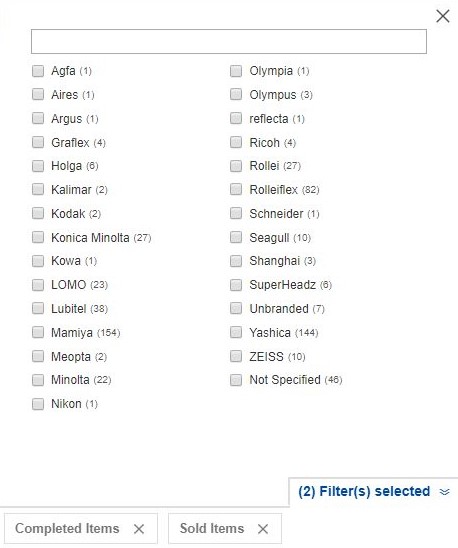
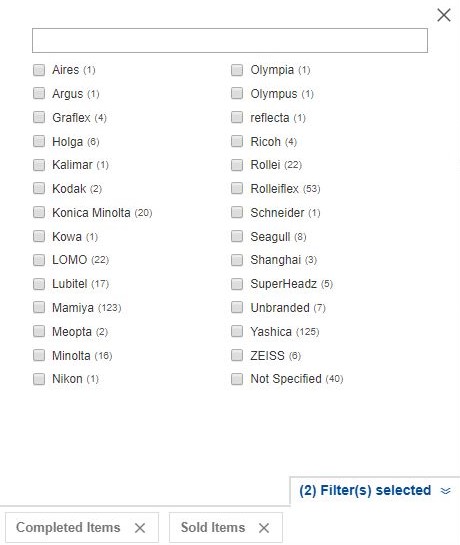
I decided to take a snapshot of just completed sales of cameras that were listed as “TLR – Film Cameras – Sold” on eBay.

tlr sold list

The top six are –

  • Mamiya
  • Yashica
  • Rolleiflex
  • Lubitel
  • Rollei
  • Konica Minolta

This list goes back to the last few days of January 2019 and does include some accessories (lenses, lens caps, cases) that are not cameras. So the total numbers will be a bit skewed.

Here’s the list searching for “TLR Camera – Film Cameras – Sold” on eBay which removed accessories like lenses, cases and other minor parts.

tlr list

The top six are –

  • Yashica
  • Mamiya
  • Rolleiflex
  • Rollei
  • Konica Minolta
  • Minolta

This represents an unscientific look at the popularity of TLRs as a viable tool for enjoying medium-format (6×6 cm) photography. 120 roll film is still widely available and it’s easy to find online companies that develop the film.

53580006

6×6 cm image taken with my Yashica-Mat EM TLR. Learning to compose and shoot this square format takes a bit of practice but the quality of the finished picture is worth it.

dscf3060

Thanks for stopping by! – Chris

My camera shop is always open and it can be found at http://www.ccstudio2380.com – I’ve got a big sale in progress with some super savings… check it out!

Please respect that all content, including photos and text, are the property of this blog and its owner, Yashica Pentamatic Fanatic, Yashica Sailor Boy, Yashica Chris.

Copyright © 2015-2019 Yashica Pentamatic Fanatic, Chris Whelan
All rights reserved.