Yashinon Lenses – 1962*

That date* might be a bit misleading as the sales brochure this was scanned from is undated (as is most Yashica marketing stuff). Our only clue as to the date is that it (the brochure) features the newly released J-3 and doesn’t include any other Yashica SLR. No Penta J or Reflex 35 (same camera different markets) and no J-5.

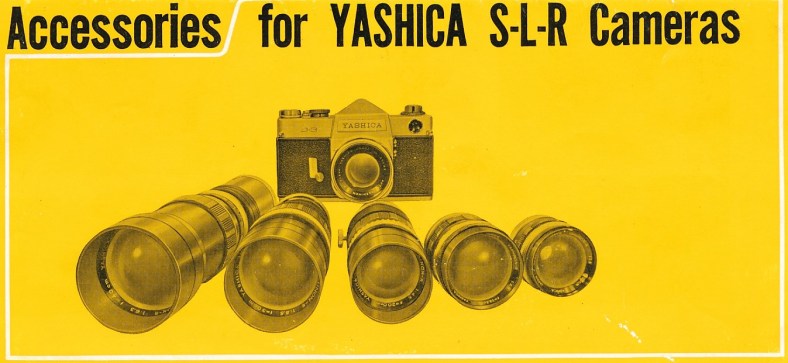
We like it because it features the Yashinon lenses available at that time. If you look closely at the mounts of the lenses, you’ll see the M42 screw-in mount. Yashica does state in the brochure that all of these lenses are available in both the Yashica Pentamatic bayonet mount and the M42 mount. My friend Paul, see An Interview with Paul Sokk – Site Author of the popular YashicaTLR.com , has proposed that Yashica may have distributed these lenses to dealers (market dependent) with both mounts – meaning that they were shipped with the “new to Yashica” M42 mounts but could be converted easily at the dealer level to bayonet mounts for the Pentamatic. Sounds very possible. At this time, Yashica also sold adapter rings for mounting their M42 lenses to Exakta mount bodies and for mounting Praktica mount (M42) lenses to their Pentamatics. Confusing? Yes. Yashica guessed incorrectly when they choose to design their own bayonet mount for the Pentamatic back in 1959. Was it Yashica or was it Tomioka’s designers? How about the ex Nicca and Zunow designers? We may never know but it doomed the Pentamatic right out of the gate.

IMG_20170726_0004

Excellent snapshot of the lenses that were available at the time. The dual mounts (bayonet and M42) reflects Yashica’s indecision as to which mount to embrace.

IMG_20170726_0007

Cover of the sales brochure that was included with our Yashica J-3 when new.

It is generally believed that all of these lenses were made by Tomioka Optical of Tokyo.

While some early Pentamatic bayonet mount lenses bear the Tomioka and sometimes Tominon names, most only carry Yashica and Yashinon. The same applies to the M42 mount lenses. Some can be found with Tominon but most simply have Yashinon. We don’t have positive proof that some lenses (both types) may have been made by another lens manufacturer. But whom? Taiho Optical (which was the former Nicca Camera hidden away in Suwa) but was really Yashica, or or or. We just don’t know. Pure speculation to think that another company did, but then again, no proof that there wasn’t another maker.

Thanks so much for your visit! If you made it this far you just may be a “Yashicaphile” or just Yashica junkies like us. Do you have something to contribute??? We’d love to hear from you and would love to include your info in our blog. Thanks! ^.^

Chris & Carol

An Interview with Paul Sokk – Site Author of the popular YashicaTLR.com

Chances are you’ve visited Paul’s site and hadn’t known it. Thousands of collectors, online auction sellers and buyers and estate sale pickers gather valuable information about their vintage Yashica cameras from Paul’s well researched and easy to understand site. First appearing in late 2011, Paul describes his website as more of an e-book about Yashica. Paul traces Yashica’s humble beginnings from early 1950s upstart to become the worldwide leader in the manufacture of twin-lens reflex cameras by the end of that decade.

Paul calls the beautiful Central Coast of New South Wales, Australia his home – retiring after 35 years of Government service. He enjoys spending time with his family, photography and writing.

Paul's View

Ahh the joys of retirement… the Central Coast, NSW and a lovely sunset.

Paul

Paul with one of his favorites. A prized Yashica Flex S from 1954.

I first met Paul via his website back in 2014. I asked a seemingly simple question about decoding Yashica serial numbers and ended up with my answer (well sort of – we still regularly battle about it to this day) and a new friend.

Chris: Paul you have an amazing site that just can’t be easily compared to anything else presently online. What was the genesis behind it?

Paul: When I got interested in Yashica TLRs, I wanted to find out more about the history of the cameras. Some of the stuff on-line seemed contradictory, the more I looked into it, the more evidence I found of discrepancies. Barry Toogood’s TLR-cameras.com seemed to be a popular source at the time for both enthusiasts and eBay sellers. Most of the wikis linked to him but their sources were different and seemed to mainly be an interpretation of original ads. Their conclusions were often different to Barry’s but still not reconcilable with what I was seeing. I wanted to set the record straight and I felt that if I could convince Barry to change some of the claims on his site, that would be a tipping point. So I wrote to him. He didn’t agree with me but did say “interesting” and offered me a webpage on his site to state my claims. Being all very new to this and enthusiastic about proving my theories, I was producing page updates at a far greater rate than Barry could keep up with plus I was making additional demands for spreadsheets and graphics etc. It didn’t take long for me to realise that what I needed was my own site. So that page became YashicaTLR.com. My continued commitment to it is partly driven by the hope that one day, Barry will indeed make some changes to his site. Are you listening Barry? (If you are, thanks mate!)

Chris: I know what you mean, and I know lots of bloggers feel the same way about providing accurate and complete information in their blogs too. But your site is huge (in a good way) and it can’t be easy researching all of that data and keeping it straight. We only blog, you maintain a database accessible worldwide that’s used as reference material. Is your background in research? 

Paul: Nah, I’m just a bit anal. Others collect things, I like to collect information about things. Back in the early 70s, I was a uni dropout and followed some friends into the Commonwealth Public Service here in Australia. With a 35 year career mostly in middle management in disciplines varying from personnel to finance to computing systems, I learnt the value of accuracy, process, facts and records management. I also learnt that collecting data is one of the best tools of research. That is why I have spreadsheets listing details of almost 5,000 Yashica TLRs I have found online. That alone has enabled me to decode 1957 to 1980 serial numbers. Mind you, all the mistakes about release dates, some by as much as three or four years, could have been easily fixed by looking at a few original ads available online to anyone.

Chris: Why Yashica? And why specifically Yashica twin-lens reflex cameras? They’ve been out of production for over 30 years now. Do you think film is making a comeback?

Paul: I was a digital convert by 2003 but couldn’t afford a DSLR back then. I craved real metal cameras as a way of linking to my past, not as replacements for my photographic tools but as a nostalgia fix, I just love the feel, sound and weight of them and disliked the plastic AF SLRs of the 80s and 90s, although that is what I still had too. After playing around with some 50s and 60s 35mm cameras, I thought I should get something medium format. Something I had never used before, maybe a TLR, and the first affordable one was a Yashica D. That turned out to be a dud with a focus problem so that was an excuse to follow up with a Yashica LM. Before you know it, a collection had started.

Is film making a comeback? Not in the sense that it is going to hurt digital market share but people are realising that there are these wonderful old tools than can still be used to make exquisite photographs with nuances quite different to a digital photo. It’s not that one is better, I think that there is room for both.

Chris: Your background is of course with film photography. Can you tell us what formats you used and which you enjoyed the most?

Paul: I’ve been mostly a 35mm shooter, although in the early 1970s, I did 2 years of a commercial photography course which mostly used 4×5 view cameras. They were a huge amount of fun but not really the kit for a non-pro. I like the square TLR formats but they are challenging at times. Sometimes a composition screams for it but when it doesn’t suit, it doesn’t suit. I hate having to crop to change format and generally I also tend to prefer a slightly wider angle of view. In that way, 35mm is more forgiving and even more so is the 4:3 aspect ratio of micro four thirds that I now use.

Chris: Do you recall your first experience with a digital camera? Did you see a bright future for digital back then or did it seem like it could never equal film’s capabilities?


My daughter was born in 1990. By her first birthday, I was following her around everywhere with an analogue camcorder. Having shot some 8mm movie stuff previously, that was an eye-opener. It was only a small step to my first digital camcorder in 2000 and by then I was a total convert to the idea of digital imaging. At about the same time, the branch I was managing got hold of its first digital stills camera. That came home quite often with me. First, our family bought a Pentax Optio p&s camera for about AU$1,200 but by 2003, I had replaced my SLR with a Canon G2. What I loved most about electronic film, both analogue and digital, was the amount of control it gave back to the user. Only a darkroom could match it for film but that was no longer a realistic possibility for me.

Chris: What equipment do you enjoy using today? Are you a film vice digital shooter or have you (like most of us) embraced digital as your primary tool and film for your artistic side?

Paul's Olympus

Paul: I use one digital body and that is an Olympus E-M5 II. My favourite and most used lens is an f/1.8 17mm prime, although I have the Pro standard zoom and some other lenses as well. I previously used Canon APS SLRs but for my purposes, I can’t tell the difference quality wise, I’m getting more keepers and my wife doesn’t cringe when I say “I’m bringing the camera”.

Chris: Money’s no object – what would be your perfect digital setup? How about film?

Paul: I’m very happy with my Olympus gear and Panasonic has some nice micro four thirds temptations as well, but, always the but, there are better low light performers and for some reason, I seem to find myself in low light quite a bit so perhaps I would give a Sony A7s II and some nice Zeiss primes a go. For film, maybe a Leica M7, or something I have just thought of, the CONTAX 645 AutoFocus SLR. Nah, too heavy for selfies.

Chris: Final questions coming up. Thinking back over the years, are there any film cameras (and lenses) you wish you still had or wished that you had gotten?

Paul: In the mid-70s, I probably should have kept my Minolta SR-T101 instead of trading it on a Zorki IV Leica copy. Going back to basics was just an excuse for “couldn’t afford the lenses”. Which brings me to the second part. I wish I had got some more Minolta lenses for the SR-T101 instead of adapted crap.

Chris: You’ve been given $500, are you going to spend it on a camera for research purposes or something more current like that special something you just have to have to make your digital photography just a tad better?

Paul: Give me the $500 and let me surprise you… No? $500 is not enough but I am pining for a decent wide angle lens. I would only spend $500 on a camera for research purposes if it was likely to be an appreciating asset. I’m not good with anything that involves making money.

Chris: OK for real this time, one more three part question. Do you have any suggestions on how to start a website like yours? Have you thought about blogging? Why no advertising?

Paul: Part 1 – Do I have any suggestions? Don’t do it my way. A wordy long book-like website is not really a website, it’s an e-book. Either learn or pay for real web-design skills or pray that you are offering a subject which will attract people regardless of what they may have to wade through. Oh, and definitely pay for more reliable hosting, it’s not worth the unbelievable angst for that teensy 5% of time that it’s really a crap service.

Part 2 – Yep, maybe when they introduce the 36 hour day.

Part 3 – It’s ad free for a number of reasons. The main one is that even though I try to stick to using my own photos, or my contributors photos, there are so many different Yashica variations to analyse and document, invariably, I end up “borrowing” from the net. Quite often this might be from a Japanese auction where it is impossible to ask permission but sometimes from western sites too. I acknowledge that on the site. I try to minimise any concerns by only using the part of the image that features whatever I am wanting to show and usually at quite low resolution. My defence for doing that is that it’s in the public interest. Mind you, that is a moral, not legal defence. If I start making money out of advertising, I lose the moral argument as well. The other reasons are “the site is too big already” and my doubts that this type of site could generate anything worthwhile.

Thanks so much Paul for taking the time to visit with us.  I encourage anyone even with a passing interest in film photography to stop by Paul’s site (be sure to bookmark it) at http://www.yashicatlr.com

You can contact Paul directly at paulsokk@live.com.au

A small sample of Paul’s most recent work which includes a trip to Japan in November, 2016 –
Paul's Sydney

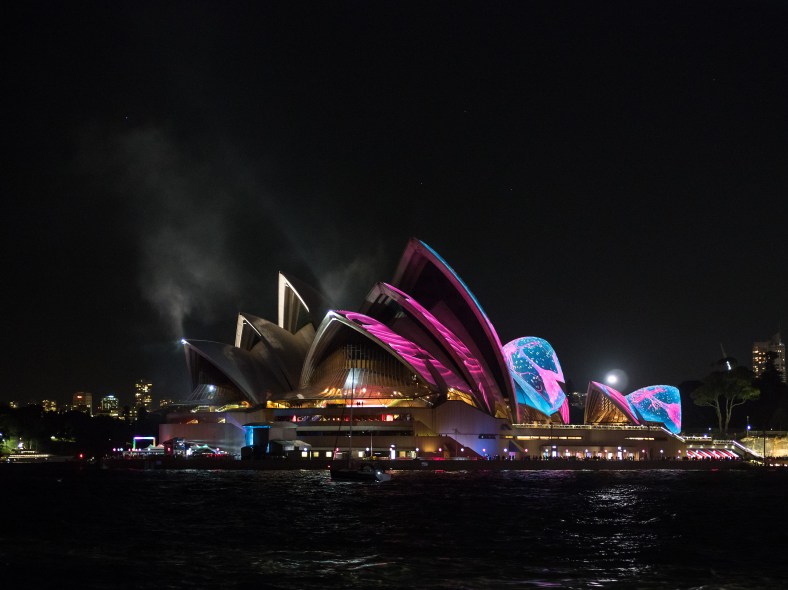
The Sydney Opera House – 27 May 2017, E-M5 Mk II and M.Zuiko 45mm f/1.8 lens. The occasion was Vivid Sydney, an annual light show.

Paul's Storm

Storm clouds across Brisbane Water, near Broken Bay, Gosford, NSW.

OLYMPUS DIGITAL CAMERA

Japan, 2016

OLYMPUS DIGITAL CAMERA

Japan, 2016

OLYMPUS DIGITAL CAMERA

Japan, 2016

OLYMPUS DIGITAL CAMERA

Hiroshima, Japan 2016

OLYMPUS DIGITAL CAMERA

Japan, 2016

Paul's Yashica 635

Yashica 635 from Paul’s collection.

Yashica TLR

http://www.yashicatlr.com

Pigeonflex, Yashima Flex, Yashica Flex, Yashicaflex & Yashica Models
ピジョンフレックス ヤシマフレックス ヤシカフレックス ヤシカ

Contents

(Scroll down or click on links. Use sidebar for other pages.)

This Site
The Challenge
My Approach – Data Sources & Scope
Other Resources – Manuals & User Guides
About Me

Site Language
Contact Details

Contributors & Other Acknowledgements
Site Format
Copyright Notice
Updates Log
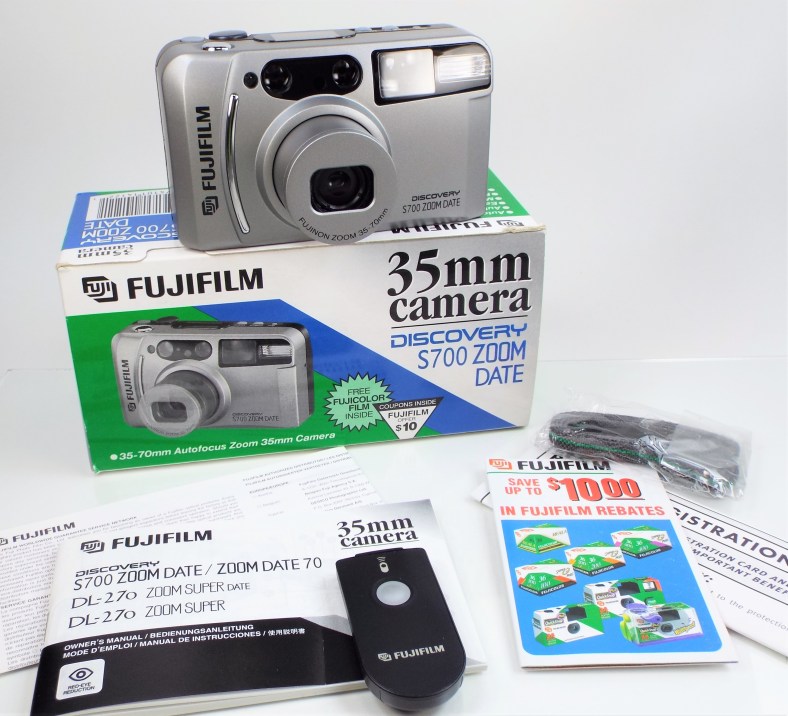
Fuji Fail-ed… Discovery S700 Zoom Date

It was bound to happen. One klunker out of a bunch of good ones isn’t bad. We think it isn’t so much a bad build as possibly improperly stored… maybe.

DSCF5800

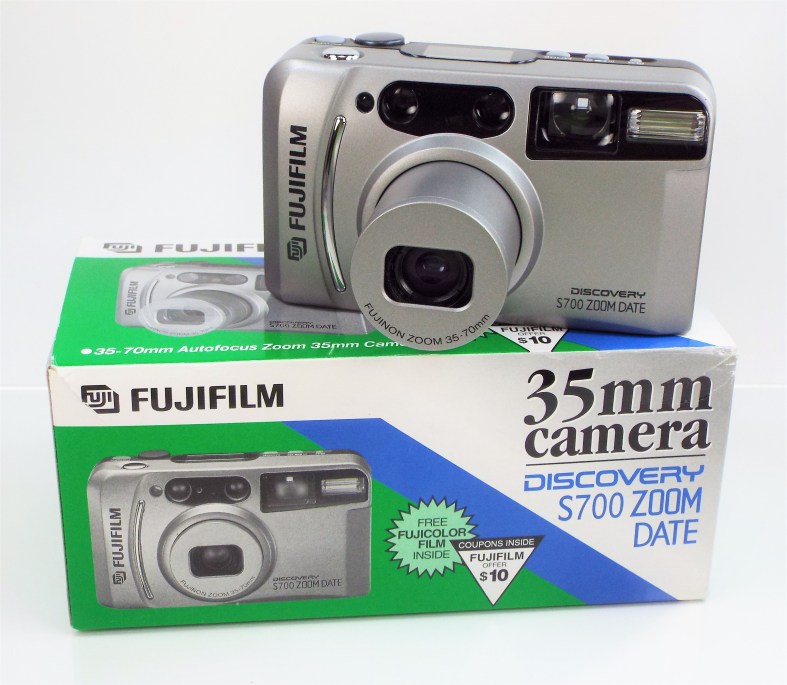
Another in the long line of plastic fantastic Fujifilm cameras from the late 1990s.

Part of the Discovery series of compact 35mm point and shoots from Fuji Photo Film. This one came to us still new in the box, unused but maybe stored in a too hot environment. Some of the plastic bag protecting the camera became stuck to the back film door (see below). This one is, using a nautical term, dead in the water. Despite a new battery, the camera won’t fire the flash and the shutter works intermittently or not at all. The power zoom works but beyond that, nothing else. Possibly a short in the circuitry caused by the hot storage (pure speculation).

DSCF5788

Sticky residue on the film door from the factory plastic bag. So far it’s resisted all attempts at cleaning it off.

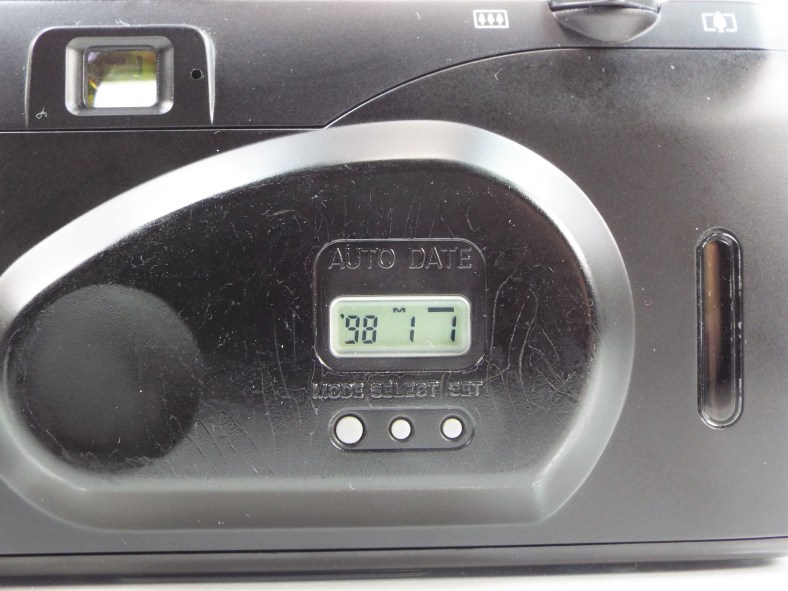
When the battery was first inserted for the date mode, this is the programmed date that popped up. We’re thinking it may be the build year. Why not?

DSCF5786

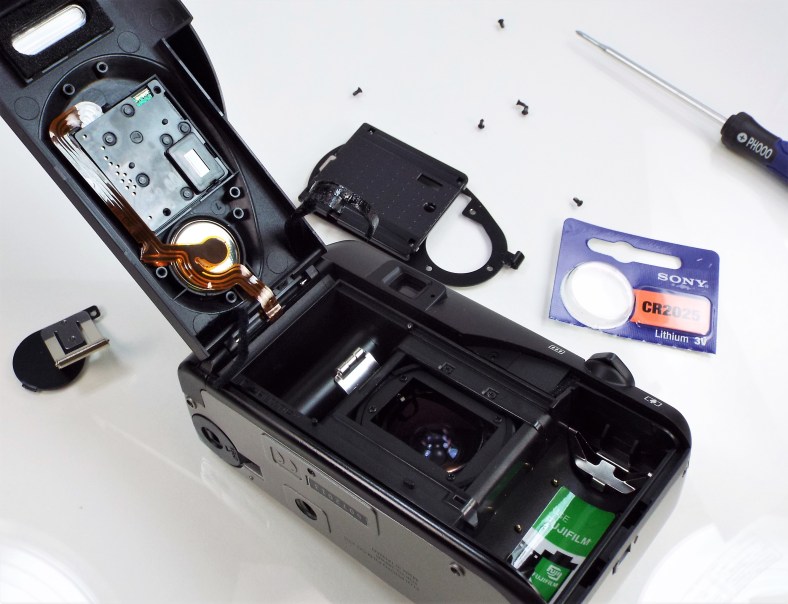
Talking about the date mode battery, what a pain to change it! Number one, it’s not even mentioned in the owner’s manual for starters. It takes a CR2025 3V lithium button battery but it wasn’t mentioned. Take a peek at what it takes to get at it… ⇓

DSCF5783

Remove 6 screws and the film pressure plate, the battery cover and then peel up 2 felt light seals!

DSCF5784

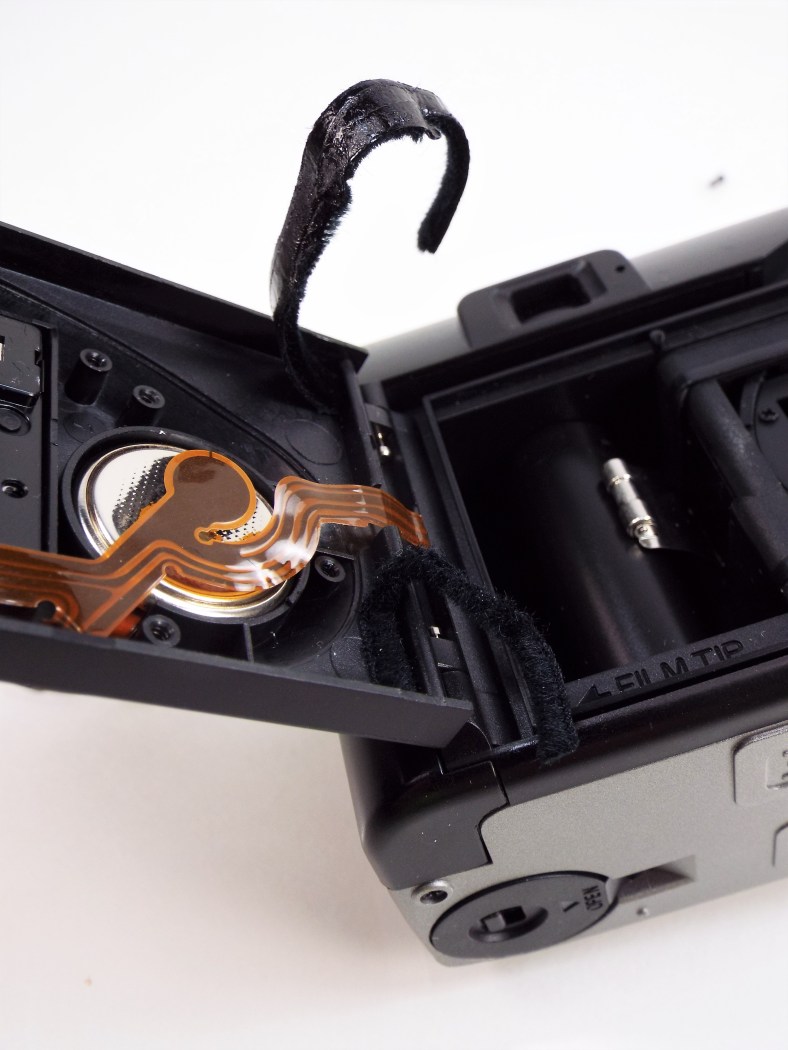
That baby was buried and stuck down with the light seals!

DSCF5789

Back together.

Anyway, it’s a good looking camera and may have been fun to use.

DSCF5794

DSCF5796

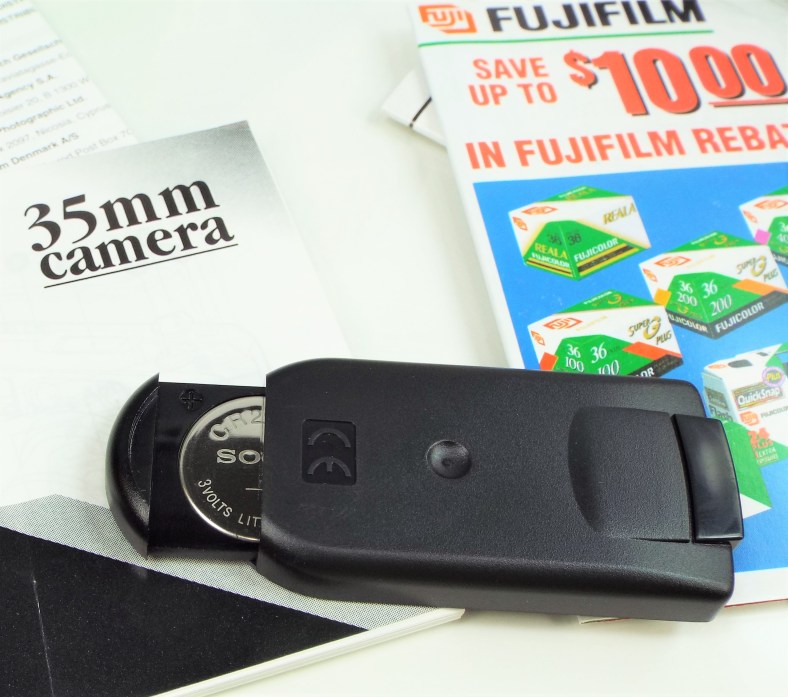
Oh and the remote control (below), no mention of that battery either.

DSCF5802

Another CR2025 button battery.

DSCF5792

We’ve had great results with our other Fujifilm Discovery series cameras in the past. No reason to believe the series is not worthy of a look. Having said that, this is a new camera that’s never been used and still failed – but that’s why there’s warranties.

DSCF5801

Quick specs: Lens Fujinon 35-70mm electronic zoom, 5 elements in 5 groups. DX coded for ISO 100/400. Continuous shooting at 1 frame per second. Weight 235 grams with battery and data back.

Can we recommend the S700 Zoom Date? Well no. There are much better models out there from Fuji. Stick with the longer zoom models still built in Japan.

Thanks for your visit! Comments always welcome.

Studio Camera: Fujifilm FinePix S9900W

Chris


Yashica FR II – the camera that made me buy the Canon F-1

I know – the FR II and the F-1 are miles apart in features (and price). I purchased my first Yashica, a TL Electro-X in 1971 and used it faithfully through much of the 1970s. Being a young (and married) US Navy Sailor and money deprived, the TL suited me just fine – until I was transferred to Japan in 1977. If you were ever stationed in Yokosuka then you know what Building A33 means. It was the Navy Exchange camera and stereo heaven!!! Reps from all of the major camera manufacturers were present and demonstrated their latest gear to the now cash flush Sailors. Upstairs was a branch of Navy Federal Credit Union… if you couldn’t afford it, finance it! Pure bliss.

I’m so easily distracted.

So it was time for me to upgrade my trusty TL Electro-X, so naturally I looked at what Yashica had to offer. The FR was out but it didn’t do it for me and quite frankly, the Contax RTS didn’t either. So I waited and saved some money and started reading the Navy Exchange catalog every day (and night). The Canon F-1 looked promising but was expensive. The TL needed to hold me over as I was diverted to purchasing stereo equipment. Sansui pre and power amps, Teac reel to reel, Dual turntable and some killer Kenwood speakers. A small fortune so a camera upgrade would have to wait.

Now it’s the summer of 1978. My ship was inport (finally) long enough for Carol and I to spend some quality time together and to focus our attention on replacing the Yashica. Another visit to A33 and another visit with the Yashica rep. Now the FR II was the camera of the day (and he was still pushing the RTS too). No way. The friendly Canon rep was all too happy to take my money and hand me a bright new F-1 with 55mm f/ 1.4 lens and Canon 80-200mm zoom. The Yashica was sold off to a friend and that was it for Yashica (for the next couple of decades).

IMG_20170420_0001

Oh happy day! July 1978 – my new Canon F-1 and Canon FD 80-200mm f/ 4 zoom lens.

Present day now and I’m finally an owner of a Yashica FR II.

DSCF5487

I picked up this beauty recently because it looked to be in near perfect condition and I figured, why not. Well I gotta say that I’m impressed. Not impressed enough to regret my F-1 purchase back in 1978, but impressed.

DSCF5492

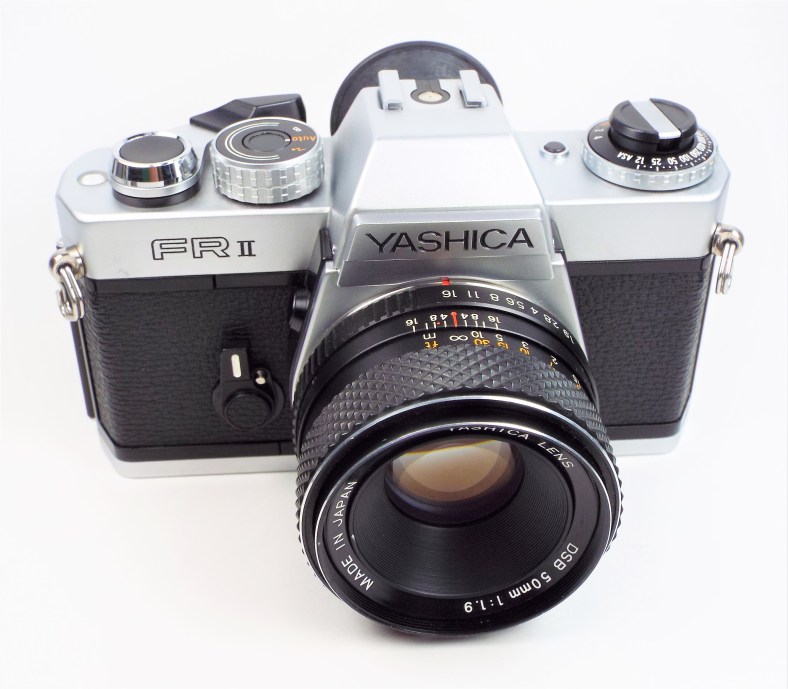
The camera feels good in my hands – well balanced and the viewfinder is super bright. What a big difference over the Yashica TL Electro-X. The Contax/Yashica lens is crisp, clear and focusses easily (split-image). The meter is simple (this is a aperture priority camera) so you’re only messing with the f stops.

DSCF5488

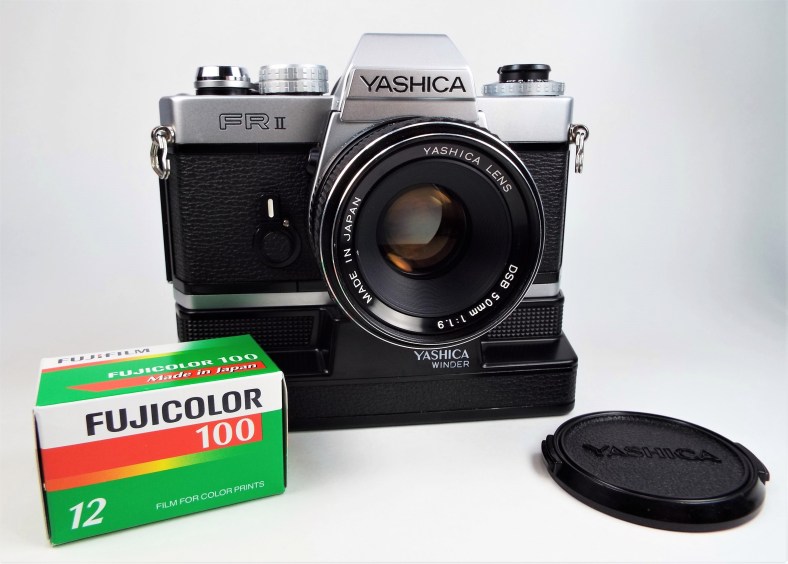
With the power winder attached it’s a tad on the heavy side but would be useful as a weapon (or anchor).

DSCF5493

Simple lines and layout. The meter switch (upper right) is a bit awkward but the meter is accurate and that’s all that matters.

DSCF5495

Uses all of the C/Y bayonet mount lenses which can be had for a song today. Here is a 135mm, f/ 2.8 lens that came with it in basically unused condition.

DSCF5489

We have so many cameras in the queue right now I have no idea when we’ll get a chance to run a roll through it.

Verdict. I’ve waited nearly 40 years to shoot with it so I’m excited to see how it does out in the field. If you find a nice one for sale (mint condition) then give it a try. Stay away from the ones that look rough – these don’t hold up well with abuse. Prices are all over the place – you may be able to strike a nice deal with a seller who’s ready to part ways. Best of luck!

Studio Camera: Fujifilm FinePix S9900W

Chris

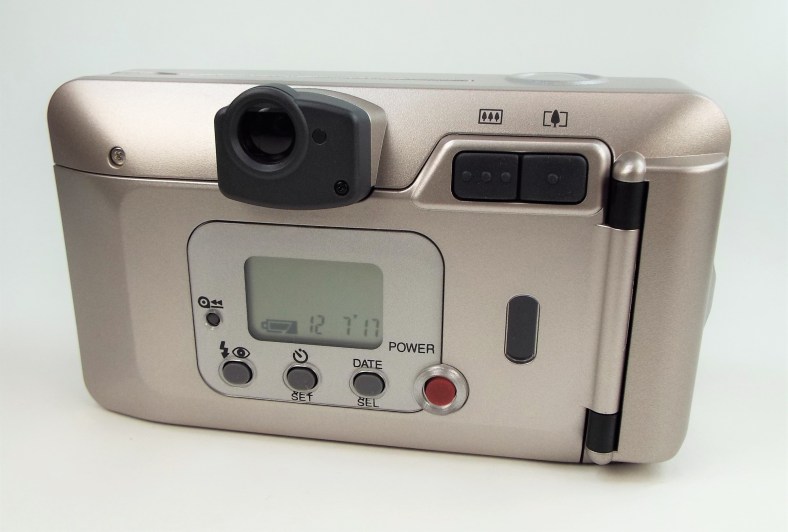
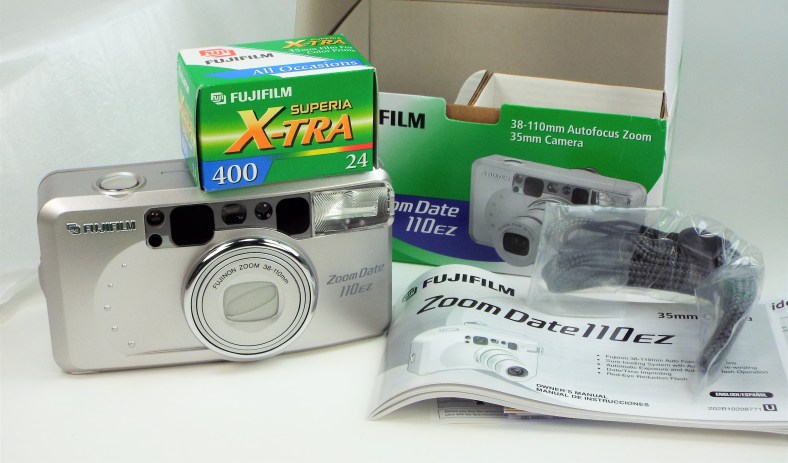
Modern Classics – Fujifilm Zoom Date 110EZ

No it’s not a 110 film camera as the name might imply but one of the last in a long series of 35mm super compact cameras from Fuji.

This one debuted about late 2003 – not that long ago when you think about recent film cameras vs. emerging digital cameras.

DSCF5732

As the name implies, it has a zoom lens (38-110mm) and can imprint the date on the film.

DSCF5731

Autofocus, exposure, flash and red-eye reduction.

DSCF5734

Electronic shutter from 1/2 to 1/500th second.

DSCF5735

Nice bright viewfinder – large LCD with date/time imprint and super fast two position zoom buttons. The red power button is almost impossible to push with a normal fingertip. Too small for me.

DSCF5737

Power zoom Fujinon lens 38-110mm (f 6.3 to 11.7).

DSCF5739

The camera is one of the smallest in our collection of plastic fantastic Fujifilm compact 35s. It weighs in at only 190 grams without the CR123A lithium battery.

Automatic DX film ISO setting from ISO 50-3200. Automatic film loading and film advance and auto pre-wind system.

As we’ve stated before, these cameras are getting harder to find in still brand new condition (with all original factory issued stuff)… so, they are somewhat collectable and if you’re looking for a super compact film camera to take on your next outing, the Fujifilm line is a very good choice.

Studio Camera: Fujifilm FinePix S9900W

Thanks for your visit!

Chris

Cute or uncomfortable by today’s standards?

Is this image from a mid 1960s Yashica camera instruction booklet simply cute or does it make you feel a tad uncomfortable?

Is it a fun reminder of how the world was in 1965 – a bit “western obsessed”? Was it a little out of line even then? If this image were to be posted to a social media site today, what would the reaction be?

IMG_20170709_0021

The original full context image from the booklet.

Weigh in if you’d like. We’d like to know your feelings.

Thanks, Chris and Carol


Twin-lens Reflex… a peek inside.

From an August 1963 sales brochure from Yashica (Printed in Japan). An excellent article we think. Of course Yashica produced twin-lens reflex (TLR) cameras well into the late 1980s so they would be considered experts (one would think).

IMG_20170709_0023

IMG_20170709_0022

Also known today (more so) as medium format. An inexpensive way to get into medium format film photography, Yashica made enough TLRs over the decades that there is an ample supply of well made Yashicas available online. Budding film photographers should be able to experiment with that format without breaking the bank.

The Yashica model A is a great first choice as it is one of the most widely available and simplest to “master”. Less stuff to break or need adjustment. Another good model is the Yashica Mat-EM (1964). It has a built-in light meter that doesn’t require a battery to operate. The meters can fail over time so be sure to ask the seller about it first and if you’re looking at one in person, then check it against a meter from a phone app.

The Yashica-Mat 124G is the last model. Usually still very expensive but has a meter and requires a battery. The good news is that they are still fixable if something fails (they all are but our point is that they’re the newest out there).

The Yashica-D… well, we’ve never had much luck but others do and they are good cameras. The Yashica-Mat is another common camera and has a crank winder.

Give it a try. Shooting in squares is a challenge but fun!

Thanks for your visit.

Chris

Maybe this isn’t the best way?

We’re always searching for interesting cameras to review here on the blog – sometimes our searches online lead us to discover cameras that we’ve never heard of.

This is one of those cases. While searching for Topcon cameras, we discovered a TLR (127 film) that struck our fancy. Partly because of the name – Sawyer’s Mark IV… made by Topcon in Japan.

And then… THIS!!!

s-l1600

Would you want to bid on this camera claimed to be in near mint condition? By the way, there is a half eaten donut on the table just behind the camera.

You don’t need a fancy studio to take good images of items that you sell online. Heck we started out by putting our cameras on a clean piece of white poster board and shooting with the natural daylight coming in through the window. Now we use “studio lights” that we put together from utility lights from a hardware store and daylight fluorescent bulbs.

I wish this seller all the best – I hope he continues to do well – just watch your backgrounds man!

Chris