First Test of the Yashica Pentamatic… July 1960

    From the July 1960 issue of Modern Photography magazine. What we find most interesting in this article can be found in the opening paragraph. Describing the Pentamatic as a “relatively small, lightweight, quiet-shutter single-lens reflex incorporating a number of features found only in cameras costing a good deal more.” Interesting that the reviewer did not mention that this was Yashica’s first ever single-lens reflex camera. It would seam important to the reader as Yashica had a reputation of building fantastic twin-lens reflex cameras and some beautiful rangefinders. Our guess is that compared to the other cameras that were available in early 1960, one could say that the Pentamatic was small and lightweight. Pick up a Pentamatic with the standard f/1.8 5.5 cm lens, and by today’s standards, it’s anything but small and lightweight! We do agree however that the Pentamatic has a quiet shutter and the price was certainly good compared to the other SLRs.

20075370121_f7dee3b7df_c

From the July 1960 issue of Modern Photography magazine.

    The specifications were supplied by Yashica from the official press releases during the March-April 1960 time frame. The entire article was written from that information with what appears to be a very brief test of the camera. No mention of the quality of the images taken with the Pentamatic other than to say that the normal lens produced little to no significant fall-off of edge sharpness at full aperture (f/1.8). The reviewer did state that the chrome finish wasn’t too good but that another technician liked it just as it is.

Yashica Flex Model S… 1954 to 1957

The Yashica Flex model S (aka Yashicaflex) is one of Yashima’s most important early cameras… well maybe the second most important behind the first. Obviously Yashima’s first camera, the oddly named Pigeonflex one could argue, was the most important. The model S though was the first twin-lens reflex (TLR) camera (in the world!!!) that had a “built-in” exposure meter.

004

The Yashica ‘Sailor Boys’ gather around the Yashica Flex model S. The boys are from 1962 and this TLR is from late 1956.

The Sekonic CB-1 exposure meter was attached to the camera’s left side and the light gathering cells were located under the nameplate flap. They were connected to one another but the meter was non-coupled to the camera settings. The user would lift the flap to expose the cells to light and then read the exposure index in the window on top of the meter. Then simply set the camera to the proper f-stop and shutter speed and snap away. No batteries required. But with the passage of time most of these meters failed in some way or another. If you find one with a working meter so much the better.

DSCF0044

Yashica-Mat EM from 1964. The exposure meter and light gathering cells were moved to the front and top… no more flaps to raise and we were a bit closer to being coupled. This EM has a working exposure meter which is pretty amazing after 50 plus years!

010

Close-up of the Sekonic CB-1 exposure meter on the Yashica Flex S.

011

Exposure meter scale for setting the f-stop and shutter speed.


012

Exposure meter light gathering cells located under the Yashica Flex nameplate.

009

Exposure meter on the Yashica-Mat EM.


007

Close-up view of the aperture and shutter speed settings on the EM.

005

Yashica-Mat EM exposure meter and exposure scale. Film speed is set at ASA 400.

So there you have it… a short (very short) history of some groundbreaking cameras from Yashima/Yashica. For more on Yashica’s awesome array of TLRs visit my friend Paul’s site at http://www.yashicatlr.com

Paul’s site is a labor of love and if you want to know anything about Yashima/Yashica that’s the place. We hope to bring some more Pentamatic blogs your way soon. We are of course, The Yashica Pentamatic Fanatic!

Thanks, Chris & Carol

A Tale of Two Boxes

Often the design of such a simple thing (here a box) can tell much about a company, its history and its growth. Yashima (later Yashica) was founded in 1953 in a then very crowded Japanese camera market. The Japanese people were urged by the American occupation authority to essentially grow technology industries so that the country could earn some much needed currency. By producing sophisticated products such as cameras that would appeal to foreign markets, Japan would strengthen the yen against other currencies and offset some of their imports of raw materials, oil and food.

How does this relate to boxes? It doesn’t directly but it does show that at least one company (others did it too) was a serious player in the dynamic camera industry of the early 1950s. Yashima had to show the world that although their cameras (mostly TLRs) were inexpensive, they were of the highest quality. The construction of such a simple thing as a presentation box had to stand out among the other manufacturer’s boxes (mainly those from Germany) and compete for space on camera dealer’s shelves and attract potential buyers to at least take a look at the camera inside. The early 1957 (below on the left) box weighs in at 352 grams empty and the box from 1964 weighs 155 grams. That’s a big difference to be sure. The early box took more time and demanded more material to construct then the simple 1964 box which was printed flat and stapled together rather then glued (think cereal box). That’s a big change and reflects a strong desire by Yashica to maximize its profit in the rapidily changing marketplace of the mid 1960s.

We should point out that by the mid 1960s, Yashica was producing record numbers of twin-lens reflex cameras (TLRs) even as the world market demand for them was decreasing. By 1964 (the year the newer box was constructed) Yashica was producing high quality 35 mm single-lens reflex cameras (SLRs) as well as innovative 35 mm rangefinder cameras and sophisticated 8 mm movie cameras. Before the decade of the 1960s would end, Yashica pioneered the use of electronic photography and the use of “computers” to control exposure and shutter speeds in their SLRs like the extremely popular TL Electro-X.

20160204_100435_Richtone(HDR)

Early 1957 Yashica Model A presentation box on the left and on the right the simple 1964 box.

20160204_095423

Bottom of the 1957 box.

Yashica’s J-3 in Pro-Black

Yashica’s first ever* black body 35 mm single-lens reflex camera from 1962. The J-3 was an amazing camera for Yashica… it was the first with a CdS exposure meter that was coupled to the shutter speed dial. Still not through-the-lens (TTL) metering but that was coming… shortly!

We are amazed that this camera has made it this far in life and the factory paint is as gorgeous as ever. Sure there are some spots that show some brassing and a ding or two but that only proves it was used.

It still performs as designed… the film advance is silky smooth and the distinctive Yashica shutter and mirror sound remain sweet (as only a 35 mm SLR can sound). If you ever get a chance to acquire a working J-3 do so. It’s a wonderful film camera.

*As best as we know!

20160127_215149

Rather rare in black. Yashica J-3 from 1962.


Original Pentamatic Ad from Japan

Another advertisement from Japan for the Pentamatic recently came to our attention. I love that in the beginning, Yashica appeared to not know what to call their first ever 35 mm single-lens reflex camera. This first ad below is from a US photography magazine and it referred to the camera as the Pentamatic ’35’. The second ad below is from an English language newspaper printed and distributed in Japan. I’ve seen similar ads like it for other Yashica’s and the price was given in yen. I don’t see a price in this ad and it’s rather small to see much detail but I think it’s important just the same. Although they just title it as the Yashica Pentamatic they are quick to point out that it is an automatic 35mm reflex as if you wouldn’t know by looking at it.

yashica 7-31 ad

First advertisement for the new Pentamatic in a US magazine. June 1960.

jn pentamatic ad framed 2

Advertisement from an English language newspaper distributed in Japan.

Yashica Happi Coat from Japan

A wonderful find in our world of Yashica collecting that we would like to share. We’re thinking this coat is from maybe as early as 1965 but more likely from 1968 to 1972. It’s always difficult to put an exact date on marketing items as sometimes they will appear again after the initial release. We thought the coat reminded us of something Doc would have dressed Marty McFly in in the 1950’s with the electron symbol and all. Maybe something Doc would have worn as a lab coat from time to time.

Anyhow it’s now part of the “silly stuff” that we’ve collected along the way. The original black sash or belt was with it too. Nice condition overall given the years its passed through. Of course ‘Sailor Boy’ had to be included.

20160126_11382820160126_114156

Yashica Pentamatic Set

Yashica Pentamatic… from 1960. The box was unlike any that had come before it. Simple with clean modern lines and well designed too. At this time, Yashica was producing mass quantities of high quality TLRs, respected 35 mm rangefinder cameras and they were big into 8 mm movie cameras and projectors. Yashica arrived in the already crowded Japanese 35 mm single-lens reflex market a bit late. Minolta, Asahi-Pentax, Nikon and others were already establishing a reputation for innovation and quality but at a considerable price for the average photographer. Yashica’s SLR would have to stand out in some way to get noticed. The engineers and designers came up with a typical Yashica innovation… build a high quality 35 mm SLR but make it affordable for the masses. So the Pentamatic was born. Different to be sure… unique bayonet mount for the lenses that were made by Tomioka Optical to Yashica’s specifications. Leave off the built-in self timer. No built-in exposure meter either. It worked to a point. The camera with the standard lens came in just under $160 in the US. Add the leather case for another $10 and if you really needed a self timer there were plenty to be had that would screw into the shutter release button. The Pentamatic camera and its unique bayonet lenses only lasted just under two years before the Penta J appeared. The Pentamatic was well liked but with no built-in exposure meter and a limited choice of lenses its time would be limited. But from the leap to the Penta J and its M42 universal screw mounted lenses thing happened quickly for Yashica after that. The J-3 would come along in 1963 and have many of the Pentamatic’s shortfalls incorporated in a sleek new body and an almost unlimited array of lenses.Bold bright colors...
From 1960. The clean simple lines of Yashica’s first SLR.

Yashica Odds & Ends

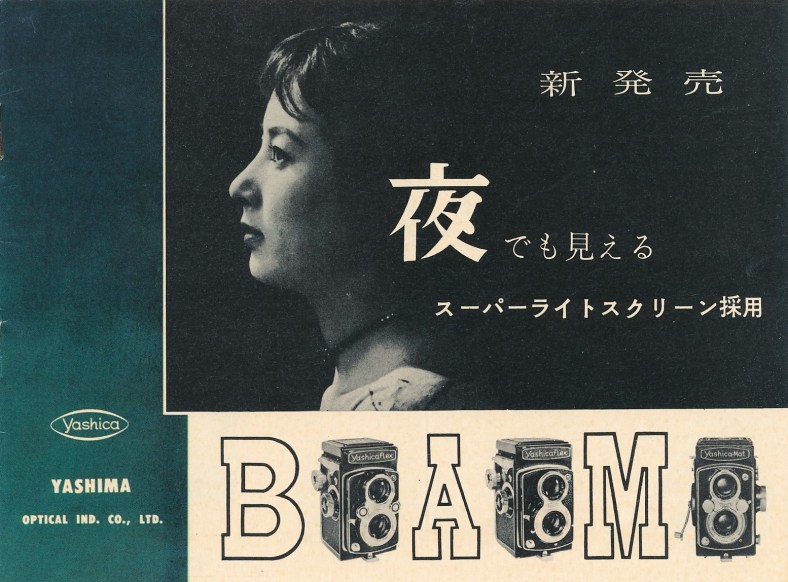
We’re always trying to find some consistency in the dating of Yashica publications. If you are a collector of all things Yashica (and Yashima) you know the frustration of not knowing when a brochure or instruction booklet was printed. Dated advertisements are a good source for dates but the lead times are often anywhere from 1 to 3 months prior (or longer) to the published date of the magazine. Through research and in some cases just plain good luck, we’ve recently spotted a trend in the date codes that occasionally appear on publications from Yashica.

We are very lucky to have in our collection a complete set of matching books from Yashica in both English and Japanese. These books came with our TL ELECTRO-X ITS that was purchased in September 1973 in Okinawa. We also have the original sales receipt from that purchase as well. The two ITS instruction booklets (English & Japanese) have the following date codes… English version 730105 and 47.6.5 for the Japanese version. The two Yashinon Lenses & Accessories booklets have date codes… English version 730410 and 7301 05 3 for the Japanese version. It is interesting that one date is in the Showa format on the Japanese version of the ITS booklet and the other Japanese booklet uses a slightly different code with an extra space in it (7301 05 3). To convert the Showa date you simply add 25 to the year and that would make it 72.6.5. All the dates precede the sales receipt (SEP 1973) so that’s a good thing.

We recently acquired two new Yashica sales brochures printed in Japan in English. The cameras depicted in the brochures are from the early to mid 1960s and many of the cameras have known “release dates”. The brochures are fold outs and are almost exactly the same in layout and style (size too). The only difference is in the date codes. The 35mm brochure has 642-2-HY and the TLR brochure has 638-3-OM. Since we know the release dates on some of the cameras in the brochures, it makes it easy to cross reference the codes as being dates. So 642-2-HY is February 1964 and 638-3-OM is August 1963. Hope our theory holds up as more brochures are compared (it will as I’ve taken a quick peek at some of the late 1950s and early 1960s brochures).

Thanks for your visit!

IMG_20160114_0001

The top scan is the 35mm brochure and the bottom is the TLR brochure.


yas brochures 63 64

Two very nice Yashica sales brochures from 1963 and 1964.