Pentamatic vs. Pentamatic S – Yashica’s Heavyweights

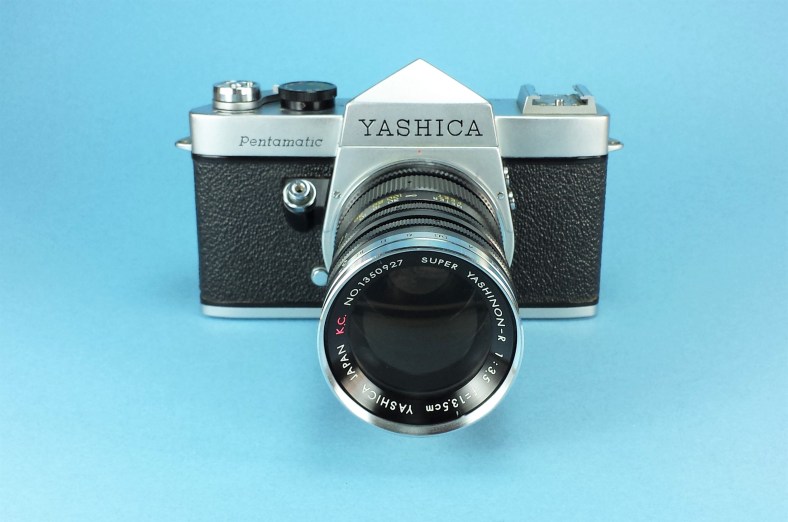
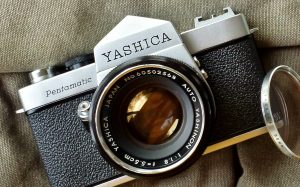
The Pentamatic was Yashica’s first single-lens reflex (SLR) and was released in 1960 (May-June) timeframe. The Pentamatic S was released about mid to late 1961. Not much changed between the two – the S model added a built-in self-timer and most notably, a provision for mounting an exposure meter to the top right of the camera that coupled with the shutter speed dial. Other small changes were to add lugs for holding the neck strap (moving them from the extreme right and left sides of the body on the Pentamatic to a more typical front mounting on the S). Unseen from the exterior is a change to the focusing screen inside the pentaprism. The original fresnel screen in the Pentamatic was replaced with a split image screen in the model S. For me, that change makes the Pentamatic S much easier to focus and improves the brightness inside the viewfinder.

A look at both models shows these changes and the tiny bit of extra weight that the S carries over the original Pentamatic.
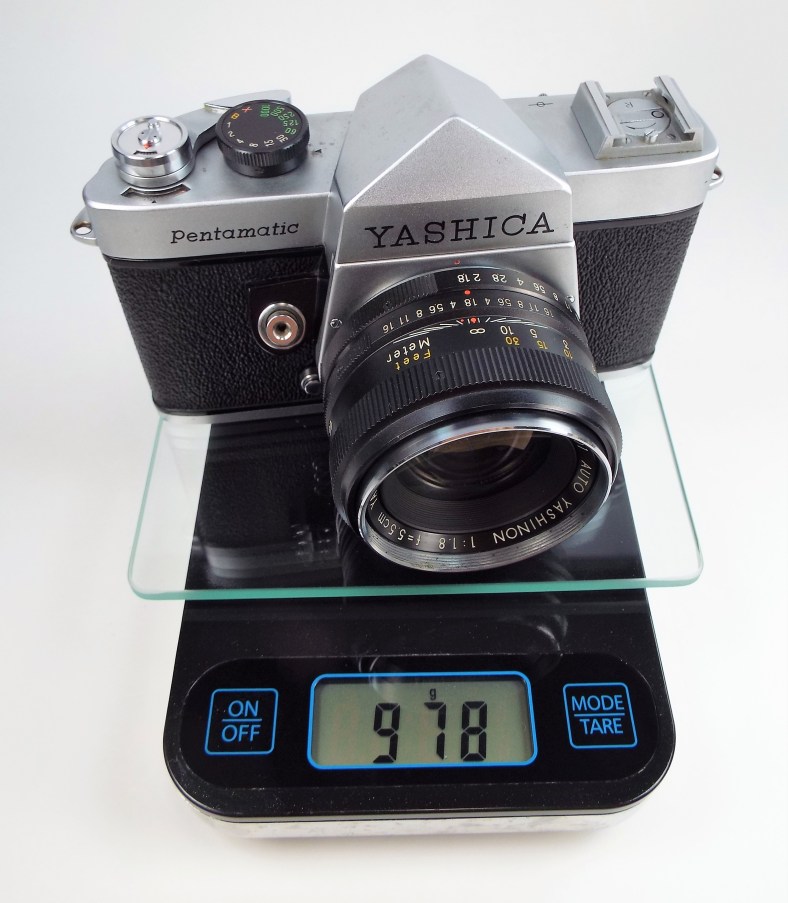
DSCF5402

At 978 grams, the original Pentamatic is anything but a lightweight. (2.16 lbs)
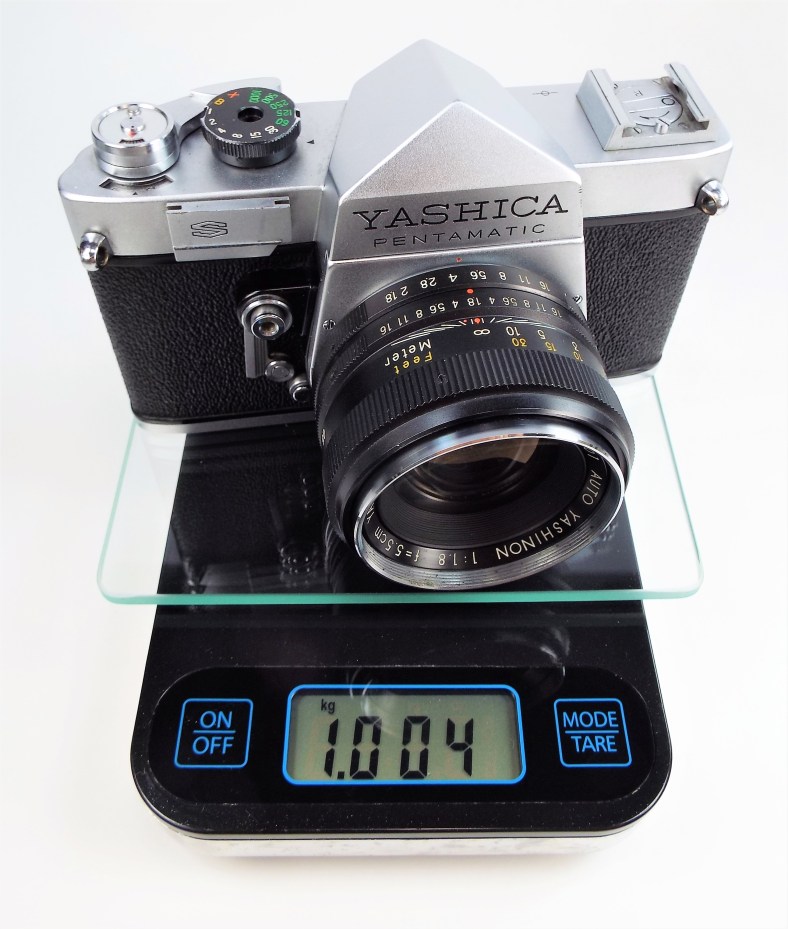
DSCF5403

At 1,004 grams, the S shows the slight weight increase from the changes made between the two models. (2.21 lbs)

Both cameras are photographed with the same lens attached – Auto Yashinon 5.5cm f1.8 lens which was the standard lens that came with both models. Only the Pentamatic II (released in September 1960) came with a different lens. (5.8cm f1.7)

Compared to other SLRs from the same time period, the Pentamatic was a bit of a beast to tote around. The buying public never embraced these wonderful cameras and they ended their production run in less than 2 years.

Finding good looking (and still working) Pentamatics is a challenge for any collector with the Pentamatic II being especially difficult to find in any condition.

Of note, if you have an Asahi Pentax, Nikon F or Canoflex camera with the standard lenses from the late 1950s or early 1960s, we would love for you to let us know what their combined weight is. We could be way off in our assumption that the Pentamatic was significantly heavier than the other cameras of that era. Thanks!

Studio Camera: Fujifilm FinePix S9900W

Chris
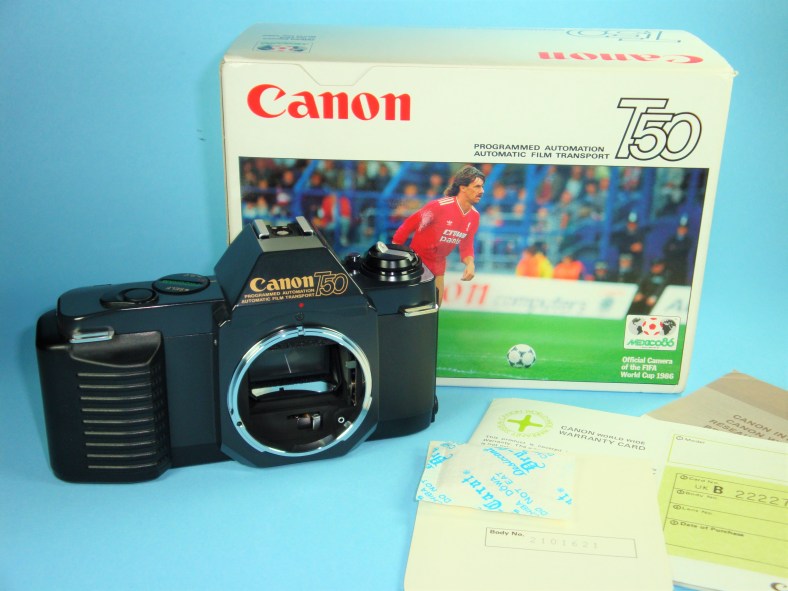
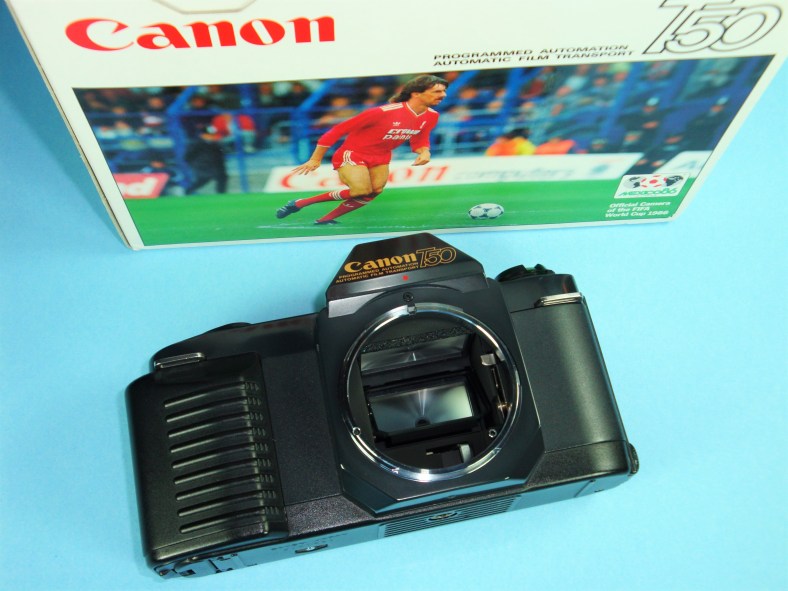
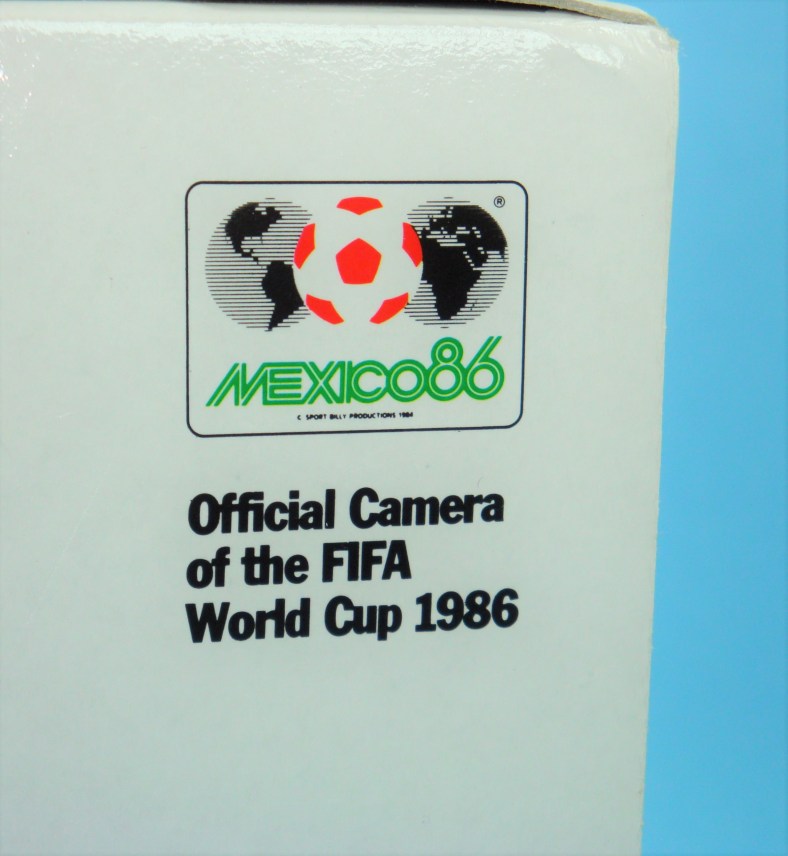
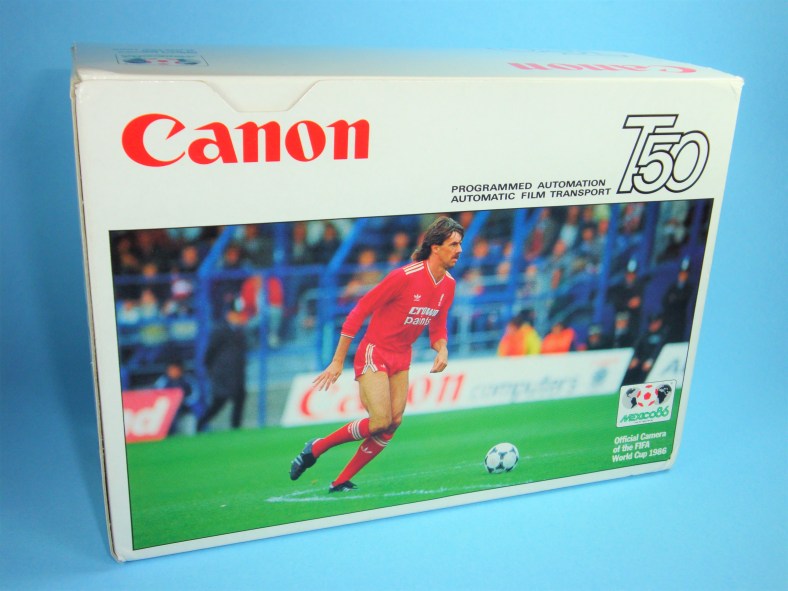
FIFA World Cup 1986 Canon T50

DSC01391

Probably not many of these floating around in the U.S. – this was in our collection of ‘all things Canon’ for awhile but has since moved on to another collector. We thought it deserved a spot on the blog if only because few people know of its existence.

DSC01401

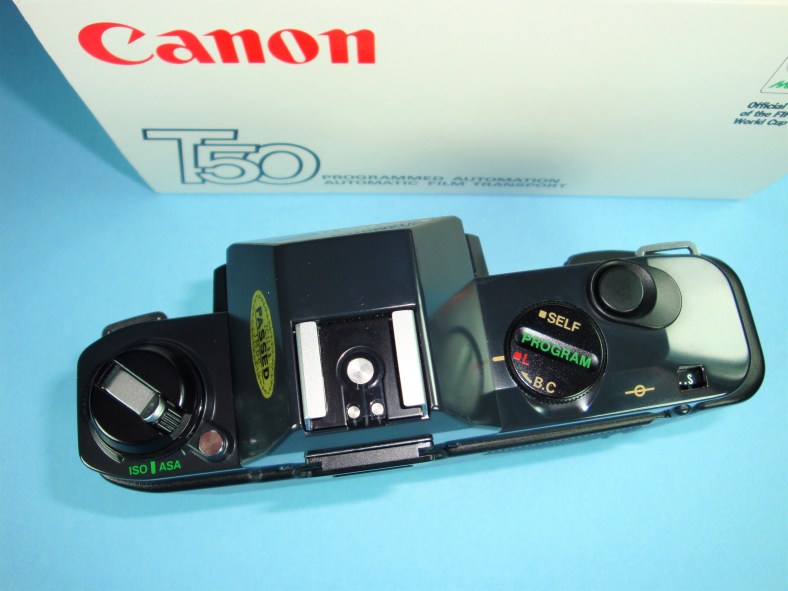
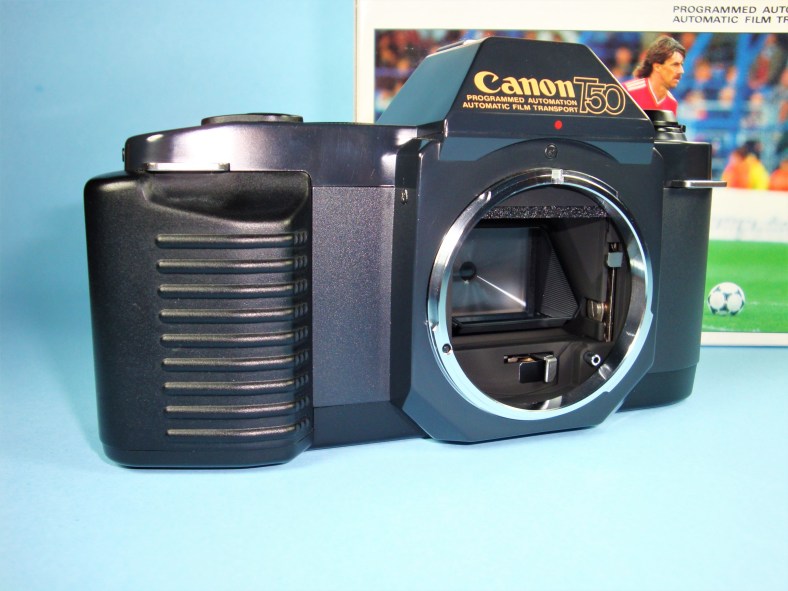
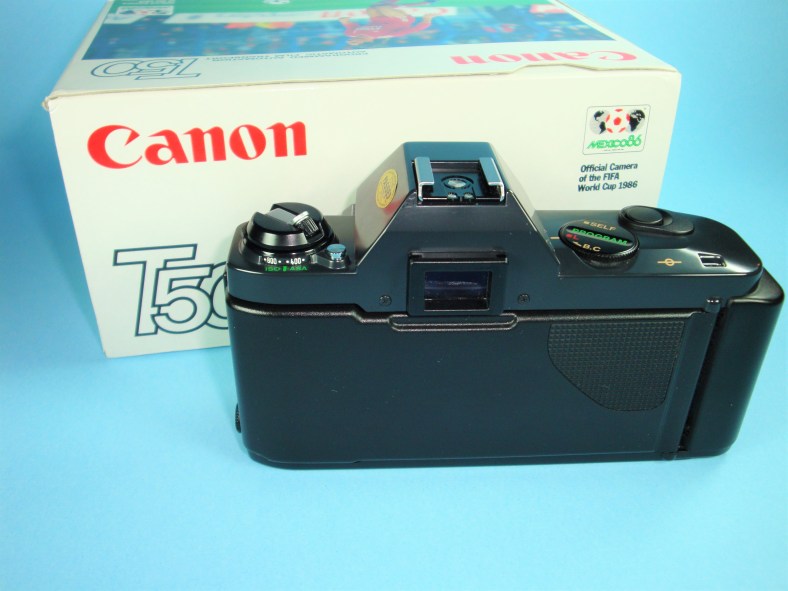
The Canon T50 is one of the simplest cameras (35mm SLR) that Canon ever produced. It accepted all Canon FD lenses, took 2 AA batteries, had a power winder built-in and had programmed automation!

DSC01389

Cool logo!

DSC01393

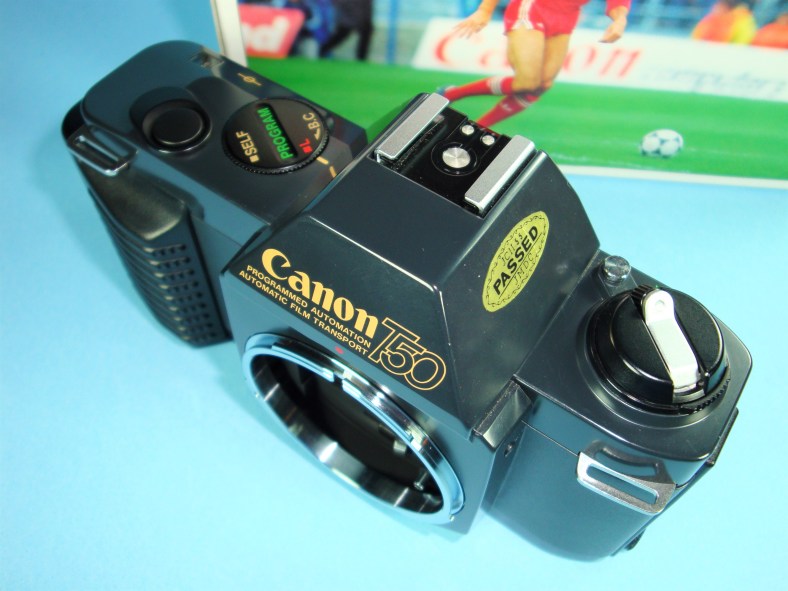
Simple Simon! Shutter button, function dial, hot shoe and rewind lever.

DSC01395

DSC01388

Nice bright graphics!

DSC01392

Bold hand grip and clean design.

DSC01394

If you want a simple, and we mean simple, 35mm SLR film camera to play around with, then the T50 and its cousin the T70 are just the ticket. Both take all of Canon’s FD lenses – and that’s worth the price of admission any day!

Camera: Sony Cyber-shot W170

Chris

More on our faked Yashica J-5 in “pro-black”…

Some time ago we purchased (through an online auction) what was listed as a rare black body Yashica J-5. The camera was sold by a well known camera dealer with a long track record of excellent prior sales. We know from our research and hands-on experience that Yashica’s first ‘Pro-Black’ 35mm SLR was the J-3 as we own two of them and have sold others that were in our collection.

I (Chris) knew that there was about a 99% chance that this J-5 was faked and I don’t have a problem with buying modified or restored cameras as long as it is disclosed as such. But I took a chance on this one even though there were numerous red flags about its originality. The bidding was through an online auction site in another country and my desire to own this ‘rare’ camera got the best of me. My purchase bid went for much more than a typical J-5 should go for and I actually paid more for it (not including the over-the-top shipping fees) than one would pay for a genuine ‘Pro-Black’ body (from the Yashica factory) J-3. In our years of research, we’ve never come across anything in print from Yashica about the black body J-3. No sales brochures (Japanese or English) have a mention of it – but we know that they did produce one a we’ve had a few and have kept track of them online in our database.

Prior to bidding on the faked black  J-5, I asked the agent representing this camera if in fact was a genuine, previously unknown black J-5. His answer was that the seller said it was… no worries.

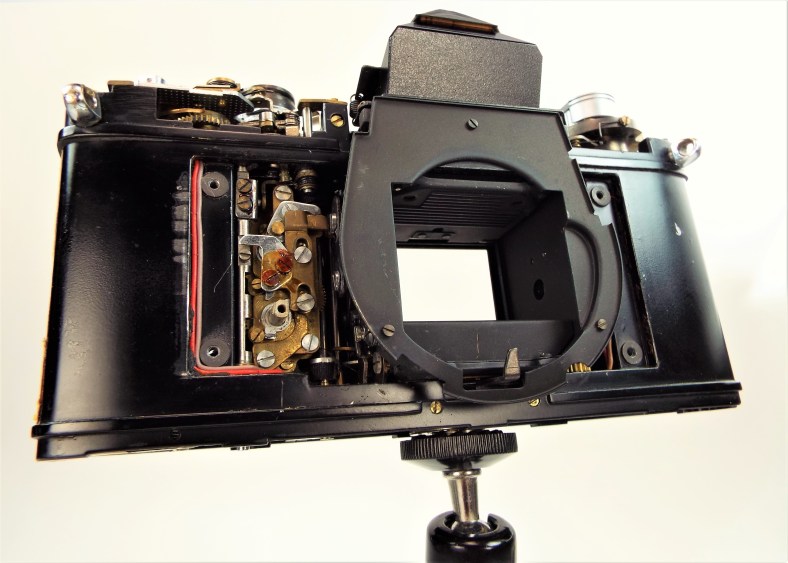
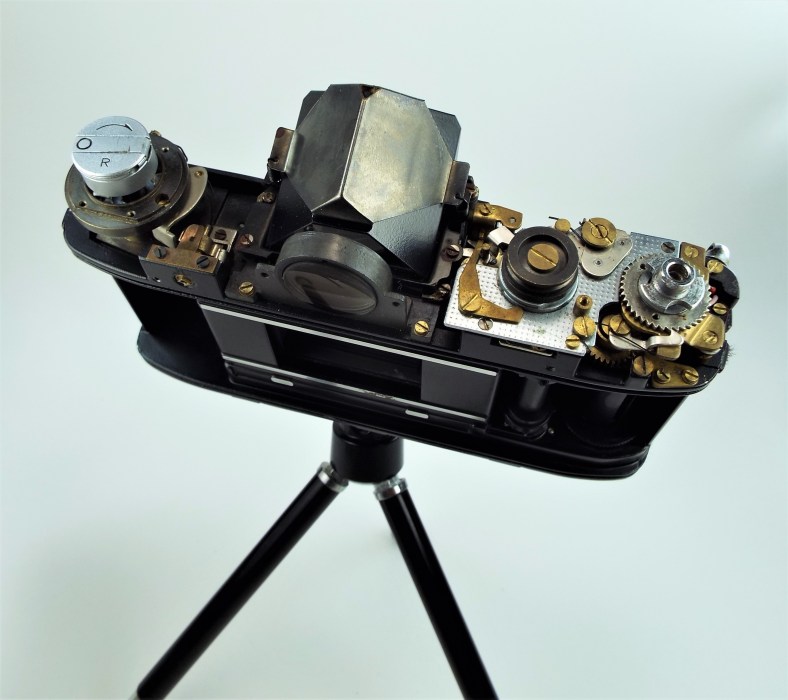
After looking at my new fake for some two years now, I’ve decided to remove the still fresh black enamel paint and reveal the satin chrome paint underneath its black mask. It was shocking just how easy the paint was to remove with alcohol and cotton swabs.

I wrote to the seller’s agent to complain that the camera was in fact faked and after some time (2 weeks) he came back with a no it wasn’t. Even with the pictures in front of them they denied that it was a re-paint. Oh well.

16666931755_eba4b91bba_o

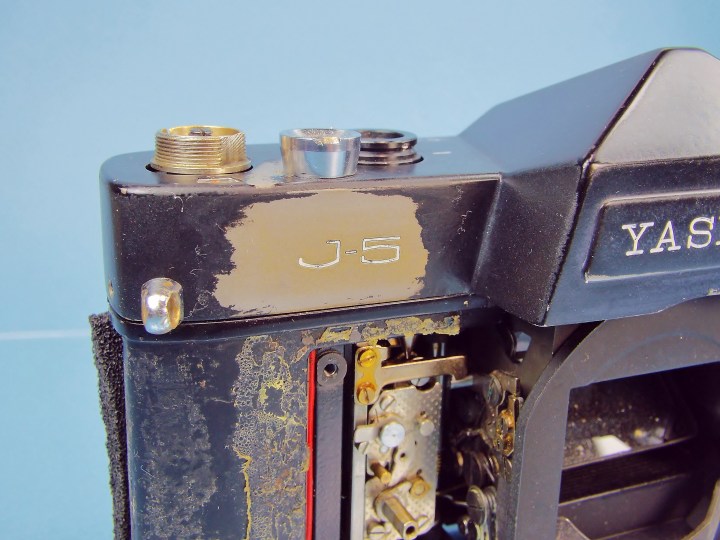
Clue number 1 – the presence of orange peel in the black paint.

16667100485_ee92845685_o

As received from the auction. From a distance it looked to be all original. When I opened the shipping box the first time I could tell something wasn’t right, the smell of fresh paint! Got me!

010
As you can now plainly see, the original satin chrome (silver) body is now exposed and in this image the orange peel black enamel paint is obvious – especially around the ‘YASHICA’. The leatherette has been removed by me and the residual adhesive remains visible at this point of the discovery phase.
011
Upon closer inspection (now that the black is gone) it appears that the original satin chrome (silver) factory finish was heavily sanded almost to the point of the brass showing through. The black enamel comes off super easy with 91% isopropyl alcohol and a cotton swab. For some strange reason, the factory etching of the J-5 logo was filled-in with white paint before it was buried under the black. Silver body Yashicas were filled-in with black from the factory.
012
Another view (right rear of the body) of the original factory finish underneath the faked black top coat.
010
It will take a bunch of cotton swabs and plenty of isopropyl alcohol to rid this J-5 of its black top-coat.

009

So lesson learned for me… only trust in what you know exists… if it’s not documented elsewhere as existing then there’s a good chance it’s been faked. Ask lots of questions. But, and it’s a big but (pardon the pun), Yashica has never mentioned that they made a black body J-3 in 1963 so it was possible that they made a few black J-5s.

The good news in all of this is that this camera is now in the home stretch of a complete rebuild and will be better than ever. It has been re-imagined as a tribute camera to the U.S. Navy. Stay tuned!

Many thanks for your visit, Chris and Carol

Advertisements

Occasionally, some of your visitors may see an advertisement here
You can hide these ads completely by upgrading to one of our paid plans.

UPGRADE NOW DISMISS MESSAGE

Yashica’s Penta J and the J-P

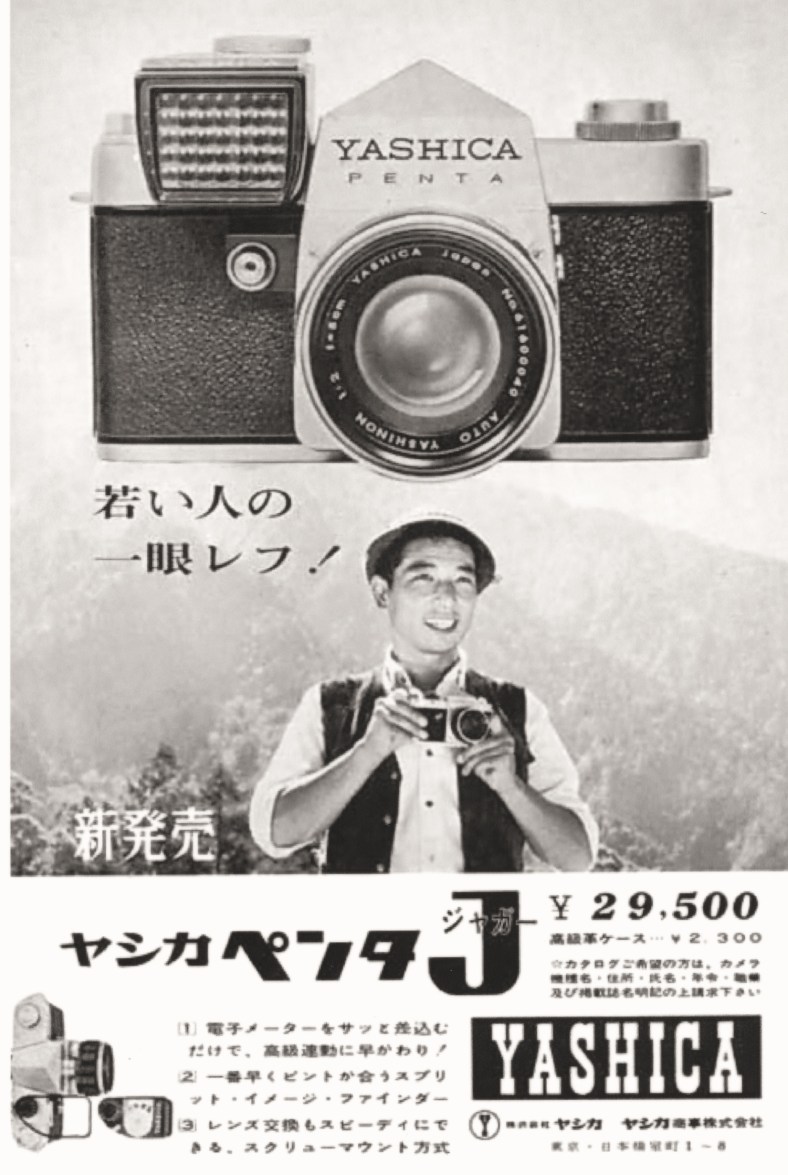
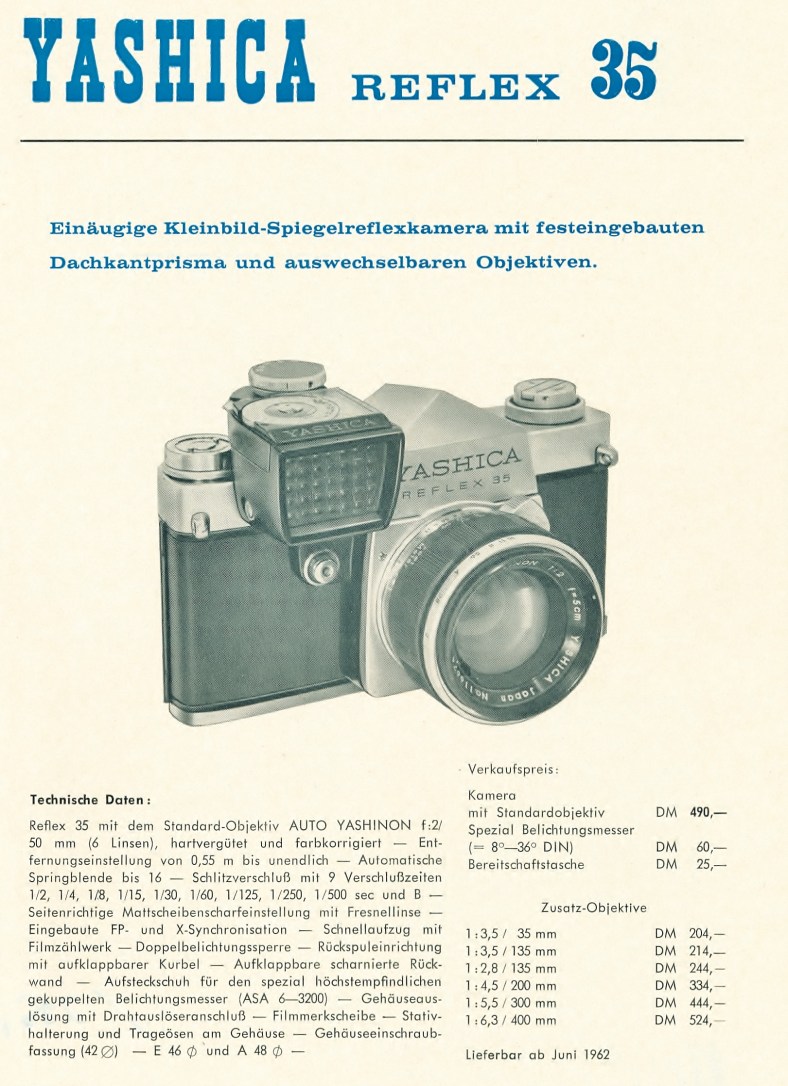
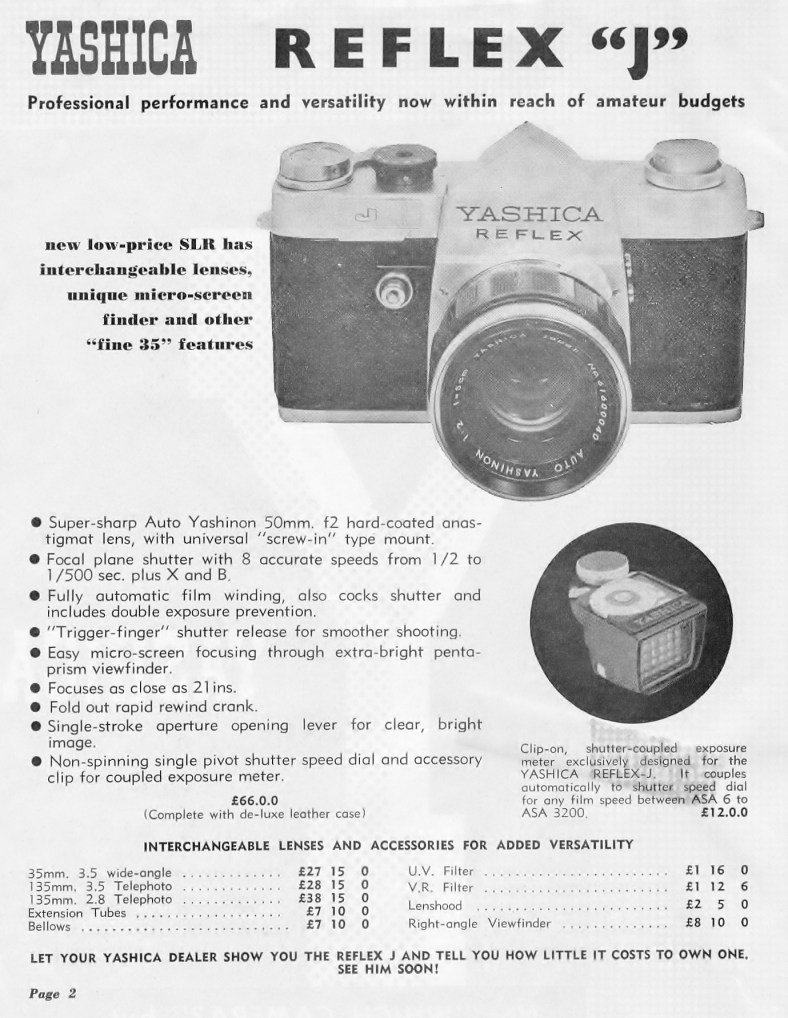
Yashica’s first 35mm single-lens reflex camera with the Praktica-thread (M42) mount lenses was the Yashica Penta J… at least here in the United States and in Japan. Elsewhere (most of the world) the camera was known as either the Yashica Reflex 35 or Reflex J (Australia and possibly the U.K.). As best we can tell, they were all the same cameras with different top plates to accommodate the different names (logos).

Part of the demise (lack of sales success) of the well-built Pentamatic series of cameras that preceded the Penta J, was that Yashica decided to go with a Pentamatic exclusive bayonet mount lens system. Sturdy and well designed to be sure, but being unique limited the available lenses that could be swapped between cameras. The Praktica design M42 screw thread mounting system was in widespread use at the time and Yashica’s bayonet design just went against the flow.

IMG_20160102_0007

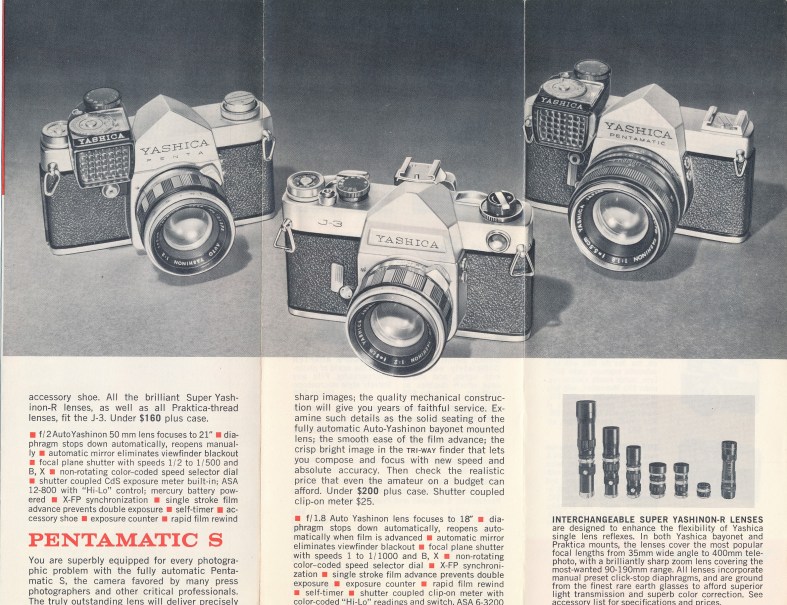
No date on this sales brochure but our guess would be early 1962. The J-3 is the newest camera featured  as it had all the goodies one would want in a modern SLR. The Penta J (upper left) had just come out in 1961 and it was Yashica’s first 35mm SLR with screw thread mounted lenses. The Pentamatic S arrived in early 1961 but used bayonet mounting for its exclusive design. Notice that the pentaprisms on the Penta J and Pentamatic S share the same design while the J-3 breaks with the previous cameras and ushers in the style that would carry through the remainder of Yashica’s SLR run of M42 cameras.

IMG_20150926_0026

Yashica Penta J.

IMG_20160102_0005

Yashica Reflex 35 in Germany.

IMG_20160102_0004

Australian Reflex J sales brochure.

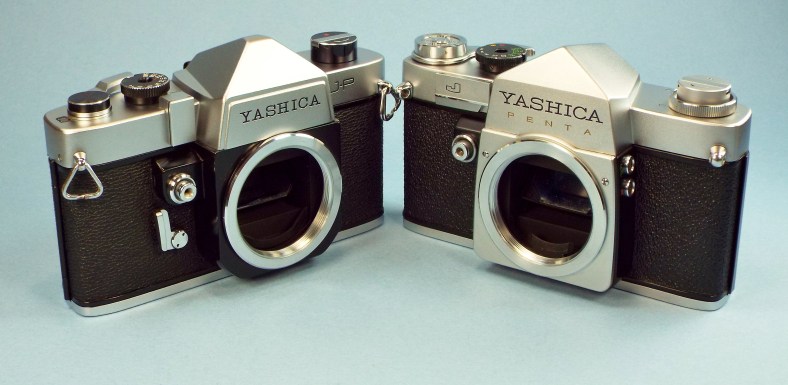
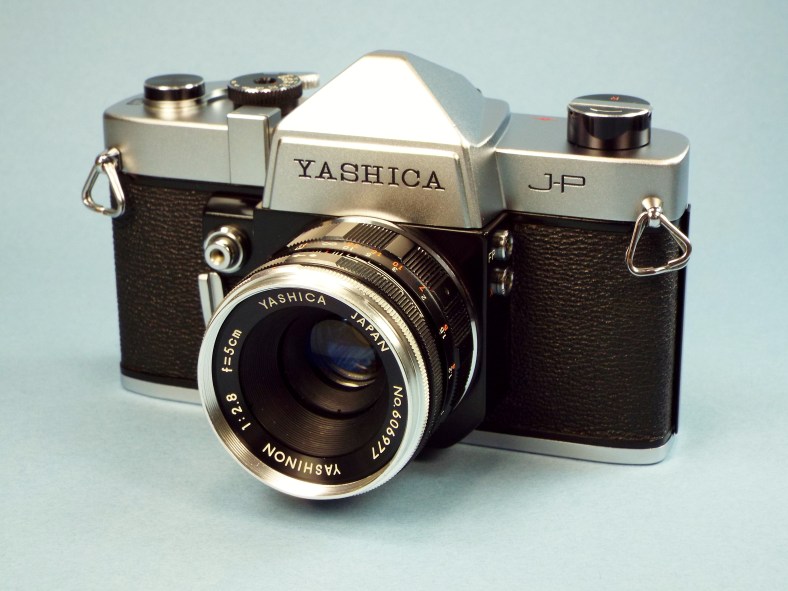
Now fast forward to 1965 ish… Yashica introduces the new J-5 AND the J-P! In between those years Yashica had introduced the J-3 and J-4. Why would Yashica go back in time and bring out another 35mm SLR in 1965 that was the cousin to the 1961 Penta J? Notice we say cousins… not brothers. They shared the same platform with one another but as you can see in the image below the top plates were of a different design.

DSCF1268

1965 J-P on the left and the 1961 Penta J on the right. Cousins but not brothers. The shutter release button is on the right front on both cameras… Yashica added a self timer on the J-P and of course the top plates are different (most noticeably the design of the pentaprism). Some small changes to the design of the mirror box. Unseen from this view is that the J-P does not have a ASA/DIN dial like the Penta J had on the camera’s bottom left. Small note about weight… Penta J weighs in at 656 grams and the J-P weighs only 619 grams. No built-in exposure meters but accessory exposure meters were available at additional cost.

DSCF1277

The J-P with a rather unique 5cm f/ 2.8 lens. The lens has to be the smallest of the M42 mount lenses and certainly it’s one of the lightest at only 136 grams!

IMG_20150903_0027

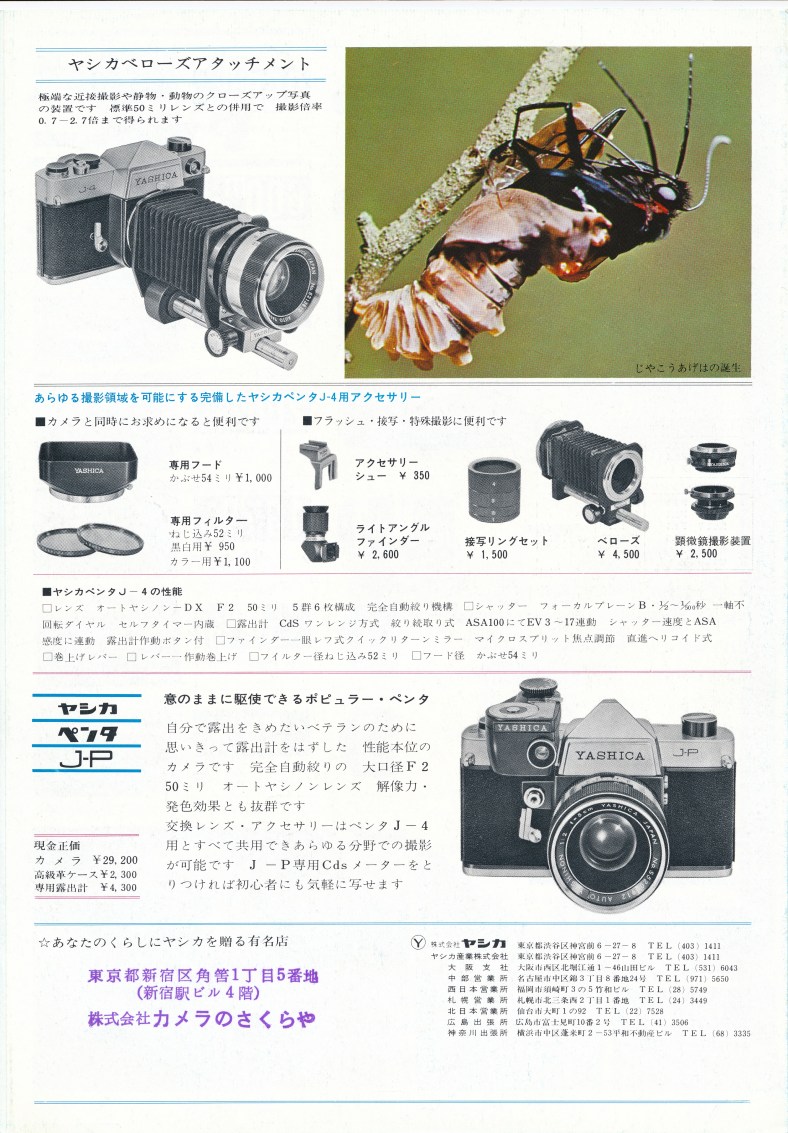
The J-P advertised together with the J-4.

IMG_20150903_0025

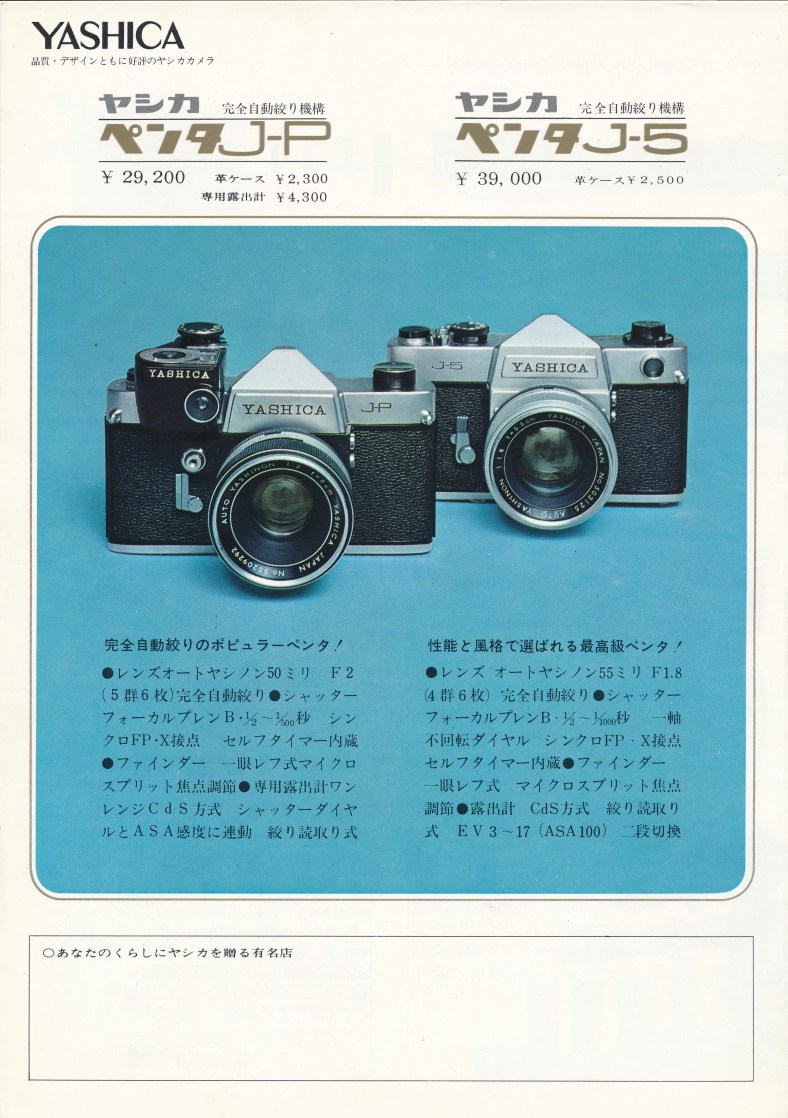
The J-P advertised with the new J-5.

Yashica J-P 6-27-15 Papers

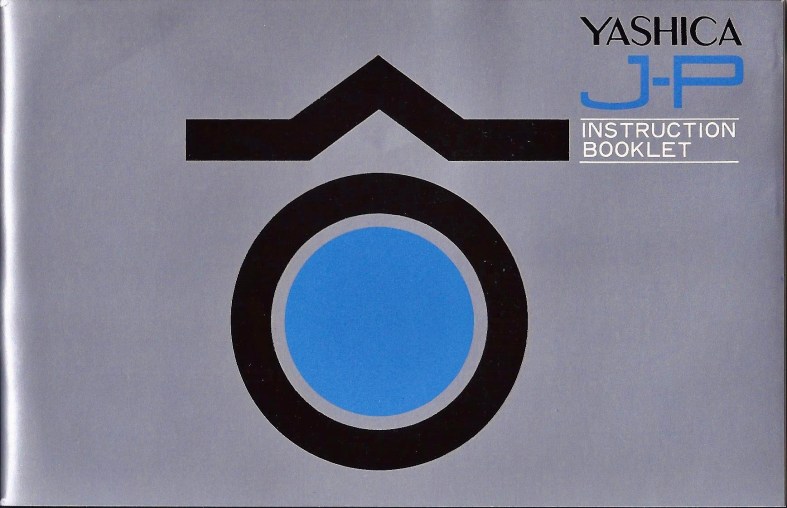
J-P instruction booklet from 1965 (in mint condition too).

Stay tuned… more to come on these Yashica classics.

Many thanks, Chris and Carol


Yashica TL Electro-X ‘ITS’

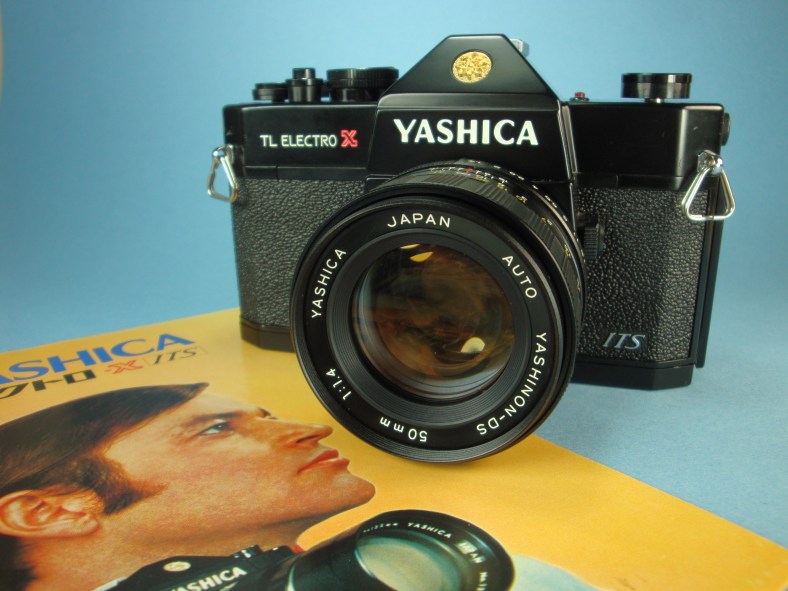
After nearly five years of research and thousands of “searches” on auction sites, I finally have my answer! ‘ITS‘ as it relates to the famous and groundbreaking Yashica TL Electro-X stands for… are you ready? Nothing!

That’s right… nothing. I’ve just finished reading what appears to be the most comprehensive guidebook on the TL Electro-X (from Yashica no less) and not one word as to why the marketing guys and gals at the office in Shibuya picked ‘ITS‘ to appear on the lower left front of the camera. Not one hint… no clues… nothing!

Okay so more than likely it was meant to mean exactly that… nothing. I can live with that. Marketing people don’t have to explain anything they do. ‘ITS‘ simply looks good. So fast forward from 1968 to the present day. Hear I am stressed out about what may have been a whim… an afterthought… or maybe something one of the designers casually mentioned in a meeting while you know, designing the thing. ‘ITS’… sounds good.

I’ve imagined what it may mean hundreds of times (sad to admit that) and nothing really fits for the time period except that maybe the ‘I‘ stands for “integrated”. Like integrated circuit or I.C. as I’ve sometimes seen it mentioned in other Yashica sales brochures. That’s got to be it. After all, the NASA people were always using that term during the height of the space race. Okay so maybe we now know that the ‘I‘ stands for “integrated”. Simple. The ‘T‘ has always stood for “technology” to me. What else would the ‘T‘ stand for? Timed? As in timed shutter. Oh that’s a good guess. I like it. Maybe the ‘TS’ part is for “timed shutter”? That’s another good one. Integrated… Timed… Shutter!!! Or how about “Interval” timed shutter? That’s ‘ITS‘ isn’t it?

Solved! Finished! No more worries right? No… that isn’t it. It’s got to mean something else. Something catchy, something better than that. Well the book (sales brochure) I just finished reading never mentioned what the ‘ITS‘ stood for. Just like the hundred other brochures and ads I’ve read. But wait! Hold on! There on the cover is a clue! There it is right in front of me! “SYSTEM”. Yashica called everything connected with the TL Electro-X ITS (lenses, filters, bellows, angle finders, accessories, etc.) SYSTEM.

So there it is! That was simple. Right? Well we’ll see. I’m going to keep on looking for that definitive statement from Yashica. Somewhere in black and white they’ll say it. For now though I’m sticking with… “Integrated Technology System” or “ITS” for brevity.

ITS = Integrated Technology System

DSC07504DSC07497Yashica 6-9-15 TL Electro-X Brochure back cover close

20151202_203809

A 45 page book from Yashica that explains everything about this fantastic camera.

No denying it – it’s a sharp looking camera and the ‘ITS’ just makes it that much cooler. It’s one of our favorite Yashicas in our collection. This one came to us via Okinawa, Japan. Purchased in late 1973 – that makes it one of our newest Yashica SLRs too. We’ve kept all of the original paperwork and of course the box. If you come across a nice looking one for sale (or better still get it as a gift) it should be on your list of must haves. The battery is an easy find and most will have working meters since they were only electronic (no moving match needle affair).

Happy hunting!

Chris and Carol ^.^

Yashica Pentamatic Timeline… update 3 (Oct 2017)

Our best timeline for the development of the Yashica Pentamatic 35mm single-lens reflex (SLR) film camera… Pentamatic ’35’

Please note that this is a “dynamic timeline” and it will be updated as we discover new dates and developments…

  • Summer 1959… Yashica develops / invents its first 35mm SLR
  • September 1959… Yashica files to trademark the name ‘Pentamatic’ in Japan
  • October 1959… Tomioka starts production of a new lens for the Pentamatic. f/1.8 5.5cm
  • December 1959… First Pentamatics assembled at the Suwa factory
  • February 1960… Yashica files to trademark the name ‘Pentamatic’ in the U.S.
  • March 1960… Production reaches 1,500 units
  • March 1960… First showing of the Pentamatic occurs at a trade show in St. Louis… first images of the camera are provided by Yashica
  • April 1960… First published look at the Pentamatic in the May 1960 issue of Modern Photography magazine
  • May 1960… First full page advertisements for the Pentamatic ’35’ appear in the June 1960 issues of Modern Photography, Popular Photography and U.S. Camera magazines and the Pentamatic is available at Yashica dealers by early May
  • June 1960… Production reaches 5,000 units
  • June 1960… First review of the camera appears in the July issue of Modern Photography magazine
  • August 1960… Production reaches 9,300 units
  • August 1960… The Pentamatic II goes into production. Sold only in Japan
  • August 1960… Zunow produces a new lens for the Pentamatic II. f/1.7 5.8cm
  • Winter 1960-1961… The Pentamatic I and II are are both sold in Japan
  • December 1960… Camera dealers in New York advertise new Pentamatics at under $110 (USD)
  • January 1961… Production reaches 15,700 units
  • January 1961… The Pentamatic S goes into production
  • January 1961… The Pentamatic II ends production at under 6,000 units
  • February 1962… February issue of Modern Photography has only two advertisements for the Pentamatic and NO mention of the Pentamatic II or Pentamatic S
  • Late 1961… The Pentamatic models are replaced by the Penta J
  • End of Production… About 30,000 Pentamatic cameras (all models) are made over 3 years
  • August 1963… ‘Pentamatic’ receives trademark registration in the U.S.
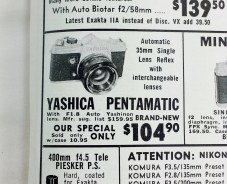
  • Pentamatic Advertisement

    By January 1961, some pretty strong discounts on the original Pentamatic I. No Pentamatic S advertised.

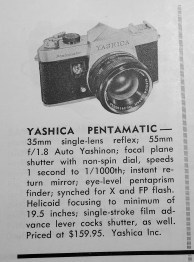
    First Look?

    First look at the new camera in the May 1960 issue of Modern Photography.