Kamakura Daibutsu

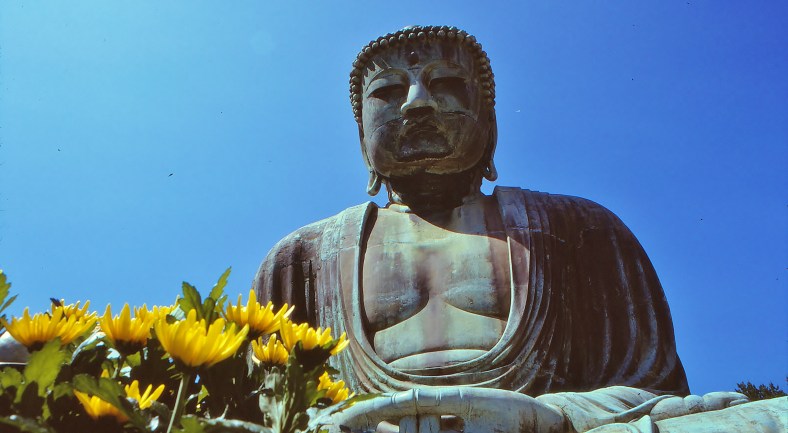
My wife and I lived in Yokohama, Naka-ku (Honmoku) from the Summer of 1977 to early Spring of 1980. We totally enjoyed our time in this wonderful country and are hopeful we will be able to return again. We had our favorite spots – Sankei-en and Kamakura being two of our most favorite. As with any well known attraction, the Great Buddha at Kamakura has been photographed from every angle imaginable. I’ve always enjoyed exploring angles that may not have been tried before.

19987739784_b6b238428b_o

July 1979. Canon F-1 with FD 24mm lens on Kodachrome 25.

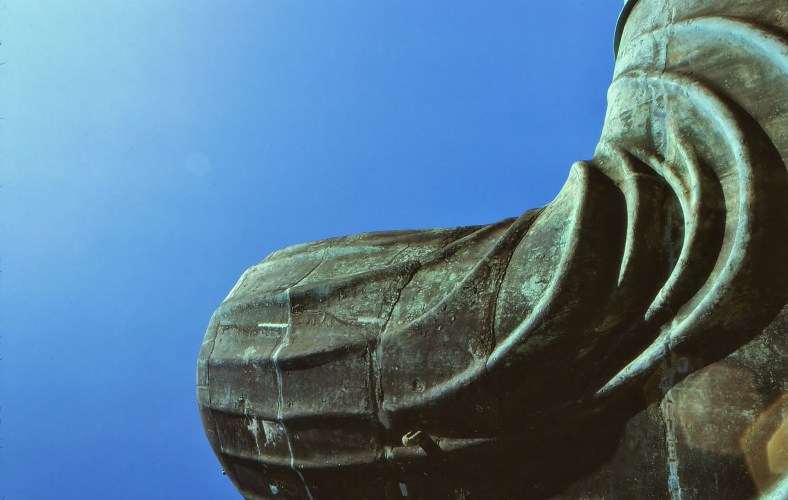
21915088979_a912894e1a_o

Kodachrome 25. Bright sun. Canon F-1 with FD 24mm lens. It’s what film photography was (is) all about.

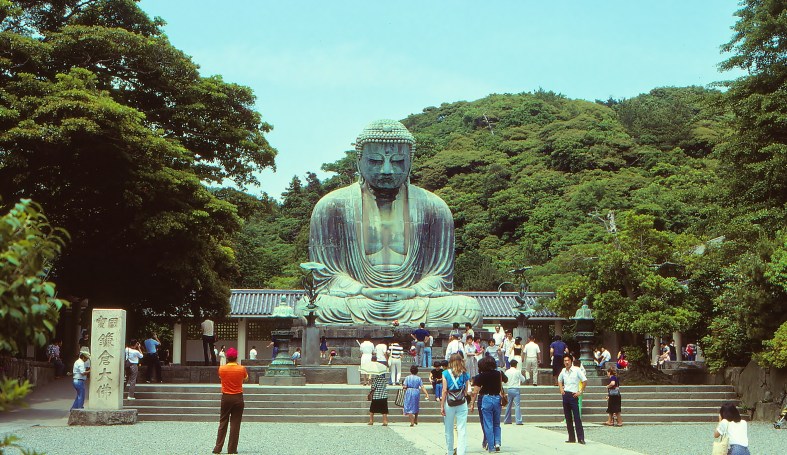
20847829440_15c046a3df_o

More traditional view of the Great Buddha. Steaming hot July day on the Kanto Plain. Yashica TL Electro-X on Kodachrome 64.

21478741664_f6ef540008_o

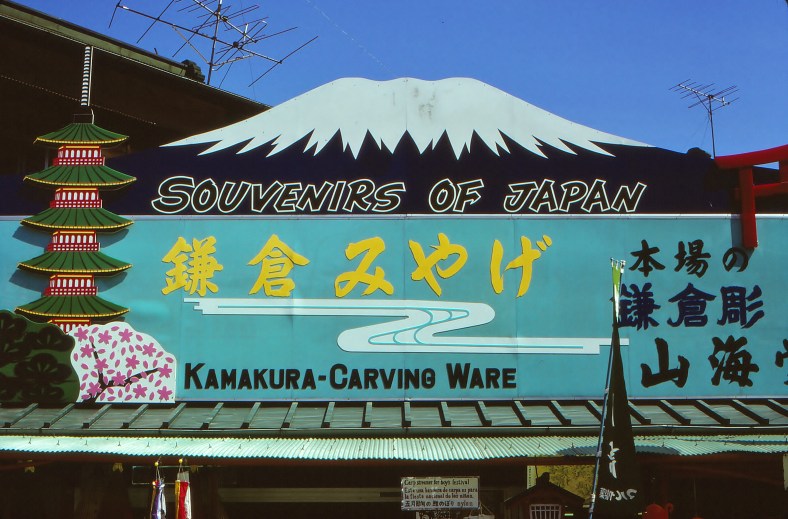
Gotta have a tourist shot! We love the antennas on top of Mt. Fuji!

So many things will have changed in Japan since we were last there but they’ll be plenty that will stay the same… forever. Kamakura is one of them.

Thanks for the visit!

Shooting in squares…

It’s tough to think square again! I’m spoiled (aren’t we all) by the ease of digital photography – nice proportions – wide screen – big images – bold colors – lots of megapixels. Exposures? Shutter speeds? Composition? No worries – the technological gems we hang from our necks will think for us. I’m as guilty as anyone – I love what digital can do and what it can’t.

Now try to think of the world in little squares – 6 x 6 centimeter squares to be exact. It’s hard to do – modern formats are always elongated squares. Who loads square images on their blog? The square format went out with the Instamatic! But if you’re lucky enough to own (or have access to) a medium format (6×6) camera then you too can shoot in squares.

I recently took one of my Yashica TLRs out on a date – threw in some fresh Fujifilm and off I went. I must confess – I love color! Sure I like an occasional fling with some black and white (Neopan 100 Acros) but color gets me going. Not “computer generated color” – the subtle color you see only on film. It’s there (just like in real life) but it doesn’t tackle you to the ground like some overly saturated digital image. Just nice and easy color.

These following images were taken with my Yashica-Mat EM twin-lens reflex (TLR) camera. Exposures were determined (suggested actually) by the EM’s on board exposure meter. Yashica claims that it’s built-in but it’s really just attached to the left side of the body by three screws and a wire. No TTL or coupled metering here… just a bunch of tiny numbers on top of more tiny numbers with an almost invisible pointer pointing at those tiny numbers. I chose Fujifilm’s Fujicolor PRO 400H color negative film because I enjoy shooting with Fujifilm and usually like the results. I will point out that no post production was done on these images. No cropping, no color adjustments – they’re just as they were when developed and scanned by the lab (which was The Darkroom).

53580001

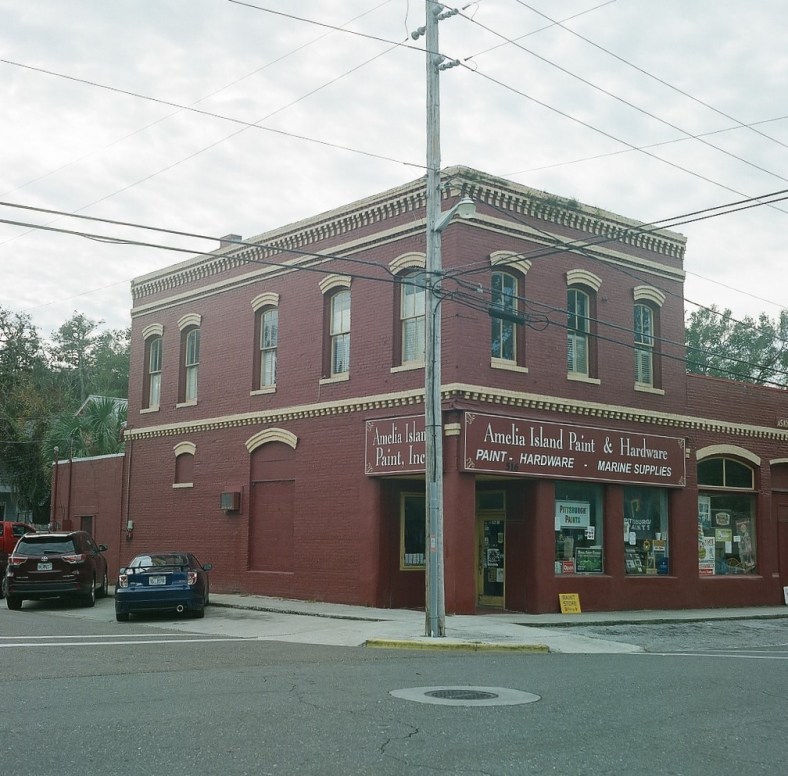
This is actually image 12 on the roll. Taken on day 2 of my travels. Perfect small town America shot. I lost my bright sun from the day before but the Fujicolor 400 made up for the dull sky. Is it properly exposed? Probably not. Off by about 1 stop or so.

53580006

Day 1 – image 7 on the roll. The Fujicolor handled the strong contrast between the sky and building. The Yashica’s meter did a fantastic job. About 1/500 at f/ 16-22.

53580008

Faded Florida – along U.S. Highway 17 in North Florida. High contrast with strong shadows. f/ 16 at 1/500.

53580012

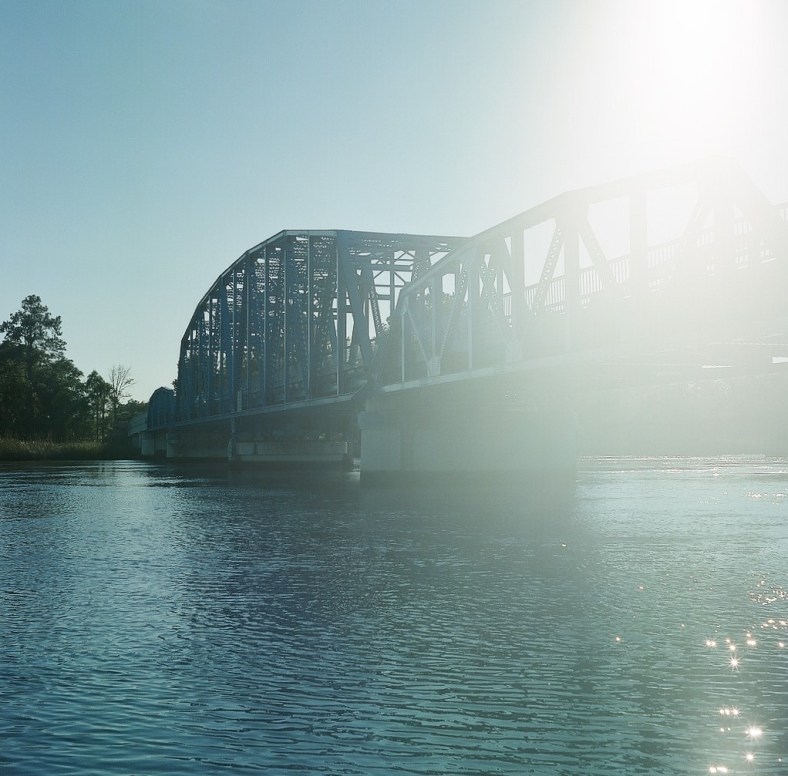
A nice test for the Tomioka 80mm lens. No flare and some nice highlights on the water. 1/250 at around f/ 11-16. I metered to the left of the bridge. Looking south into Florida from Georgia. Highway 17 bridge over the St. Marys River.

53580009

Looking north towards Georgia. The Yashica’s meter did a wonderful job suggesting the proper shutter speed and aperture setting. 1/250 at f/ 16.

Shooting in squares can be fun and challenging. Do I think some of the images would be better in a 6 x 4.5 or 6 x 7 format? Yes – definitely. Can I learn to enjoy squares again? Yes – definitely.

Comments are always appreciated and welcomed. Thanks for your visit!

Chris


Pentamatic bling!

A little eye candy for all the Pentamaniacs* out there!

20150107_084533

Some original Pentamatic packaging items. Yashica kept a theme of the pentaprism design on the presentation box and the instruction booklet.

20150107_090633

The red box on the right is the outer or shipping box. Once again Yashica kept the pentaprism design going.

20150108_150847

More Pentamatic toys.

If you’re looking to collect a really interesting camera (that’s also a joy to use), then give the humble Pentamatic a try. First available for sale by late Spring 1960… never sold in large quantities so it’s a bit of a challenge to find. The viewfinder is bright and appears very large (no needles or other stuff in the way), and the normal 5.5cm lens is big and bright – easy to focus too.

*Many thanks to a reader for the suggestion of ‘pentamaniacs’. ^.^

Thanks for your visit. Questions and comments are always appreciated.

Chris

A beautiful sight…

Nothing like a fresh roll of film in your camera. The possibilities are endless – the results, well I’ll have to wait a week for those. Could be the reason digital became so popular so quickly. Could be why people still load cameras with instant film.

dscf3067

Some Fujicolor Pro 400H color negative film.

It’s a beautiful sight…

Thanks for your visit! Now load up some film!

dscf3068

Yashica-Mat EM… on assignment… update 12.9.2016

This month’s assignment (actually from September) is to load some Fujifilm into our Yashica-Mat EM and enjoy the benefits that only medium format film photography can fulfill.

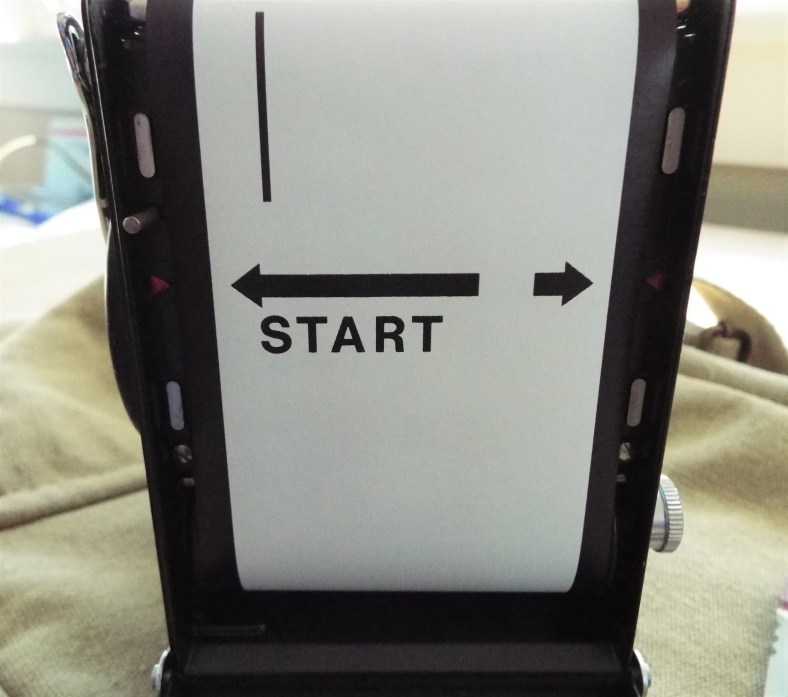
Oh the joys of composing 6 x 6 cm images through a pop-up viewing hood in bright sunlight. What I do find nice is that the focusing dial is on the camera’s left side… a natural place for it to me. The EM has a built-in exposure meter and a ‘computer’, slide rule actually, to adjust the aperture and shutter speeds which you then set by using the two thumb wheels. I’ve learned over the years to use the guess method of focusing – I’ve learned how to judge distances by eye and then I set the focus on the marked dial. If you’re shooting in bright light and use the smallest apertures then the dept of field will cover most inaccuracies in your focus guess. Saves time and frustration. This month the Yashica-Mat EM (this one is from 1964) I will be using is in perfect condition… all shutter speeds sound correct and the aperture blades behave as they should. The meter does not require batteries and I’m sure most of my bright and sunny shots will be f/ 11 and 16 and f/ 22 for the Fujifilm 400. Below is my favorite one camera-one day bag. It’s made from vintage washed canvas material and is super soft inside and out. I trust it not to scratch my cameras going in and out and once inside, they’re safely cushioned.

dscf3060

My day bag – one camera only. The bag is super soft vintage cotton canvas and has a cushioned liner to protect its precious cargo.

The bag is 100% cotton and made by ‘Rothco’. It was stitched in India which makes me feel a bit better about it. It was purchased at the National Navy UDT-SEAL Museum in Ft. Pierce, Florida which helps support this awesome museum. The desert toned U.S. Flag was also purchased there and was added to the bag by me. No worries when I travel with it. No matter what I wear, I’ll always look like an American. I mention this only because when I was a Sailor in the U.S. Navy (a long time ago) we were often told to not look American while travelling overseas – which is a hard thing to do when an aircraft carrier is in a foreign port and 5,000 Sailors were out on liberty.

I plan on shooting two rolls of Fujifilm – gorgeous Neopan 100 Acros and a roll of PRO 400H color negative film. The Yashica has Tomioka Optical made Yashinon 80mm lenses with a fairly bright f/ 3.5 taking lens. The glass is crystal clear and always produces sharp details. The image is nice and bright on the focusing screen and the red grid marks help to keep things straight. I’ll tote along the lens hood just in case. No tripods needed but I may bring along my monopod.

We hope to post our images soon. Now that the fall weather has given us a brake from the oppressive heat and humidity of summer it will be fun to roam about our little town and the adjacent countryside.

dscf3067

Fresh roll of Fujicolor PRO 400H color negative film.

And some of the results…
53580012

Purposely pointed into the low angled sun – great way to test how the lens is going to look. The stars from the highlights on the water was a nice plus. Also a great test for the EM’s exposure meter. I metered off the water well left of the bridge. About 1/250 at f/ 11 maybe f/ 16.

53580006

The Fujicolor did well here. Big contrast in this image between the stark beige of the building and the deep blue sky. Shot at 1/500 around f/ 16-22. No post production of this image. As framed in the focusing hood on the EM.
53580001

Dat two of the photoshoot. I lost the bright sunshine and the sky turned rather blah. Small town America at its best. 1/250 at f/ 11-16. No post production. As developed.

The EM performed beautifully – the built-in exposure meter was spot on and the shutter was accurate. These images were focused at infinity so no real chance to test the accuracy of mid-range focusing. Another time.

Thanks for your visit!

Chris & Carol
Yashica 44… a ladies camera?

Any doubts that Yashima-Yashica was marketing to women for their new smaller 4×4 cm twin-lens reflex camera are erased once you see the cover to the sales flyer.

img_20161129_0026

In a male dominated society, Yashima-Yashica needed to leave no doubts as to who these new smaller and lighter cameras were for.

Normally sales flyers and brochures in the late 1950s were geared to and appealed to the male buyer. In all fairness, it was likely that’s who took most of the photographs during that period. Yashima-Yashica’s direct pitch to Japanese women was an attempt to tap the vast market of female buyers.

img_20161129_0027

As we understand it, the 44 model came in at least 7 or 8 colors!

Even though the front of the flyer was simple and left no doubt as to who the buyer would be – the reverse of the flyer was still detailed and quite technical. It’s possible that the camera was designed for the wife to use for taking pictures of the children (while the husband was off at work all day) but still detailed enough for the husband to feel comfortable purchasing. Just our take on things.

Thanks again for your visit – as always we appreciate any and all comments. In the interest of fair play, we ask that you do not copy the images and include them in your blog or post without asking for permission – thanks! ^.^

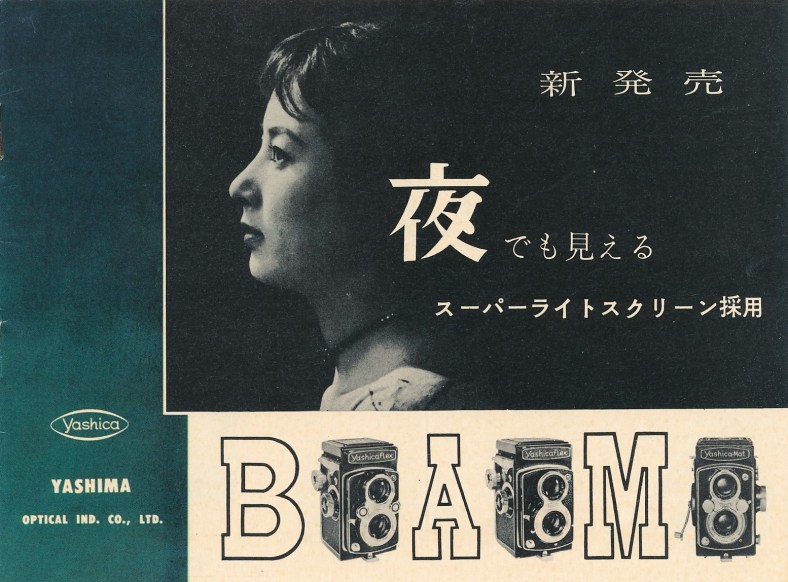
Yashima Sales Brochure… 1956

In just 3 short years, Yashima beat the odds and became a Japanese camera company that lasted long enough to produce multiple models. In the case of this sales brochure from 1956 – the Yashica Flex B, A and Yashica-Mat twin-lens reflex cameras.

img_20161129_0015

Well designed sales brochure from the little company that became Yashica.

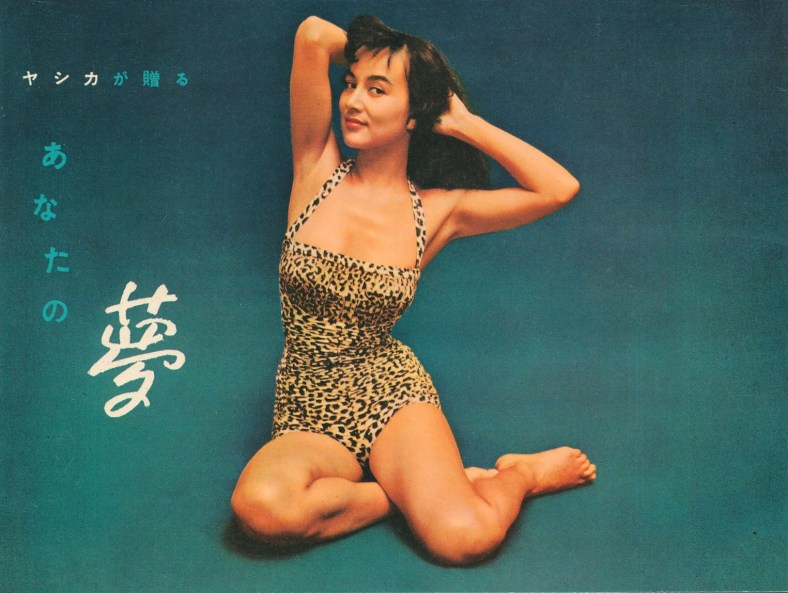
Not that we’ve seen a ton of sales brochures from other Japanese camera manufacturers from this era, but we think this was rather provocative for the mid 1950s (at least in the US we would think). This brochure was intended for the home market and the culture of Japan is a tad less uptight about things like this.

img_20161129_0016

Lovely model on the back cover of the brochure.

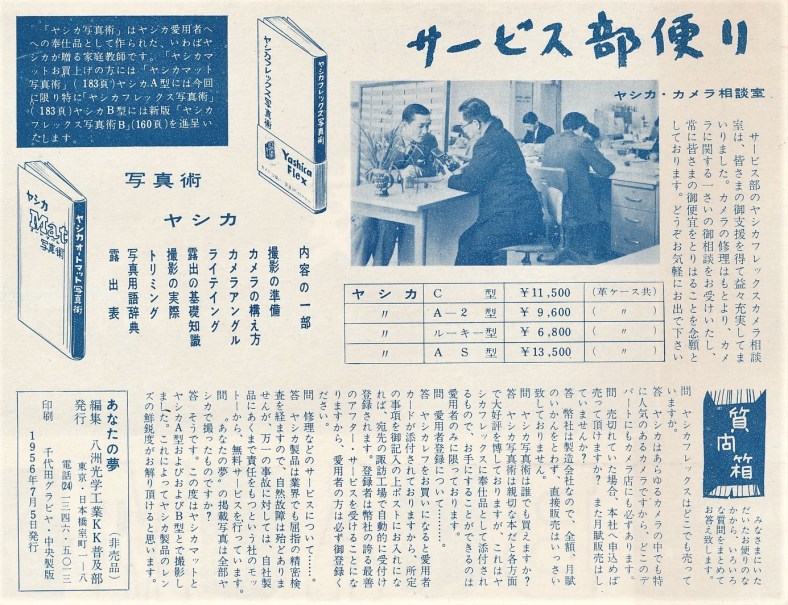
The first page inside the brochure in packed with information not typically found in a brochure. Yashima was, in our opinion, marketing itself beyond what such a young company would normally look like. These series of Yashica Flex Photography books were excellent creations that went far beyond a simple owner’s guide.

img_20161129_0011

You’ve got the year (1956), two examples of the Yashica Flex Photography books and some prices of the cameras.

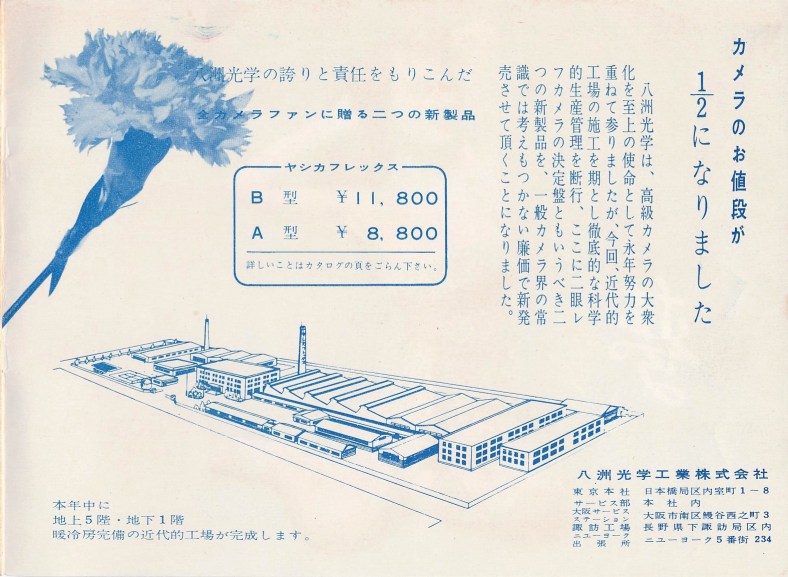
img_20161129_0025

Last inside page of the brochure depicting Yashima’s new modern factory in Suwa, Nagano Prefecture, Japan.

Yashima was a very proud company and they were eager to show how much they grew since 1953.

Thanks so much for your visit. The goal of our blog is to stimulate discussion and further the knowledge of all things Yashima-Yashica. Please share your comments with us… we’d be happy to read them. One final thought, we share our brochures with others and ask that you do not copy or post our images into your blog or post without permission. Thanks!

Chris & Carol

1954… Yashica Flex Model S

When Yashima started making twin-lens reflex cameras in a small factory along the shores of Lake Suwa in Nagano Prefecture, they were but one of hundreds of “start-ups” entering the already crowded Japanese camera manufacturing business. Many would fail – and fail quickly they did. But little Yashima, with two brothers from Nagano at the helm, managed to take a big step – to make a second and then third camera.

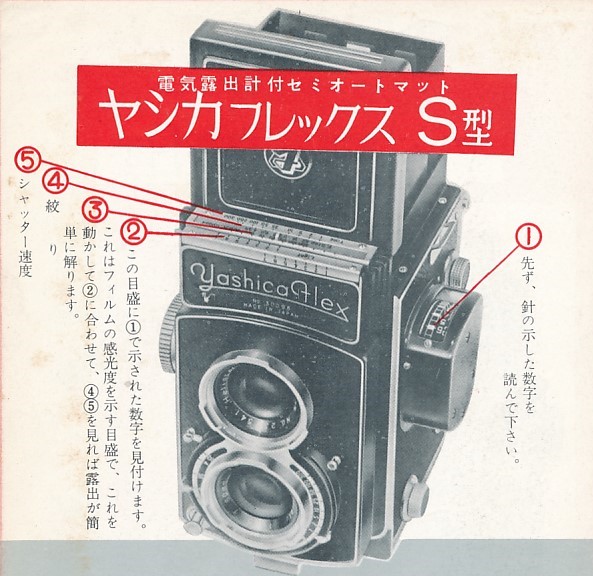
The first was the Pigeonflex (great name but how do you grow with a name like that), then came the Yashima Flex and Yashica Flex B. In 1954 (late) they built the now famous Yashica Flex Model S. The first TLR in the world with an attached exposure meter! Yep, in the world! None of the already established players had produced one like that. The meter was supplied by Sekonic and screwed to the side of the body and hidden light sensors under the name flap sent electricity to the meter. Bingo. Meter and camera merged! 1954

img_20161129_0004

Cropped scan from a rather rare (in the US) Yashima sales flyer for the Yashica Flex Model S. It’s one of the earliest pamphlets around for this camera.

The light sensing cells were built-in under the flap that was the nameplate. You would open the flap and the maximum amount of light would strike the cells and send an electrical signal to the meter  (#1 above). You then used # 2, 3, 4, and 5 to “compute” your exposure settings. Simple except that you needed the eyesight of an eagle to actually see the numbers on the scale. It it was real sunny out, you didn’t need to lift the flap to get an accurate reading – there were 12 holes in the flap that would let in enough light to set the exposure.

In a testament to the designers, many of these early exposure meters still function even after 6 decades of use. But, many have fail too mostly caused by a failure of the wire to meter connection. The cells are fine (no batteries, sun powered).

As always we appreciate your visit. We’re glad to share some of our collection of early sales material and of course to chat up our Yashima-Yashicas. In the spirit of fair play, we ask that you do not copy or post our images in your blog or post without our permission. Thanks.

Chris & Carol

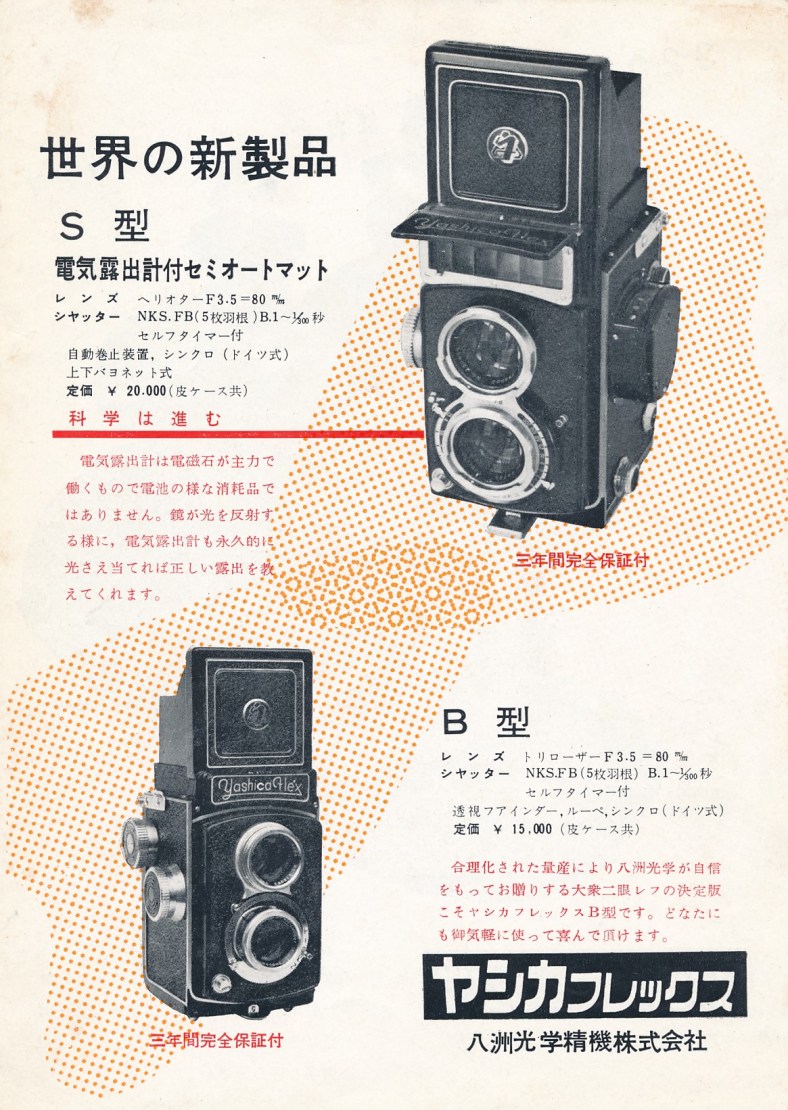
Super Rare Yashica Flex S Brochure… 1954

We’ve recently acquired a super rare (here in the US) Yashima sales flyer (pamphlet) that covers one of Yashima’s most advanced cameras at the time. The Yashica Flex S was the first TLR with an attached exposure meter in the world! The meter was made and supplied by Sekonic. And if you had great eyesight and were good with sliding scales, you could actually set the proper aperture and shutter speed for your film. Cool! Yashima-Yashica was the first to do it! One of our Yashica Flex S models has a working exposure meter even after six decades! Double cool!

img_20161129_0014

From 1954.

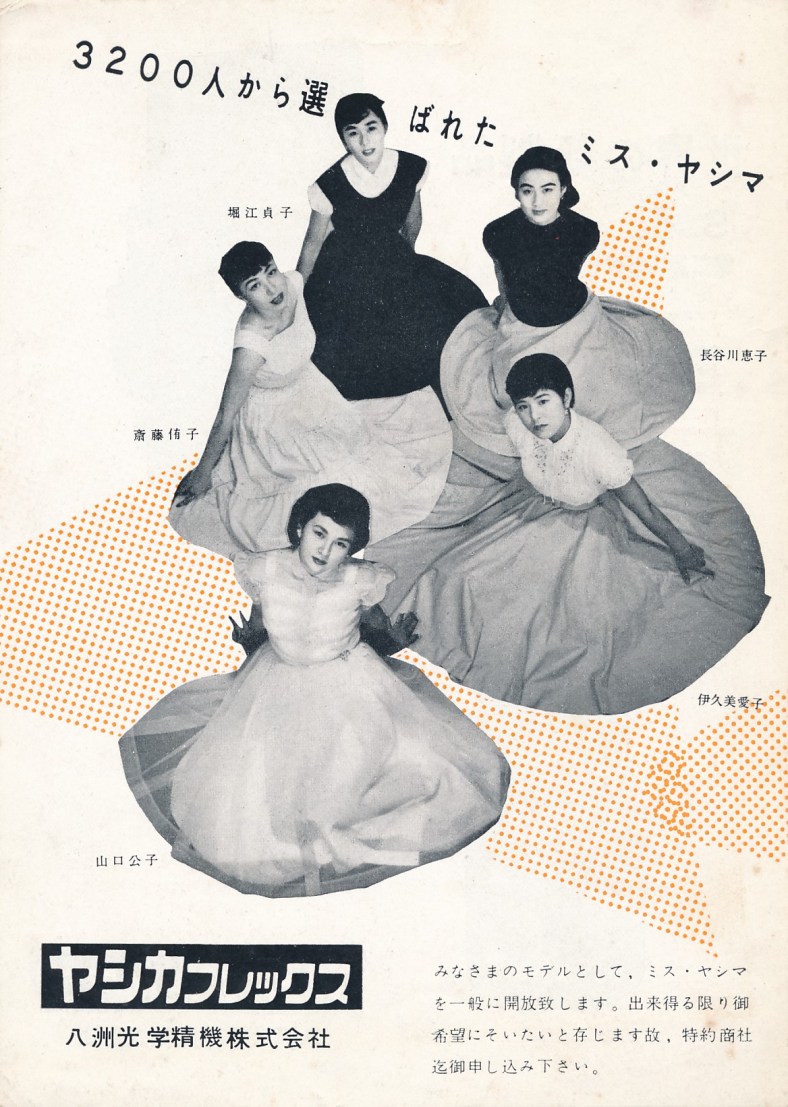
The next scan is the reverse side of the flyer and featured a contest!

img_20161129_0012

Out of 3,200 entrants these ladies were chosen to vie for the title of “Miss Yashima”. All you had to do was vote at your favorite trading company (camera store). We chose Miss Kimiko Yamaguchi (front left) as our Miss Yashima.

We hope you enjoyed these glimpses into Yashima-Yashica’s past. We like that we can share them. In the spirit of all things fair, we ask that you do not copy them or use them in another blog or post without asking for permission first.

Many thanks for your visit! Chris & Carol
Fujica ST701 Part 2… getting closer!

Definitely on our “to shoot with” list – and in the very near future we will! Now that the atmosphere in Florida has transitioned from nuclear hot to just a pleasant warmth, time to dust off the collection and put them to work.

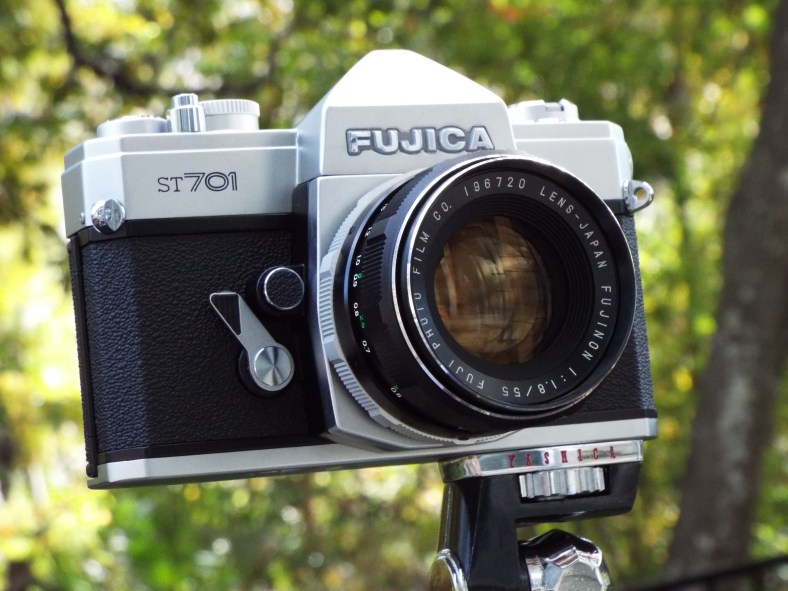
Here’s a nice ST701 from the Fuji Photo Film Company of Tokyo – no battery for the meter but on a nice sunny day who needs one! Seals are a bit of a mess so we’ll keep the bottom half of the case on for a little extra light tight security.

dscf3015

Our ST701 from 1971. About to get some field testing.

We’ve heard good things about the Fujinon 55mm – of course the fact that it’s a M42 mount helps too. Since we’re such big fans of everything Yashica, we naturally collect Fujifilm too because of the M42 connection. My very humble digital camera is a Fujifilm FinePix S9900W – it’s not going to blow the socks off the big boys but with 16 mp and a killer long-ass zoom it does pretty well.

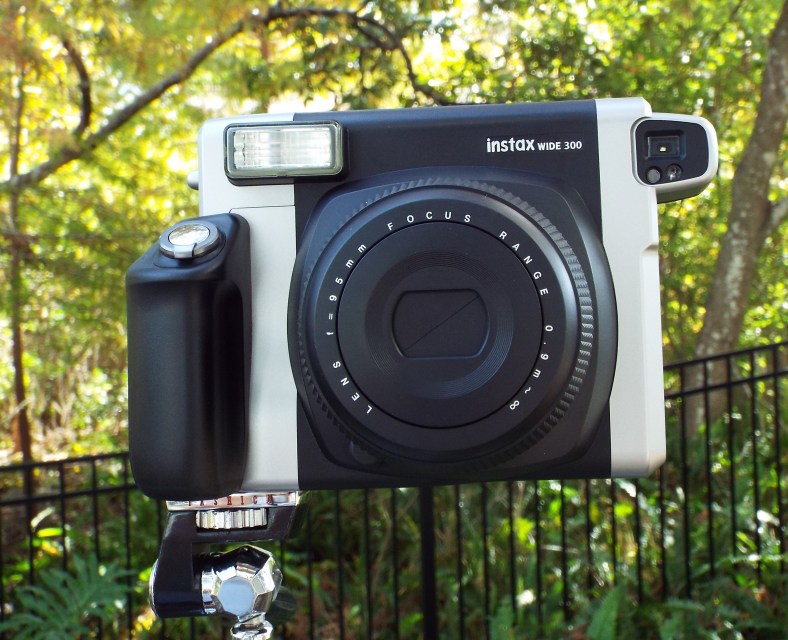
Another Fuji friend is our Instax Wide 300 instant camera. We occasionally enjoy a instant picture or two and we choose the Wide 300 for the extra image size over the credit card sized mini format. We’re waiting to see if Fujifilm will bring out some black and white Instax film for the Wide 300 especially since the B&W Instax mini format has been so well received.

dscf3019

Fujifilm Instax Wide 300. Lots of plastic but it gets the job done.

I’m (Chris) still spinning my wheels a bit with close-ups with the Wide 300 – so far the Fuji is 0 for 4 in that department. I’ll have to start using the close-up attachment and see what happens. The autofocus for close-ups needs full sun otherwise it defaults to what looks like infinity. I’ll get it.

Off to use some film…  ^.^

Thanks for your visit! C&C