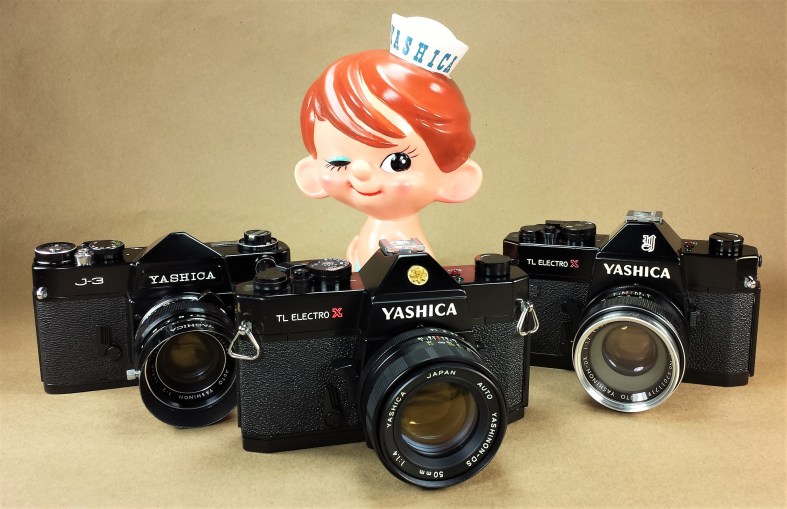
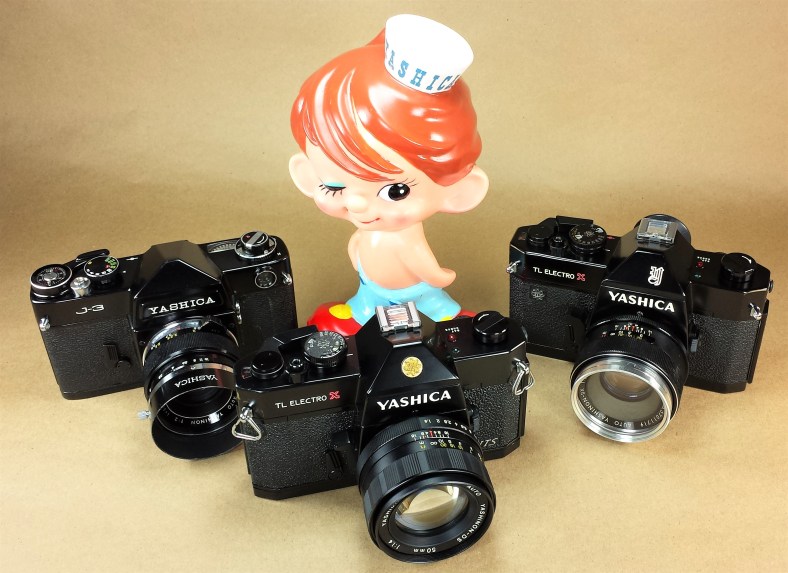
Yashica’s three finest cameras in black. The J-3 was the first truly modern 35mm SLR from Yashica and it was their first SLR to be made in pro-black with matching black lens. Only a small amount of the J-3s were black – most were the traditional silver top and black leatherette body. On the far right is the most successful SLR Yashica ever made. Fully loaded with electronic everything, all commanded by its ‘IC’ brain. The next step on the evolutionary ladder is the TL Electro X ‘ITS’ (center). A mostly marketing idea, the ITS was essentially the same camera as the TL Electro X with the added gold ‘Electron’ symbol on the front of the pentaprism and the stylized ITS emblazoned on the camera’s left front (not seen here but can be seen below). The marketing folks at Yashica never said what the ‘ITS’ stood for (if anything). Our best guess is ‘Integrated Technology System’. Some say ‘Interval Timed Shutter’ as the shutter was electronically controlled and could fire at any speed. Later the Contax-Yashica ‘RTS’ was introduced and it was advertised as ‘Real Time System’ whatever the heck that meant.
We’ve used all three, and the TL Electro X with the white stylized ‘Y’ on the pentaprism is our favorite. It just feels perfect in your hand and the electronic over and under (exposure) arrows in red are easily visible in the viewfinder.
By the way, the advertising icon (Yashica Sailor Boy) was never given a proper name by Yashica. He made his debut in 1962 and still could be found kicking around in sales brochures and ads into the late 1960s. This guy is the 20cm (10 inch) dealer display model and he was in his sealed bag and box from Modern Plastics of Japan when we acquired him. He comes in about 3 other sizes and different styles and colors.
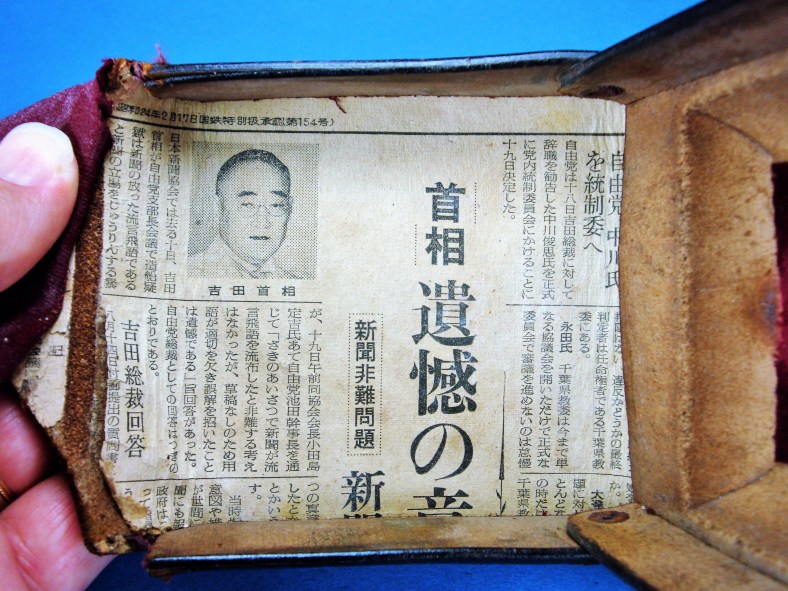
During a recent restoration of our 1955 Yashicaflex A-II twin-lens reflex camera, we discovered that the leather case held an interesting surprise!
The thread below is taken from our Flickr page (Yashica Sailor Boy).
Chris “As part of a restoration of my c1955 Yashima (Yashica) twin lens camera’s leather case, I discovered that the red felt material inside the case used backing made from Japanese newspapers! Leave it to the Japanese during the mid 1950’s to make good use of something that would normally have had one use and then thrown away here in the West. What really surprised me was how easy the felt pulled away from the newsprint without destroying the paper. I hope to get the writing translated… maybe some interesting clues as to where the case was made and when.”
Chris “The leather case was made for a Yashica Flex model A-II from 1955. The camera was purchased from a seller from Hiroshima, Japan. The camera was made in Tokyo and I am not sure if Yashima (Yashica) made their own leather cases or if they were made by a supplier. Maybe the newspaper will yield some clues as to where.”
Chris “I now know that it is a picture of Prime Minister Yoshida. This was a special edition newspaper made for (?) the Japanese National Railways (JNR). It appears that the paper is dated 17 February 1949. ‘Special Treated Approval Number 154 Issue’.”
Ken “The caption at the top actually records the newspaper’s national railways special handling permit #154, and does not identify the actual date of the issue in question. The article has to do with a controversy the prime minister created when he criticized a newspaper for allegedly spreading rumors about a political scandal concerning the shipbuilding industry. The scandal erupted in January 1954 and became one of the main causes of the fall of Yoshida’s government. It is not clear which newspaper this article comes from, but from the anti-government tone of the writing it is possibly the Asahi.”
Chris “Thank you so very much KenjiB_48. It helps to know this as it makes more sense for the Japanese company that made the leather case would have used a current (1955) newspaper for a camera made in 1955.”
The inside front of the leather case held a similar surprise. It would appear that in the mid 1950s, some Japanese manufacturers found ways of recycling almost everything produced. Used newspapers, I would think, could be had for free. Why not use them for backing the felt to the leather. Pretty smart!
Purchased new by us in 1977… wow, 40 years ago! It’s still going strong – the automatic exposure is accurate, the Canon electronic zoom lens is flawless, and all controls and gizmos are doing their things. Why? Well number one is it was designed and built super well and it uses readily available double A (AA ‘penlight’) batteries. No out of manufacture mercury batteries and their modern replacements to deal with! Thank you Canon!
The business side of this gem. It’s a TTL Servo EE electronic exposure system using still available Super 8 film. It operates like an SLR in the sense that you focus and adjust zoom and exposure through the lens. Canon’s 7-70mm f/ 1.4 Macro Zoom (10x) Lens C-8 is razor sharp and produces vivid colors and delivers exceptional contrast.
Macro capabilities are incredible – as close as 10mm from the front of the lens! Slow motion, fades, interval shooting and time lapse plus the ability to manually control the aperture!
The camera loaded with a Super 8 cartridge and the six AA batteries weighs in at nearly 2 kg! I can tell you that lugging it through Walt Disney World was no picnic… but fun!
Carol exploring her plants via the Canon AZ 1014. This is so 1977! Our home in Yokohama.
The photographer observed! The young lad was friendly and couldn’t figure out what in the world I was filming! Olongapo City, Philippines 1978.
Bug hunting in Yokohama… 1978.
Playing with the camera again makes me want to start filming again… well maybe not. 50 feet of Super 8 movie film disappears quickly and so does the money in your wallet. The camera is amazing but outdated – but, for the money, you can’t beat the quality of the Canon optics that cost thousands today.
Carol and I have so many cameras that we can’t ever use them all before we pass on. So we are documenting our cameras just before they go to auction via eBay and Etsy. So sad but the time’s come to thin out the heard.
Photographed with our Fujifilm FinePix S9900. Carol (photo by me) with my Canon F-1 and me (photo by Jim) was taken with some junky old Nikon! Can you imagine!
The Fujifilm GF670 Professional 6×7/6×6 dual-format folding camera is another shining example of Fujifilm’s unwavering commitment to preserving and nurturing the culture of photography. Designed with the traveling professional in mind, the GF670 is lightweight and sports a Gauss-type EBC Fujinon lens allowing the photographer to not compromise quality for ease of travel.
It’s amazing to think that Fujifilm USA recently found an undisclosed amount of these beautiful cameras in their warehouse. They were then sold (as best as I can tell) to B&H in New York for sale to the public. It looks like the first guess pricing was around $1899 then quickly up to $1999 and now on B&H’s site they’re at $2199 or so. They’re taking pre-orders now with availability in February. Released in early 2009? and discontinued in 2014. I would love to be able to put one of these in our collection – but it’s not gonna happen!
Just back from the Fujica’s first photo assignment in the US. What a simple and fun camera to use! The viewfinder (rangefinder) is super bright and big! It made it easy to compose my images and focus.
Yeah the leaf shutter going off isn’t going to get a bunch of oohs and ahhs from the crowd – it works and that’s what matters. The shutter sounds just like our Fujipet from 1958. Stay with what you know Fuji Photo!
It took up the entire camera bag! I only had room for some lens wipes and the lens cap. Just back from its test shots.
The camera did draw some attention from the tourists that were downtown. It’s fun to answer their questions about film vs. digital (we love both) and the most common question – why would you take pictures with such an old camera? The weather was gorgeous too today – bright blue sky and and plenty of strong Florida sunshine. It took no time for me to burn through the 8 exposures!
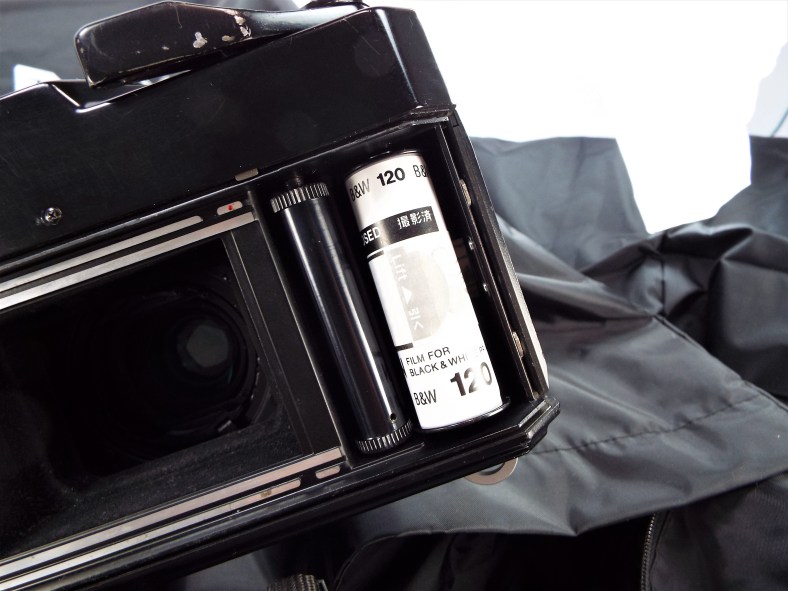
When I advanced the film after exposure number 8, it took only 5 strokes (maybe only 4) of the film advance lever to free the film fully from the supply roll. Thinking that I’d better be cautious, I decided to remove the film in my dark bag at home.
All went well in the dark bag. The roll had properly wound itself.
We wish Fujifilm still made Neopan 400.
Now that the first part of the test is done, time to send off the roll to ‘The Darkroom’ for processing and digital scans. We should see something online from them by late Friday afternoon (it’s Tuesday now). Time to head to the post office!
Check back soon to see the finished results. Thanks for your visit!
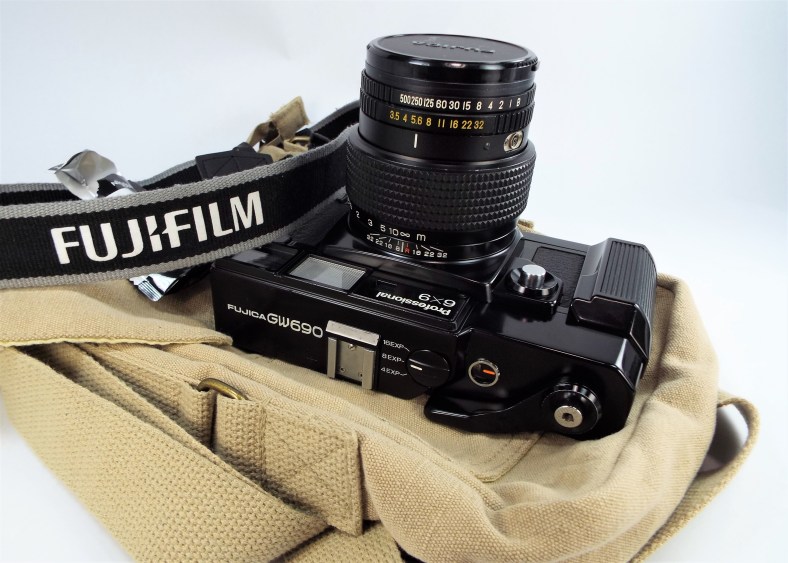
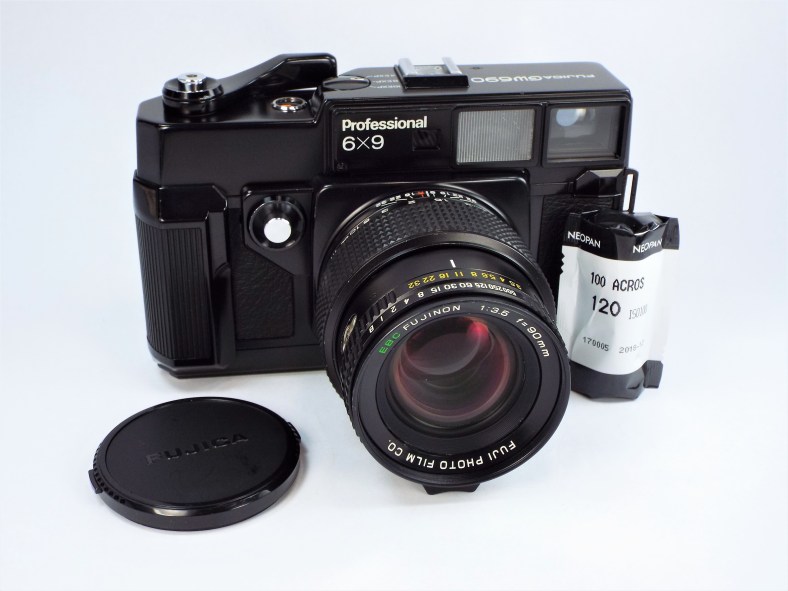
Fujica GW690 Professional – 1978 version. Yes it’s big. Yes it’s a bit heavy too. But who doesn’t love big 6x9cm negatives! We had an Asahi Pentax 6×7 SLR for a while in our active collection and thoroughly enjoyed the images it produced. The 6×7 and 6×9 in our opinion are great formats. We still shoot in squares though – it’s fun to compose a 6×6 frame on a twin-lens reflex. If anything will slow your photography down it’s that.
This camera arrived yesterday and it’s all cleaned up and ready to go. This is a heavily used (think venerable workhorse) GW690 with all sorts of dings, dents and scrapes to show for it’s almost four decades of use. We imagine it’s seen more than a few tour groups in its time – now it’s time to slow down a bit. We purchased it to be a user camera for some fine art prints we want to create and sell on our online site. We normally print on 8.5 x 11 inch Canon paper with an occasional bump to 13 x 19 inches and the 6×9 format is perfect.
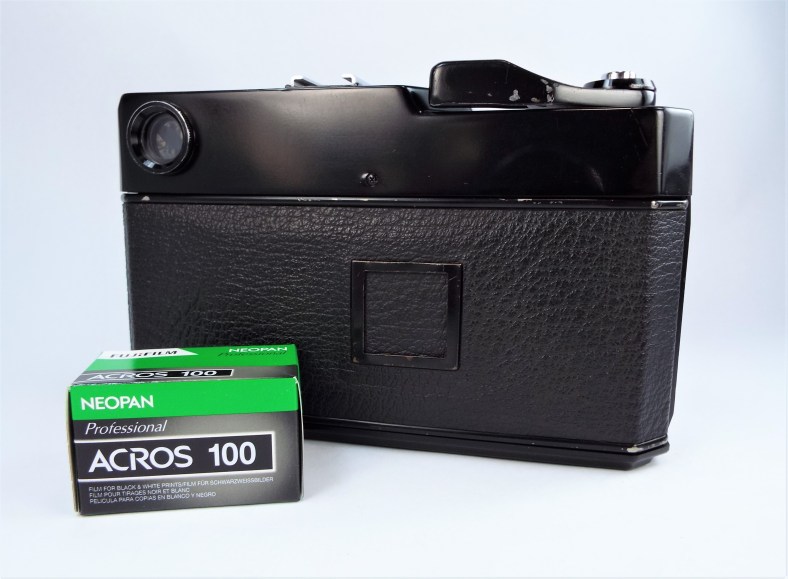
We’re big fans of Fuji cameras and this one will earn its keep in our studio. I’m headed out this afternoon with a roll of Fujifilm Neopan 100 Acros loaded to test it out.
It’s a simple camera – completely analog. No onboard exposure meter, no auto film advance, no auto focus – just what we wanted.
We chose the GW690 vice the “newer” models (II and III) because I’m not a big fan of the built-in lens hood on the later models (gets in the way). The shutter settings (leaf shutter) and aperture settings are right next to one another which makes it super easy to see the relationship each has on the other. Focusing is quick on this model and the rangefinder window is bright and easy to see.
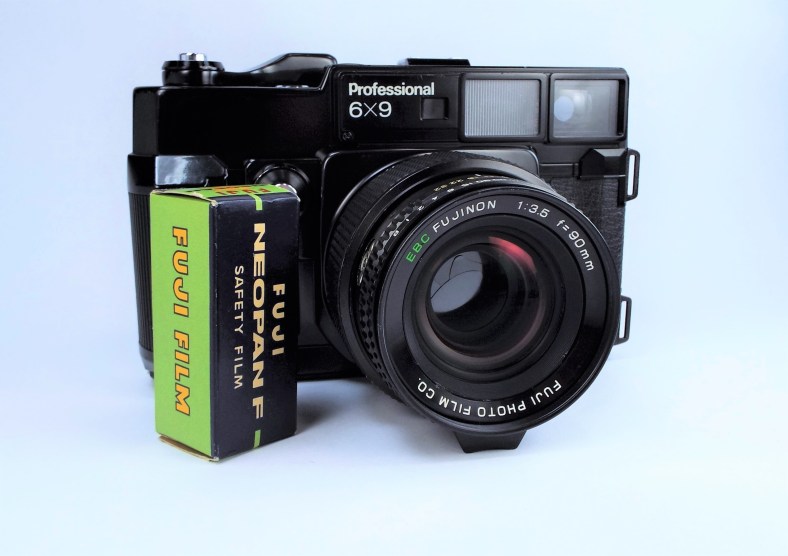
A 35mm box of film gives you a comparison to just how big the Fujica is. By the way, this model was the last to be called a Fujica.
Ready to rock some Neopan!
We thought it would look good with some vintage Fuji Film beside it. The film expired in 1964!
We’ll have the results next week as we send our film out to ‘The Darkroom’ for their professional development and scans. 6×9 on 120 roll film produces only 8 exposures so I should be able to shoot in one afternoon. Let’s see… with the purchase of the film, processing and shipping it’s going to cost about $25 per 8 images. Yikes!
Oil refinery as seen from the hill behind our house in Naka-ku, Honmoku, Yokohama. Canon F-1 (1978 version) with Canon FD 80-200mm f/4 zoom lens on Kodak Ektachrome at about 5 seconds at f/16. As best as we can tell, the refinery is still there today.
Memories of our time in Japan – 1977 to 1980. We lived in Yokohama, Naka-ku. Lovely place. Wonderful people. Every day an adventure. As I read current blogs from Japan, it strikes me that so many signs are now in English. Back in the day (as they say) that wasn’t the case. These two signs were within walking distance of major U.S. Navy installations. No English. No problem. I’m sorry to say that we never learned to read kanji or katakana but we at least learned what the kanji characters looked like for where we wanted to be.
Yokosuka train station, Keihin Kyuko Line schedule heading north to Yokohama.
I always tried for the “green” trains at 15, 35 and 55 after the hour. These were the fastest to Yoko!
Waiting for Bus 8 to Yokohama train station. We knew to look for the kanji character that looked like an old style camera on a tripod as that was Yokohama. Hey it worked!
Bus driver giving me the look.
This was the only sign that I can remember that had English on it near our house in Yokohama. BTW, it was a hot, hazy and humid summer day on the Kanto Plain that day.
Anyway, no complaints here, but as you can see not much in the way of English (none actually). That was Japan in the late 1970s. We had a blast!
Some time ago we purchased (through an online auction) what was listed as a rare black body Yashica J-5. The camera was sold by a well known camera dealer with a long track record of excellent prior sales. We know from our research and hands-on experience that Yashica’s first ‘Pro-Black’ 35mm SLR was the J-3 as we own two of them and have sold others that were in our collection.
I (Chris) knew that there was about a 99% chance that this J-5 was faked and I don’t have a problem with buying modified or restored cameras as long as it is disclosed as such. But I took a chance on this one even though there were numerous red flags about its originality. The bidding was through an online auction site in another country and my desire to own this ‘rare’ camera got the best of me. My purchase bid went for much more than a typical J-5 should go for and I actually paid more for it (not including the over-the-top shipping fees) than one would pay for a genuine ‘Pro-Black’ body (from the Yashica factory) J-3. In our years of research, we’ve never come across anything in print from Yashica about the black body J-3. No sales brochures (Japanese or English) have a mention of it – but we know that they did produce one a we’ve had a few and have kept track of them online in our database.
Prior to bidding on the faked black J-5, I asked the agent representing this camera if in fact was a genuine, previously unknown black J-5. His answer was that the seller said it was… no worries.
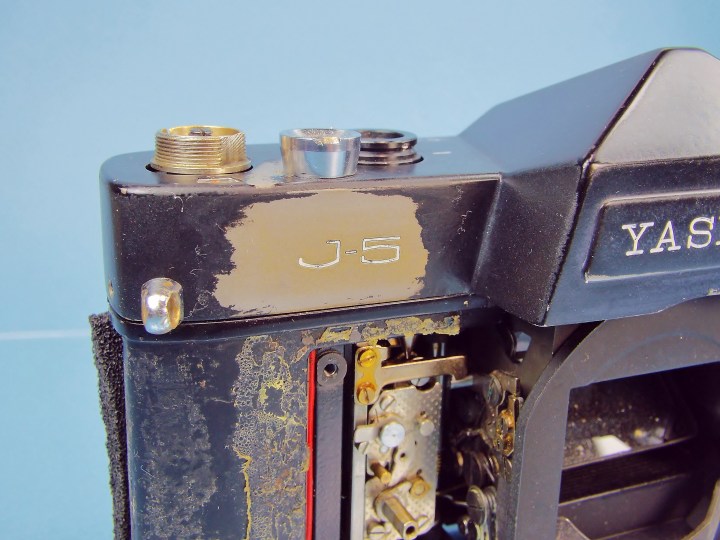
After looking at my new fake for some two years now, I’ve decided to remove the still fresh black enamel paint and reveal the satin chrome paint underneath its black mask. It was shocking just how easy the paint was to remove with alcohol and cotton swabs.
I wrote to the seller’s agent to complain that the camera was in fact faked and after some time (2 weeks) he came back with a no it wasn’t. Even with the pictures in front of them they denied that it was a re-paint. Oh well.
Clue number 1 – the presence of orange peel in the black paint.
As received from the auction. From a distance it looked to be all original. When I opened the shipping box the first time I could tell something wasn’t right, the smell of fresh paint! Got me!
As you can now plainly see, the original satin chrome (silver) body is now exposed and in this image the orange peel black enamel paint is obvious – especially around the ‘YASHICA’. The leatherette has been removed by me and the residual adhesive remains visible at this point of the discovery phase.Upon closer inspection (now that the black is gone) it appears that the original satin chrome (silver) factory finish was heavily sanded almost to the point of the brass showing through. The black enamel comes off super easy with 91% isopropyl alcohol and a cotton swab. For some strange reason, the factory etching of the J-5 logo was filled-in with white paint before it was buried under the black. Silver body Yashicas were filled-in with black from the factory.Another view (right rear of the body) of the original factory finish underneath the faked black top coat.It will take a bunch of cotton swabs and plenty of isopropyl alcohol to rid this J-5 of its black top-coat.
So lesson learned for me… only trust in what you know exists… if it’s not documented elsewhere as existing then there’s a good chance it’s been faked. Ask lots of questions. But, and it’s a big but (pardon the pun), Yashica has never mentioned that they made a black body J-3 in 1963 so it was possible that they made a few black J-5s.
The good news in all of this is that this camera is now in the home stretch of a complete rebuild and will be better than ever. It has been re-imagined as a tribute camera to the U.S. Navy. Stay tuned!


 Manuals & Brochures