Fujicaflex Automat – Fuji Photo Film’s 1st TLR – 1954

Vintage camera wish list item 101.

The Fuji Photo Film Co., Ltd., Fujicaflex 

フジカフレックス

Designed to incorporate the best features that were available in the medium format twin-lens reflex camera market, the Fujicaflex debuted in 1954 – at a very premium price, we might add. While surfing today, we stumbled upon this wonderful site from Fujifilm Europe. You can check it out here

It’s nice to see a large corporation like Fujifilm blog about some of the really cool cameras that helped make their company great. In another blog, they go on to talk about the amazing Fujipet from 1957.

Twin-Reflex-Cam-433x375

For more about this wonderful camera, take a trip here too to see Mr. Yoshinobu Koyasu’s camera collection… it is not to be missed!

It’s certainly interesting to read (Fujifilm Europe’s blog) – the older posts that pay tribute to the cameras of their roots are so interesting.

43736184315_b71cdcee7d_o

My Fujicaflex acquired in 2018 from a collector in Thailand. Finally!

Thanks for stopping by! – Chris

Please stop by my camera shop at http://www.ccstudio2380.com


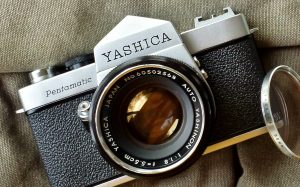
Pentamatic S on a walkabout.

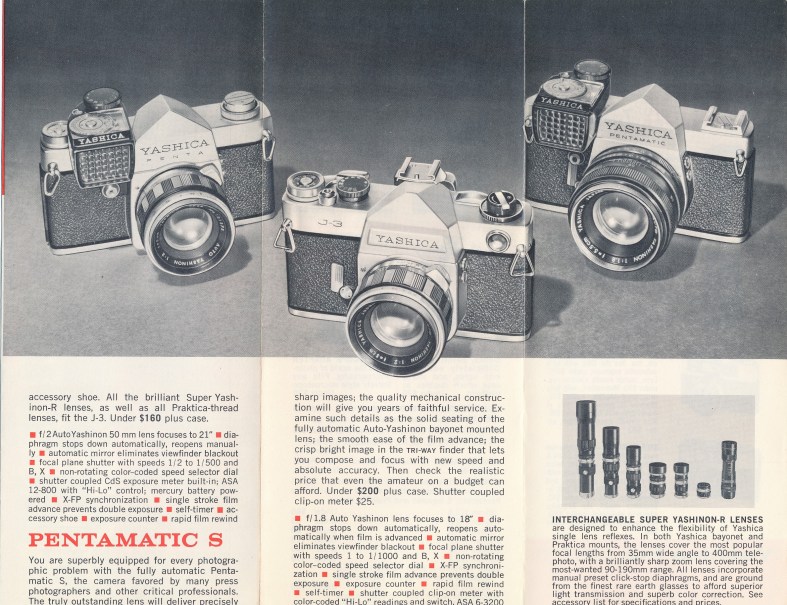
Here’s one of our nicer S models outfitted with the “no name” add on light meter (clip on exposure meter) from Yashica.

20186770749_3906ae1138_o

Another in Yashica’s short lived series of the Pentamatic 35mm SLR. This one c1961. Yashica’s first SLRs had a steep learning curve for the company. Groundbreaking for Yashica to be sure but a miss overall against the competition. Yashica’s best was still to come. We happen to appreciate the rock solid construction of this often overlooked camera… the Tomioka Optical “normal” lens focal length of 5.8cm was a bit odd but the bayonet mount lenses were sharp and attached very solidly to the body. This was not the lens that was supplied with the S – Yashica went back to the 5.5cm, f/1.8 lens. No batteries needed for either the camera or meter.

20150110_153411

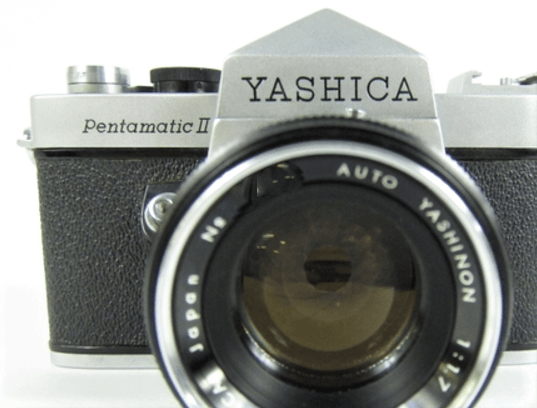
The Pentamatic S wasn’t made in large quantities over a long period of time. Nice working examples are still available and some very nice collector quality examples are still out there. You are much more likely to find a Pentamatic S for sale than a Pentamatic II – probably by a 4 to 1 margin.

Happy hunting!

Chris

Recent Pentamatic Auction Action

As you know, here on the Fanatic we are constantly searching for new and exciting Yashica Pentamatic gear that becomes available on various collector auction sites. Here are some interesting pieces that sold recently.

First up this little gem! Unloved but working well, this ugly duck sold for just $12… shipping included! Turns out to be fully working with super nice glass and clean guts. It was made (the body) in June of 1960 and is the 5,843rd Pentamatic to roll off the factory floor.

s-l1600 (16)

From June 1960. It cleaned up rather nicely. (here still dirty)

Tominon lenses were hot on the auction block – here’s what appears to be a new in the box (unverified) Tominon 10cm, f/2.8 lens with a sharp looking box.

s-l1600 (10)

Very low serial number on this beautiful lens… 336!

Very nice looking original box with what looks like a complete set. This brought a solid $250 at auction. Not bad if it’s really unused and has no issues.

s-l1600 (11)

And here’s another Tominon 10cm, f/2.8 lens mated with a good looking body. This lens is a tad newer (serial number wise) than the one above but still a low number… 611

s-l1600 (12)

The body was made in January of 1960 so it’s part of the first wave of Pentamatics to come off the line. It has the honor of being only the 669th made since December 1959 (when the P1 was first built).

s-l1600 (13)

This combo did well at auction with aggressive bidding by many bidders. It brought just over $300! Not bad for such a nice early set.

So there you have it. From $12 to over $300… a busy period for the Pentamatic.

Thanks for your visit!

Chris

Canon Sure Shot Zoom S – S AF (1989)

Part of the “Modern Classics” series of our collection. This one is from mid 1993. One of the more sophisticated AF point and shoot (click) plastic fantastic 35mm cameras of the 1990s. There were two versions of this camera – this one, the Sure Shot Zoom S and the Sure Shot Caption Zoom (with removable remote control).

DSCF5531

As released from the factory – still new in the box.

The zooming range covers 38-60mm. Other features include auto focus, auto film load, advance wind, auto flash and auto macro. Canon claims it has an improved autofocus control – ‘Evaluative Active System’  that looks at the entire frame and recognizes the main subject based on its distance to the camera (sounds pretty standard to me). Anyway they made a big deal about it in the owner’s manual.

DSCF5543

The Canon lens is Spectra-coated and is constructed with 6 elements in 6 groups. I assume it’s glass.

Canon recommends using DX-coded film. The camera automatically sets ISO 50-3200. Non DX-coded film will set to ISO 100.

DSCF5541

Well placed shutter release button and large LCD. The auto flash feature can be turned off. What I found surprising was that there was no “Red Eye” reduction system available. Probably too early for that.

The Canon Sure Shot Zoom S features a 3-zone metering, AE programmed system that focuses from about 60cm to infinity. It uses one 6V lithium battery (2CR5) which is still readily available (I just purchased one for $7 with free shipping).

DSCF5540

Nice centered viewfinder that is bright and well marked. Super simple back with easy to find and use on-off button.

DSCF5544

The TILT lever is pretty cool – it has two positions when you pull it out. When setting the camera down on a flat surface (like a table) for taking selfies, it tilts the camera slightly upward so as not to get the table or whatever in the pic.

The camera is large for a point and shoot – weighs in at 384 grams with the battery and compared to the 1980 model Canon A-1 35mm SLR, almost as large!

DSCF5548

The Sure Shot is a large camera – it fits very nicely in my hands and feels solid. The buttons are all recessed so it does take a bit of finger olympics to push them all the way in. By the way, the A-1 with my FD 24mm lens weighs in at 934 grams!

DSCF5537

As you hear us say all the time, if you want to collect modern film cameras from the 1980s and 1990s, the best way is if you can find a complete original set, new in the box. Why not if they’re still out there and available. They don’t make them anymore and some of these cameras are quite capable of outstanding images – some would spend crazy money on the more well known cameras for almost unnoticeable differences in the final image (especially since most people don’t enlarge and print images anymore) and scanned to a PC they’ll look just fine on a high quality monitor.

Pick up one of these Sure Shots and I’m sure you’ll be impressed with it.

Studio Camera: Fujifilm FinePix S9900W

Chris

Yashica Half 17 – Classic mid 1960s design

Many thanks to our friend and fellow blogger Peggy at Camera Go Camera for sending us this wonderful classic Yashica. It needs a little work on the slower shutter speeds but it’s super clean and a fun sized camera to boot. We look forward to running a roll through it soon.

DSCF5526

Being a half frame 35mm camera means that you can get up to 72 exposures from a standard 36 exposure film cartridge!

DSCF5528

One of the more unique and modern looking Yashica logos. We like it better than the western style font that Yashica used for years.

DSCF5516

Certainly a nice camera to add any collection of 1960s 35mm cameras. It has such smooth lines and an exceptionally nice finish to the satin chrome.

Studio Camera: Fujifilm FinePix S9900W

Chris

Yashica-A: Collecting 101*

*Or how to run out of space for it all real quick!

As much as Carol and I would love to go on collecting camera sets, the cameras will eventually win out! Even when we narrow our collecting to let’s say only twin-lens reflex cameras made in the mid 1950s, and only made by Yashima-Yashica, we’d still run out of space and money. There were just too many made (obviously) to be able to collect all the different models and all the different variations. Yashima-Yashica was, by far, the most prolific TLR maker – ever! I believe they finally stopped by 1986 which was long after TLRs fell from favor!

So we’ve reached the point they sing about in that Disney movie – “Let it Go”! 

Collecting Yashima-Yashica cameras is a very satisfying endeavor. We’ve been at it for decades, we know. There’s enough of them around so the choices are plenty – but since Yashicas were built well but built for the masses, they weren’t collected when they were new. Most that are available are well used. They’re still very functional, but well used nonetheless. So if you’re trying to collect complete sets just as they came from the factory, and you want them to work and be in mint (or near mint) condition, good luck! It’s not like collecting Leicas, Nikons, Canons or Rolleis where when you google “nikon mint box” you end up with hundreds to pick from from all across the web. Google “mint yashica box” and you’ll see maybe a dozen of Yashica’s last TLR – the Mat 124G. A great camera but it’s common. The early stuff from Yashima-Yashica, well that’s a whole different ballgame, and that ballgame is fun!

DSCF5446

This one is from 1957,  made by Yashima Optical – the Yashica-A

DSCF5448

Solidly built and well maintained.

DSCF5457

All the factory goodies.

DSCF5453

“Fall out of bed” easy to operate – shoot 6x6cm negatives or color slide film soon after loading it. Great optics, accurate shutter and bright viewing screen.

DSCF5454

Yashimar f/ 3.5, 80mm lenses made by Tomioka Optical.

The Yashica-A is a great medium format camera. Simple to use and produces super sharp, large images that you’ll be amazed came from your hands. Why is the A the best? This one is 6 decades old and works perfectly. Why? Virtually nothing on it to break or jam. Simple winding knob, no self-timer and black yarn light seals that never fail. No built-in light meter (use a phone app) or use a vintage hand held meter or guess at the exposure or learn the “Sunny-16” rule. You almost have to try to make a bad image with a camera like this. Worried about the reversed image in the viewing hood? You’ll get over it quickly and you’ll soon love composing and shooting in the square format (6 x 6).

This model A (remember, “Let it Go”) is available for purchase. If you have an interest, contact us at chriscarol@ccstudio2380.com or visit us at http://www.ccstudio2380.com

If there’s something that you’re looking for maybe we have it or can find one for you. You never know!

Thanks for stopping by!

Studio Camera: Fujifilm FinePix S9900W

Chris


Pentamatic vs. Pentamatic S – Yashica’s Heavyweights

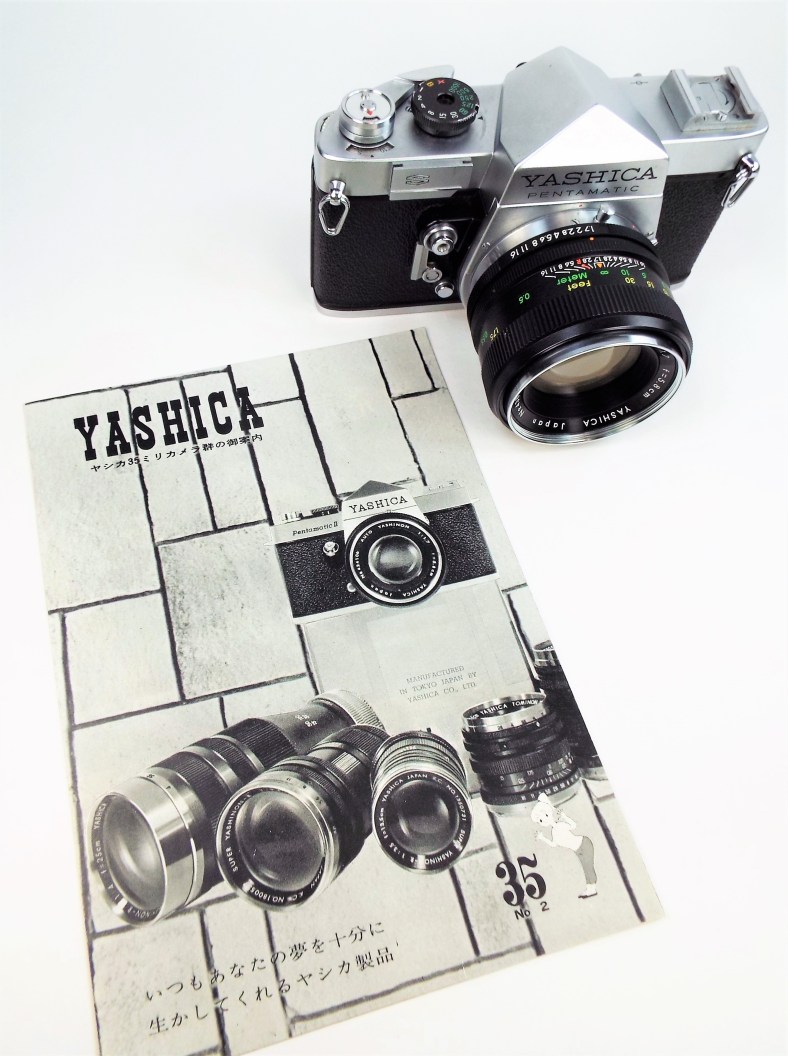
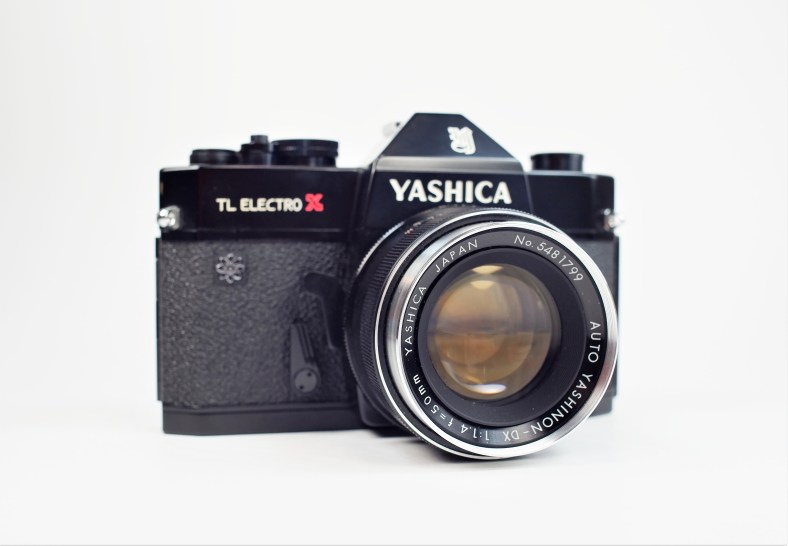
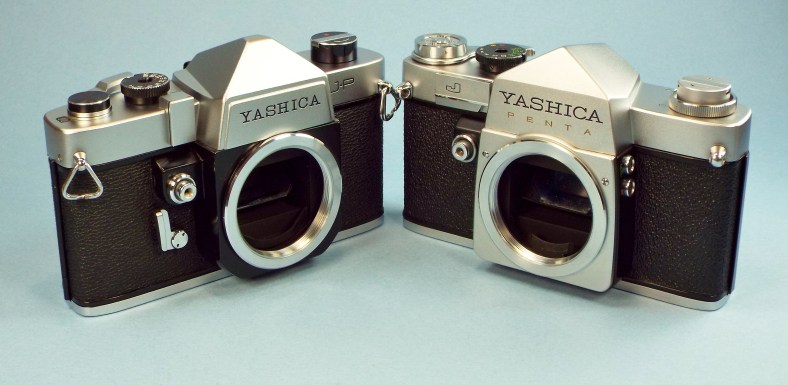
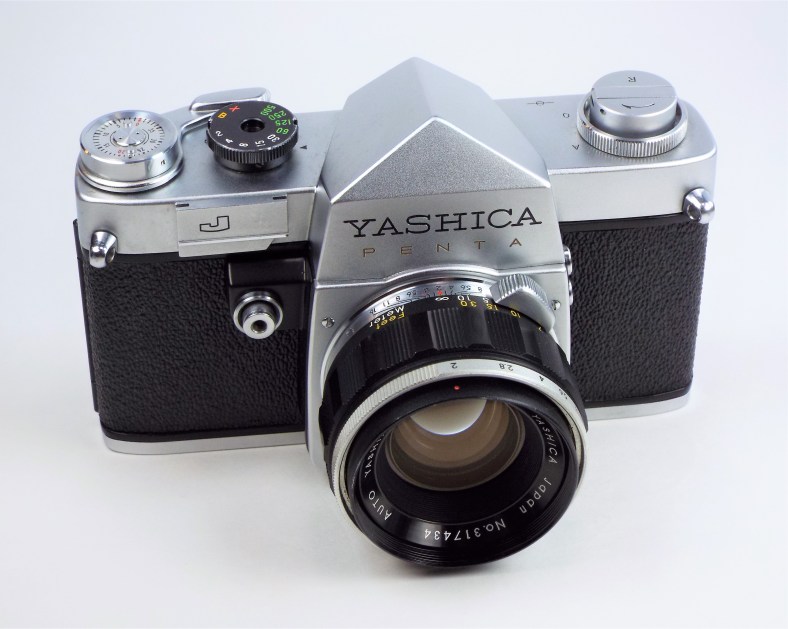
The Pentamatic was Yashica’s first single-lens reflex (SLR) and was released in 1960 (May-June) timeframe. The Pentamatic S was released about mid to late 1961. Not much changed between the two – the S model added a built-in self-timer and most notably, a provision for mounting an exposure meter to the top right of the camera that coupled with the shutter speed dial. Other small changes were to add lugs for holding the neck strap (moving them from the extreme right and left sides of the body on the Pentamatic to a more typical front mounting on the S). Unseen from the exterior is a change to the focusing screen inside the pentaprism. The original fresnel screen in the Pentamatic was replaced with a split image screen in the model S. For me, that change makes the Pentamatic S much easier to focus and improves the brightness inside the viewfinder.

A look at both models shows these changes and the tiny bit of extra weight that the S carries over the original Pentamatic.

DSCF5402

At 978 grams, the original Pentamatic is anything but a lightweight. (2.16 lbs)

DSCF5403

At 1,004 grams, the S shows the slight weight increase from the changes made between the two models. (2.21 lbs)

Both cameras are photographed with the same lens attached – Auto Yashinon 5.5cm f1.8 lens which was the standard lens that came with both models. Only the Pentamatic II (released in September 1960) came with a different lens. (5.8cm f1.7)

Compared to other SLRs from the same time period, the Pentamatic was a bit of a beast to tote around. The buying public never embraced these wonderful cameras and they ended their production run in less than 2 years.

Finding good looking (and still working) Pentamatics is a challenge for any collector with the Pentamatic II being especially difficult to find in any condition.

Of note, if you have an Asahi Pentax, Nikon F or Canoflex camera with the standard lenses from the late 1950s or early 1960s, we would love for you to let us know what their combined weight is. We could be way off in our assumption that the Pentamatic was significantly heavier than the other cameras of that era. Thanks!

Studio Camera: Fujifilm FinePix S9900W

Chris

Yashica’s YT-300 Transistor Radio – 1960

Yashica produced more than just cameras during its boom years. As a leader in the field of electronic photography in the middle to late 1960s, Yashica’s early electronic devices ranged from such diverse items as transistor radios, record players, movie projectors, calculators, editing equipment and tape recorders to name but a few.

Most of the earliest electronic devices are rather rare now (as one would expect after 50 years) and only occasionally does something come up in auctions both on the web and in estate sales. I suspect that the more common electrical items such as projectors and editing equipment are still flooding eBay and other on-line auction sites.

Finding early radios such as the YT-300 and YT-100 is quite difficult. Here we share some of what we’ve been able to collect over the years.

20150716_203028_Richtone(HDR)

Yashica YT-300 Radio Brochure

20150726_120249_Richtone(HDR)

20150726_115718_Richtone(HDR)

20160113_213553

20150717_152009_Richtone(HDR)

Thanks for your visit! If you come across a working Yashica radio or tape recorder snag it! They’re really rare and a fun little reminder of the first transistor radios and how cool they were.

Studio Camera: Samsung Galaxy S4

Chris

Fun with Fuji’s K-28 “Construction Camera”

Here’s a camera you don’t see often – maybe never – Fuji Photo Film Japan’s Fuji K-28. A waterproof and dust/dirtproof 35mm compact camera. Designed for rugged use like on a jobsite or in the rain. All of the controls are sealed against the elements via tight fitting rubber gaskets and secure latching systems.

The camera gets its power from 2 AA LR6 alkaline manganese batteries. Here’s an interesting note from Fujifilm Japan: 

Apologies and Requests
Fujifilm “Construction Camera” For Customers

By the way, when the capacity of the batteries is not complete (for example, when new alkaline batteries are used with used alkaline batteries) in part of “construction camera” we sell at this time. It is extremely rare that hydrogen gas is sometimes released from the battery, the gas mixes with the air inside the camera, and it turned out that there was a possibility that the back cover of the camera could come off with a sound when using the strobe . December 8, 2000 – We would like to thank our customers for their continued patronage and appreciate their continued patronage.

Fuji Photo Film Co., Ltd

DSCF5375

Besides being a way cool looking camera, this Fuji is more than capable where it counts. A sealed Fujinon f3.9 28mm lens with adjustable focusing and auto exposure with a set 1/100th of a second shutter. ISO auto set for film rated from ISO 100-400.

DSCF5371

DSCF5373

The Fujinon lens has 5 elements in 5 groups – closest focusing is 0.75m and the front glass is 4mm thick. The camera weighs in at 423g  and 467g with batteries.

DSCF5376

The focus scale is only in meters. The flash must be turned on via the well marked lever (center), film advance is manual by the lever on the camera’s right side and the shutter can be locked to prevent accidental exposures. The film rewind lever (left) gets tucked away to prevent damage and to help seal the top of the camera.

DSCF5377

DSCF5379

DSCF5391

Looks great in B&W!

DSCF5389

Nice lines.

DSCF5385

DSCF5386

DSCF5388

When the K-28 was released in June of 1991, the yen to dollar exchange rate was 138 JPY to the USD. So it listed for around $215 but was not for sale outside of Japan.

The K-28 certainly will hold a spot in our Fuji collection as it is basically brand new and in mint condition. The box, although a silly thing, is important to our collection as we like to collect camera sets as complete as possible. Besides, who wouldn’t want a bulldozer on their camera box!

If you find something incorrect in our post, please feel free to let us know what it is and we’ll gladly correct it.

Thanks for stopping by!

Studio Camera: Fujifilm FinePix S9900W

Chris