Who IS this guy? Part 2

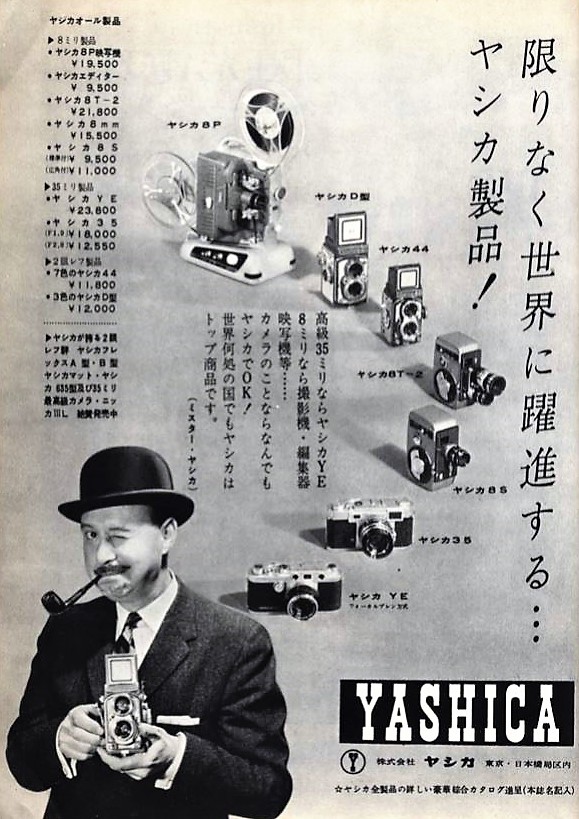
Yashica Guy Ad 22

Yashica advertisement from 1959.

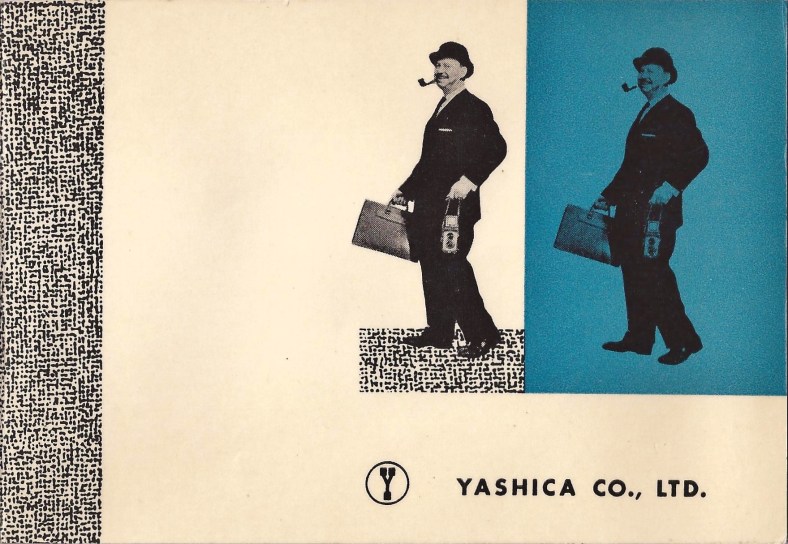
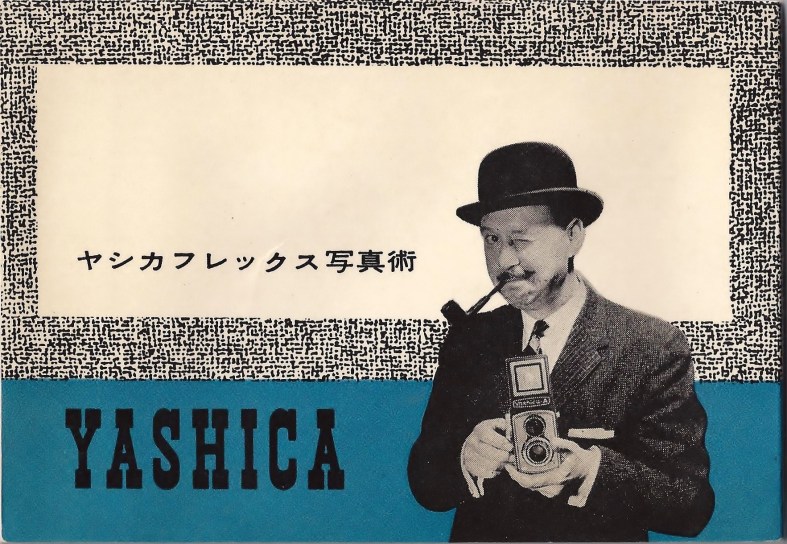
In a previous post, I had asked who this gentleman was since he appears in a few ads from this period and has appeared on the cover of a Yashica camera instruction booklet.

Yas Guy 1

Same image as above except this time in color.

Yas Guy 2

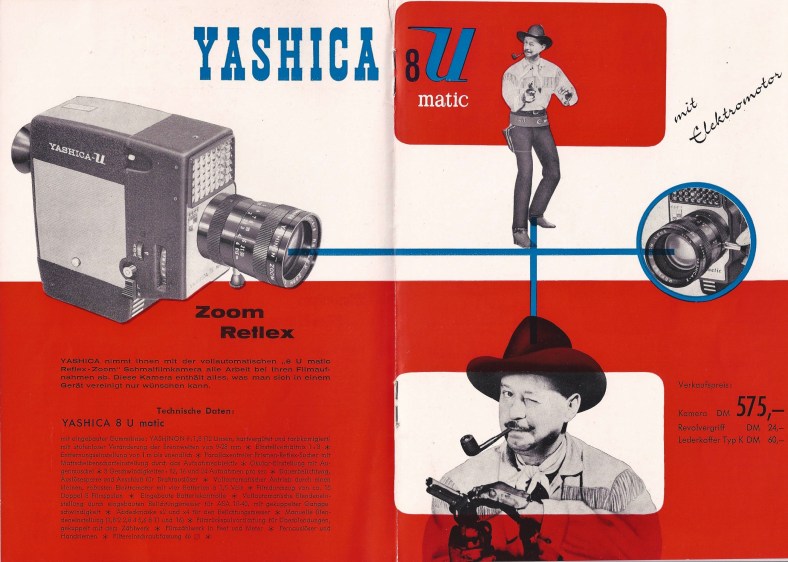
Now dressed as a “cowboy”. Same time period, late 1959. Sales brochure in German.

Yas Guy 3

My first thought was that he was a television star or movie star of some note but no solid leads.

Apparently, the bowler hat, pipe, and wink are all part of his act.

Thanks for stopping by! – Chris

Please respect that all content, including photos and text, are the property of this blog and its owner, Yashica Pentamatic Fanatic, Yashica Sailor Boy, Yashica Chris.

Copyright © 2015-2019 Yashica Pentamatic Fanatic, Chris Whelan
All rights reserved.

Happy SUNday! – Shea Stadium August 19, 1972

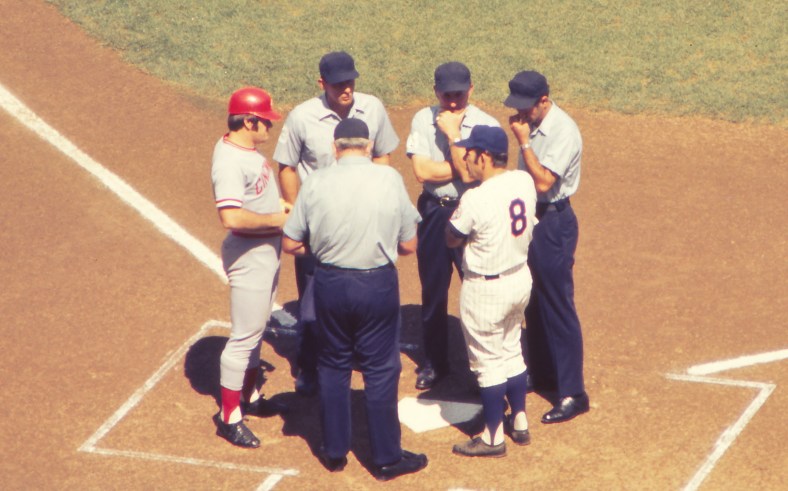
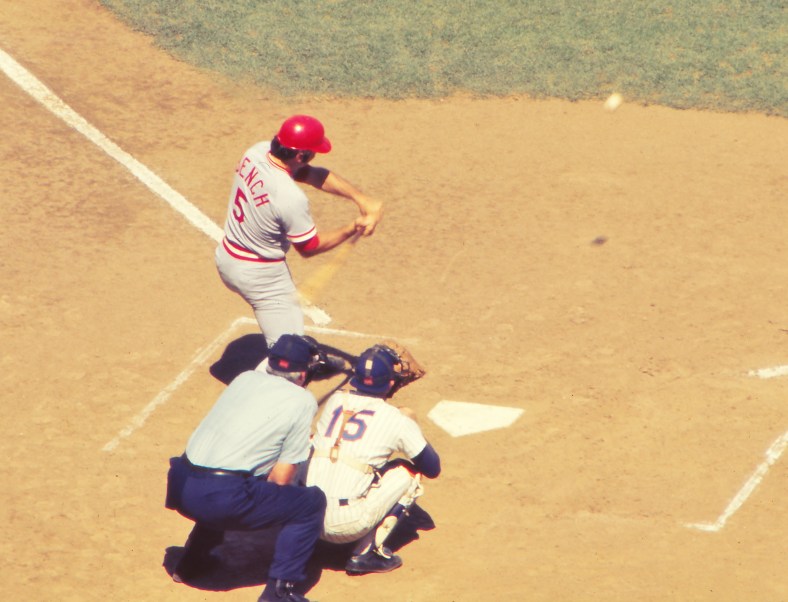
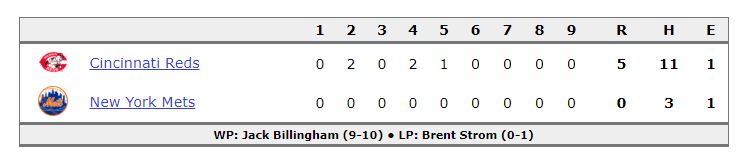
New York Mets vs. Cincinnati Reds at Shea Stadium, Flushing, New York. A Saturday afternoon game on August 19, 1972, with a crowd of 43,257 fans. The Mets lost 5-0 to the Reds.

47 years ago almost to the day.

Mets Aug 1972 Yogi

(L-R) Pete Rose LF, Tom Gorman Home Plate Umpire, Yogi Berra Manager, Chris Pelekoudas 1B, Nick Colosi 2B, Andy Olsen 3B.

Tom Seaver

The GREAT Tom Seaver hitting flies to the outfielders before the start of the game during warmups.

Johnny Bench

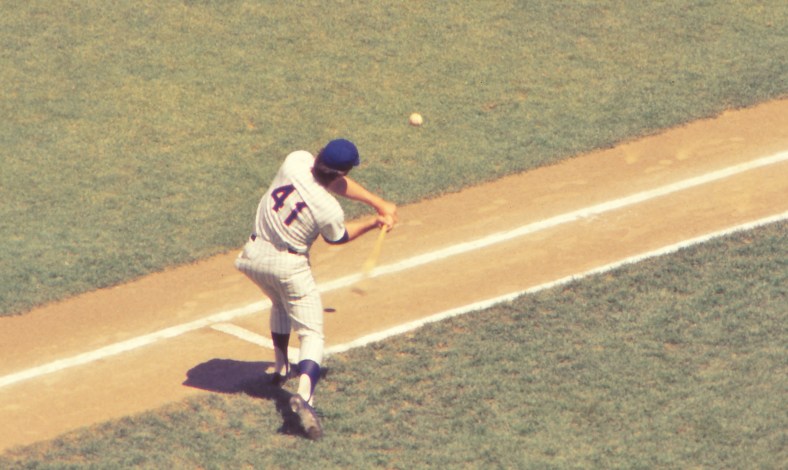
The great Johnny Bench takes a mighty home run swing. He did hit a home run that game (#27) and was playing right field. The GREAT Jerry Grote is catching for the Mets.

All pics were taken by me with my trusty Yashica TL Electro-X 35mm SLR on Kodak Ektachrome 64 color slide film. I was using a 2x teleconverter on my 50mm Auto Yashinon lens.

The high temperature was 84 degrees which was recorded at Central Park. Bright sunshine and low humidity – perfect baseball weather!

boxscore 8-19-1972

The Mets record stood at 59-52 which is just a bit lower than their 2019 record of 63-60 but still in the typical range for the Mets this time of year.

Have a great day everyone and Let’s Go Mets! – Chris

Please respect that all content, including photos and text, are the property of this blog and its owner, Yashica Pentamatic Fanatic, Yashica Sailor Boy, Yashica Chris.

Copyright © 2015-2019 Yashica Pentamatic Fanatic, Chris Whelan
All rights reserved.

In the Shop – Rare Fuji Photo & More!

New in the shop this week at http://www.ccstudio2380.com

listings 8.16.19

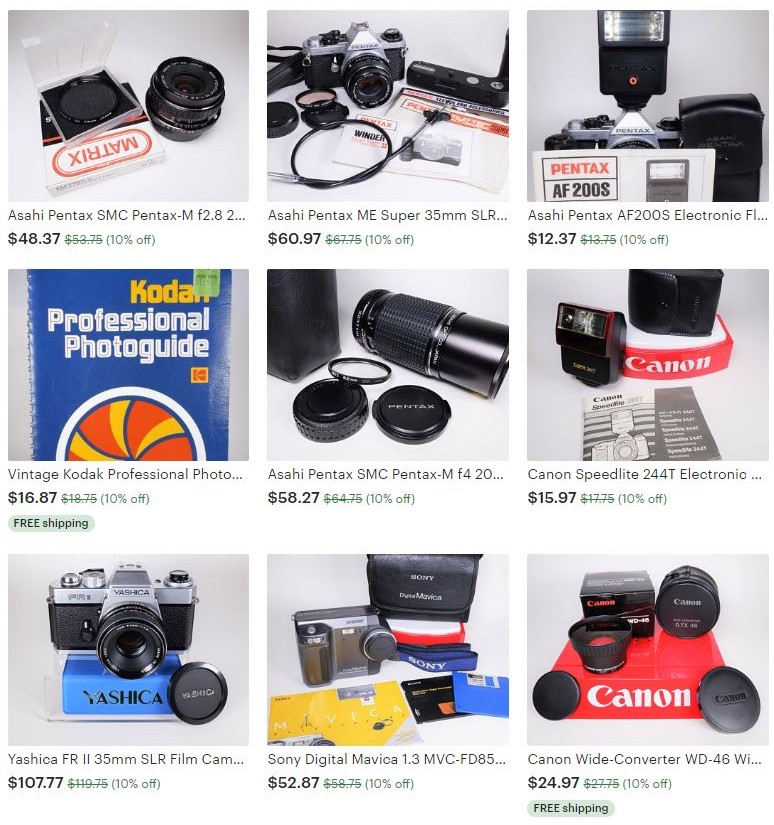
Stop by my camera and photo gear shop hosted by Etsy for some really interesting items. I ship almost anywhere in the world quickly and securely. Give my shop a look! Thanks

listings 8.16.2019

If there’s something you don’t see that you have been looking for give me a shout – I may already have it in my collection or I know where to get it. Email me at ccphotographyai@gmail.com

Thanks, Chris

Yashima Flex Box – revisited

As a die-hard collector of Yashica cameras and photo gear, I can’t pass up the opportunity to share interesting bits that represent Yashica’s history. Of course, Yashica started off as Yashima and this represents the only camera that bore the Yashima name. Subsequent cameras quickly were named Yashica while the company name remained Yashima (until 1958).

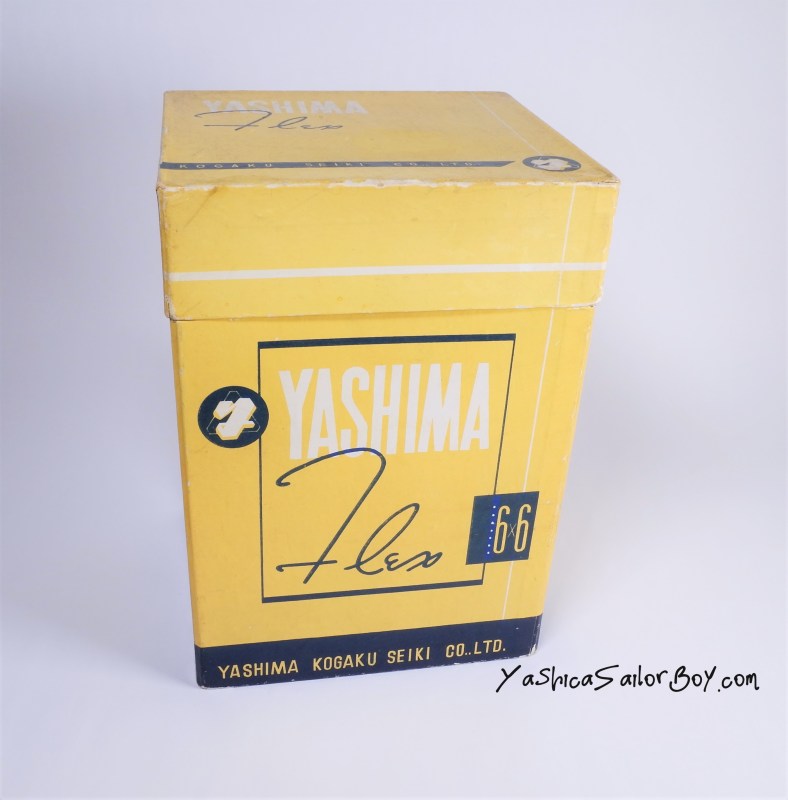
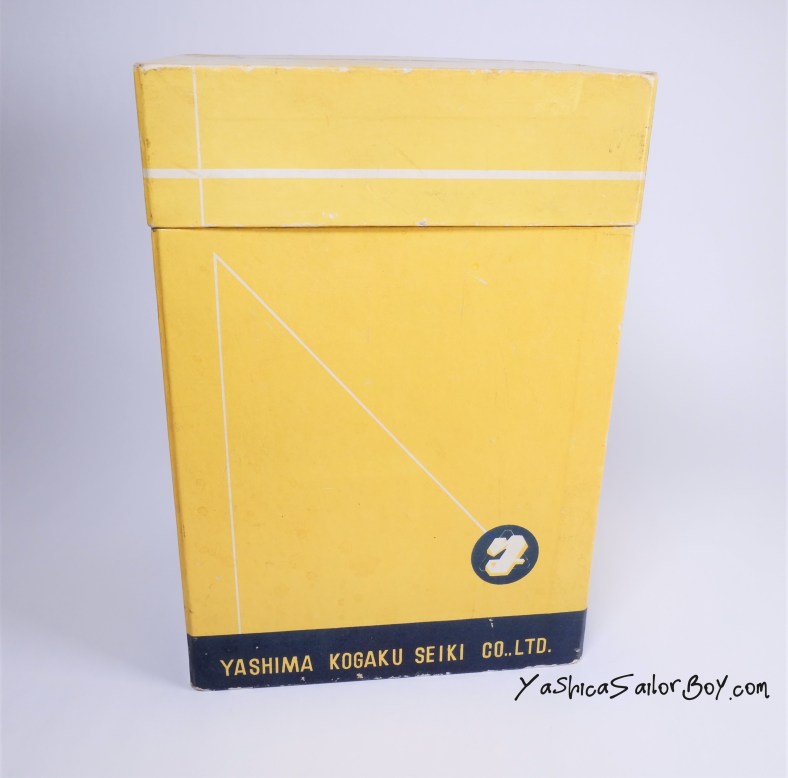
So the Yashima Flex is pretty unique as it is a one-off. Here’s a pretty rare find – an original box for the Yashima Flex from 1953. The box structurally is sound and the graphics are clear and still appealing. There is some embedded soil that stained the paper on the top of the box but that’s to be expected as the top receives the most fallout from pollutants.

YashimaFlex Box

YashimaFlex Box 2

YashimaFlex Box 3

This is spot on to the actual color of the box (faded I’m sure after all these years).

These boxes are often called presentation boxes as they were inside of an outer cardboard shipping box. As best as I can tell, the boxes were never intended to be a place to store your camera when not in use so most were disposed of as soon as the camera was used. There’s no reason not to store your camera in its leather case in the box other than it wasn’t very convenient to do so. Finding an intact box for a camera made in Japan sixty-five years ago is pretty amazing especially considering that there weren’t many made.

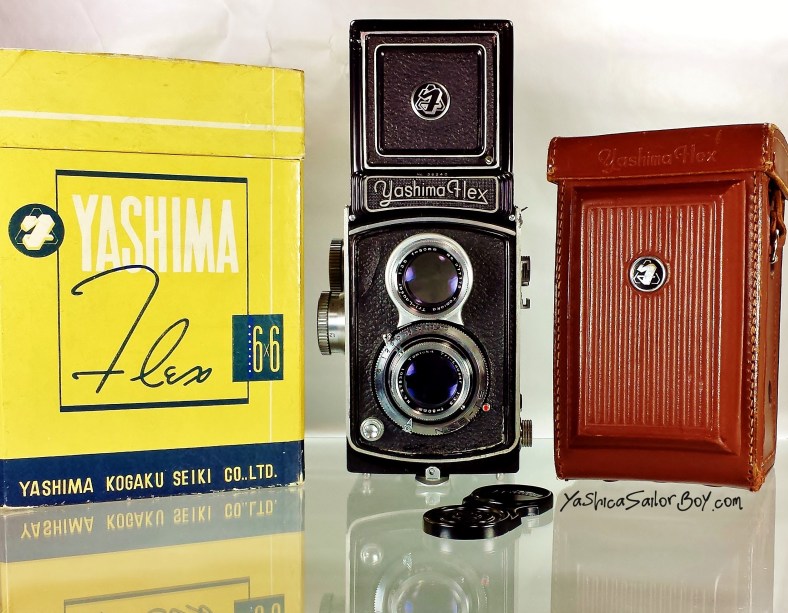
Yashima was a startup just like hundreds of others in post-war Japan. How their boxes looked in a dealers display mattered so these early 1950s boxes often were made extremely well. To give an idea of its size here are its dimensions. About 7 inches tall, 5 inches wide and 4.25 inches deep ( 170 x 124 x 110mm).

Yashima Flex Box Set (1) with logo

Yashima’s pride and joy! Not quite as good a representation of the actual color of the box compared to pictures earlier in this post.

Thanks for stopping by! Chris

Yashima Flex Inspection Tag – update 2

Yashima Flex Insp Tag 2

Earliest known inspection tag from Yashima Kogaku Seiki Company (Yashica) – 1954

It seems at first glance to be nothing important, but to a fanatic Yashica collector, this is golden. It’s the earliest known tag from Yashima complete with serial number and inspector’s stamps.

What it is. Most cameras from Japan came with some sort of inspection tag, form or sticker. This one says it’s an Inspection Form (across the top). What makes this find special is that it was included with the first twin-lens reflex (TLR) camera that bore the company name – Yashima. The Yashima Flex TLR camera was produced between 1953 and 1954 before changing the name to Yashica Flex in subsequent models and the company became known as Yashica in 1958.

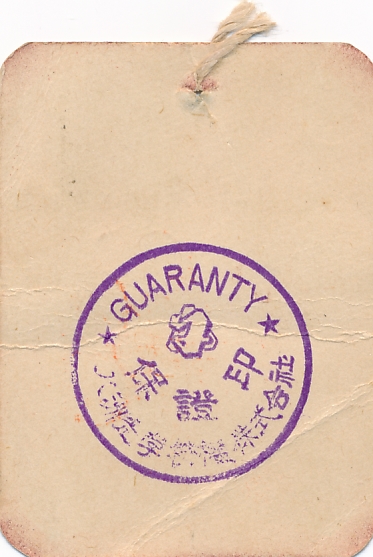
This would have hung from the camera body and the serial number of the camera is recorded on the tag (here the last two numbers are blocked). The inspector would have entered a date next to the word Showa – or that would have been entered by the camera store at the time of sale. Here’s a scan of the reverse side of the tag.

IMG_20190822_0005

Super cool inspection stamp!

Yashima Flex Green Book

This could be the instruction book (leaflet) that would have come with the camera but since none have been documented yet it could be something else entirely. ***My good friend Paul Sokk has suggested that it could be filled with a pad of papers for recording data about your photographs.***

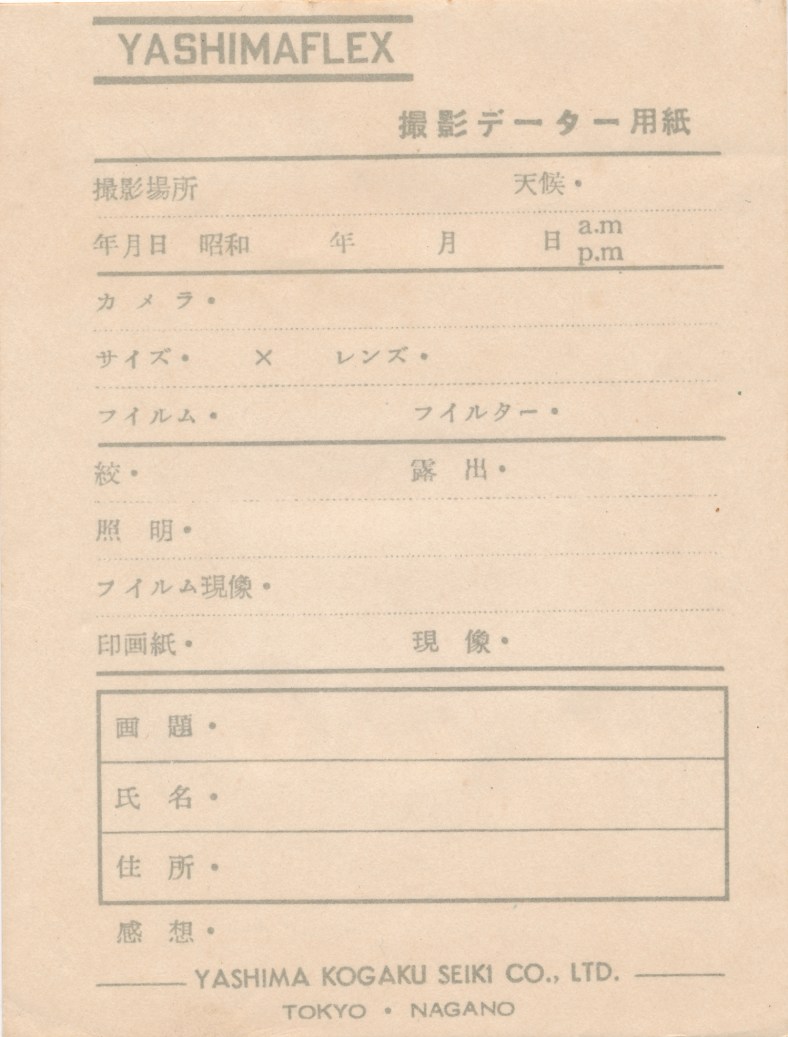
Update August 22, 2019 – Paul was correct! A+ for him. It is a pad filled with forms for recording your exposures (images).

IMG_20190822_0014

The form that is inside the green booklet. You would record the date, time of day and even the weather!

Kanji on Green Book

“Store​ the​ record​ of​ your​ photo​ data.​ Print​ your​ photos​ on​ this​ paper​ to​ better​ preserve​ your​ photos”.

i-img1200x803-1564275787yunmwl273

This is the set I just purchased from Japan. It shows the size of the green booklet as it relates to the camera box. It is not an instruction booklet.

More about this exciting find soon!

Thanks for stopping by! – Chris

Please respect that all content, including photos and text, are the property of this blog and its owner, Yashica Pentamatic Fanatic, Yashica Sailor Boy, Yashica Chris.

Copyright © 2015-2019 Yashica Pentamatic Fanatic, Chris Whelan
All rights reserved.

Nicca Flash Unit from around 1953

As you may have guessed by now if you casually follow this blog that I also have a passion for collecting bits of camera gear made by and for the Nicca Camera Company. Nicca was acquired by Yashica in 1958 and that acquisition led directly to Yashica developing (with lots of help from Nicca designers) its first 35mm single-lens reflex camera the Pentamatic 35 by early 1960. Yashica was a bit slow to the marketplace with an SLR as Canon, Asahi Pentax and Canon (among others) had already introduced SLRs by then.

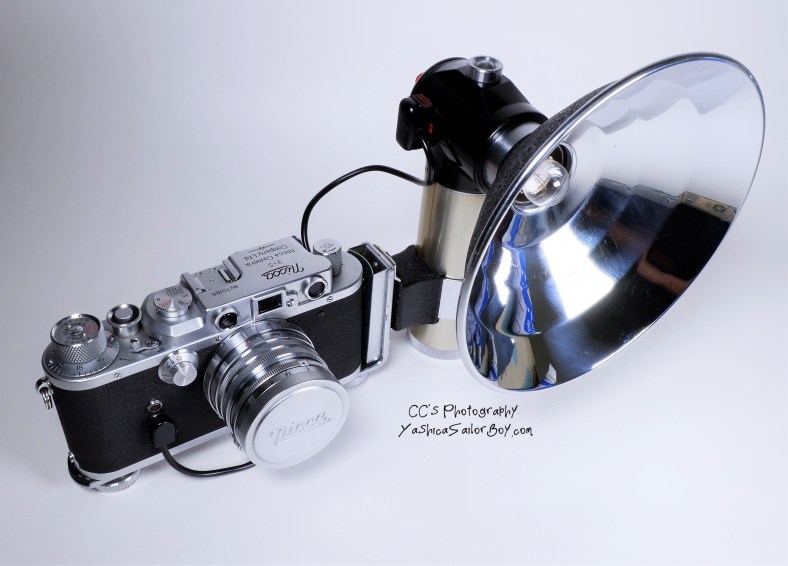
Because of this relationship, Nicca has always held a prominent spot in my collection and the Nicca 3-S remains one of my favorite 35mm rangefinders to shoot with. Recently I’ve added this wonderful flash set to my collection.

From the instruction booklet, it describes this as “an automatic rechargeable flash gun specifically designed for Nicca cameras”.

DSCF6402

Considering its age (1953) it’s in outstanding condition. Hey, it’s as old as me!
DSCF6378

All set to go. The Nicca B.C.B. flash unit attached to my Nicca 3-S.

DSCF6377

Viewed from above the pilot lamp is visible on the top center of the flash head. It lights up when the flash is ready to fire.

DSCF6380

The red-tipped bulb ejector button. You don’t want to handle a hot bulb.

DSCF6383

As part of the set, I received the original instruction booklet and a pamphlet for the flashbulbs which were made by West Electric Company of Tokyo and Osaka – later to become or at least partner with National-Matsushita.

DSCF6413

A closer look at the “Exposure Guide Numbers” card pictured in the previous image above.

DSCF6405

The reflector is about 5.5 inches across. The bulb looks tiny compared to the reflector but believe me, it puts out some light!
Nicca AD Cool

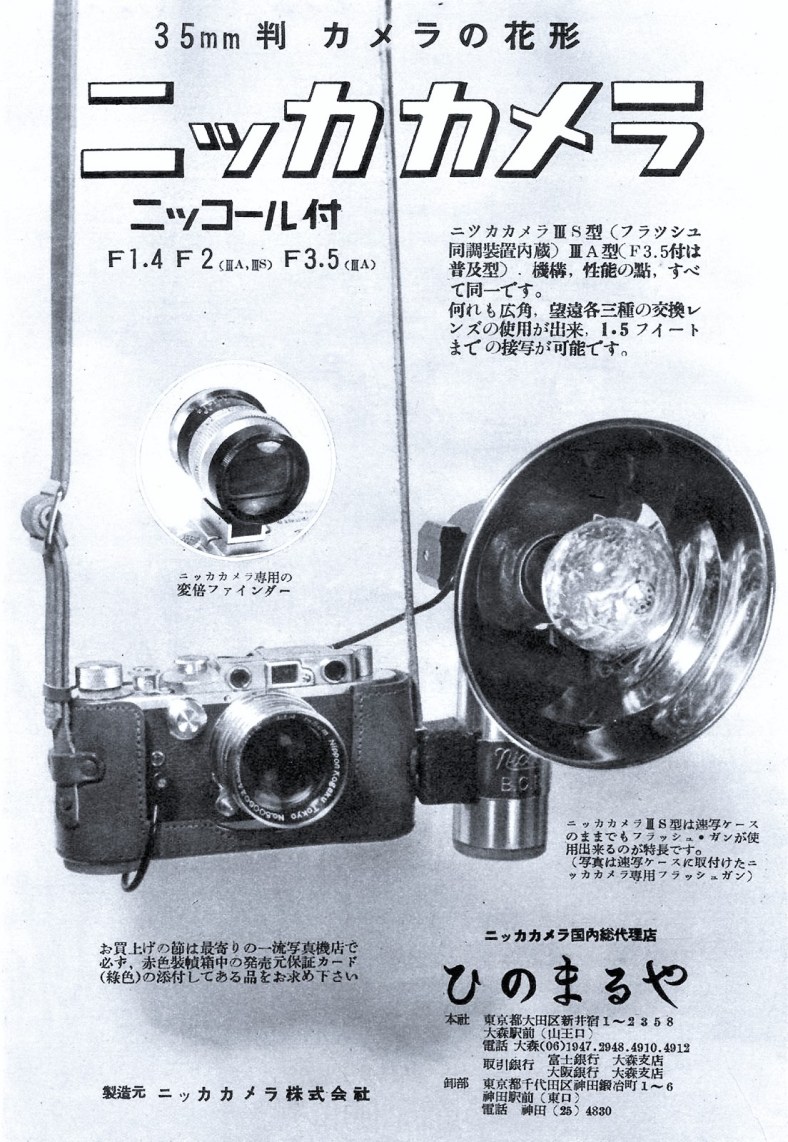
Advertisement from late 1951 0r 1952.  The flash looks like it used a slightly different connector cord than the one in my set. Hinomaruya ( ひのまるや ) was the Domestic General Agent for Nicca in Japan.

DSCF6418

Details from the instruction booklet. Shown in this image is a capacitor and 22.5-volt battery to power the flash but it could also be powered by two “D” cell batteries or three “AA” penlight batteries with an adapter.

DSCF6458

Size comparison between the flash handle and two D-cell batteries. As can be seen, the optional add on handle extension would need to be used. 

DSCF6420

Front view without the reflector. My guess is that the “BC” means battery-capacitor and the “B” is for battery (I don’t know for sure about the last “B” at this point).

DSCF6422

Camera side view with the shutter cord connector and “L” bracket connector visible. The red-tipped bulb ejector button is also visible.

DSCF6426

Parts detail minus the reflector and the capacitor/battery.

Nicca only made 35mm rangefinder cameras (maybe a lens or two but unproven) during its existence so the flash unit was made by another company. It’s likely that the West Electric Company, Limited, of Osaka and Tokyo was the manufacturer although no part of the flash is marked with the name “West”. Only the included pamphlet mentioned West. As stated earlier in this post, it’s likely that West merged or partnered with National-Matsushita Electric to build additional models of flash units during the second half of the 1950s.

Thanks for stopping by! If you know what “B.C.B.” means please share it with me. – Chris

Please respect that all content, including photos and text, are the property of this blog and its owner, Yashica Pentamatic Fanatic, Yashica Sailor Boy, Yashica Chris.

Copyright © 2015-2019 Yashica Pentamatic Fanatic, Chris Whelan
All rights reserved.
 

When batteries attack and other shop notes – 7.27.19

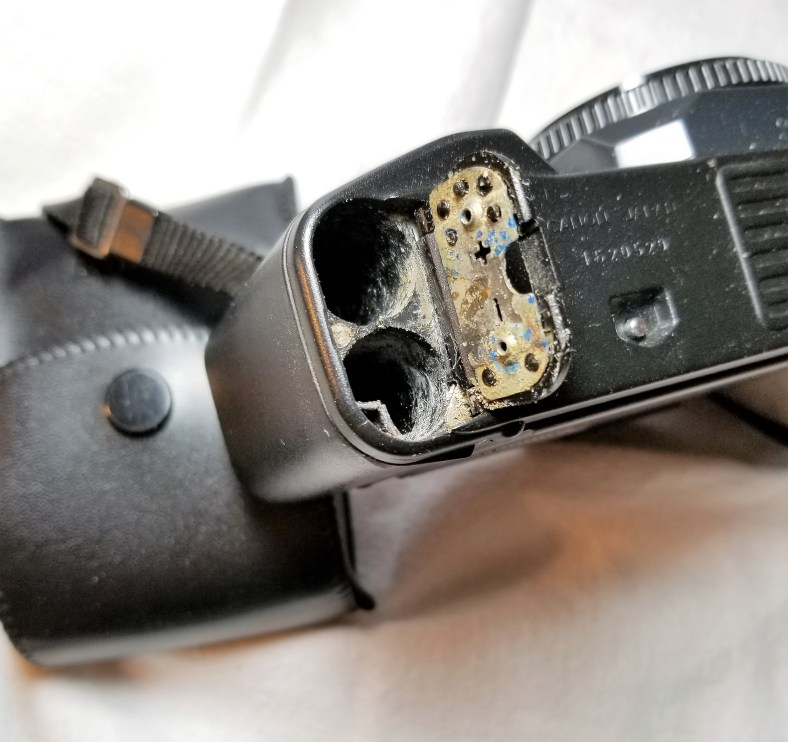
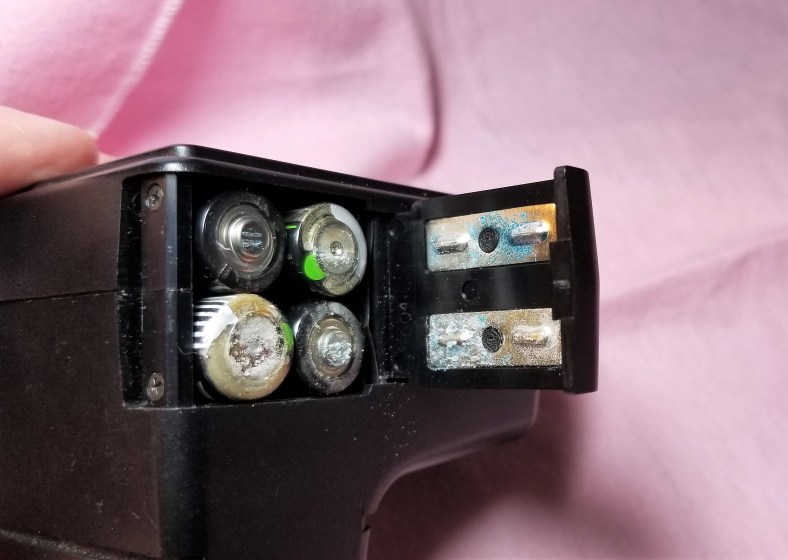
I purchased a large collection of vintage photogear this week and of course, they’ll always be some victims of battery leakage mixed in. We’ve all been victimized by this process – we leave a battery (mostly alkaline) in a seldom-used camera, remote or toy only to discover that it doesn’t work when we go to use it. Even fresh batteries installed in a device can leak and corrode the battery compartment in as little as weeks! That’s right, I said weeks.

assets_icons_iconwarninginverted

Caution!

20190719_161148

This battery compartment was so bad that I had to dig out the AA batteries with a screwdriver!

20190719_161322

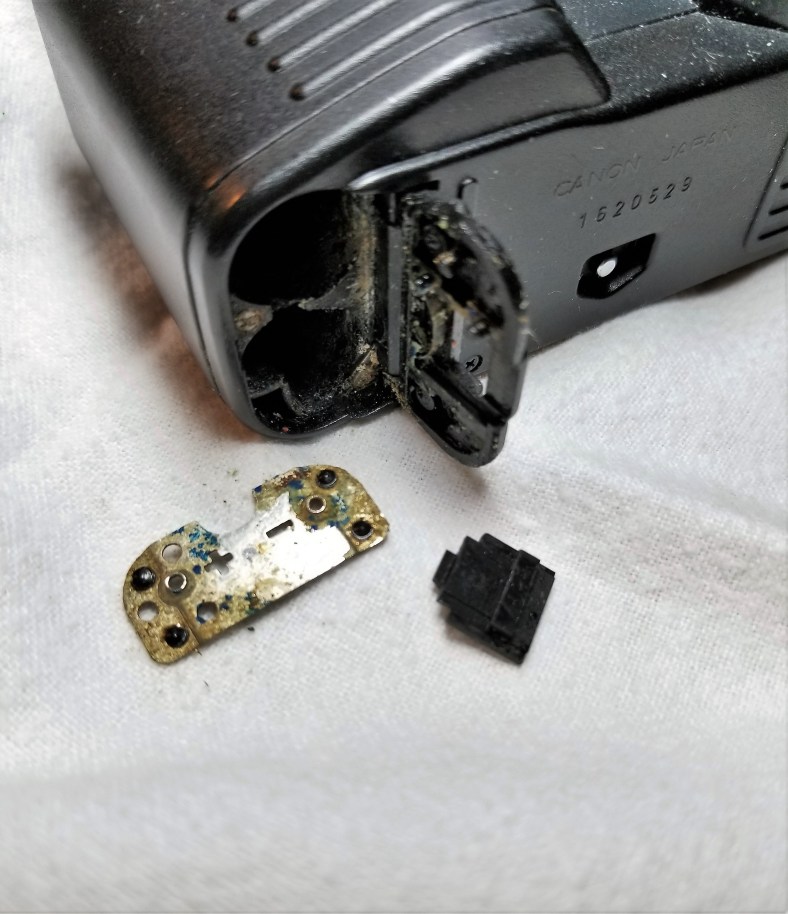
The corrosive acid from the battery destroyed the battery compartment cover and latch.

20190727_103613

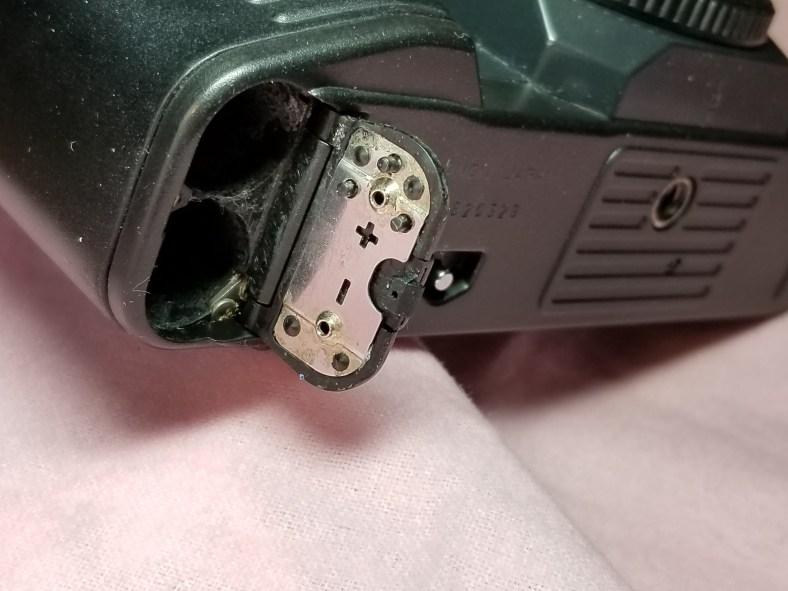
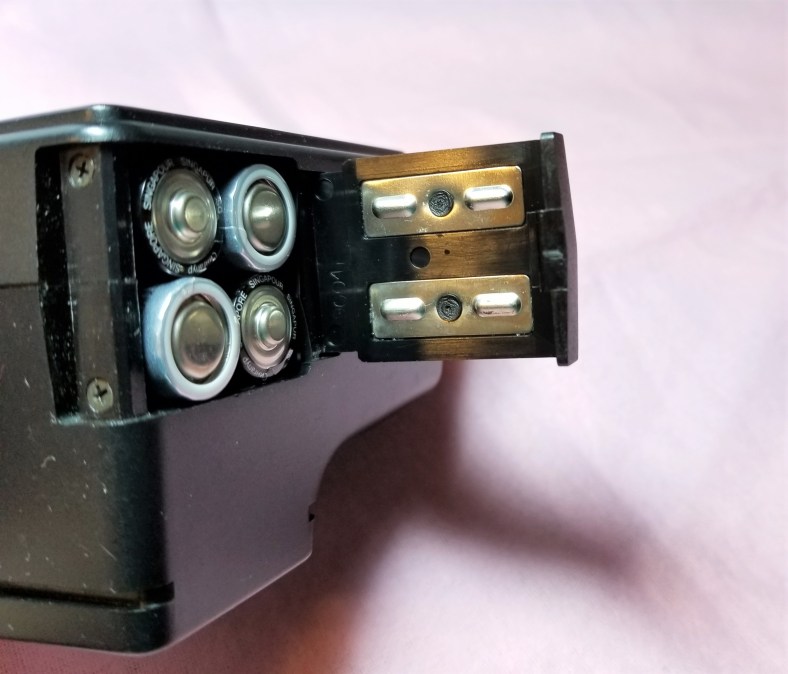
The same camera with the corrosion removed and the compartment door repaired. The camera is fully operational again. It’s still a bit ugly but at least it works.

20190727_084656

Electronic flash units are notorious for finding battery corrosion. I believe that the slight continuous drain on the battery (called parasitic drain) expedites battery failure – sometimes in as little as three weeks!

20190727_103255

Same flash unit – clean and fresh and fully operational!

The best and safest way to clean these corroded contacts is with a cotton swab (Q-tip) dipped in straight white distilled vinegar. Go slowly, don’t touch the corroded batteries and gently dab the vinegar on the corrosion (you’ll see it bubble). Use plenty of swabs and reapply the vinegar being extremely careful not to oversoak the part. Too much fluid may migrate deeper inside your camera or flash causing additional and often fatal damage. I finish with a swab dipped in Windex and gently clean the metal and plastic surfaces until shiny. I’d say I’m successful about half of the time – it’s harder to save flash units as the corrosive gases often migrate internally to critical circuits destroying them beyond repair.

On cameras where the battery compartment is away from critical circuits will have a better chance of being rescued. Give it a try if you discover that this corrosive mess is trying to destroy your fun (and device). It just may work. Please note, the chemicals that you are using and exposing yourself to are DANGEROUS and you should exercise extreme caution whenever attempting to salvage a corroded part. Wash your hands afterward and keep your fingers away from your mouth and eyes! There, the legal part is done!

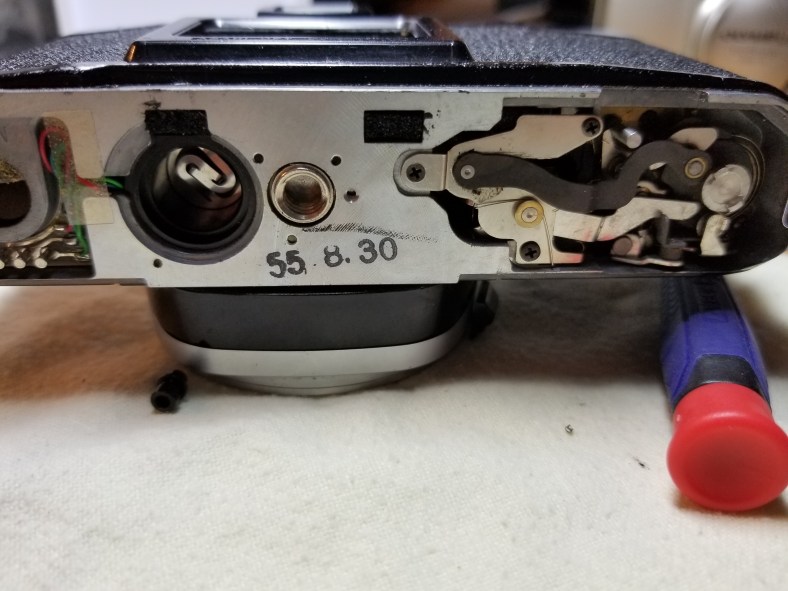
While repairing a Pentax ME Super’s baulky mirror (staying in the up position) I noticed these numbers beneath the camera’s base plate. They look like a date to me, possibly a manufacture date. The 55 looks to be the year using the Japanese Showa date. To convert this into a Western date simply add 25 (1980). Of course, the next two numbers should be the month and day (August 30). This fits within the manufacturing dates of the camera which are reported to be 1979-1984. Do you have a Pentax? If you’re interested to see your date code simply remove the 3 tiny screws (be careful, they are small and often grow legs after removing them) taking note as to which screw was removed from which hole.

20190725_223819

With the bottom plate removed on this Pentax ME Super, you’ll see a date code (maybe) similar to this one. The first two numbers are the Showa date. Add 25 to that date to arrive at the Western year (55 + 25 = 80) 1980.

Thanks for stopping by and have a great weekend! – Chris

Please respect that all content, including photos and text, are the property of this blog and its owner, Yashica Pentamatic Fanatic, Yashica Sailor Boy, Yashica Chris.

Copyright © 2015-2019 Yashica Pentamatic Fanatic, Chris Whelan
All rights reserved.
Zunow SLR – 1958

Another look at this hyper-rare SLR.

Chris and Carol's avatarChasing Classic Cameras with Chris

One of the rarest early Japanese 35mm SLR cameras ever made. The Zunow SLR (below).

zunow beauty Zunow SLR 1958.

This gorgeous Zunow sold for a cool ¥ 1,880,000 (about $16,700 USD)!

The Yashica Pentamatic (below) just sold for $16,598 less!

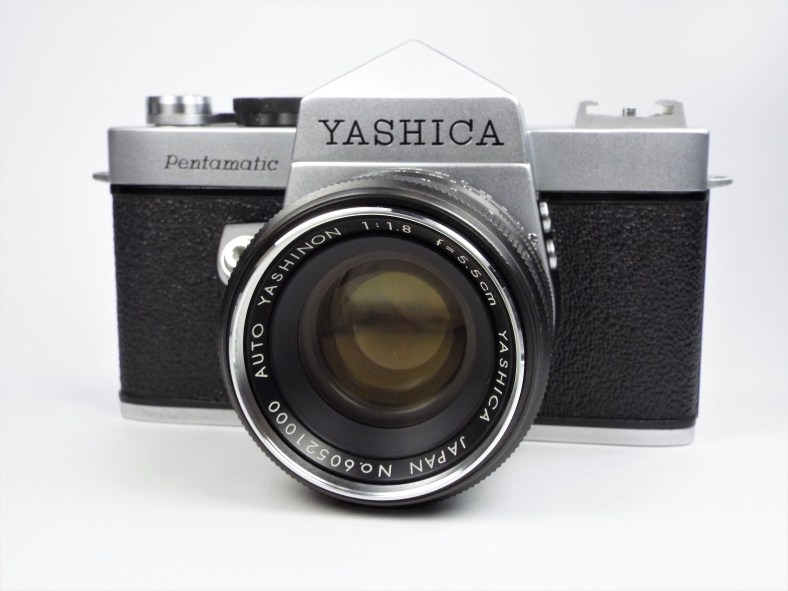
DSCF6236 Yashica Pentamatic 35mm SLR. Yashica’s first ever. A cousin to the Zunow? We think so.

We believe designers and engineers from Zunow and Nicca played a big part in bringing the Pentamatic to market by early 1960.

Thanks for your visit! To find out more about Yashica and the Zunow connection stay a bit and check out our blog here on the ‘Yashica Pentamatic Fanatic’!

Chris and Carol ^.^

Please respect that all content, including photos and text are property of this blog and its owner, Yashica Pentamatic Fanatic, Yashica Sailor Boy, Yashica Chris.

Copyright © 2015-2017 Yashica Pentamatic Fanatic, Chris Whelan
All rights reserved.
View original post