Yashica Odds & Ends

We’re always trying to find some consistency in the dating of Yashica publications. If you are a collector of all things Yashica (and Yashima) you know the frustration of not knowing when a brochure or instruction booklet was printed. Dated advertisements are a good source for dates but the lead times are often anywhere from 1 to 3 months prior (or longer) to the published date of the magazine. Through research and in some cases just plain good luck, we’ve recently spotted a trend in the date codes that occasionally appear on publications from Yashica.

We are very lucky to have in our collection a complete set of matching books from Yashica in both English and Japanese. These books came with our TL ELECTRO-X ITS that was purchased in September 1973 in Okinawa. We also have the original sales receipt from that purchase as well. The two ITS instruction booklets (English & Japanese) have the following date codes… English version 730105 and 47.6.5 for the Japanese version. The two Yashinon Lenses & Accessories booklets have date codes… English version 730410 and 7301 05 3 for the Japanese version. It is interesting that one date is in the Showa format on the Japanese version of the ITS booklet and the other Japanese booklet uses a slightly different code with an extra space in it (7301 05 3). To convert the Showa date you simply add 25 to the year and that would make it 72.6.5. All the dates precede the sales receipt (SEP 1973) so that’s a good thing.

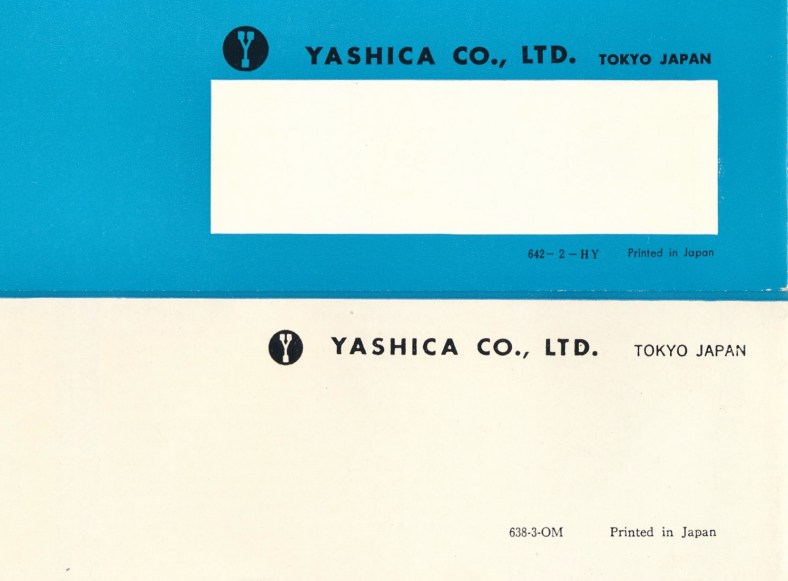
We recently acquired two new Yashica sales brochures printed in Japan in English. The cameras depicted in the brochures are from the early to mid 1960s and many of the cameras have known “release dates”. The brochures are fold outs and are almost exactly the same in layout and style (size too). The only difference is in the date codes. The 35mm brochure has 642-2-HY and the TLR brochure has 638-3-OM. Since we know the release dates on some of the cameras in the brochures, it makes it easy to cross reference the codes as being dates. So 642-2-HY is February 1964 and 638-3-OM is August 1963. Hope our theory holds up as more brochures are compared (it will as I’ve taken a quick peek at some of the late 1950s and early 1960s brochures).

Thanks for your visit!
IMG_20160114_0001

The top scan is the 35mm brochure and the bottom is the TLR brochure.
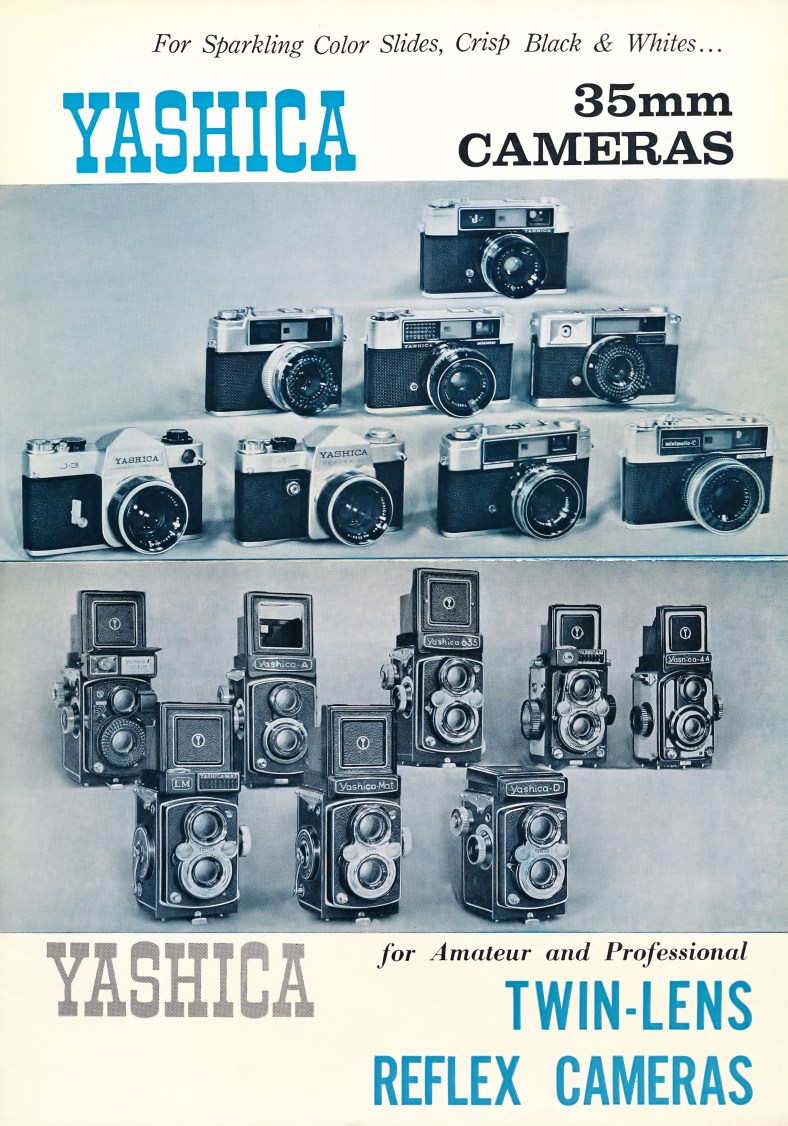
 

yas brochures 63 64

Two very nice Yashica sales brochures from 1963 and 1964.
Yashica Christmas 1959

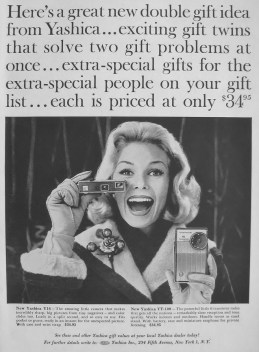
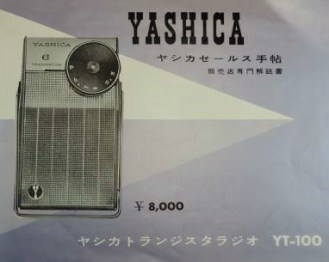
Nice advertisement from Yashica for Christmas 1959. This same model was used in at least four other ads from Yashica in late 1959 and early 1960. She was a very busy lady to be sure. We haven’t seen her in a Japanese sales brochure as of yet but we wouldn’t be surprised if she was. Most of our collection of vintage Yashica sales brochures come from this very prolific marketing period. Between 1958 and late 1960, Yashica was introducing a wave of new cameras and as in this case a transistor radio (YT-100).

yashica jn radio bookley

blonde girl with yashica (2)

Simple Little Lens Hood

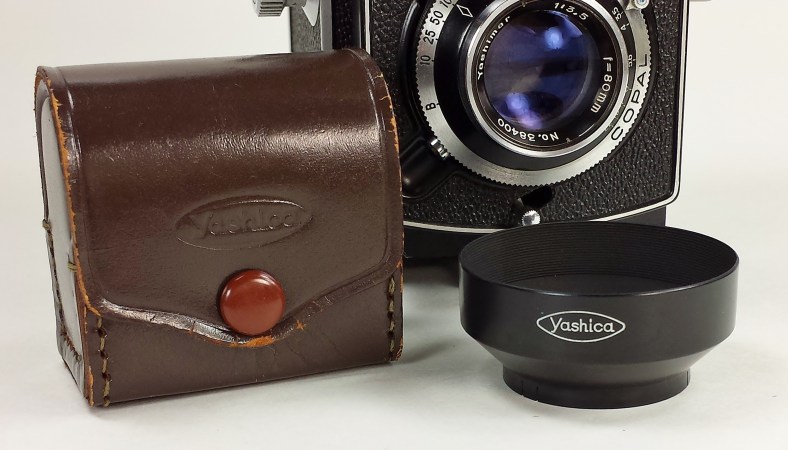
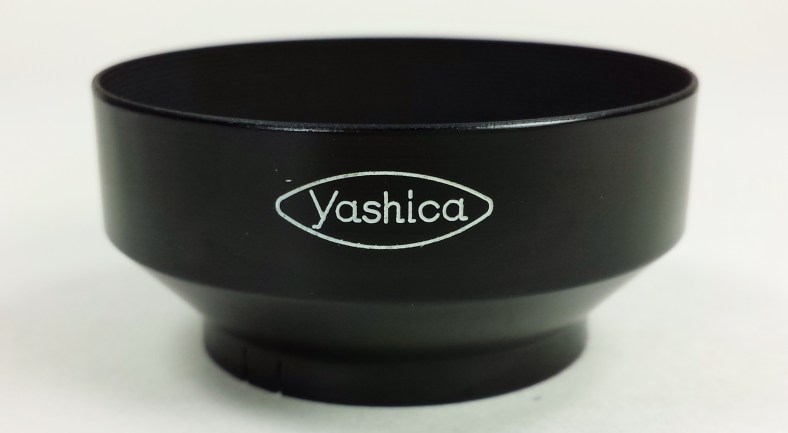
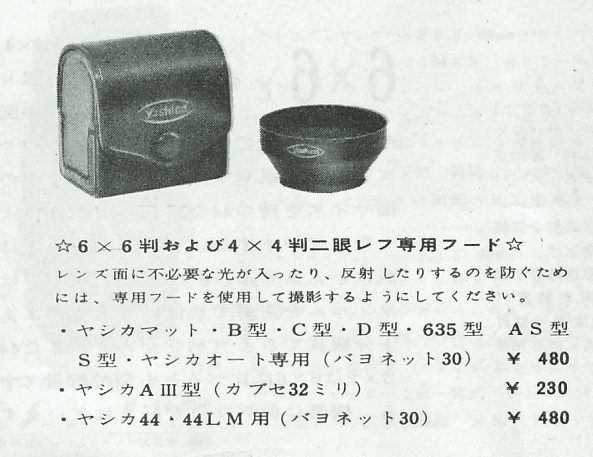
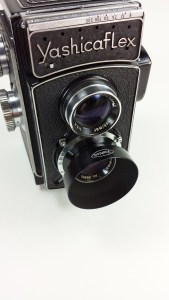
This very nice looking lens hood might be one of Yashima’s first to carry the Yashica name in the “squished” oval design. It’s a 32 mm metal push-on type designed to simply slide over the taking lens’ chrome ring. The case is a very mellow brown… the stiching is more or less taupe and the snap is orange-brown. The inside has the typical red felt on two sides and natural leather elsewhere. The case and hood may be from early 1956-ish. It’s fitted to our c1954 Yashicaflex AS-II. A later Japanese sales brochure from 1959 has the hood listed for only ¥230 and it’s with the Yashica A III.

20160111_121934

Yashica lens hood from early 1956 or so.


20160111_122241

Close-up detail of the metal hood (32mm) push on type.

20160111_122206

IMG_20160115_0003

Only 230 yen! 1959 sales brochure.


20160111_122119

Yashicaflex AS-II

Yashima Flex

The camera that started it all!

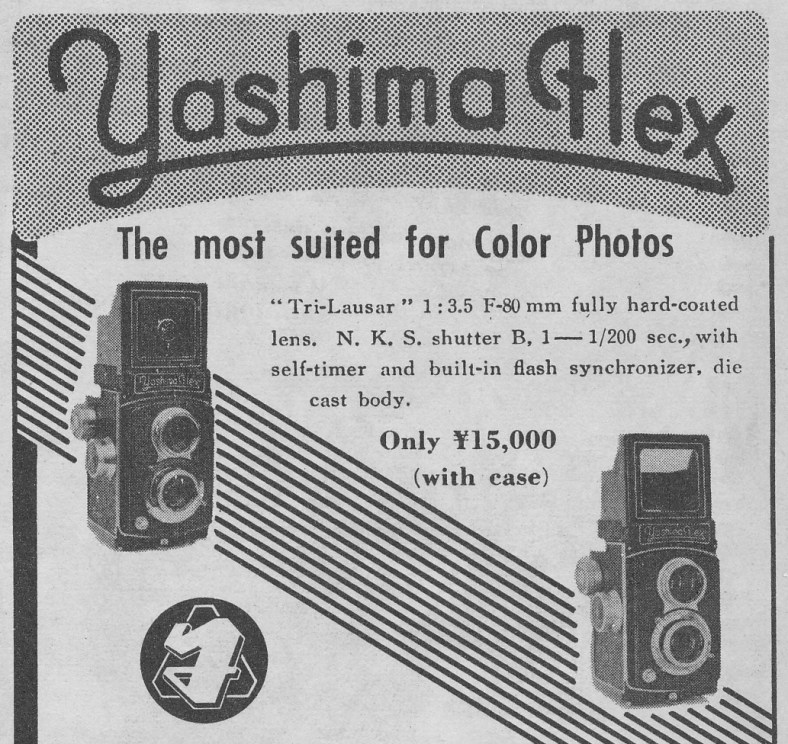
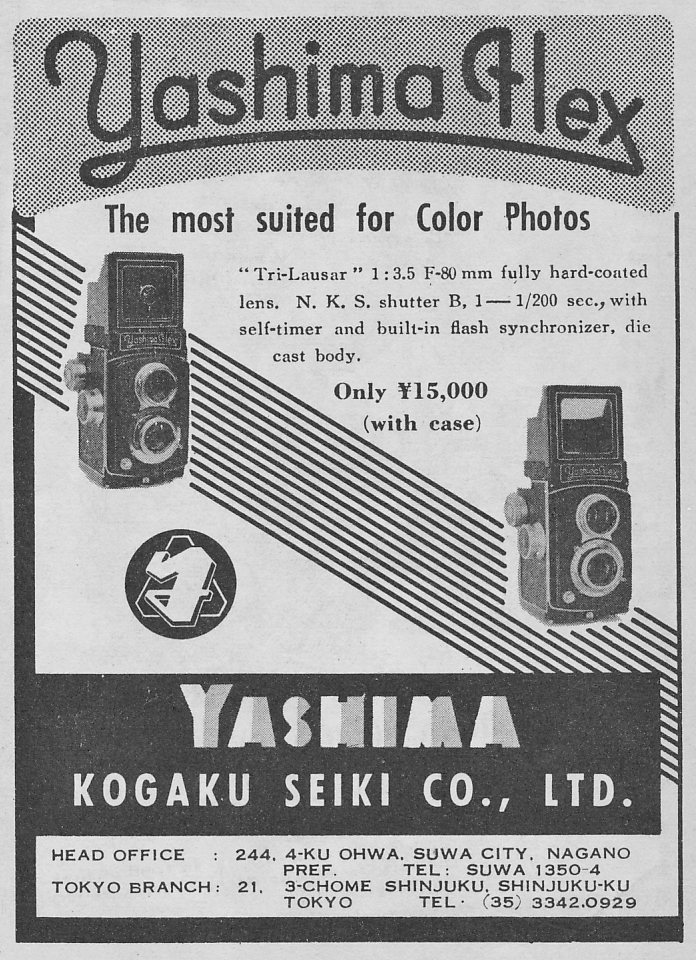
We believe that this is Yashima’s first newspaper advertisement in English. The newspaper appears to be from sometime in 1954 and the camera depicted could be a late 1953 model. The newspaper, more than likely, was circulated in and around United States military bases in Japan in the 1950s. On the other side of this ad is an advertisement for a furniture store in Tokyo. The ¥15,000 price (with case) is extremely low for such a well built camera.

IMG_20160111_0001

From a 1954 Japanese newspaper published in English.

yashima flex

Yashima’s first(?) English language ad from 1954.

Camera Store Window… 1964

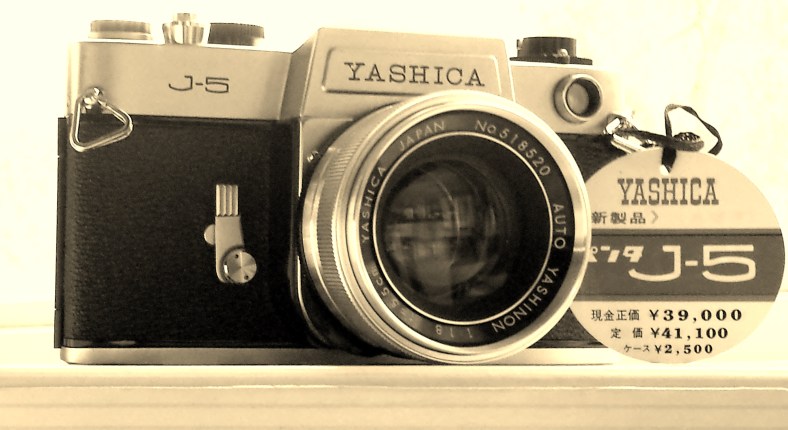
Imagining a Tokyo camera store window display in Akihabara or Shinjuku or Shibuya (our favorite spots in Tokyo) during the late summer of 1964. The searing heat and oppressive humidity of the Kanto Plain is starting to wane… at least a bit. Soon the Tokyo Summer Olympics will begin and on the first of October the Tokaido Shinkansen will make its inaugural run from Tokyo to points south. Yashica releases their newest 35mm single-lens reflex camera in time for both events. In just under a generation, less time than anyone could have imagined, Japan was hosting the first Olympics to be held on Asian soil. From the ruins of the Great Pacific War, and with guidance from the United States and others, Japan has turned its economy from near the brink of elimination to being world leaders in electronic technologies and precision equipment… cameras and high speed “bullet trains”… and on the horizon, world class automobiles that were small, inexpensive and fuel efficient.

The Yashica J-5 was another big step for a small manufacturing company that started out making simple but well built twin-lens reflex cameras in a little town along the shores of Lake Suwa, Nagano Prefecture.

20160105_141054 (2)

More Yashica Penta J Stuff!

IMG_20150926_0026Some interesting “clippings” from our vast trove of Yashica sales brochures, advertisements and instruction booklets… Enjoy!

IMG_20160102_0006

Brochure featuring the Penta J with the Pentamatic S and the new J-3.

IMG_20160102_0009

From the same brochure. Nice detailed description of the Penta J.

IMG_20160102_0005

German catalog featuring the Reflex 35. Available by June 1962.

IMG_20160102_0004

Australian sales catalog and the new Reflex J.

IMG_20160102_0008

U.S. sales brochure featuring the “big 3” from Yashica.

IMG_20160102_0002

From the Penta J instruction booklet.

IMG_20160102_0001

Penta J instruction booklet.

om3om3om3-img517x469-1439588582ntktna15667

Yashica’s “no name or model number” exposure meter.

IMG_20160102_0003

Another ‘First’ for Yashica

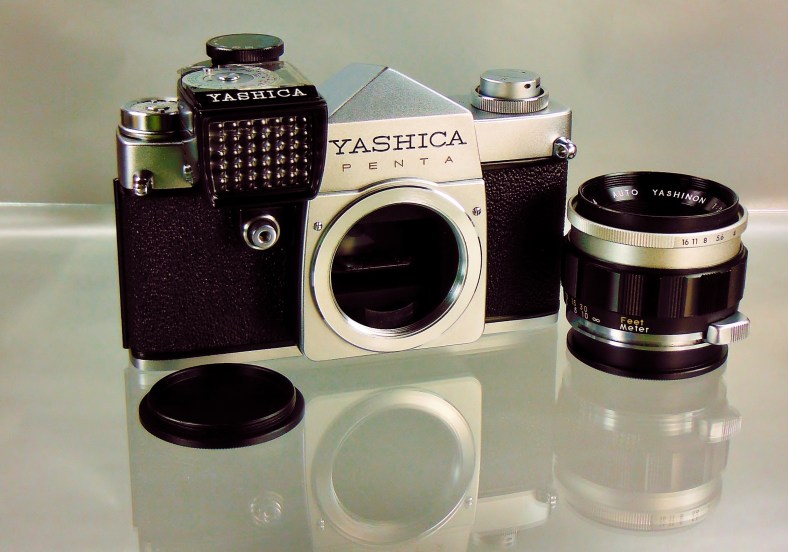
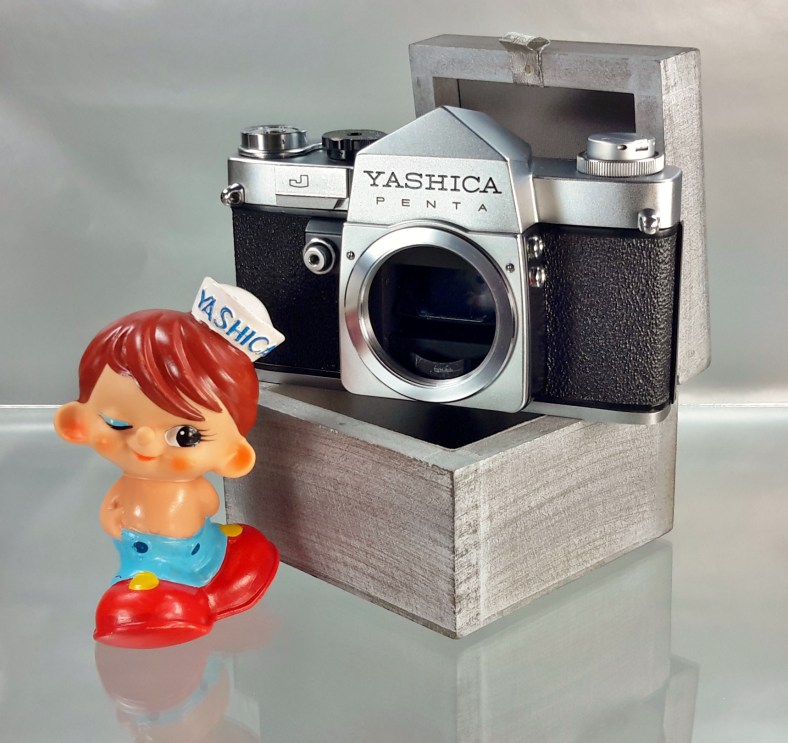
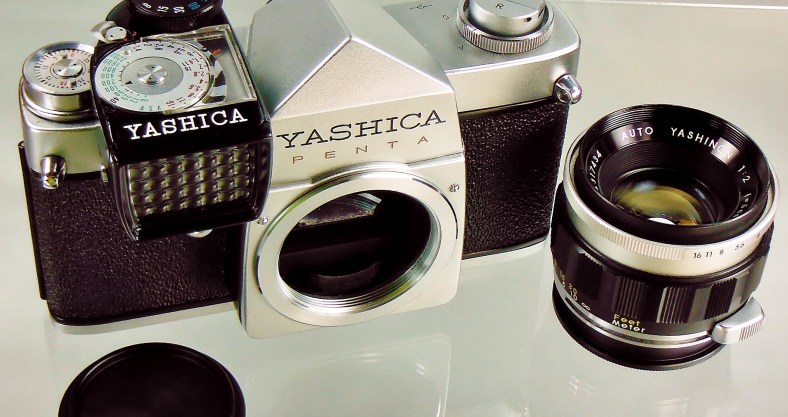
Another example of a Yashica first. After Yashica introduced its first 35mm single-lens reflex (SLR) film cameras in the Pentamatic series, it followed up in 1962 with the little know Penta J. The Penta J was also know as the Reflex J in Australia and the UK and the Reflex 35 J in Europe. As I’ve discussed before, the Pentamatics were either a complete failure or a big success for Yashica. Choosing to go with an exclusive bayonet mount for their lenses (Pentamatic series), Yashica decided to go mainstream by using the more common M42 screw mount lenses and to forgo their exclusive bayonet mount. This gave Yashica the opportunity to reach more potential customers and more than likely helped Tomioka Optical (their lens maker) as they did not have to produce a unique mount just for Yashica. The Penta J with lens listed for around $130 in the U.S. and 28,000 yen in Japan. Just as with the Pentamatic S before it, the Penta J had the ability to attach a clip-on exposure meter that was coupled to the shutter speed dial (about $25).

DSCF0331

Even with the rather clunky exposure meter attached, the Penta J was an elegant camera that retained the strong lines of the Pentamatics and a feeling of solid construction.

20160101_194510

The location of the shutter release button was moved slightly from the Pentamatic design so as to allow room for the clip-on exposure meter. 

DSCF0330

A beautiful set from 1962.

Yashima Flex… the First!

JN ad for Yashima Flex

An original advertisement for the new Yashima Flex camera from 1954. 

Yashima’s first twin-lens reflex film camera. More correctly, the first camera of any type to carry the Yashima name. Built in 1954 by the good folks at Yashima Kogaku Seiki Co., Ltd. at their factory in Nagano Prefecture. Prior to this camera, Yashima produced a model called the Pigeonflex which at least gave them some great ideas on how to present the camera that would eventually carry the company name. The camera, the presentation box and the leather case all show great attention to detail and a solid foundation that would become the standard for years to come. The sophistication of the first camera would lead to many firsts for both Yashima and the Japanese camera industry as a whole. Yashima would later be called Yashica as that name came to be more recognizable in the crowded marketplace of the 1950s and beyond.

20151230_205755

The beautiful styling of all three elements are clearly seen in this rather rare view of a mid production camera kit. The leather case was more than likely outsourced to a supplier and more than likely the presentation box was too. The lenses came from Tomioka Optical in Tokyo and the shutter was a N.K.S. design and build. After nearly 62 years since this camera left Nagano it still functions as new. The only true signs of age are typical of many older cameras in that the leatherette covering becomes brittle and the glue gives up its bond to the metal. A masterpiece of early Japanese engineering and craftsmanship.

Neat Little Find

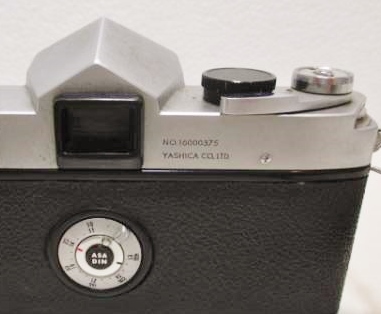
A quick note about the Yashica Pentamatic and the beauty of their serial numbers. I found this camera listed for sale in Japan recently. It appears that Yashica may have been selling the Pentamatic in their home market earlier than most people thought (including myself) and may have released the Pentamatic in the United States and elsewhere sooner than commonly thought. My rational is that it’s not likely that this particular Pentamatic was sold in the U.S. and then made its way back to Japan during its lifetime. Possible yes but unlikely.

JN Pentamatic SN 16000375

Very early Yashica Pentamatic. The serial number (No. 16000375) decodes to… 1 = Jan / 60 = 1960 / 00375 = 375th body produced. Production did begin at the Yashica factory complex in early December 1959 with a very slow run-up to full production. This serial number would indicate that even by sometime in January 1960, fewer than 500 units were made. At its peak, the Pentamatic was rolling off the assembly line at an average of just under 1,300 units per month by the summer of 1960.

More Tomioka…

20151221_125602

Taking lens on the Pigeonflex. Uses full name Tomioka Opt. Co.

More Tomioka branded lenses. Tomioka Optical Co., Ltd. taking lens (above image) on the Pigeonflex. Yashima’s first ever TLR before becoming Yashima Flex.

(Below images)… This is the taking lens (on the bottom) and the viewing lens on our Yashima Flex TLR. The Yashima Flex is the first camera to carry the Yashima name. This example is from very late 1953 to early 1954. The Tomioka Tri-Lausar name would soon be removed from all future Yashima (later Yashica) TLRs.

20151221_113048

Both lenses on the Yashima Flex. Simply Tomioka.

20151221_112904

Taking lens on the Yashima Flex. Simply just Tomioka.