We’ve always assumed that the Nicca cameras were pretty much the same size from one model to another. The early 1950s models look for the most part, the same as the 1958 models. Now that we have two Niccas in our collection it’s time to do some comparisons.
Nicca 3-F on the left and the Nicca 3-S on the right.
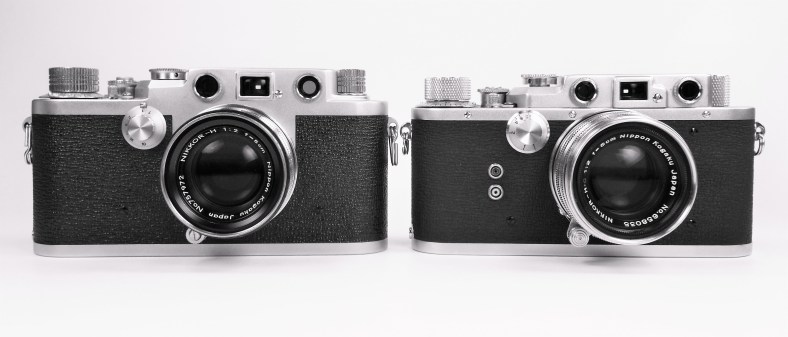
First off, without the lenses attached, there is a slight difference in weight between the two with the 3-F weighing in at 445 grams and the 3-S weighing 432 grams.
There is however a difference in size which surprised us. The later model 3-F (left) is taller than the 3-S (right) by about 4mm.
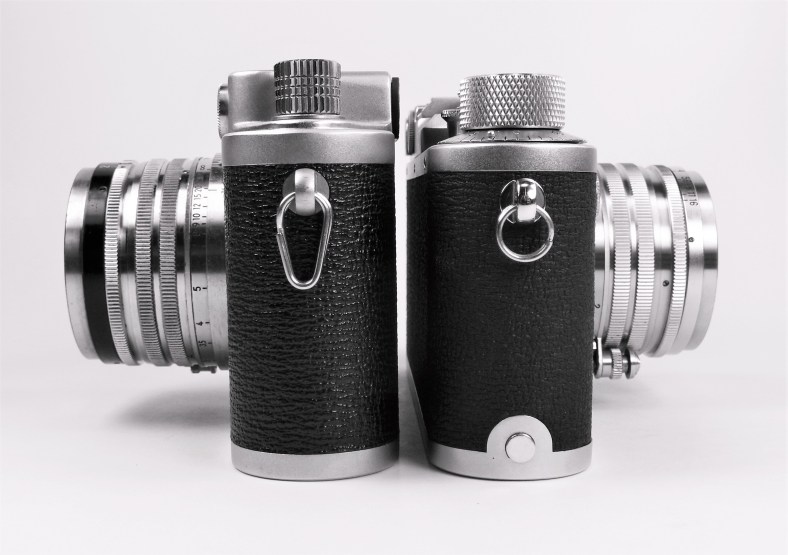
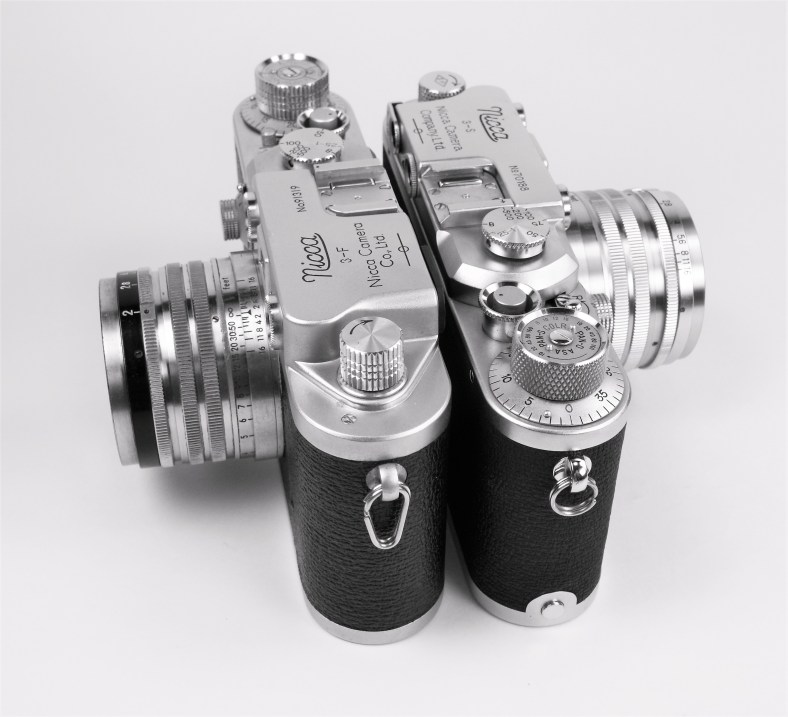
The 3-F is also longer than the 3-S by about 7mm.
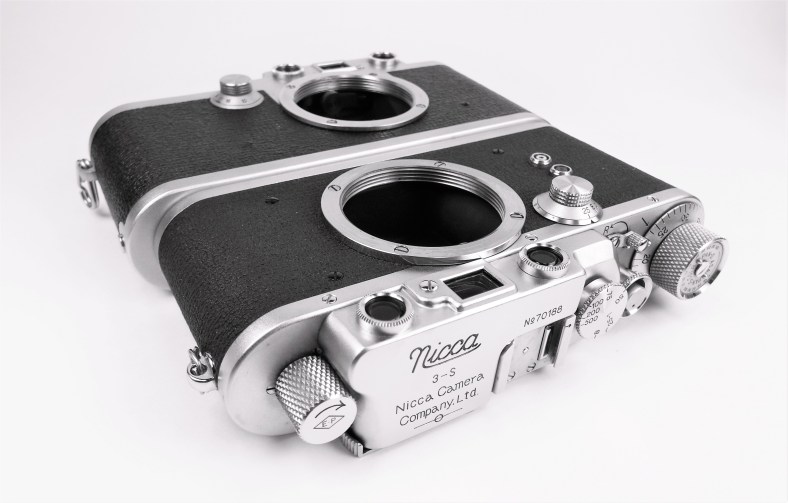
The 3-F is about 7mm longer and 1mm wider than the 3-S.
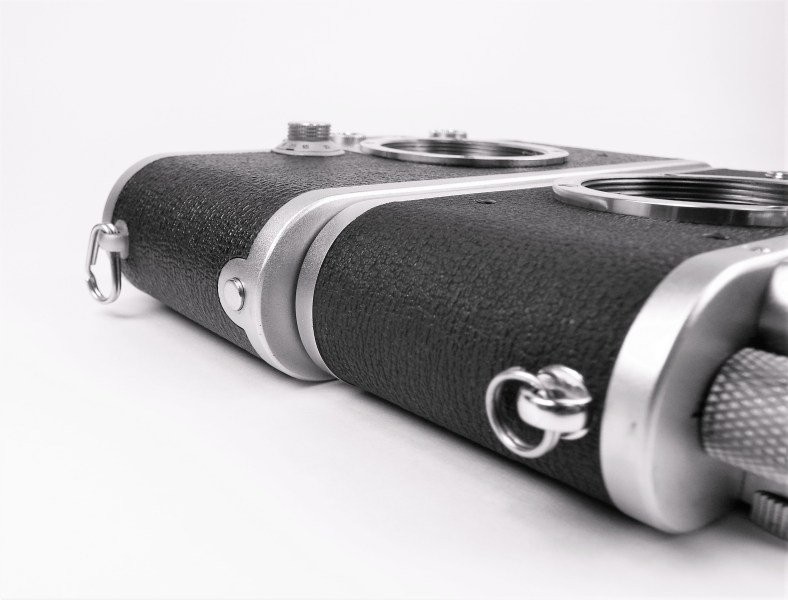
The 3-F is the top body with the 3-S on the bottom.
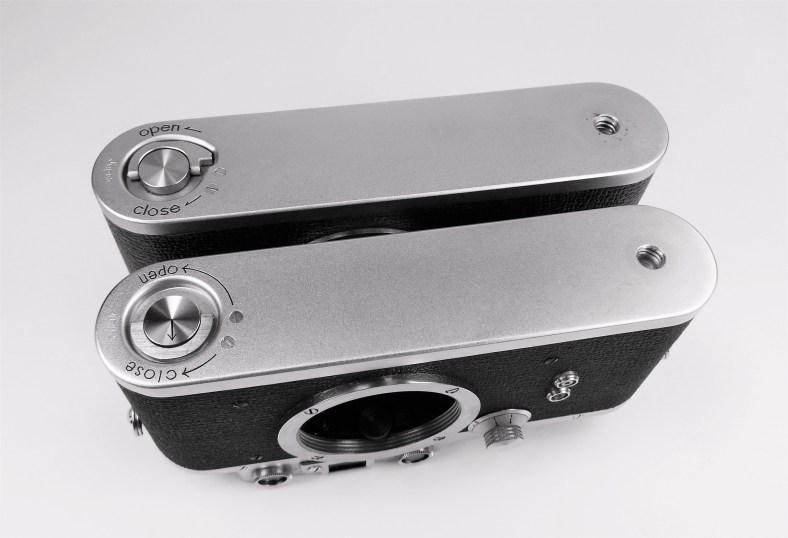
Since these Niccas share the same specs it’s surprising that Nicca expanded the body of the 3-F.
Our best guess is that the later model (3-F) uses its extra length to improve the film path. Measuring the distance between the spindles with the baseplates off, the 3-F is 5mm longer than the 3-S (108mm vice 103mm).
So nothing earth shaking – just some subtle differences. As we have stated before, these are high quality cameras with exceptional fit and finish. Adding a Nicca will enhance any collection of 1950s Japanese made rangefinder cameras.
Studio Camera: Fujifilm FinePix S9900W
Chris
 Chasing Classic Cameras with Chris
Hi Chris, wonderful ! Were they based on the Leica screw mount camera’s, the look very identical to me ?
LikeLiked by 1 person
Hello yes as I understand it – the 3-S is an exact copy of the Leica IIIb.
LikeLiked by 1 person
Reblogged this on Yashica Pentamatic Fanatic and commented:
Another look at these two classic cameras from Nicca.
LikeLiked by 1 person
Hello,
I have a Nicca 3S camera and would like to know whether an electronic flash can be used on it via a syn cable or not. Thank you very much for our help.
LikeLiked by 1 person
Thanks for your comment. This is from my good friend Paul Sokk’s excellent site: Note, because there is only one socket, some sites claim that the late bodies only feature X sync. The highly regarded by many HPR, Hans P. Rajner, in his book, “Leica Copies”, shares the misconception and has perhaps helped popularise it.
Also except for the Type 33, see further below, X sync is at the the changeover speed for the high speeds, anything above that selects FP sync and any type of flash can be used below the changeover speed. The changeover speed for the earlier die-cast bodies was 1/25 and for the Type 33 and III-L, 1/30, with the Type 33 offering X sync at 1/60, but not FP sync above 1/30.
Again except for the Type 33, the baseplate of die-cast models features an adhesive label with film loading and flash synchronisation information. The label indicates that flash bulbs can be used at any shutter speed from 1 second to 1/500, or 1/1,000 for models so equipped. However, in accordance with user manual instructions, above 1/25, or 1/30 on the III-L, flash bulbs must be of the FP type. Unlike the restrictions with earlier twin socket models, “any types of flash bulbs” may be at used at speeds “slower than” 1/25, or 1/30 as relevant. Electronic flash can be used from 1 second to, and including, 1/25 or 1/30.
I hope this helps. His site is at http://leica-copies-japan.com/Nicca.html#flashsync
Chris
LikeLike
Dear sir, Thank you very much for your information but my Nicca is a 3S (according to the owner who sold it to me) and it has two sockets in the front below the slow speed dial. Please advise which one is for FP and which one is for X. Thank you very much for your help. Phong Nguyen
VÃ o Th 6, 20 thg 12, 2024 vaÌo luÌc 22:36 Chasing Classic Cameras with
LikeLiked by 1 person
Click to access Nicca%203-S%20&%204%20(LoRes).pdf
This is from the instruction booklet.
LikeLike
Click to access Nicca%203-S%20&%204%20(LoRes).pdf
LikeLike