Fujifilm Instax Wide 300 Review

I wish Yashica was still around… the ‘real’ Yashica from Japan not H.K.

But they’re not so what’s a Yashica freak to do if you want to review new gear and new film formats? Well you turn to my go to camera makers (for the record; Yashica, Canon, Fujifilm)… Fuji Photo Company as they used to be known. Now just Fujifilm. I do appreciate the Fujica line of cameras and would love to own a Fujicaflex and a Fujicarex! But I wander as I often do.

I’ve had my eye on the line of Instax film cameras from Fujifilm ever since they introduced the Instax film (I might have been a little behind the times here). Anyway, since I’ve almost always have had an instant film camera… Polaroids and the Kodak EK4, I decided to splurge and get the Fujifilm Instax Wide 300. Why? The format. I like wide shots and the Wide 300 gives a nearly 62 x 99mm image in bright color.

dscf2118

The Instax Wide 300… a simple camera… clean lines and has a nice feel to it.

Plenty of places to get a good grip on this camera… the large handle on the camera’s right side is just the right size (for me) to get a grip. With the camera in off, the built in lens shield slides into place. The shutter release button is in a good spot… my only complaint is that it lacks feedback when you push it. Only the actual sound of the shutter firing inside (if you can hear it) lets you know it’s tripped. Of course the picture does pop out immediately on top with the typical motor noise of an instant camera which confirms the shutter was fired. Minor detail.

dscf2120

Lens extended in its fully open position (close-up photography).

dscf2121

Once you get the feel of where the viewfinder is in relationship to your right eye it’s actually very bright and gives a good view of the actual lens image.

dscf2122

The access to the film compartment couldn’t be easier… it opens a full 90 degrees to make loading film quick and easy. The LCD shows basic info… flash on, image number and the plus or minus exposure compensation.

dscf2123

Open back with empty film pack.

dscf2131

Pictures pop out via this slot on top of the camera.

20160908_144816

A small sample of the images taken today with the Fuji. Shot at around early afternoon in bright Florida sunlight. The colors are vivid and because the film speed is 800 the sharpness and detail are nice.

dscf2116

Back inside for a studio shot.

20160908_144800

It’s a big camera (really big) and has some heft to it. I had more than a few looks as the picture ejects from the top with that familiar instant camera sound. That’s not the standard strap… it’s a little thing and I like to have something wider around my neck.

dscf2127

Bold colors under bright sunlight. An excellent daylight film.

dscf2128

Back to the future with instant film. The Fujifilm Instax Wide 300 is a hit with me.

The camera is a point and shoot… well OK it does have two settings on the lens… 3 meters to infinity and 3 meters to 0.9. It does have an auxiliary close-up lens that I’ll try out next pack of film. It has a built in flash that worked great for daytime fill ins and you can adjust the exposure plus 1 or minus 1. Takes 4 AA batteries (which I love).

fujifilm_1934

It would be cooler if it sported this logo!

fujifilm_past_logos

So would I recommend the Fujifilm Instax Wide 300 camera? Yes and Yes! Mine was purchased online for around $86 from B&H and another $10 for two 10 exposure film packs. It was a great deal and it included free shipping. At fifty cents per image you can’t go wrong!

img_20160907_0003

Enjoy!

Thanks for the visit!

Chris and Carol ^.^


New Pentamatic Brochure

Recently we’ve come across a nice Yashica Pentamatic sales brochure from Germany. It looks to have been printed around early 1961 as another brochure that was with it (same style) is for the Yashica Rapide camera and it was introduced in 1961.

IMG_20160902_0005

Yashica sales brochure for the Pentamatic. Nothing new about the Pentamatic is noted… probably came out in early 1961.

What is surprising to me is that only two other lenses are shown in this brochure besides the standard 5.5 cm f/1.8 normal lens. Surprising because by early 1961 Yashica had at least three other lenses for the Pentamatic that we are aware of. The 35 mm f/2.8 and the 100 mm f/2.8 pictured are fantastic lenses designed and built for Yashica by Tomioka Optical of Tokyo. It is possible that in Germany the other lenses were not available in 1961. Just a guess.

IMG_20160902_0006

Full front and back cover scan of the brochure. The back cover shows various accessories available for the Pentamatic.

The Yashica Rapide brochure pictures two different flashes for the Rapide. The one on the right of the camera is identified as the Yashica Quick Lite 11 (or is it II)? Not sure on these as we’ve yet to find them in another brochure.

IMG_20160902_0009

Scan of the back cover of the Rapide brochure showing two flash units for the Yashica Rapide camera. One identified as the Yashica Quick Lite 11 (???).

Prior to seeing this brochure, we were not aware of Yashica branded flashbulbs. We would love to find those and add them to our collection. Hint hint!

Thanks for the visit!

C&C

September Photo Assignment

By Chris…
    I’ve been a photographer almost my entire life…
IMG_20160831_0009

December 1961… at Lake Mead and Hoover Dam. Using a Kodak Brownie Starmite (1960 model) with 127 film. This image taken by my dad with his Polaroid.

I can remember when I was eight I pleaded with my dad to let me use his camera as I was growing tired of my simple Kodak. While on a trip to California around Christmas 1961, he handed me his massive Polaroid Pathfinder Land Camera model 110… I could barely hold it let alone be able to take a picture (shown below). He showed me how to use the controls and instructed me on the proper way to hold it steady (me leaning against a tree worked fine). I don’t exactly remember what I shot but it was magic to watch the image I took come to life. Hooked!
20141130_102905

This image of the Pathfinder 110 is as massive as the actual camera!

Over the years I’ve used many different cameras with many diverse formats. My first 35 mm camera was a Nikonos II that I purchased new in 1971. Next came a Yashica TL Electro-X 35 mm SLR followed closely by my first Canon, a F-1 in 1977. Then another Canon… this one a AE-1 (actually Carol’s camera), brief flirtations with a Kodak E4 instant camera and then a Polaroid Spectra and finally my last film camera (for a while)… a Canon Rebel.

    I moved to digital… very basic cameras… mostly simple point and shoot gear but with good optics (Sony Zeiss) for one. But I jumped back into film in a really big way in 2008 when I purchased a used Yashica TL Electro-X on eBay. Replacing my first 35 mm SLR that I loved. Since then I’ve been lucky to collect a wide variety of cameras… none more treasured then the Yashica’s that arrived in my home in ever increasing numbers… 35 mm SLRs and Yashima-Yashica TLRs. But what’s caught my fancy recently is one of my most humble cameras in the collection… a 1958 Fuji Photo Film Fujipet! A true medium format (6 x 6 cm) camera. I was lucky to find one that essentially was never used so it arrived to me clean and working like a charm. Nice fixed focus plastic lens (70 mm) and a accurate 1/50th of a second shutter (B works too). Add in three aperture settings… f/11, 16 and 22 and some Neopan 100 Acros and I was all set to venture back into the world of film photography.
DSCF1962

Fantastic Fujipet! Great images with a nice “feel” to them.

Now the challenge! 1958 vs. 1964 technology!

DSCF2057

The Fujipet and a small sample of its images. The Yashica EM ready to take on the Pet.

I am very pleasantly surprised with the quality of the images with the Fuji. 120 roll film 6×6 cm negatives make for fine 5 x 5 inch prints (seen above). Which brings me to the point of this article… I’m about to “compare” my Fujipet against my 1964 Yashica EM. Yes I know ahead of time that the images will be night and day better with the optics of the Yashica but I want to also judge the “feel” of the images. How will they “speak” to me. So I’ll be loading the EM with the same Neopan 100 Acros black and white film and shooting the same scenes around the historic town I live in.

DSCF1708

Fujipet loaded with fresh Neopan 100 Acros B&W film.

    I’ll share those images as soon as I can. Should be interesting…
Thanks for the visit!
Chris

Yashica Tomioka f/1.2 Lenses…

Another beautiful Tomioka made f/1.2 lens has been spotted. These gorgeous lenses are things of beauty. This one appears to be in outstanding condition inside and out. They are M42 screw mount lenses so they fit a wide variety on SLRs.

tomioka f1.2 lens

Our feeling on these Auto Yashinon 55 mm f/1.2 lenses are that they are worth the price! Most go in the high $800’s to $1100 or more. The serial number is rather low on this one… the 552 is the model number and the 1773 is the production sequence number.

phtrqi8znul0j

There’s that desirable f/1.2 on the aperture ring.

tomioka tominon aug29.2016

This one looks to be in a bit rougher condition overall with some visible dings. But it’s a Auto Tominon 55 mm f/1.2 lens with Tomioka Kogaku Japan on the lens ring! Double secret nice as it carries the Tomioka name. Still a M42 screw mount lens. Not sure of the serial number… the Auto Yashinon Tomioka lenses start with the model number ‘552’. This one starts with 71 and then what would appear to be a sequence number of 0107. I don’t believe Tomioka built many with their own name on them so it’s likely that this could be number 107.

In our June 20, 2016 post we have a close cousin to the above lens… its serial number is 71 0102 which puts it 5 lenses before the lens pictured above! Not many out there!

tomiokas-l1600

And another Auto Yashinon Tomioka made f/1.2 lens… this one has the model number ‘552’ and a sequence number of 0354.

By the way, the yashica model number of ‘552’ indicates that the lens is a 55 mm and has a max aperture of f/1.2… ‘552’.

If you’re a collector of really nice M42 mount lenses, don’t pass up the chance to add one of these to your gear bag.

Thanks for the visit!

Chris & Carol

Fabulous Fujipet!

I know…

I know… we’ve gone a bit overboard with all this “Fujipet Thing”. One post after another… posts in flickr and posts on our blog (which is supposed to be about the Pentamatic)! We just can’t get enough of our little pet.

I imagine some of this has to do with the Fujipet being considered as a toy camera by many citing the plastic lens and simple operation as the basis for their statements. As best we can tell, the original idea behind the Fujipet was to design an attractive and quirky camera that would allow novice photographers to experience the joys of photography… medium format photography with large 6 x 6 cm negatives that enlarge nicely to let’s say 5 x 5 inches. The original brochures and the instruction book clearly point out that the Fujipet was designed for women and children to experience “picture taking” without lugging around pounds of equipment and learning how to read an exposure meter or focus. Point and shoot as they say.

DSCF1966

The prints may not be on par with more expensive medium format cameras but they’re not horrible either. The softened edges of the image help to direct the eye towards the center of the picture and gives a somewhat vintage feel to the shot.

DSCF1962

For basic 6 x 6 cm photography we completely recommend the Fujipet as a vintage camera that’s worth taking a look at. By the way, we used Fujifilm Neopan 100 Acros 120 film and had the film developed and printed with http://www.thedarkroom.com


Having used the Fujipet in the field I can say that it will become a part of our picture taking gear… its ability to capture quality images without a lot of fuss makes it an attractive alternative to more expensive equipment.

Thanks for your visit… as always, we encourage comments and likes!

C&C

Fujipet Fun!

These fun guys are part of the Fuji Photo Film’s instruction booklet for the Fujipet.

IMG_20160812_0021

From 1958 or so. Great ways to steady your camera!

IMG_20160812_0025

Parts of the Fujipet.

Still waiting on our prints to be developed… stay tuned! And here’s one of the first images from our new Pet!

20280011

Strong late morning Florida sun in August. Lots of strong shadows and high contrast. The Fujipet handled it very well! The film used was FujiFilm Neopan Acros 100 black and white negative film. The columns are a very deep green and the door is a medium brown. I love the detail in the doors and the slight edge distortion of the frame. This is the actual scan of the 6x6cm negative with no post production.  

We sent the film to be processed at https://thedarkroom.com

More to come on another blog.

Thanks, C&C


Fuji Petting with our Fujipet! New Pet Pics Posted…

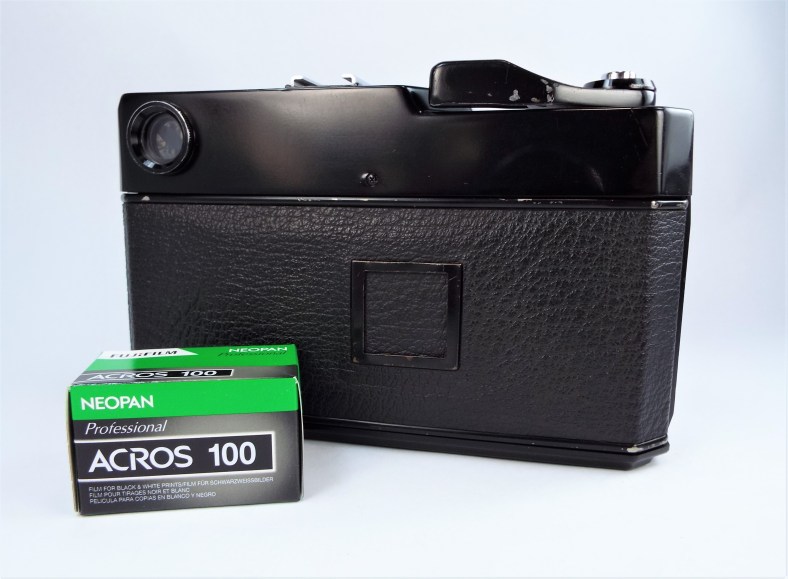
The goal is to take our 1958 medium format camera from Fuji Photo for a little picture taking. We’ve loaded some fresh Fujifilm Neopan 100 Acros (in days past it was Neopan SS) into the Fujipet and see how it does after 58 years of non use. We’re very curious about the “look” of the images. If you don’t know much about the Fujipet, please take a stroll through our archives for a little catch-up.

DSCF1741

1958 Fuji Photo Fujipet with its new strap. A simple modification to the Canon strap made it perfect for this lightweight Fuji. We have the original vinyl (leather?) strap for the Fuji but it’s still sealed in its original package. No reason to ruin it by using it LOL.

20160815_100355

The Pet as seen on a local legend (Mr. David Yulee).

20160815_102312

Hoping the bright Florida sunshine was just right for our first test of the Pet.

And just how did the Pet perform?

DSCF1962

The entire roll of 12 exposures came out just great! Here’s a sample of some of them. The Pet gave a special look to the images. We had ‘The Darkroom’ print up these four images in their true square format (here they are 5 x 5 inches).

Well as you can see the pictures came back from the outing with the Fujipet. We couldn’t be more thrilled with how they came out! The lens was actually super sharp (all things considered) and the almost 60 year old plastic lens had some nice contrast to it too. We can’t say enough about Neopan 100 Acros – exceptional film!

28477728874_65f641d3ae_o

28495471114_8a530a1d53_o

28531727084_f98756bf81_o

29344870275_cb1d30bbfe_o

If you can get your hands on a Fujipet then do so. There’s almost always one or two listed on the Japanese online auction sites. Be careful though! Japan (like my Florida) is a very humid climate and that can wreck havoc on old metal cameras and plastic lenses. Ask questions of the sellers and look very closely at the images of it. By the way, in 1958 when the Pet’s were selling wildly in Japan, they went for 1950 yen or about just under $6. You’ll pay a little more than that today but a good one can still be found for under $100 and questionable ones for $10 to $20.

Thanks for your visit! Comments are always welcome.

C&C ^.^

More Fuji Photo ‘Fujipet’…

We’re about ready to give our little Pet a work out with some fresh Fujifilm Neopan film. Probably the first time this little beauty had film in it since the 1960s!

It has a fixed focus plastic lens with a focal length of 70 mm and three aperture settings… f11, 16 and 22. Shutter speeds are bulb and 1/50 of a second. She weighs in at an impressive 288 grams with film!

We’ll be sure to post the images here!

DSCF1708

The Fujipet getting its first roll of film in decades! A fresh roll of Neopan (SS) Acros 100 black and white negative film. Can’t wait to see what the Pet will do!

DSCF1711

Exposure number one ready to go!

DSCF1713

Ready for some picture taking!

Many thanks for your visit! Please let us know what you think and if you want to share something with us please feel free to do so!

Chris and Carol


Pentamatic Instruction Booklets

Yashica has always called their user manuals ‘instruction booklets’. Here is a sample of the front and back covers of the Pentamatic ’35’ and the Pentamatic S booklets. These are seldom seen in their proper colors and with this amount of detail. The first booklet’s design draws its inspiration from the box that the camera comes in, which is often referred to as the presentation box. Same colors and same pentaprism design.

IMG_20160812_0016

Original Pentamatic ’35’ front cover.

IMG_20160812_0017

Pentamatic ’35’ back cover.

IMG_20160812_0012

Pentamatic S front cover. Of course this booklet is simply referred to as ‘instructions’. It is one of the few that does not use the word ‘booklet’.

IMG_20160812_0014

Pentamatic S back cover.

We do not have the Pentamatic II instruction booklet and would love to acquire one. If someone has a clear copy of one we would love to see it.

Thanks for the visit! As always, please share with us your likes and possibly dislikes about our blog. We are always looking to expand our knowledge of this often unseen camera from Yashica.

Chris & Carol

Pentamatic S

The Pentamatic ’35’ went into production starting in December 1959. Our best guess as to how many were built is just that… a guess based on body serial numbers. The original Pentamatic has a rather easy to decode serial number as it uses the year, month and sequential production number in the overall serial number. An example would be… 56003354. That serial number decodes to ‘5’ = May, ’60’ = 1960, and ‘03354’ = number 3,354 th made since December 1959. Later serial numbers for October, November and December would be 116015100 which would be ’11’ = November, ’60’ = 1960, and ‘15100’ = the 15,100 th made since December 1959.

009

Pentamatic ’35’ made in May 1960 and it is the 3,354 th made.

Staying on our best guess path, it appears that about 16,000 Pentamatic ’35’ bodies were built during the approximately 15 month production run. So that brings us to the Pentamatic S which was the last version of the Pentamatic series of cameras. The serial number date coding theory hasn’t been fully been decoded as there is way too few in our database.

006

Here’s a Pentamatic ’35’ that was built in January 1961 and was the 13,838 th made since production began.

20150110_142809

The Pentamatic S back view. Our guess, and it’s a big guess, is that the model S body serial “might” be ‘1’ = 1961, ‘4’ = April, and ‘0294’ = 294 th made.

20150110_132214

Pentamatic S front view all decked out. The lens pictured is the standard lens for the Pentamatic model II.

Thank you for your visit and as always, please share your views with us and please, if we’ve made a mistake correct us! Our goal is to provide the most accurate data on the Pentamatic series.

Chris and Carol