How looking for a misplaced camera case saved my family…

It’s the holiday season for most of us – opportunities to spend some time with our families and give thanks for all that we enjoy in our lives. This will be an especially thankful Christmas for me and my family as we were spared almost certain disaster.

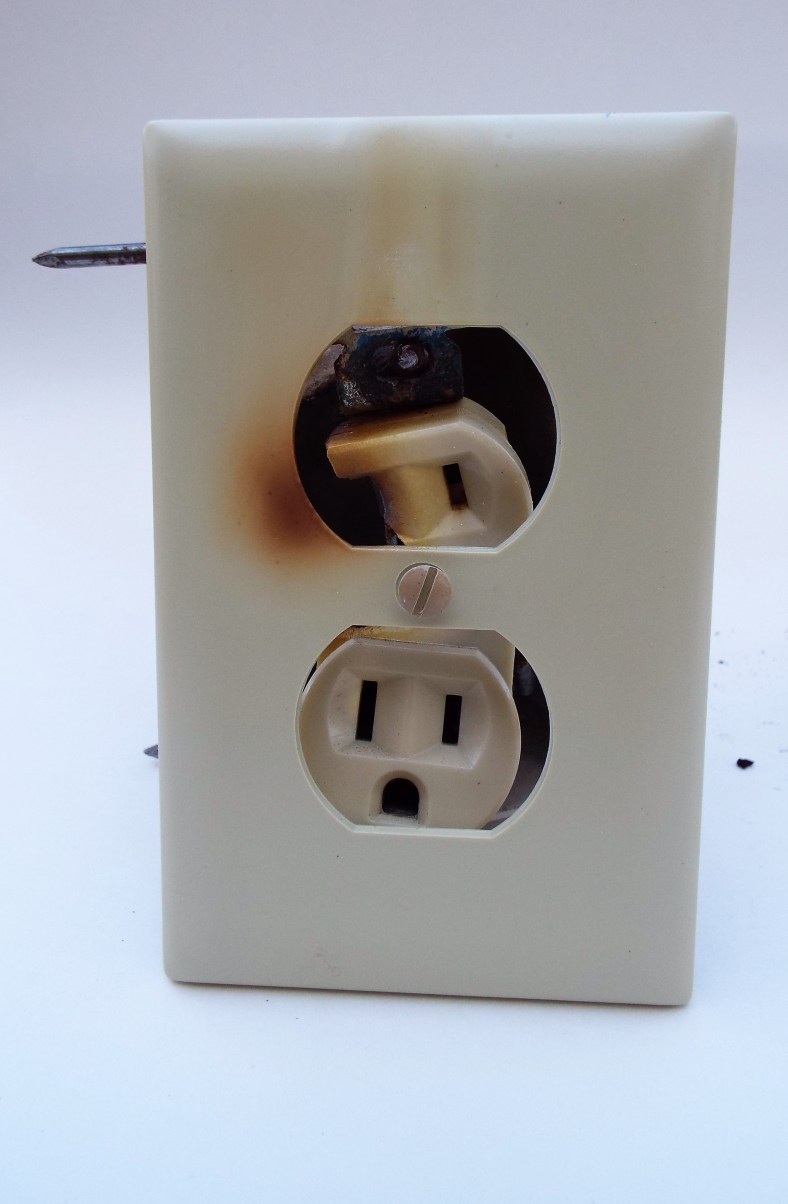
In the rush to get a million things done in only a short time, I was a bit miffed that I couldn’t find a vintage leather camera case for one of my Yashica cameras. I searched everywhere twice and then searched again in the usual hiding spots. Whenever something photographic goes missing, my studio (actually an unused guest bedroom but it sounds better saying “studio”) is the likely hiding place. I checked the open shelving unit that holds the boxes and bins of camera stuff (again) when I caught sight of something wedged behind it between the bottom shelf and the wall. Ah ha I thought, found it! It’s no easy task to move this beast of shelving so I would need to lighten the load if I ever hoped to slide it away from the wall. That’s when I saw it – a small discolored spot on the electrical outlet cover. Thinking that something dirty had stained it, I wedged myself behind the shelves for a better look. As I watched, the small spot became bigger and then the spot turned into something else –
dscf3246

The first clue something was wrong. I saw the small discoloration on the cover – but it quickly became more!

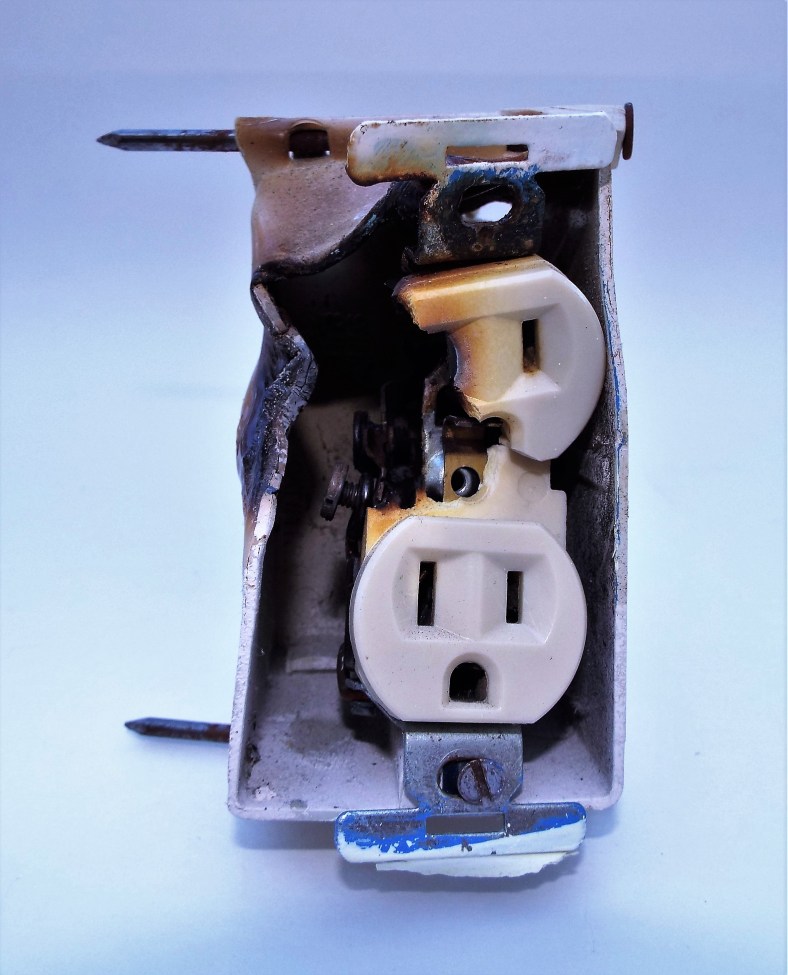
I raced to the garage and ripped open the service panel box and found breaker number 10 – the bedrooms – and switched it off. Then I raced back inside to access the damage. There were no flames and only a small bit of smoke but the spot on the cover and outlet had grown larger. I put the back of my hand near the cover, it was warm but not hot. Convinced that it was no longer burning I dashed out again to find a screwdriver. I removed the cover and was completely shocked to see –
dscf3237

In only a few seconds this is what happened to the outlet box and receptacle.
dscf3238

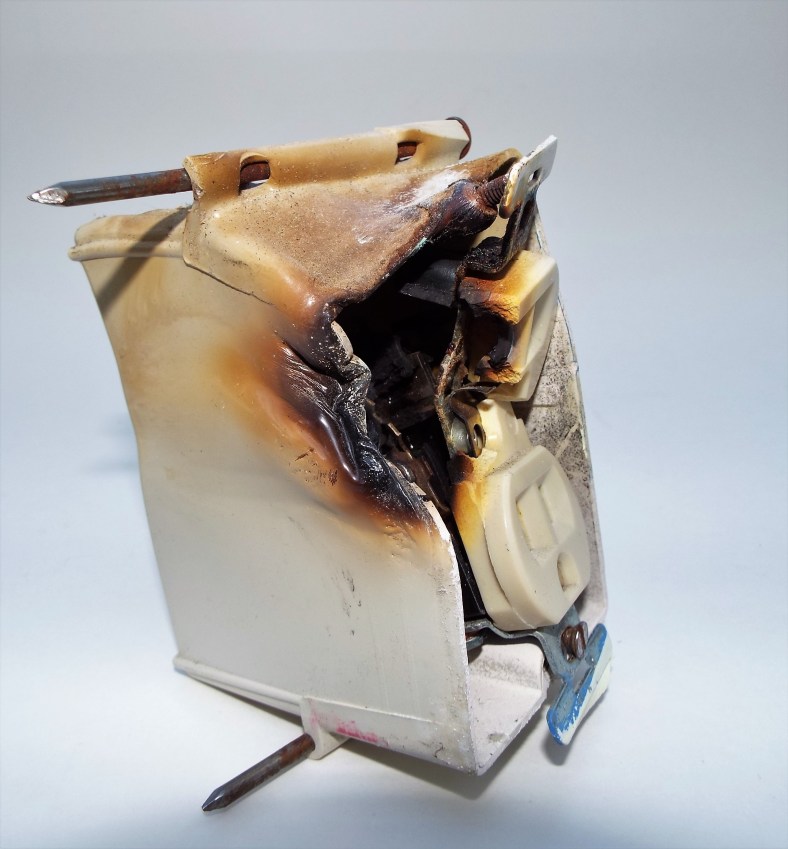
By this stage of the meltdown the heat had scorched the wood stud that the box was nailed to and blackened the paper facing on the insulation. Seconds before flames I’m sure.

Seeing these images again as I write this has reawakened the panic that swept over me that day. The thoughts of “what if” I hadn’t been home or “what if” I hadn’t gone searching for that case at that very moment or the dozens of other “what ifs” that I can’t think of at this moment.

Sure we thought we were protected. Our home was built in late 1989 and is a modern home in good condition. We are the only owners of the house so that means we’ve lived here for over 25 years now. Our electrical service panel is rated at 200 amps and the wiring is code approved copper 12 gauge with ground. The bedroom is never used so nothing more than a lamp is plugged in at any time.

So what happened? Why didn’t the circuit breaker trip? Why did the short occur? How could this happen to me when I’m one of the most safety oriented guys I know?

The answer, it doesn’t matter how careful a person you are, it’s the unseen electrical dangers that almost destroyed our house. As I dissected  what had happened here’s what I’ve learned…

  1. My home is 25 years old… wiring and outlets don’t last forever.
  2. The outlet was unused and therefore uninspected.
  3. Uninspected outlets are potential trouble. I bet there were early warning signs that something was wrong.
  4. Trusting a circuit breaker to trip and shut off the power and save the home. Not so!
  5. Circuit breakers don’t trip for this type of short.
  6. I need to have an electrician install AFCI (Arc Fault Circuit Interrupters) in my service panel.
  7. I need to inspect all outlets in my home and feel if they or the plugs that are plugged into them are warm, hot or discolored.
  8. Replace faulty outlets as soon as possible.
  9. dscf3242

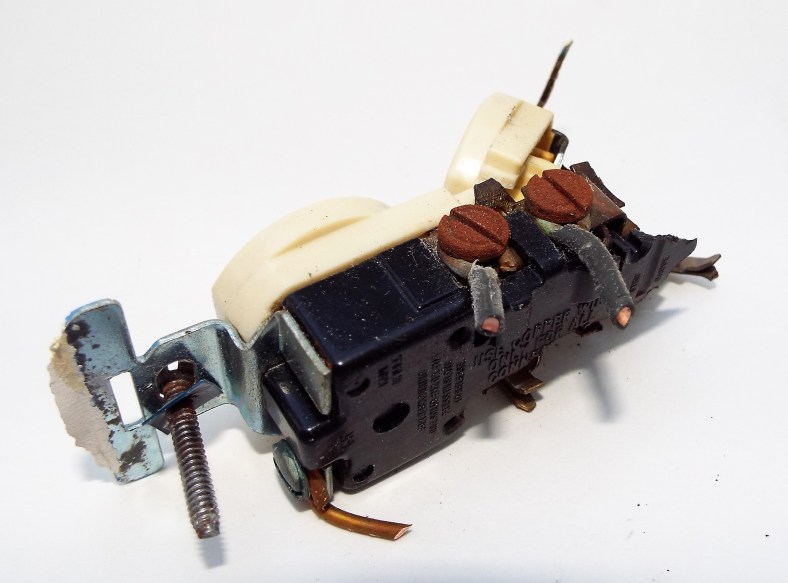
    This is the non melted side of the receptacle. Notice the two rusted screws – they were the early warning signs of trouble. The outlet box and receptacle are mounted on an outside wall behind a brick exterior. Although there’s a vapor barrier (I hope) behind the brick and wood sheathing it’s still an unheated space – moisture in the air condensed on the terminals and caused rust. The rust loosened (slightly) the connections and created resistance which led to heat which led to the short and meltdown.

    Now please understand that I am not an electrician and the points I make here are my unprofessional views of what happened. What I hope you can take away from this is that you need to do regular check-ups of your electrical service and if you see or feel something is wrong, call an electrician to check. You and your families health depend on it (the electrical system) in your house to be safe. Look into installing AFCIs in your home (in the United States). I understand that they are required in new home construction and in some restorations of existing homes and something like it is required overseas (Europe). If I had these AFCIs in my panel box then the power would have been shut off instantly an arc was detected and there would have been no meltdown. Have a blessed Holiday Season!

    Please share This story with your friends and discuss it with your family. ^.^ Chris

Yashica Super Yashinon-R f/3.5 13.5cm Telephoto Lens

Nice little addition to our Pentamatic family of lenses. Purchased in Japan and was with an early model Pentamatic’35’ set in “well used” but stable working condition. It came with the original Yashica brown leather case, unbranded plastic rear lens cap, Yashica front metal 52mm push-on lens cap, unbranded lens hood, and a very nice looking Walz chrome metal and glass Skylight C. (cloudy) 52mm filter.

dscf2868

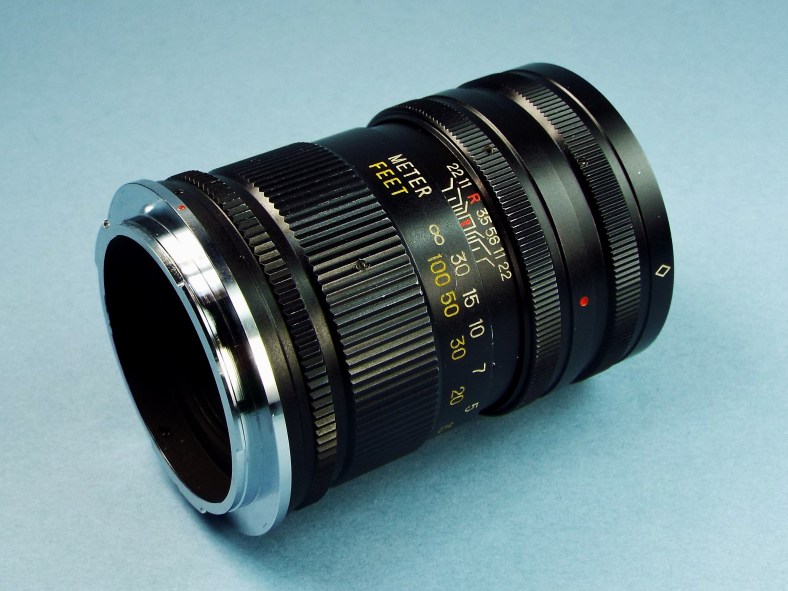
Pentamatic bayonet mount 13.5cm short telephoto lens… f/3.5 with rather low serial number. Early Yashica lenses were often given a serial number that starts with the focal length of the lens. In this example, ‘135 0722’ shows it to be a 135mm lens with a sequential production number of 722. Best guess is that this lens was made in early to mid-1960. We have another Super Yashinon-R 13.5cm lens with a serial number of ‘135 0927’.

The above image shows the lens partially disassembled for cleaning and inspection. No fungus or mold, but I’ve found some funky streaks on the face of the first removable lens element (large lens element to the right).

dscf2872

The chrome nose removed.

dscf2873

The main lens group removed. If you look closely, you may see the funky streaks across the face of the lens.

dscf2876-2

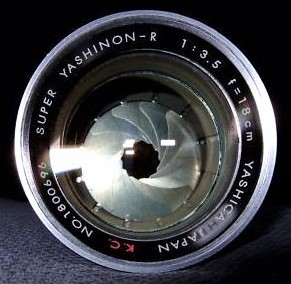
Aperture blades set at f/ 22. No oil and no problems (looking into the lens barrel from the front of the lens). Note the 12 aperture blades.

super yashinon p mount 25cm

Here is a similar lens with the 12 blades that was for sale recently. The seller identified the lens as having been made by Kyoei Optical Co., Ltd.  using the brand name “Acall” Kyoei was also abbreviated as “KOC” which may be the reason for the red “K.C.”

New info as of Feb 5, 2020 – At first, I guessed that my lens was made by Tomioka Optical as they were responsible for most of Yashica’s lenses. A reader has pointed out the similarities between my lens and the design of the Acall lenses with both  Pentamatic and M42 mounts. I must say that I agree with them upon further review. Thank you for your input!

dscf2877

Partially assembled body. Nice clear markings and solid-looking bayonet mount.

These first Pentamatic lenses were pre-set and not automatic and were the kings of the heavyweight division. Lots of metal and glass here! When properly stored they were not prone to fungus… but almost all classic lenses will have some sort of mold, dust or fungal issues when left in the dark and in their leather cases.

Thanks for the visit!

Chris and Carol

You’re invited to visit our online store at https://www.ccstudio2380.com for some great vintage and collectible cameras, lenses, and accessories.

A Little More Pigeon Poo…

DSCF1701

It would appear that this Pigeon may be a rather rare version. From late 1952 to early 1953… is this a Model IIA? It doesn’t match completely with the other known Pigeon models.

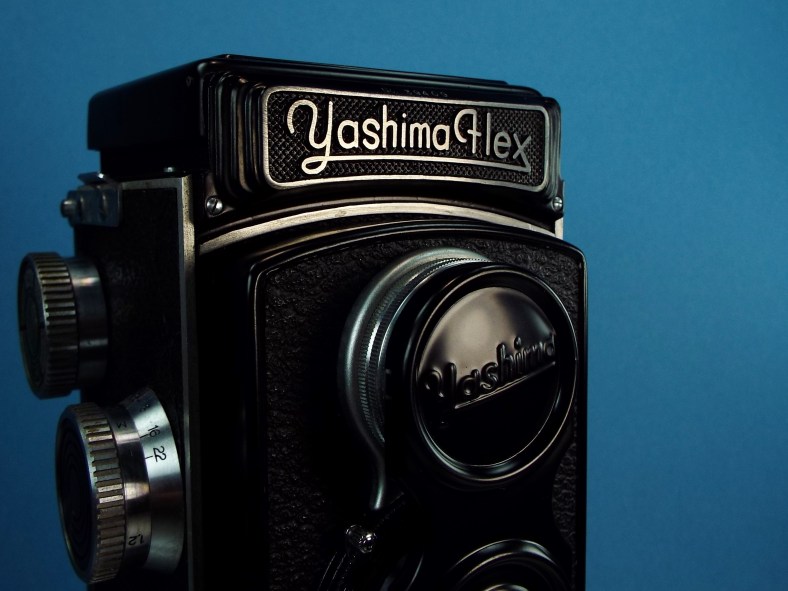
The Shinano Pigeon 35 was not a groundbreaking camera during its run… it was just a solidly built 35mm viewfinder camera that still works like a charm even after 6 decades of use. Shinano, which had its roots in Suwa, Nagano Prefecture in the early 1950s, would cross paths with another start-up manufacturer from Nagano… Yashima. Yashima would go on to make its first TLR and call it a ‘Pigeonflex’. Shinano faded and Yashima eventually changed its name to Yashica (1958) and the name Pigeon essentially dropped from sight and memory.

DSCF1695

Complete filter set and lens shade from Shinano for the Pigeon 35.

DSCF1699

Vintage view of the Pigeon 35 Model IIA.

More images soon… from the camera! If you would like to know more about the Shinano Pigeon and all things related to Yashima-Yashica twin-lens reflex cameras, please stop by my friend Paul’s amazing website http://www.yashicatlr.com/Pigeonflex.html#pigeon35

Thanks for the visit… Chris and Carol

Pigeon 35 by Shinano Camera Co., Ltd.

Why show a 35mm viewfinder camera on a blog about the Yashica Pentamatic? Well, Shinano and Yashima-Yashica share a common history. The first camera that carried the Yashima name was the Pigeonflex… a twin-lens reflex (TLR) camera!

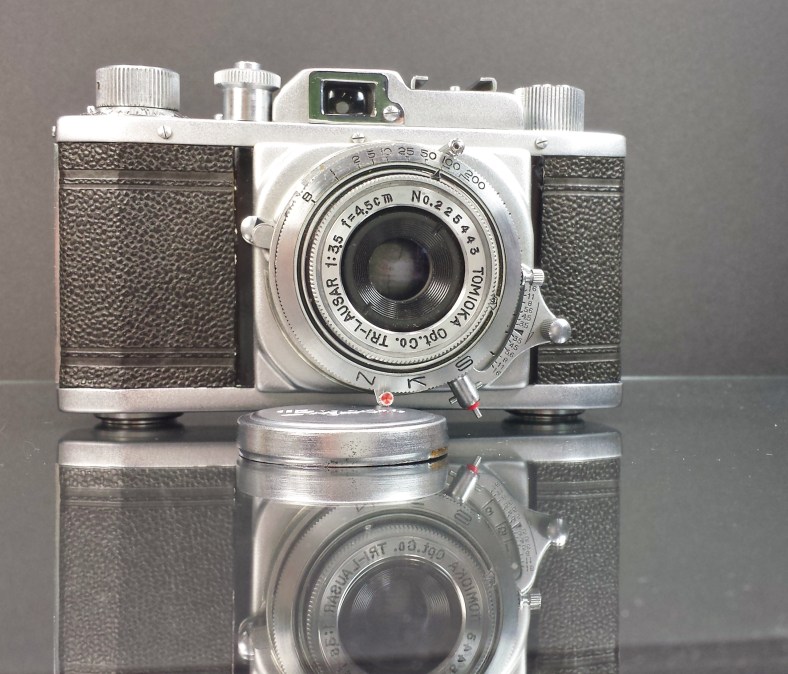
Anyway here’s a nice example of a gorgeous 35 mm viewfinder camera that we acquired recently. The lens is made by Tomioka… a sharp (we hope) Tri-Lausar f/ 3.5 4.5 cm lens. NKS shutter B – 1/200.

It’s a nice heavyweight camera that has a good feel to it. In our opinion, it’s far from being a cheaply built camera as some would say. In fact, it still functions as intended after 6 decades of use. Most leather cases would be a complete mess after this amount of time but the leather is nice and the stitching is intact.


20160801_183736

1952 Pigeon 35 by Shinano.

20160801_183800

Nice view of the Tomioka lens.

20160801_184255

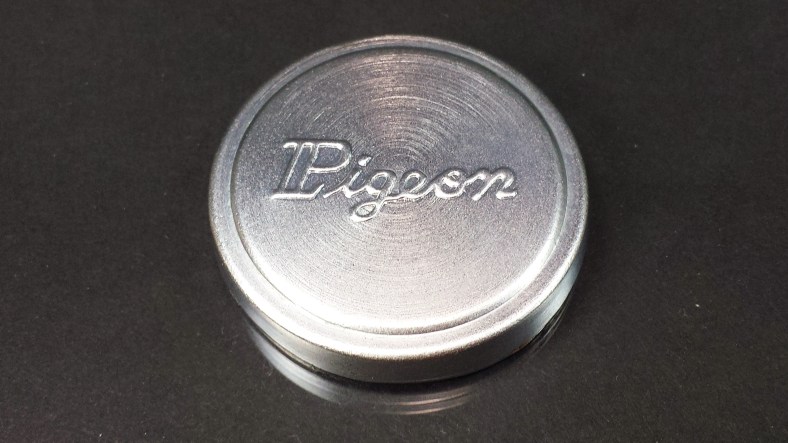
Beautiful logo on this metal cap.

20160801_184349

Classic style. The top plate of the Pigeon 35.

DSCF1574

After 6 decades of use, the case has held up nicely.

DSCF1581

Interesting bottom plate

More to come! By the way, everything works just fine! Can’t wait to run a roll of film through it. Images of the leather case to follow too!

Thanks for stopping by! – Chris

My camera shop is always open at http://www.ccstudio2380.com


Yashica ヤシカ J-3 in Pro-Black

Another of our favorites in the Yashica family. This limited edition J-3 is rather rare to find in nearly new condition these days. We haven’t found evidence from Yashica of the when and why they chose this model to be their first SLR in black (with matching lens). In all the brochures and pamphlets we’ve been able to read, nothing has ever been written about it and no pictures from Yashica either. We’ve checked Japanese home market sales brochures and of course those available in English. Not one word! The serial numbers (both the bodies and lenses) run within a small time period of mid 1962 (we believe).

***Please if a reader has more information about this elusive J let us know!

007

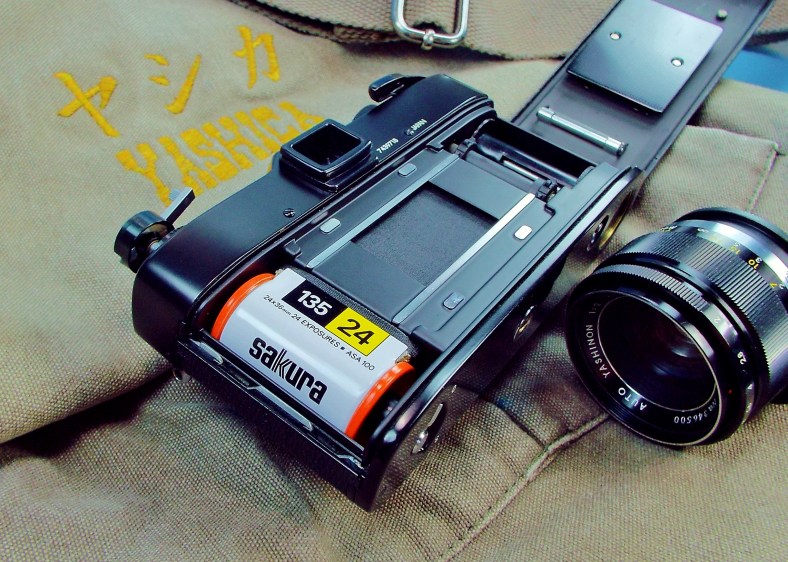
J-3 finished a roll of Sakura film.

003

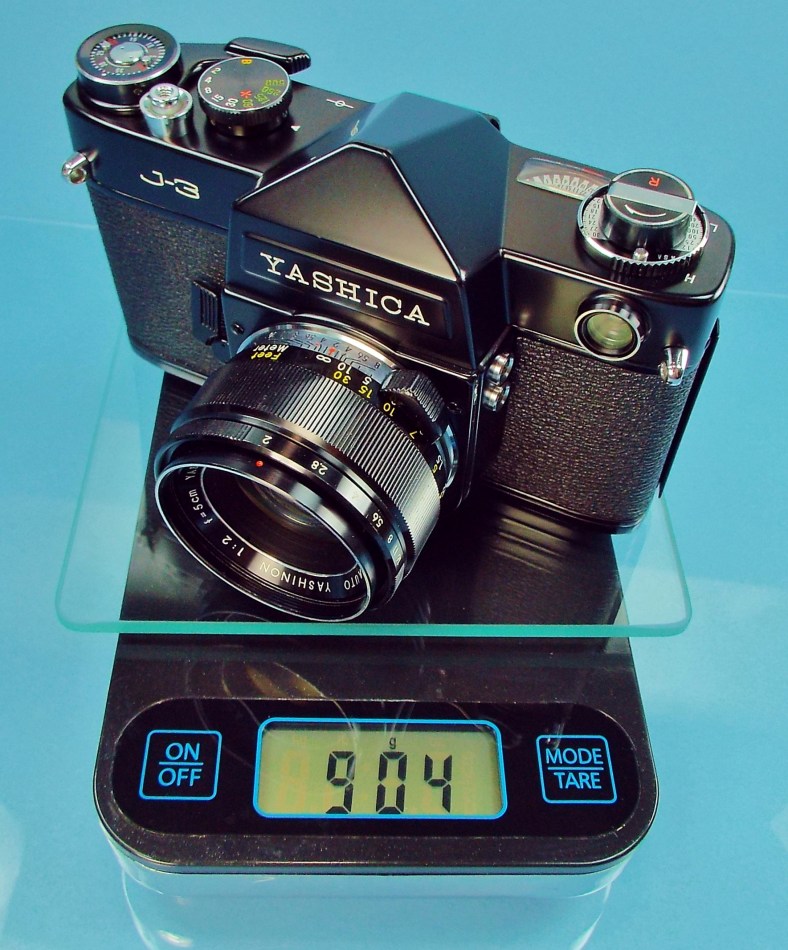
Not quite the heavyweight the Pentamatic is but still a beast at just over 900 grams!

022

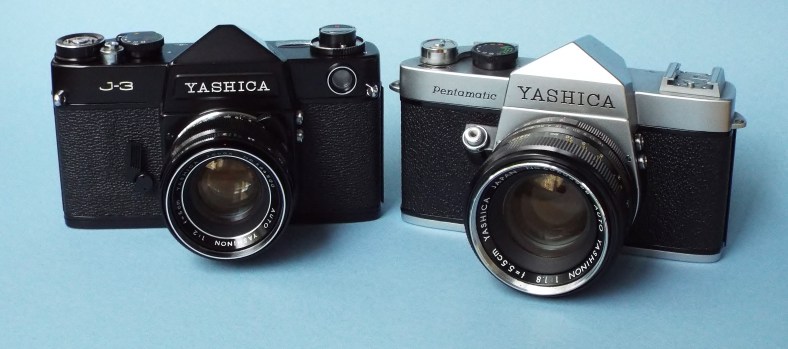
Same family but very distant cousins! Yashica made countless changes in its SLR line-up in just under three years.

As always… thanks for the visit!

Chris & Carol

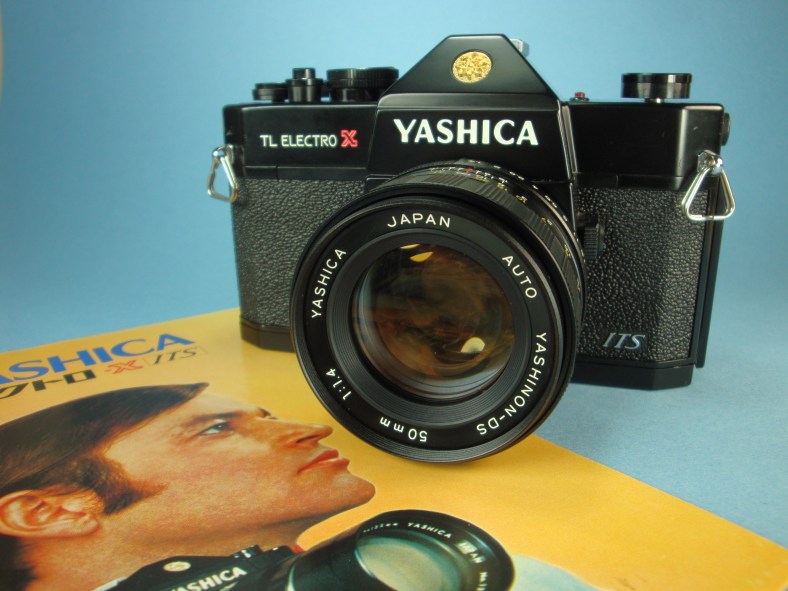
Yashica TL Electro-X ‘ITS’

After nearly five years of research and thousands of “searches” on auction sites, I finally have my answer! ‘ITS‘ as it relates to the famous and groundbreaking Yashica TL Electro-X stands for… are you ready? Nothing!

That’s right… nothing. I’ve just finished reading what appears to be the most comprehensive guidebook on the TL Electro-X (from Yashica no less) and not one word as to why the marketing guys and gals at the office in Shibuya picked ‘ITS‘ to appear on the lower left front of the camera. Not one hint… no clues… nothing!

Okay so more than likely it was meant to mean exactly that… nothing. I can live with that. Marketing people don’t have to explain anything they do. ‘ITS‘ simply looks good. So fast forward from 1968 to the present day. Hear I am stressed out about what may have been a whim… an afterthought… or maybe something one of the designers casually mentioned in a meeting while you know, designing the thing. ‘ITS’… sounds good.

I’ve imagined what it may mean hundreds of times (sad to admit that) and nothing really fits for the time period except that maybe the ‘I‘ stands for “integrated”. Like integrated circuit or I.C. as I’ve sometimes seen it mentioned in other Yashica sales brochures. That’s got to be it. After all, the NASA people were always using that term during the height of the space race. Okay so maybe we now know that the ‘I‘ stands for “integrated”. Simple. The ‘T‘ has always stood for “technology” to me. What else would the ‘T‘ stand for? Timed? As in timed shutter. Oh that’s a good guess. I like it. Maybe the ‘TS’ part is for “timed shutter”? That’s another good one. Integrated… Timed… Shutter!!! Or how about “Interval” timed shutter? That’s ‘ITS‘ isn’t it?

Solved! Finished! No more worries right? No… that isn’t it. It’s got to mean something else. Something catchy, something better than that. Well the book (sales brochure) I just finished reading never mentioned what the ‘ITS‘ stood for. Just like the hundred other brochures and ads I’ve read. But wait! Hold on! There on the cover is a clue! There it is right in front of me! “SYSTEM”. Yashica called everything connected with the TL Electro-X ITS (lenses, filters, bellows, angle finders, accessories, etc.) SYSTEM.

So there it is! That was simple. Right? Well we’ll see. I’m going to keep on looking for that definitive statement from Yashica. Somewhere in black and white they’ll say it. For now though I’m sticking with… “Integrated Technology System” or “ITS” for brevity.

ITS = Integrated Technology System

DSC07504DSC07497Yashica 6-9-15 TL Electro-X Brochure back cover close

20151202_203809

A 45 page book from Yashica that explains everything about this fantastic camera.

No denying it – it’s a sharp looking camera and the ‘ITS’ just makes it that much cooler. It’s one of our favorite Yashicas in our collection. This one came to us via Okinawa, Japan. Purchased in late 1973 – that makes it one of our newest Yashica SLRs too. We’ve kept all of the original paperwork and of course the box. If you come across a nice looking one for sale (or better still get it as a gift) it should be on your list of must haves. The battery is an easy find and most will have working meters since they were only electronic (no moving match needle affair).

Happy hunting!

Chris and Carol ^.^

Why the Pentamatic?

The Yashica Pentamatic has always fascinated me from the moment I first caught a glimpse of it while doing research on the Yashima / Yashica Company. It was (and still is) a strange-looking camera… so 1960s and it was Yashica’s very first 35mm single-lens reflex (SLR) camera. I love its sleek lines and simple design… and it was just a little bit “quirky”. My first 35mm SLR was the very popular and stylish Yashica TL Electro-X (in satin chrome finish) which I purchased in early 1972. That camera was big and heavy just like the Pentamatic… lots of brass and glass as they say. The exposure system was a through the lens (TTL) affair that used two red arrows to guide you in adjusting the shutter speed and aperture to obtain a properly exposed image. It was fairly accurate and easy to use but under some low light conditions the meter would be off as much as 1/2 to 1 full “f stops” especially when shooting with color slide film for transparencies. I used that Yashica through my first year of living in Yokohama before purchasing a Canon F-1 in 1978. Why the departure from Yashica? Simple, when comparing the new Contax RTS to the F-1, in my opinion, there was no contest. I also liked the system that Canon offered and the wide array of professional accessories and lenses.

So back to the Pentamatic. When I started to concentrate my research on the Pentamatic, I found nothing but confusing and contradicting information on the internet (as is typical of anything). No clear images of the camera, no images of its boxes or the accessories available. The release date was especially bothersome as it was all over the map and even now many sites still give the wrong introduction date in the U.S. The specifications of the cameras are often wrong or incomplete and when I did find solid proof of something, it made the existing entries even more out of line with reality. The Pentamatic series of SLRs (the original model I, model II and the model S) never sold in vast quantities (the original Pentamatic model I was produced at around 1,500 units per month at its peak of production) as best as I can tell, so finding a complete set was rare and finding sales brochures was even more daunting.

My quest was simple (I thought)… purchase a few Pentamatics and find a few instruction booklets and I would be all set. Wrong! Yashica normally does not date their cameras, lenses and publications (instruction booklets, warranty cards, accessory pamphlets and sales brochures) so I knew that I had my work cut out for me. On the other side of the coin, my Canon collection has dates everywhere! I can honestly say that I’ve never found something from Canon that was not dated in some way. Why didn’t Yashica do the same? I did discover eventually that from about 1956 or so onward Yashica (then Yashima) did date many of their photography booklets and featured pictures of their factories in Nagano Prefecture and of their headquarters in Shibuya-ku, Tokyo. Many of these early booklets even had pictures of the president and founder (Mr. Yoshimasa Ushiyama) of Yashima… not often seen in other camera manufacturer’s publications. The practice of dating publications slowly vanished around late 1958 and by 1960 was basically gone. It wasn’t until the late 1960s and early 1970s that Yashica would occasionally slip in a date on a publication (but never on the camera or lens).

In summary… I don’t have all the answers to my Pentamatic questions and I am constantly updating information as I receive it both here on my blog and on my Flickr page (Yashica Sailor Boy). My goal is to be as accurate as I can, fill in the blanks and share whatever I have with others. I encourage comments and would gladly receive any and all bits of info that you may want to share with me. Thank you for visiting my page!

Chris

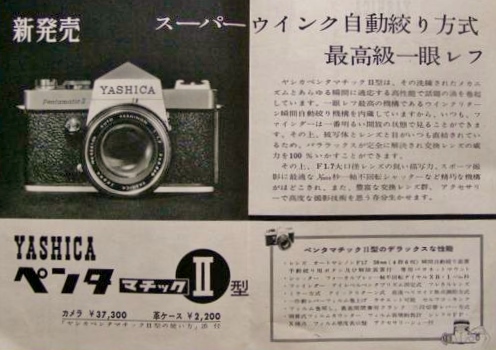
600x450-2015111900010

Nice Pentamatic model II page from a Yashica sales brochure from February 1961. Not a bad price in Japan at that time… about $110 (USD) with case. When introduced in mid 1960, the original model I was listed at about $159 (USD) here in the U.S.

First Look!

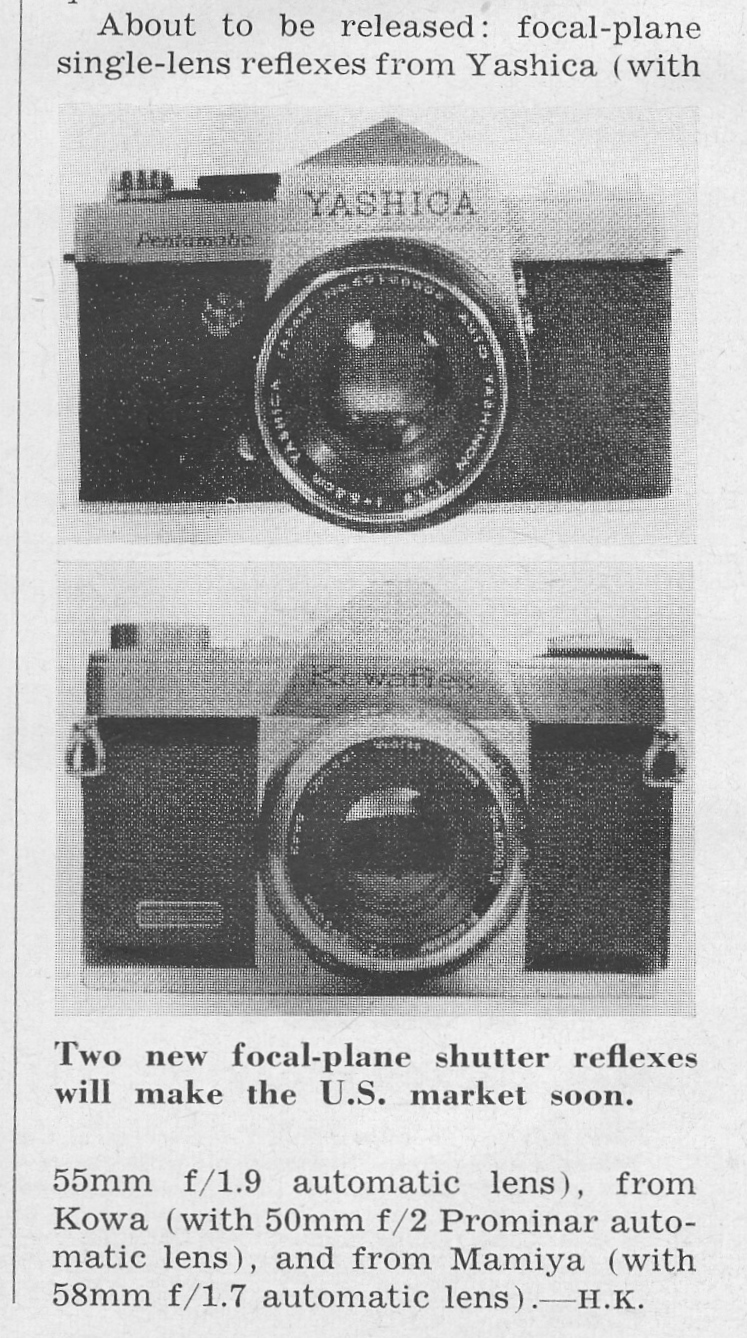
The exciting first look (in print) of the Pentamatic…

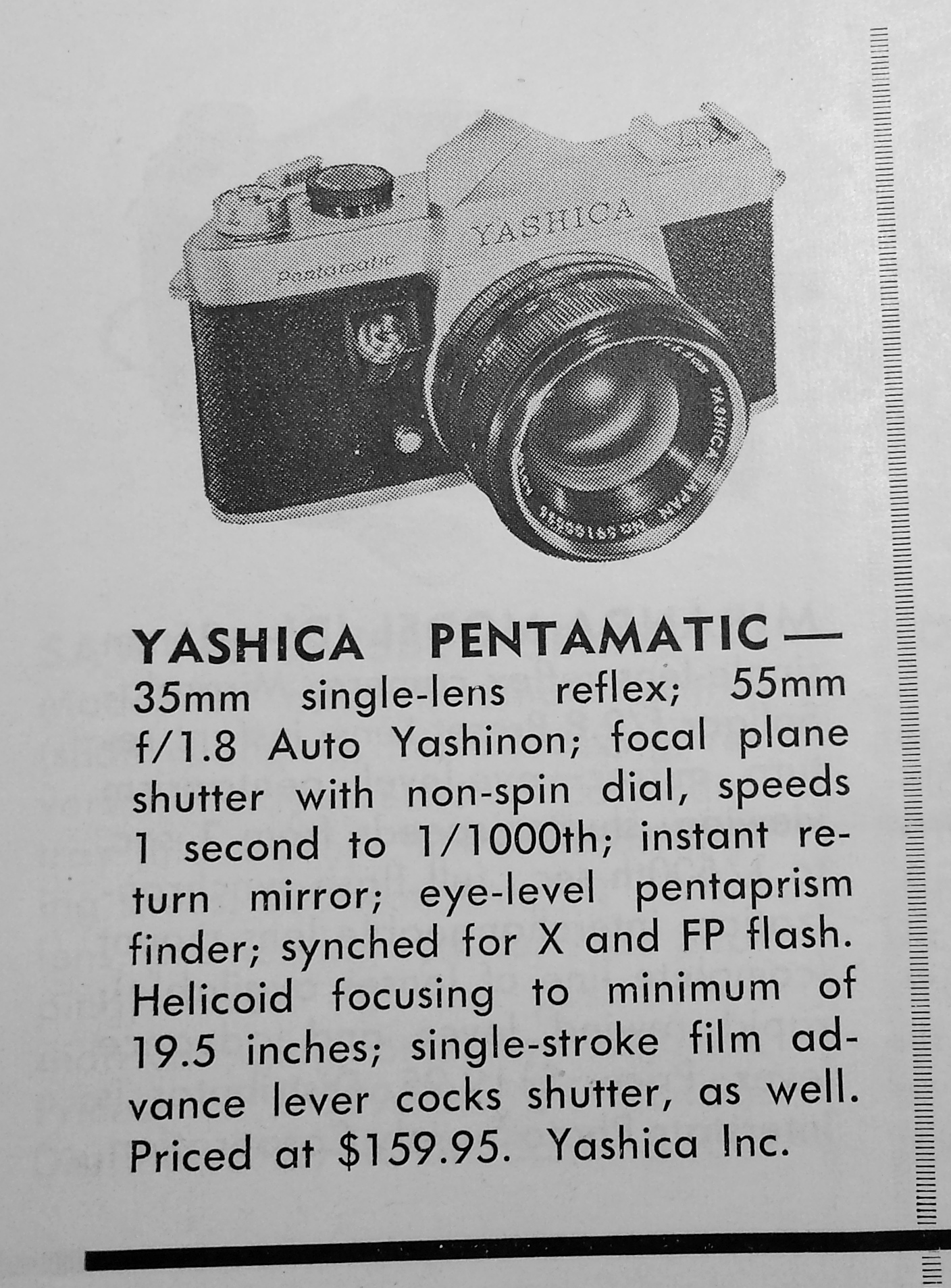
First official appearance of the Pentamatic occurs in the May 1960 issue of Modern Photography magazine. In the June 1960 issues of Modern Photography, U. S. Camera and Popular Photography, the first full-page ads appeared for the Pentamatic ’35’ reflex camera. The actual release date in the United States has almost always been considered by many to be March of 1960.

As of yet, I haven’t found evidence in print to support the March date. I do know that the Pentamatic was shown at the 36th annual ‘Master Photo DeaIers & Finishers Association’ trade show (MPDFA) held in St. Louis from March 21-25, 1960. I don’t know if the Pentamatic was released in Japan at an earlier date. From the progression of the serial numbers, by March 1960, about 1,500 cameras had been produced since production began in December 1959 at the Yashica Suwa factory. I doubt that there were enough cameras by March to support any widespread release in Japan or in Asia at that time. By June 1960, about 6,000 cameras had been built. There may have been enough to ship to the world markets starting in April and May. At their peak of production (summer 1960), it looks like Yashica was rolling out about 1,200 to 1,400 cameras each month.

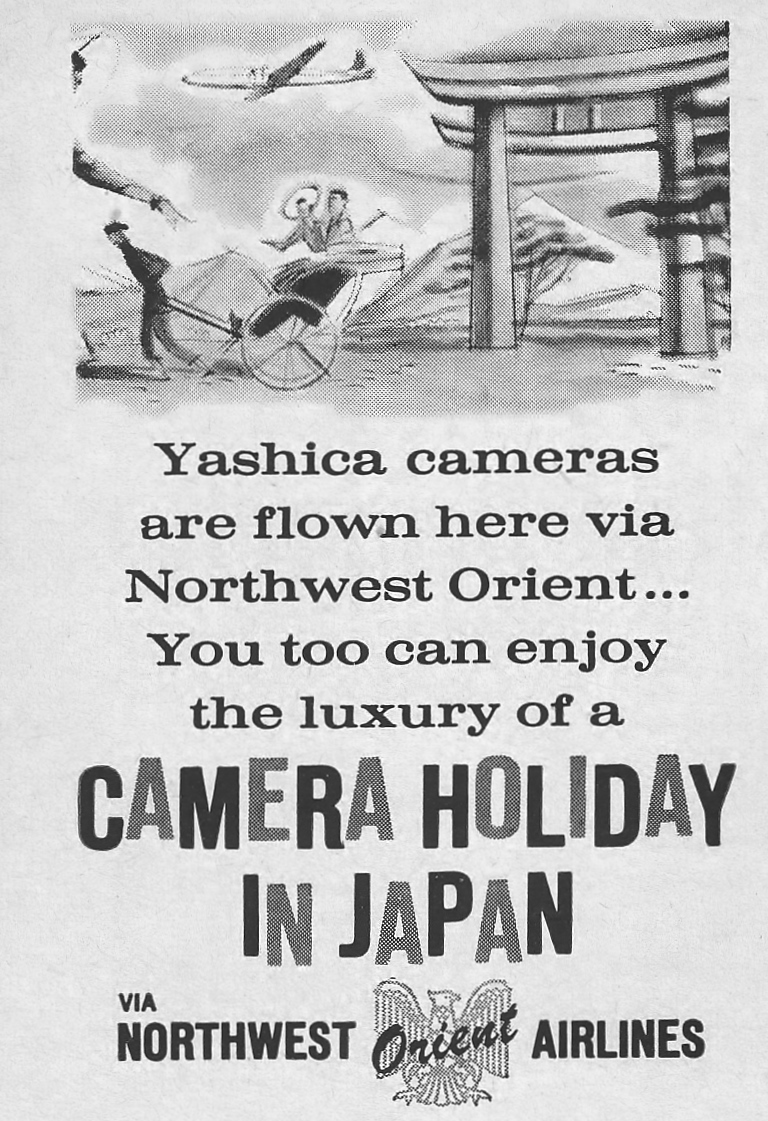
Have a

Have a “Camera Holiday” in Japan. May 1960 magazine ad.

Part two of the

Part two of the “Camera Holiday” in Japan promotion. Very nice mention of Yashica’s factory in Suwa and the wonders of Japan!


Yashica provided this first ever look at their new Pentamatic SLR at the March 1960 MPDFA trade show in St. Louis.

Yashica provided this first ever look at their new Pentamatic SLR at the March 1960 MPDFA trade show in St. Louis.

First published look at the new Pentamatic from Yashica. May 1960

First published look at the new Pentamatic from Yashica. May 1960

The Fasinating World of Yashica Photography

A short history of one of the most dynamic and innovative camera manufacturers in Japan during the decades of the 1950s and 1960s.

An amazing start-up before there were start-ups! In less than a decade, the Yashica Company of Tokyo, Japan, became a major player in the field of high quality, low-priced photographic equipment and cameras in the international marketplace. Competing against literally hundreds of other newcomers and established camera manufacturers, Yashica rose to market dominance by 1960.

25262272564_d4dcebb6c5_o

Back when Yashica was Yashima. Yashica’s second TLR in a long line of twin-lens reflex cameras.